Customer Journey Map Skill
Build a customer journey map for a product, service, or experience.
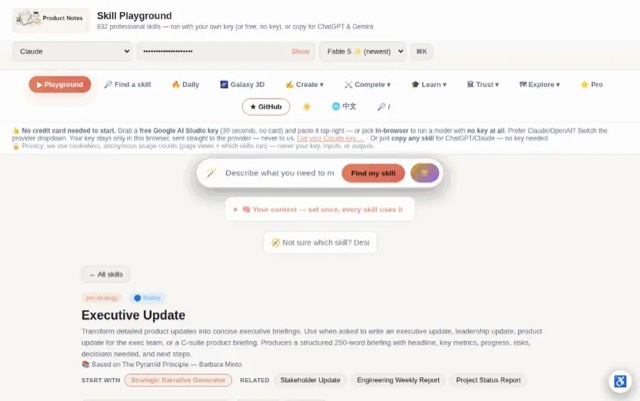
From the mohitagw15856/pm-claude-skills README — shows the whole collection, not only this skill. · view on GitHub
How to use it
Claude Code
- Run the line below. It pulls the whole folder into
~/.claude/skills/customer-journey-map. - Describe your job in plain words. Claude Code follows the skill from there.
npx degit mohitagw15856/pm-claude-skills/skills/customer-journey-map#main ~/.claude/skills/customer-journey-mapFor one project only, change the path to .claude/skills/customer-journey-map.
Claude (web or desktop app)
- On this page open ⋯ → Download .md.
- Save it as SKILL.md in a folder, zip the folder, then Customize → Skills → + → Create skill → Upload a skill.
- Pick the file and Save. Claude shows the name and description and runs a security scan.
- Check the skill is switched on.
- Start a new chat and describe your job in plain words. The AI follows the skill from there.
ChatGPT or another app
- ChatGPT: make a Project and paste it into Instructions.
- Neither? Paste it at the top of a new chat — it works for that chat.
Not working?
- Check which app you pasted it into — the steps above name the right one.
- Some skills need the paid tier of Claude or ChatGPT.
Paste into Claude, ChatGPT or Cursor.
Source of Customer Journey Map Skill
Show the full text242 lines
| name | description |
|---|---|
| customer-journey-map | Build a customer journey map for a product, service, or experience. Use when asked to map a customer journey, create a user journey, document touchpoints and pain points, or design an experience map. Produces a complete journey map with stages, touchpoints, emotions, pain points, and prioritised opportunities. |
Customer Journey Map Skill
This skill produces a complete customer journey map covering every stage from awareness through advocacy. Each stage includes touchpoints, customer actions, emotions, pain points, and specific improvement opportunities. Output is ready for use in product discovery, UX design, or cross-functional alignment workshops.
Required Inputs
Ask the user for these if not provided:
- Product or service being mapped
- Customer persona — which customer segment is this map for? (be specific — one persona per map)
- Journey scope — full end-to-end (awareness → advocacy), or a specific phase (e.g. onboarding only)?
- Current state or future state? — mapping how it works today, or designing how it should work?
- Data sources — any research, user interviews, support tickets, NPS comments, analytics available?
- Goal of the map — what decision will this inform? (redesign, prioritisation, stakeholder alignment, new feature)
Output Structure
Customer Journey Map: [Product / Service]
Persona: [Name — e.g. "Sarah, the overwhelmed HR manager"] Journey scope: [Full end-to-end / Onboarding / Purchase / Renewal] Current or future state: [Current state / Desired future state] Prepared by: [Name / Team] Date: [Date] Based on: [Research sources — interviews, analytics, support data, assumed/hypothetical]
Persona Summary
| Name | [Sarah] |
| Role | [HR Manager at a 200-person professional services firm] |
| Goal | [Reduce time spent on manual employee data management] |
| Frustrations | [Too many tools that don't talk to each other; always chasing approvals] |
| Tech comfort | [Moderate — comfortable with SaaS tools but not a power user] |
| Decision power | [Recommends tools; budget approved by CHRO] |
Journey Overview
AWARENESS → CONSIDERATION → DECISION → ONBOARDING → ADOPTION → ADVOCACY
   [Stage 1]      [Stage 2]      [Stage 3]    [Stage 4]     [Stage 5]   [Stage 6]
Overall experience rating (current state): [😤 Frustrating / 😐 Neutral / 😊 Positive]
Stage 1: Awareness
How does the customer first discover the product exists?
Customer goal at this stage: [e.g. Realise they have a problem worth solving — or find a solution to a specific pain]
| Element | Detail |
|---|---|
| Trigger | [What event makes them start looking? — e.g. Manual process breaks down / peer recommendation / saw ad] |
| Where they are | [Google search / LinkedIn / conference / colleague conversation / email newsletter] |
| What they do | [e.g. Searches "automate employee onboarding" / asks peers in HR community / clicks LinkedIn ad] |
| Emotion | [😤 Frustrated — overwhelmed by manual processes and hoping for a better way] |
| Pain points | [Overwhelming number of options / hard to know which tools are credible / can't tell what's B2B vs B2C from homepage] |
| Opportunities | [SEO content targeting the trigger keyword / LinkedIn thought leadership / peer community presence] |
Stage 2: Consideration
The customer is actively evaluating options. What do they do to decide?
| Element | Detail |
|---|---|
| Customer goal | [Narrow down from many options to a shortlist of 2–3] |
| What they do | [Reads G2/Capterra reviews / watches demo video / downloads comparison guide / asks peers who use something similar] |
| Touchpoints | [Website / review sites / social proof / demo request flow / sales email] |
| Emotion | [😕 Anxious — worried about making the wrong choice; past tool purchases haven't delivered] |
| Pain points | [Pricing not visible on website / demo requires a call before seeing the product / unclear if it works with their existing stack] |
| Opportunities | [Self-serve demo or interactive product tour / transparent pricing page / ROI calculator / case studies from similar company size] |
Stage 3: Decision
The customer is ready to buy — or not. What makes them commit?
| Element | Detail |
|---|---|
| Customer goal | [Get sign-off from CHRO and justify the decision with a business case] |
| What they do | [Books sales call / requests security questionnaire / builds internal business case / negotiates contract] |
| Touchpoints | [AE / sales call / security review / contract / procurement process] |
| Emotion | [😬 Cautious — doesn't want to be wrong; presenting to leadership adds pressure] |
| Pain points | [Sales process is slow / security questionnaire takes weeks / contract terms are non-standard and require legal] |
| Opportunities | [Security FAQ self-serve / standard contract with predictable terms / champion toolkit (slides, business case template) to help them sell internally] |
Stage 4: Onboarding
The customer has bought. Now they need to get value fast.
| Element | Detail |
|---|---|
| Customer goal | [Get the product working and show their CHRO it was a good decision] |
| What they do | [Receives welcome email / attends kickoff call / configures integrations / invites team] |
| Touchpoints | [Onboarding email sequence / in-product onboarding checklist / CSM / help centre / integrations marketplace] |
| Emotion | [😬 Anxious but hopeful — excited about potential but stressed about the setup work] |
| Pain points | [Setup is more complex than expected / IT required for SSO but IT is slow to respond / generic onboarding doesn't match their use case] |
| Opportunities | [Role-specific onboarding paths / IT connector with pre-filled request template / quick win email at day 3 (show them one thing that already works)] |
Key moment of truth: [What single moment in this stage determines whether they'll become an active user or ghost? — e.g. "First time the product saves them 30 minutes on a task they used to do manually"]
Stage 5: Adoption
The customer is using the product. Are they getting consistent value?
| Element | Detail |
|---|---|
| Customer goal | [Make the product a regular part of their workflow; demonstrate ROI to leadership] |
| What they do | [Uses core features daily / discovers new features / hits a limitation / contacts support / attends webinar] |
| Touchpoints | [Product UI / in-app notifications / email / support / community / customer success manager] |
| Emotion | [Variable — some days 😊 when the product works well; some days 😤 when hitting a gap or bug] |
| Pain points | [Feature they expected isn't there / reporting doesn't show the metric leadership wants / power features are too complex / feels like they're underutilising what they're paying for] |
| Opportunities | [Proactive CSM check-in at day 30 / in-product feature discovery / usage dashboard for the customer to see their own ROI / community for peer learning] |
Adoption health indicators:
- [DAU/MAU ratio — what does healthy look like?]
- [Feature X used by Y% of seats within Z weeks]
- [First NPS survey at 60 days — target score]
Stage 6: Advocacy
The customer loves the product. How do you turn them into a referral engine?
| Element | Detail |
|---|---|
| Customer goal | [Solve problems faster; feel like an expert; feel valued as a customer] |
| What they do | [Refers a peer / writes a G2 review / participates in case study / speaks at event / becomes a power user / joins community] |
| Touchpoints | [CSM / community / review request email / referral programme / case study outreach / conference sponsorship] |
| Emotion | [😊 Proud — the tool is part of their professional identity; they feel smart for choosing it] |
| Pain points | [Referral programme is clunky / no structured way to connect with peers / case study process is slow and effortful for them] |
| Opportunities | [One-click G2 review request at high-satisfaction moment / peer community / referral programme with meaningful reward / case study process that does most of the work for them] |
Emotion Curve
Plot the customer's emotional experience across the journey:
High  😊 │        *                              *          *
          │                                   *
Neutral 😐│  *         *
          │                  *
Low   😤 │                        *    *
          └────────────────────────────────────────────────────
            Aware   Consider  Decide  Onboard  Adopt   Advocate
Lowest point: [Which stage has the worst experience — and why?] Highest point: [When is the customer most delighted — what drove it?] Biggest drop: [Where does sentiment fall most sharply — this is usually the biggest opportunity]
Prioritised Opportunities
| Opportunity | Stage | Impact on customer | Effort to fix | Priority |
|---|---|---|---|---|
| [Self-serve product tour before sales call] | Consideration | [High — removes top buying barrier] | [Medium] | P1 |
| [Quick win email at day 3] | Onboarding | [High — builds early habit] | [Low] | P1 |
| [IT SSO setup template] | Onboarding | [Medium — removes specific blocker] | [Low] | P2 |
| [30-day proactive CSM check-in] | Adoption | [Medium — catches churn signals early] | [Medium] | P2 |
| [Peer referral programme] | Advocacy | [High for growth — reduces CAC] | [High] | P3 |
What We Don't Know (Research Gaps)
| Gap | How to close it | Priority |
|---|---|---|
| [What actually triggers the decision to start looking?] | [5 JTBD interviews with recent buyers] | [High] |
| [What causes customers to stall in onboarding?] | [Drop-off analysis in onboarding funnel + 3 interviews with churned customers] | [High] |
| [What % of customers have reached the advocacy stage?] | [Product analytics — identify power users; NPS by cohort] | [Medium] |
Deeper Materials
This skill ships with support files — use them when they are available:
references/evidence-based-mapping.md— Journey Maps Built on Evidence (Not Conference-Room Fiction). Apply it while producing the output; it carries the calibration and judgment calls the method summary above compresses.templates/journey-canvas.md— a fill-in version of the deliverable with the quality gates inline. Offer it when the user wants to work the document themselves rather than have it generated.
Scoring Rubric (0–40)
Score any output of this skill before handing it over; 32+ is ship-quality.
| Dimension | 0 | 5 | 10 |
|---|---|---|---|
| Persona specificity | "All customers" or a demographic sketch that could be anyone; touchpoints generic to any product | One persona named but thin — goals and frustrations could apply to any buyer in the category | One vivid persona with role, goal, frustrations, and decision power; every touchpoint and pain point is recognisably this product and this person |
| Evidence grounding | Map is conference-room fiction — no data sources cited, pain points invented | Some sources named but pain points not traced to them; assumed sections not distinguished from researched ones | Sources listed in the header, key pain points tied to specific data (ticket categories, survey %, interview quotes), assumed stages labelled, and a research-gaps table covering the claims the recommendations lean on |
| Emotional truthfulness | No emotional layer — a process flow wearing a journey map's clothes | Emotions listed per stage but the curve is aspirationally smooth; lowest point unnamed or softened | Emotion at every stage, a curve with a real low, and the lowest point / biggest drop named with evidence — including customer pain that conflicts with an internal team's metric |
| Opportunity actionability | Opportunities missing, unranked, or platitudes ("improve onboarding") | Opportunities listed but vague, or ranked without impact/effort reasoning; not weighted toward the worst friction | Every opportunity written as a backlog-ready item, ranked by impact and effort, with P1s targeting the highest-friction moment the curve identified |
Quality Checks
- Map covers one specific persona — not "all customers"
- Each stage includes the customer's emotional state — not just actions
- Pain points are the customer's pain — not the company's pain
- Opportunities are specific enough to become backlog items or design prompts
- Emotion curve shows the real experience — not an aspirationally positive version
- Research gaps are documented — the map reflects what is known, not assumed
Anti-Patterns
- Do not build the map from assumptions alone — ground at least the pain points in real customer data or research
- Do not treat all journey stages as equally weighted — identify the highest-friction moments explicitly
- Do not omit the emotional layer — a journey map without emotions is a process flow, not a customer map
- Do not create generic touchpoints that apply to any product — each touchpoint must be specific to this product and customer
- Do not leave opportunities unranked — prioritise by impact and feasibility
Example Trigger Phrases
- "Map the customer journey for [product]"
- "Build a user journey from awareness to advocacy"
- "Create a journey map for our onboarding experience"
- "Map out the touchpoints and pain points for [customer type]"
- "Design an experience map for [process or product]"
| 1 | |
| 2 | name customer-journey-map |
| 3 | description "Build a customer journey map for a product, service, or experience. Use when asked to map a customer journey, create a user journey, document touchpoints and pain points, or design an experience map. Produces a complete journey map with stages, touchpoints, emotions, pain points, and prioritised opportunities." |
| 4 | |
| 5 | |
| 6 | # Customer Journey Map Skill |
| 7 | |
| 8 | This skill produces a complete customer journey map covering every stage from awareness through advocacy. Each stage includes touchpoints, customer actions, emotions, pain points, and specific improvement opportunities. Output is ready for use in product discovery, UX design, or cross-functional alignment workshops. |
| 9 | |
| 10 | ## Required Inputs |
| 11 | |
| 12 | Ask the user for these if not provided: |
| 13 | **Product or service** being mapped |
| 14 | **Customer persona** — which customer segment is this map for? (be specific — one persona per map) |
| 15 | **Journey scope** — full end-to-end (awareness → advocacy), or a specific phase (e.g. onboarding only)? |
| 16 | **Current state or future state?** — mapping how it works today, or designing how it should work? |
| 17 | **Data sources** — any research, user interviews, support tickets, NPS comments, analytics available? |
| 18 | **Goal of the map** — what decision will this inform? (redesign, prioritisation, stakeholder alignment, new feature) |
| 19 | |
| 20 | ## Output Structure |
| 21 | |
| 22 | |
| 23 | |
| 24 | # Customer Journey Map: [Product / Service] |
| 25 | |
| 26 | **Persona:** [Name — e.g. "Sarah, the overwhelmed HR manager"] |
| 27 | **Journey scope:** [Full end-to-end / Onboarding / Purchase / Renewal] |
| 28 | **Current or future state:** [Current state / Desired future state] |
| 29 | **Prepared by:** [Name / Team] |
| 30 | **Date:** [Date] |
| 31 | **Based on:** [Research sources — interviews, analytics, support data, assumed/hypothetical] |
| 32 | |
| 33 | |
| 34 | |
| 35 | ## Persona Summary |
| 36 | |
| 37 | | | | |
| 38 | |---|---| |
| 39 | | **Name** | [Sarah] | |
| 40 | | **Role** | [HR Manager at a 200-person professional services firm] | |
| 41 | | **Goal** | [Reduce time spent on manual employee data management] | |
| 42 | | **Frustrations** | [Too many tools that don't talk to each other; always chasing approvals] | |
| 43 | | **Tech comfort** | [Moderate — comfortable with SaaS tools but not a power user] | |
| 44 | | **Decision power** | [Recommends tools; budget approved by CHRO] | |
| 45 | |
| 46 | |
| 47 | |
| 48 | ## Journey Overview |
| 49 | |
| 50 | |
| 51 | AWARENESS → CONSIDERATION → DECISION → ONBOARDING → ADOPTION → ADVOCACY |
| 52 | [Stage 1] [Stage 2] [Stage 3] [Stage 4] [Stage 5] [Stage 6] |
| 53 | |
| 54 | |
| 55 | **Overall experience rating (current state):** [😤 Frustrating / 😐 Neutral / 😊 Positive] |
| 56 | |
| 57 | |
| 58 | |
| 59 | ## Stage 1: Awareness |
| 60 | |
| 61 | *How does the customer first discover the product exists?* |
| 62 | |
| 63 | **Customer goal at this stage:** [e.g. Realise they have a problem worth solving — or find a solution to a specific pain] |
| 64 | |
| 65 | | Element | Detail | |
| 66 | |---|---| |
| 67 | | **Trigger** | [What event makes them start looking? — e.g. Manual process breaks down / peer recommendation / saw ad] | |
| 68 | | **Where they are** | [Google search / LinkedIn / conference / colleague conversation / email newsletter] | |
| 69 | | **What they do** | [e.g. Searches "automate employee onboarding" / asks peers in HR community / clicks LinkedIn ad] | |
| 70 | | **Emotion** | [😤 Frustrated — overwhelmed by manual processes and hoping for a better way] | |
| 71 | | **Pain points** | [Overwhelming number of options / hard to know which tools are credible / can't tell what's B2B vs B2C from homepage] | |
| 72 | | **Opportunities** | [SEO content targeting the trigger keyword / LinkedIn thought leadership / peer community presence] | |
| 73 | |
| 74 | |
| 75 | |
| 76 | ## Stage 2: Consideration |
| 77 | |
| 78 | *The customer is actively evaluating options. What do they do to decide?* |
| 79 | |
| 80 | | Element | Detail | |
| 81 | |---|---| |
| 82 | | **Customer goal** | [Narrow down from many options to a shortlist of 2–3] | |
| 83 | | **What they do** | [Reads G2/Capterra reviews / watches demo video / downloads comparison guide / asks peers who use something similar] | |
| 84 | | **Touchpoints** | [Website / review sites / social proof / demo request flow / sales email] | |
| 85 | | **Emotion** | [😕 Anxious — worried about making the wrong choice; past tool purchases haven't delivered] | |
| 86 | | **Pain points** | [Pricing not visible on website / demo requires a call before seeing the product / unclear if it works with their existing stack] | |
| 87 | | **Opportunities** | [Self-serve demo or interactive product tour / transparent pricing page / ROI calculator / case studies from similar company size] | |
| 88 | |
| 89 | |
| 90 | |
| 91 | ## Stage 3: Decision |
| 92 | |
| 93 | *The customer is ready to buy — or not. What makes them commit?* |
| 94 | |
| 95 | | Element | Detail | |
| 96 | |---|---| |
| 97 | | **Customer goal** | [Get sign-off from CHRO and justify the decision with a business case] | |
| 98 | | **What they do** | [Books sales call / requests security questionnaire / builds internal business case / negotiates contract] | |
| 99 | | **Touchpoints** | [AE / sales call / security review / contract / procurement process] | |
| 100 | | **Emotion** | [😬 Cautious — doesn't want to be wrong; presenting to leadership adds pressure] | |
| 101 | | **Pain points** | [Sales process is slow / security questionnaire takes weeks / contract terms are non-standard and require legal] | |
| 102 | | **Opportunities** | [Security FAQ self-serve / standard contract with predictable terms / champion toolkit (slides, business case template) to help them sell internally] | |
| 103 | |
| 104 | |
| 105 | |
| 106 | ## Stage 4: Onboarding |
| 107 | |
| 108 | *The customer has bought. Now they need to get value fast.* |
| 109 | |
| 110 | | Element | Detail | |
| 111 | |---|---| |
| 112 | | **Customer goal** | [Get the product working and show their CHRO it was a good decision] | |
| 113 | | **What they do** | [Receives welcome email / attends kickoff call / configures integrations / invites team] | |
| 114 | | **Touchpoints** | [Onboarding email sequence / in-product onboarding checklist / CSM / help centre / integrations marketplace] | |
| 115 | | **Emotion** | [😬 Anxious but hopeful — excited about potential but stressed about the setup work] | |
| 116 | | **Pain points** | [Setup is more complex than expected / IT required for SSO but IT is slow to respond / generic onboarding doesn't match their use case] | |
| 117 | | **Opportunities** | [Role-specific onboarding paths / IT connector with pre-filled request template / quick win email at day 3 (show them one thing that already works)] | |
| 118 | |
| 119 | **Key moment of truth:** [What single moment in this stage determines whether they'll become an active user or ghost? — e.g. "First time the product saves them 30 minutes on a task they used to do manually"] |
| 120 | |
| 121 | |
| 122 | |
| 123 | ## Stage 5: Adoption |
| 124 | |
| 125 | *The customer is using the product. Are they getting consistent value?* |
| 126 | |
| 127 | | Element | Detail | |
| 128 | |---|---| |
| 129 | | **Customer goal** | [Make the product a regular part of their workflow; demonstrate ROI to leadership] | |
| 130 | | **What they do** | [Uses core features daily / discovers new features / hits a limitation / contacts support / attends webinar] | |
| 131 | | **Touchpoints** | [Product UI / in-app notifications / email / support / community / customer success manager] | |
| 132 | | **Emotion** | [Variable — some days 😊 when the product works well; some days 😤 when hitting a gap or bug] | |
| 133 | | **Pain points** | [Feature they expected isn't there / reporting doesn't show the metric leadership wants / power features are too complex / feels like they're underutilising what they're paying for] | |
| 134 | | **Opportunities** | [Proactive CSM check-in at day 30 / in-product feature discovery / usage dashboard for the customer to see their own ROI / community for peer learning] | |
| 135 | |
| 136 | **Adoption health indicators:** |
| 137 | [DAU/MAU ratio — what does healthy look like?] |
| 138 | [Feature X used by Y% of seats within Z weeks] |
| 139 | [First NPS survey at 60 days — target score] |
| 140 | |
| 141 | |
| 142 | |
| 143 | ## Stage 6: Advocacy |
| 144 | |
| 145 | *The customer loves the product. How do you turn them into a referral engine?* |
| 146 | |
| 147 | | Element | Detail | |
| 148 | |---|---| |
| 149 | | **Customer goal** | [Solve problems faster; feel like an expert; feel valued as a customer] | |
| 150 | | **What they do** | [Refers a peer / writes a G2 review / participates in case study / speaks at event / becomes a power user / joins community] | |
| 151 | | **Touchpoints** | [CSM / community / review request email / referral programme / case study outreach / conference sponsorship] | |
| 152 | | **Emotion** | [😊 Proud — the tool is part of their professional identity; they feel smart for choosing it] | |
| 153 | | **Pain points** | [Referral programme is clunky / no structured way to connect with peers / case study process is slow and effortful for them] | |
| 154 | | **Opportunities** | [One-click G2 review request at high-satisfaction moment / peer community / referral programme with meaningful reward / case study process that does most of the work for them] | |
| 155 | |
| 156 | |
| 157 | |
| 158 | ## Emotion Curve |
| 159 | |
| 160 | Plot the customer's emotional experience across the journey: |
| 161 | |
| 162 | |
| 163 | High 😊 │ * * * |
| 164 | │ * |
| 165 | Neutral 😐│ * * |
| 166 | │ * |
| 167 | Low 😤 │ * * |
| 168 | └──────────────────────────────────────────────────── |
| 169 | Aware Consider Decide Onboard Adopt Advocate |
| 170 | |
| 171 | |
| 172 | **Lowest point:** [Which stage has the worst experience — and why?] |
| 173 | **Highest point:** [When is the customer most delighted — what drove it?] |
| 174 | **Biggest drop:** [Where does sentiment fall most sharply — this is usually the biggest opportunity] |
| 175 | |
| 176 | |
| 177 | |
| 178 | ## Prioritised Opportunities |
| 179 | |
| 180 | | Opportunity | Stage | Impact on customer | Effort to fix | Priority | |
| 181 | |---|---|---|---|---| |
| 182 | | [Self-serve product tour before sales call] | Consideration | [High — removes top buying barrier] | [Medium] | P1 | |
| 183 | | [Quick win email at day 3] | Onboarding | [High — builds early habit] | [Low] | P1 | |
| 184 | | [IT SSO setup template] | Onboarding | [Medium — removes specific blocker] | [Low] | P2 | |
| 185 | | [30-day proactive CSM check-in] | Adoption | [Medium — catches churn signals early] | [Medium] | P2 | |
| 186 | | [Peer referral programme] | Advocacy | [High for growth — reduces CAC] | [High] | P3 | |
| 187 | |
| 188 | |
| 189 | |
| 190 | ## What We Don't Know (Research Gaps) |
| 191 | |
| 192 | | Gap | How to close it | Priority | |
| 193 | |---|---|---| |
| 194 | | [What actually triggers the decision to start looking?] | [5 JTBD interviews with recent buyers] | [High] | |
| 195 | | [What causes customers to stall in onboarding?] | [Drop-off analysis in onboarding funnel + 3 interviews with churned customers] | [High] | |
| 196 | | [What % of customers have reached the advocacy stage?] | [Product analytics — identify power users; NPS by cohort] | [Medium] | |
| 197 | |
| 198 | |
| 199 | |
| 200 | ## Deeper Materials |
| 201 | |
| 202 | This skill ships with support files — use them when they are available: |
| 203 | |
| 204 | **`references/evidence-based-mapping.md`** — Journey Maps Built on Evidence (Not Conference-Room Fiction). Apply it while producing the output; it carries the calibration and judgment calls the method summary above compresses. |
| 205 | **`templates/journey-canvas.md`** — a fill-in version of the deliverable with the quality gates inline. Offer it when the user wants to work the document themselves rather than have it generated. |
| 206 | |
| 207 | ## Scoring Rubric (0–40) |
| 208 | |
| 209 | Score any output of this skill before handing it over; 32+ is ship-quality. |
| 210 | |
| 211 | | Dimension | 0 | 5 | 10 | |
| 212 | |---|---|---|---| |
| 213 | | Persona specificity | "All customers" or a demographic sketch that could be anyone; touchpoints generic to any product | One persona named but thin — goals and frustrations could apply to any buyer in the category | One vivid persona with role, goal, frustrations, and decision power; every touchpoint and pain point is recognisably this product and this person | |
| 214 | | Evidence grounding | Map is conference-room fiction — no data sources cited, pain points invented | Some sources named but pain points not traced to them; assumed sections not distinguished from researched ones | Sources listed in the header, key pain points tied to specific data (ticket categories, survey %, interview quotes), assumed stages labelled, and a research-gaps table covering the claims the recommendations lean on | |
| 215 | | Emotional truthfulness | No emotional layer — a process flow wearing a journey map's clothes | Emotions listed per stage but the curve is aspirationally smooth; lowest point unnamed or softened | Emotion at every stage, a curve with a real low, and the lowest point / biggest drop named with evidence — including customer pain that conflicts with an internal team's metric | |
| 216 | | Opportunity actionability | Opportunities missing, unranked, or platitudes ("improve onboarding") | Opportunities listed but vague, or ranked without impact/effort reasoning; not weighted toward the worst friction | Every opportunity written as a backlog-ready item, ranked by impact and effort, with P1s targeting the highest-friction moment the curve identified | |
| 217 | |
| 218 | ## Quality Checks |
| 219 | |
| 220 | [ ] Map covers one specific persona — not "all customers" |
| 221 | [ ] Each stage includes the customer's emotional state — not just actions |
| 222 | [ ] Pain points are the customer's pain — not the company's pain |
| 223 | [ ] Opportunities are specific enough to become backlog items or design prompts |
| 224 | [ ] Emotion curve shows the real experience — not an aspirationally positive version |
| 225 | [ ] Research gaps are documented — the map reflects what is known, not assumed |
| 226 | |
| 227 | ## Anti-Patterns |
| 228 | |
| 229 | [ ] Do not build the map from assumptions alone — ground at least the pain points in real customer data or research |
| 230 | [ ] Do not treat all journey stages as equally weighted — identify the highest-friction moments explicitly |
| 231 | [ ] Do not omit the emotional layer — a journey map without emotions is a process flow, not a customer map |
| 232 | [ ] Do not create generic touchpoints that apply to any product — each touchpoint must be specific to this product and customer |
| 233 | [ ] Do not leave opportunities unranked — prioritise by impact and feasibility |
| 234 | |
| 235 | ## Example Trigger Phrases |
| 236 | |
| 237 | "Map the customer journey for [product]" |
| 238 | "Build a user journey from awareness to advocacy" |
| 239 | "Create a journey map for our onboarding experience" |
| 240 | "Map out the touchpoints and pain points for [customer type]" |
| 241 | "Design an experience map for [process or product]" |
| 242 |
Discussion
Browse more free Claude skills.