360-Degree Feedback Template Skill
Design a 360-degree feedback survey or write a structured 360 feedback report.
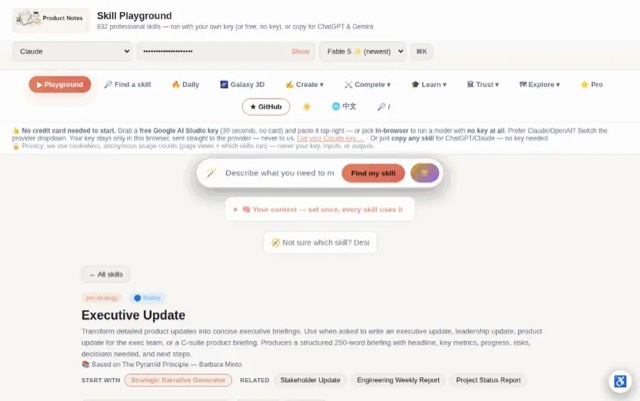
From the mohitagw15856/pm-claude-skills README — shows the whole collection, not only this skill. · view on GitHub
How to use it
Claude Code
- Run the line below. It pulls the whole folder into
~/.claude/skills/360-feedback-template. - Describe your job in plain words. Claude Code follows the skill from there.
npx degit mohitagw15856/pm-claude-skills/skills/360-feedback-template#main ~/.claude/skills/360-feedback-templateFor one project only, change the path to .claude/skills/360-feedback-template.
Claude (web or desktop app)
- On this page open ⋯ → Download .md.
- Save it as SKILL.md in a folder, zip the folder, then Customize → Skills → + → Create skill → Upload a skill.
- Pick the file and Save. Claude shows the name and description and runs a security scan.
- Check the skill is switched on.
- Start a new chat and describe your job in plain words. The AI follows the skill from there.
ChatGPT or another app
- ChatGPT: make a Project and paste it into Instructions.
- Neither? Paste it at the top of a new chat — it works for that chat.
Not working?
- Check which app you pasted it into — the steps above name the right one.
- Some skills need the paid tier of Claude or ChatGPT.
Paste into Claude, ChatGPT or Cursor.
Source of 360-Degree Feedback Template Skill
Show the full text265 lines
| name | description |
|---|---|
| 360-feedback-template | Design a 360-degree feedback survey or write a structured 360 feedback report. Use when asked to build a 360 feedback process, write 360 feedback for a colleague, design a feedback survey, or produce a feedback report. Produces either a complete survey instrument with rating scales and open-ended questions, or a structured narrative feedback report with themes, strengths, and development areas. |
360-Degree Feedback Template Skill
This skill produces two outputs depending on what the user needs: (1) a complete 360 survey instrument for gathering feedback, or (2) a structured 360 feedback report written from gathered notes. Both outputs follow best practice: behaviourally anchored ratings, specific examples, and development-oriented framing.
Required Inputs
Ask the user which output they need, then gather inputs:
For a survey instrument:
- Role being reviewed (job title and level)
- Competencies to assess (or use defaults below)
- Reviewer relationships (peer / direct report / manager / cross-functional)
- Rating scale preference (1–5 / 1–4 / frequency-based)
- Anonymity level (fully anonymous / attributed / confidential aggregated)
For a feedback report:
- Person being reviewed (role and level)
- Feedback notes or raw themes from reviewers (paste what you have)
- Reviewer relationships (how many peers, direct reports, managers responded)
- Any context — performance cycle, specific behaviours to address, promotion consideration
Output A: 360 Survey Instrument
360 Feedback Survey: [Role / Level]
Purpose: This survey helps [Name / "the reviewee"] understand how their behaviours and impact are perceived by the people they work with most closely. Responses [are / are not] anonymous. Results will be shared as [individual responses / aggregated themes].
Instructions: For each statement, rate how frequently you observe this behaviour. Add specific examples in the open-ended sections — these are the most valuable part of the survey.
Rating scale:
- 5 — Consistently: Almost always demonstrates this behaviour, even in difficult situations
- 4 — Usually: Demonstrates this behaviour more often than not
- 3 — Sometimes: Demonstrates this behaviour inconsistently
- 2 — Rarely: Seldom demonstrates this behaviour
- 1 — Not observed: Have not had the opportunity to observe this behaviour
Section 1: Delivery & Execution
| Statement | Rating (1–5) |
|---|---|
| Delivers work on time and to the expected quality | |
| Proactively flags risks and blockers before they become problems | |
| Follows through on commitments without needing to be chased | |
| Manages their workload effectively without compromising quality | |
| Adapts quickly when priorities or requirements change |
Open question: Describe a specific time when [Name] handled a delivery challenge particularly well or poorly.
Section 2: Communication & Collaboration
| Statement | Rating (1–5) |
|---|---|
| Communicates clearly and concisely in both written and verbal formats | |
| Listens actively and considers others' input before responding | |
| Keeps the right people informed without over-communicating | |
| Resolves disagreements constructively and without defensiveness | |
| Makes it easy for others to collaborate with them |
Open question: Give an example of how [Name] handled a difficult or high-stakes communication.
Section 3: Leadership & Influence
| Statement | Rating (1–5) |
|---|---|
| Sets a clear direction that others can follow | |
| Builds confidence and capability in people around them | |
| Influences decisions without relying on authority | |
| Gives clear, constructive feedback that helps others improve | |
| Creates an environment where people feel safe to raise concerns |
Open question: Describe a situation where [Name]'s leadership had a notable positive or negative impact on the team.
Section 4: Strategic Thinking
| Statement | Rating (1–5) |
|---|---|
| Understands the broader business context, not just their immediate work | |
| Makes connections between their work and organisational goals | |
| Thinks ahead and anticipates second-order consequences | |
| Brings original ideas or new approaches to problems | |
| Balances short-term needs with longer-term thinking |
Open question: Give an example of [Name] demonstrating (or missing) strategic thinking.
Section 5: Culture & Values
| Statement | Rating (1–5) |
|---|---|
| Treats everyone with respect, regardless of level or background | |
| Is someone people trust and can rely on | |
| Gives credit to others and shares the spotlight | |
| Takes responsibility for mistakes without placing blame | |
| Contributes positively to team morale, especially under pressure |
Open question: How does [Name] embody (or not embody) the team's values in practice?
Section 6: Overall & Development
Open questions (all reviewers):
What is [Name]'s single most important strength? Give a specific example.
What is the one behaviour or habit that, if changed, would most increase [Name]'s effectiveness?
Is there anything else you want [Name] to know? (This response will be shared directly.)
Output B: 360 Feedback Report
360 Feedback Report: [Name] — [Role]
Review cycle: [Quarter / Year / Promotion cycle] Responses received: [X total — X peers, X direct reports, X managers, X cross-functional] Report prepared by: [HR / People team / Manager / Coach] Date: [Date]
This report synthesises feedback from [X] reviewers. Open-ended responses have been lightly edited for clarity; no individual response is attributed to protect reviewer confidentiality. Direct quotes marked in italics appear verbatim.
Executive Summary
[3–4 sentences. State the overall picture: what is this person known for, what is working well, and what one or two areas are the consistent development themes. Balanced, honest, and grounded in the data — not a sanitised summary.]
Overall rating: [X.X / 5.0 — above average / at level / below expectations for level]
Strengths: What to Build On
Theme 1: [Strength — e.g. Reliability and follow-through]
[2–3 sentences synthesising the feedback evidence for this strength. Reference how many reviewers noted it and in what contexts.]
"[Direct quote from reviewer that best illustrates this theme]"
Theme 2: [Strength — e.g. Collaborative problem-solving]
[2–3 sentences synthesising evidence.]
"[Direct quote]"
Theme 3: [Strength — e.g. Clear communication under pressure]
[2–3 sentences synthesising evidence.]
"[Direct quote]"
Development Areas: What to Work On
Theme 1: [Development area — e.g. Giving timely upward feedback]
[2–3 sentences describing the behaviour pattern observed, what impact it has, and what different looks like. Non-blaming and specific.]
"[Direct quote that captures the theme]"
Suggested actions:
- [Specific, observable behaviour change — e.g. In the next team meeting where you disagree with a decision, name your concern in the meeting rather than after it]
- [Development resource or practice — e.g. Try the "I notice / I wonder / I suggest" framework for giving difficult feedback]
Theme 2: [Development area — e.g. Strategic communication to leadership]
[2–3 sentences.]
"[Direct quote]"
Suggested actions:
- [...]
- [...]
Ratings Summary
| Competency | Average score | Range | Notable pattern |
|---|---|---|---|
| Delivery & Execution | [X.X] | [X–X] | [e.g. Consistently high; one outlier] |
| Communication & Collaboration | [X.X] | [X–X] | [e.g. Peers score higher than direct reports] |
| Leadership & Influence | [X.X] | [X–X] | [...] |
| Strategic Thinking | [X.X] | [X–X] | [...] |
| Culture & Values | [X.X] | [X–X] | [...] |
| Overall | [X.X] | [X–X] |
Score variance: [Is there high agreement or wide spread across reviewers? High variance suggests the behaviour is context-dependent — explore when and with whom.]
Direct Message from Reviewers
[Include up to 3 unedited quotes from the "Is there anything else you want [Name] to know?" question. These are shared verbatim as agreed in the survey instructions.]
"[Quote 1]"
"[Quote 2]"
"[Quote 3]"
Recommended Focus for the Next 90 Days
[1–2 specific, measurable development commitments. Written to be agreed in the feedback conversation — not prescriptive.]
- [Behaviour to change]: [What does success look like at 90 days? How will we measure it?]
- [Skill to build]: [What specific resource, practice, or support will help? Who will observe progress?]
Quality Checks
- Survey questions are behaviourally anchored — they describe observable actions, not attitudes
- Open-ended questions ask for specific examples — not general impressions
- Report strengths are backed by specific evidence, not generic praise
- Development areas name the behaviour and its impact — not the person's character
- Suggested actions are specific enough that the reviewee knows exactly what to do differently on Monday
- Direct quotes are genuinely direct — not paraphrased into blandness
Anti-Patterns
- Do not write survey questions that ask about personality traits rather than observable behaviours ("is a good communicator" vs "communicates updates before deadlines")
- Do not write development feedback that names the person's character flaws instead of specific behaviours and their impact
- Do not aggregate ratings without noting high-variance scores — a 2/5 and a 5/5 averaged to 3.5 hides a real signal
- Do not include direct quotes in the report that could identify the reviewer in small teams — paraphrase or omit
- Do not write suggested actions so vague they could apply to anyone ("be more strategic") — every suggestion must name a specific observable behaviour change
Example Trigger Phrases
- "Build a 360 feedback survey for a [role] at senior level"
- "Write a 360 feedback report from these notes: [paste notes]"
- "Design a 360 review template for engineering managers"
- "Help me write constructive 360 feedback for my colleague [Name]"
- "Create a peer feedback survey for our upcoming performance cycle"
| 1 | |
| 2 | name 360-feedback-template |
| 3 | description "Design a 360-degree feedback survey or write a structured 360 feedback report. Use when asked to build a 360 feedback process, write 360 feedback for a colleague, design a feedback survey, or produce a feedback report. Produces either a complete survey instrument with rating scales and open-ended questions, or a structured narrative feedback report with themes, strengths, and development areas." |
| 4 | |
| 5 | |
| 6 | # 360-Degree Feedback Template Skill |
| 7 | |
| 8 | This skill produces two outputs depending on what the user needs: (1) a complete 360 survey instrument for gathering feedback, or (2) a structured 360 feedback report written from gathered notes. Both outputs follow best practice: behaviourally anchored ratings, specific examples, and development-oriented framing. |
| 9 | |
| 10 | ## Required Inputs |
| 11 | |
| 12 | Ask the user which output they need, then gather inputs: |
| 13 | |
| 14 | **For a survey instrument:** |
| 15 | **Role being reviewed** (job title and level) |
| 16 | **Competencies to assess** (or use defaults below) |
| 17 | **Reviewer relationships** (peer / direct report / manager / cross-functional) |
| 18 | **Rating scale preference** (1–5 / 1–4 / frequency-based) |
| 19 | **Anonymity level** (fully anonymous / attributed / confidential aggregated) |
| 20 | |
| 21 | **For a feedback report:** |
| 22 | **Person being reviewed** (role and level) |
| 23 | **Feedback notes or raw themes** from reviewers (paste what you have) |
| 24 | **Reviewer relationships** (how many peers, direct reports, managers responded) |
| 25 | **Any context** — performance cycle, specific behaviours to address, promotion consideration |
| 26 | |
| 27 | |
| 28 | |
| 29 | ## Output A: 360 Survey Instrument |
| 30 | |
| 31 | |
| 32 | |
| 33 | # 360 Feedback Survey: [Role / Level] |
| 34 | |
| 35 | **Purpose:** This survey helps [Name / "the reviewee"] understand how their behaviours and impact are perceived by the people they work with most closely. Responses [are / are not] anonymous. Results will be shared as [individual responses / aggregated themes]. |
| 36 | |
| 37 | **Instructions:** For each statement, rate how frequently you observe this behaviour. Add specific examples in the open-ended sections — these are the most valuable part of the survey. |
| 38 | |
| 39 | **Rating scale:** |
| 40 | **5 — Consistently:** Almost always demonstrates this behaviour, even in difficult situations |
| 41 | **4 — Usually:** Demonstrates this behaviour more often than not |
| 42 | **3 — Sometimes:** Demonstrates this behaviour inconsistently |
| 43 | **2 — Rarely:** Seldom demonstrates this behaviour |
| 44 | **1 — Not observed:** Have not had the opportunity to observe this behaviour |
| 45 | |
| 46 | |
| 47 | |
| 48 | ### Section 1: Delivery & Execution |
| 49 | |
| 50 | | Statement | Rating (1–5) | |
| 51 | |---|---| |
| 52 | | Delivers work on time and to the expected quality | | |
| 53 | | Proactively flags risks and blockers before they become problems | | |
| 54 | | Follows through on commitments without needing to be chased | | |
| 55 | | Manages their workload effectively without compromising quality | | |
| 56 | | Adapts quickly when priorities or requirements change | | |
| 57 | |
| 58 | **Open question:** Describe a specific time when [Name] handled a delivery challenge particularly well or poorly. |
| 59 | |
| 60 | |
| 61 | |
| 62 | ### Section 2: Communication & Collaboration |
| 63 | |
| 64 | | Statement | Rating (1–5) | |
| 65 | |---|---| |
| 66 | | Communicates clearly and concisely in both written and verbal formats | | |
| 67 | | Listens actively and considers others' input before responding | | |
| 68 | | Keeps the right people informed without over-communicating | | |
| 69 | | Resolves disagreements constructively and without defensiveness | | |
| 70 | | Makes it easy for others to collaborate with them | | |
| 71 | |
| 72 | **Open question:** Give an example of how [Name] handled a difficult or high-stakes communication. |
| 73 | |
| 74 | |
| 75 | |
| 76 | ### Section 3: Leadership & Influence |
| 77 | |
| 78 | | Statement | Rating (1–5) | |
| 79 | |---|---| |
| 80 | | Sets a clear direction that others can follow | | |
| 81 | | Builds confidence and capability in people around them | | |
| 82 | | Influences decisions without relying on authority | | |
| 83 | | Gives clear, constructive feedback that helps others improve | | |
| 84 | | Creates an environment where people feel safe to raise concerns | | |
| 85 | |
| 86 | **Open question:** Describe a situation where [Name]'s leadership had a notable positive or negative impact on the team. |
| 87 | |
| 88 | |
| 89 | |
| 90 | ### Section 4: Strategic Thinking |
| 91 | |
| 92 | | Statement | Rating (1–5) | |
| 93 | |---|---| |
| 94 | | Understands the broader business context, not just their immediate work | | |
| 95 | | Makes connections between their work and organisational goals | | |
| 96 | | Thinks ahead and anticipates second-order consequences | | |
| 97 | | Brings original ideas or new approaches to problems | | |
| 98 | | Balances short-term needs with longer-term thinking | | |
| 99 | |
| 100 | **Open question:** Give an example of [Name] demonstrating (or missing) strategic thinking. |
| 101 | |
| 102 | |
| 103 | |
| 104 | ### Section 5: Culture & Values |
| 105 | |
| 106 | | Statement | Rating (1–5) | |
| 107 | |---|---| |
| 108 | | Treats everyone with respect, regardless of level or background | | |
| 109 | | Is someone people trust and can rely on | | |
| 110 | | Gives credit to others and shares the spotlight | | |
| 111 | | Takes responsibility for mistakes without placing blame | | |
| 112 | | Contributes positively to team morale, especially under pressure | | |
| 113 | |
| 114 | **Open question:** How does [Name] embody (or not embody) the team's values in practice? |
| 115 | |
| 116 | |
| 117 | |
| 118 | ### Section 6: Overall & Development |
| 119 | |
| 120 | **Open questions (all reviewers):** |
| 121 | |
| 122 | What is [Name]'s single most important strength? Give a specific example. |
| 123 | |
| 124 | What is the one behaviour or habit that, if changed, would most increase [Name]'s effectiveness? |
| 125 | |
| 126 | Is there anything else you want [Name] to know? (This response will be shared directly.) |
| 127 | |
| 128 | |
| 129 | |
| 130 | ## Output B: 360 Feedback Report |
| 131 | |
| 132 | |
| 133 | |
| 134 | # 360 Feedback Report: [Name] — [Role] |
| 135 | |
| 136 | **Review cycle:** [Quarter / Year / Promotion cycle] |
| 137 | **Responses received:** [X total — X peers, X direct reports, X managers, X cross-functional] |
| 138 | **Report prepared by:** [HR / People team / Manager / Coach] |
| 139 | **Date:** [Date] |
| 140 | |
| 141 | > This report synthesises feedback from [X] reviewers. Open-ended responses have been lightly edited for clarity; no individual response is attributed to protect reviewer confidentiality. Direct quotes marked in *italics* appear verbatim. |
| 142 | |
| 143 | |
| 144 | |
| 145 | ### Executive Summary |
| 146 | |
| 147 | [3–4 sentences. State the overall picture: what is this person known for, what is working well, and what one or two areas are the consistent development themes. Balanced, honest, and grounded in the data — not a sanitised summary.] |
| 148 | |
| 149 | **Overall rating:** [X.X / 5.0 — above average / at level / below expectations for level] |
| 150 | |
| 151 | |
| 152 | |
| 153 | ### Strengths: What to Build On |
| 154 | |
| 155 | **Theme 1: [Strength — e.g. Reliability and follow-through]** |
| 156 | |
| 157 | [2–3 sentences synthesising the feedback evidence for this strength. Reference how many reviewers noted it and in what contexts.] |
| 158 | |
| 159 | *"[Direct quote from reviewer that best illustrates this theme]"* |
| 160 | |
| 161 | |
| 162 | |
| 163 | **Theme 2: [Strength — e.g. Collaborative problem-solving]** |
| 164 | |
| 165 | [2–3 sentences synthesising evidence.] |
| 166 | |
| 167 | *"[Direct quote]"* |
| 168 | |
| 169 | |
| 170 | |
| 171 | **Theme 3: [Strength — e.g. Clear communication under pressure]** |
| 172 | |
| 173 | [2–3 sentences synthesising evidence.] |
| 174 | |
| 175 | *"[Direct quote]"* |
| 176 | |
| 177 | |
| 178 | |
| 179 | ### Development Areas: What to Work On |
| 180 | |
| 181 | **Theme 1: [Development area — e.g. Giving timely upward feedback]** |
| 182 | |
| 183 | [2–3 sentences describing the behaviour pattern observed, what impact it has, and what different looks like. Non-blaming and specific.] |
| 184 | |
| 185 | *"[Direct quote that captures the theme]"* |
| 186 | |
| 187 | **Suggested actions:** |
| 188 | [Specific, observable behaviour change — e.g. In the next team meeting where you disagree with a decision, name your concern in the meeting rather than after it] |
| 189 | [Development resource or practice — e.g. Try the "I notice / I wonder / I suggest" framework for giving difficult feedback] |
| 190 | |
| 191 | |
| 192 | |
| 193 | **Theme 2: [Development area — e.g. Strategic communication to leadership]** |
| 194 | |
| 195 | [2–3 sentences.] |
| 196 | |
| 197 | *"[Direct quote]"* |
| 198 | |
| 199 | **Suggested actions:** |
| 200 | [...] |
| 201 | [...] |
| 202 | |
| 203 | |
| 204 | |
| 205 | ### Ratings Summary |
| 206 | |
| 207 | | Competency | Average score | Range | Notable pattern | |
| 208 | |---|---|---|---| |
| 209 | | Delivery & Execution | [X.X] | [X–X] | [e.g. Consistently high; one outlier] | |
| 210 | | Communication & Collaboration | [X.X] | [X–X] | [e.g. Peers score higher than direct reports] | |
| 211 | | Leadership & Influence | [X.X] | [X–X] | [...] | |
| 212 | | Strategic Thinking | [X.X] | [X–X] | [...] | |
| 213 | | Culture & Values | [X.X] | [X–X] | [...] | |
| 214 | | **Overall** | **[X.X]** | [X–X] | | |
| 215 | |
| 216 | **Score variance:** [Is there high agreement or wide spread across reviewers? High variance suggests the behaviour is context-dependent — explore when and with whom.] |
| 217 | |
| 218 | |
| 219 | |
| 220 | ### Direct Message from Reviewers |
| 221 | |
| 222 | [Include up to 3 unedited quotes from the "Is there anything else you want [Name] to know?" question. These are shared verbatim as agreed in the survey instructions.] |
| 223 | |
| 224 | *"[Quote 1]"* |
| 225 | |
| 226 | *"[Quote 2]"* |
| 227 | |
| 228 | *"[Quote 3]"* |
| 229 | |
| 230 | |
| 231 | |
| 232 | ### Recommended Focus for the Next 90 Days |
| 233 | |
| 234 | [1–2 specific, measurable development commitments. Written to be agreed in the feedback conversation — not prescriptive.] |
| 235 | |
| 236 | **[Behaviour to change]:** [What does success look like at 90 days? How will we measure it?] |
| 237 | **[Skill to build]:** [What specific resource, practice, or support will help? Who will observe progress?] |
| 238 | |
| 239 | |
| 240 | |
| 241 | ## Quality Checks |
| 242 | |
| 243 | [ ] Survey questions are behaviourally anchored — they describe observable actions, not attitudes |
| 244 | [ ] Open-ended questions ask for specific examples — not general impressions |
| 245 | [ ] Report strengths are backed by specific evidence, not generic praise |
| 246 | [ ] Development areas name the behaviour and its impact — not the person's character |
| 247 | [ ] Suggested actions are specific enough that the reviewee knows exactly what to do differently on Monday |
| 248 | [ ] Direct quotes are genuinely direct — not paraphrased into blandness |
| 249 | |
| 250 | ## Anti-Patterns |
| 251 | |
| 252 | [ ] Do not write survey questions that ask about personality traits rather than observable behaviours ("is a good communicator" vs "communicates updates before deadlines") |
| 253 | [ ] Do not write development feedback that names the person's character flaws instead of specific behaviours and their impact |
| 254 | [ ] Do not aggregate ratings without noting high-variance scores — a 2/5 and a 5/5 averaged to 3.5 hides a real signal |
| 255 | [ ] Do not include direct quotes in the report that could identify the reviewer in small teams — paraphrase or omit |
| 256 | [ ] Do not write suggested actions so vague they could apply to anyone ("be more strategic") — every suggestion must name a specific observable behaviour change |
| 257 | |
| 258 | ## Example Trigger Phrases |
| 259 | |
| 260 | "Build a 360 feedback survey for a [role] at senior level" |
| 261 | "Write a 360 feedback report from these notes: [paste notes]" |
| 262 | "Design a 360 review template for engineering managers" |
| 263 | "Help me write constructive 360 feedback for my colleague [Name]" |
| 264 | "Create a peer feedback survey for our upcoming performance cycle" |
| 265 |
Discussion
Browse more free Claude skills or everything in Product.