Ambiguity Resolver Skill
Structure vague opportunities and unclear briefs into actionable one-page problem statements.
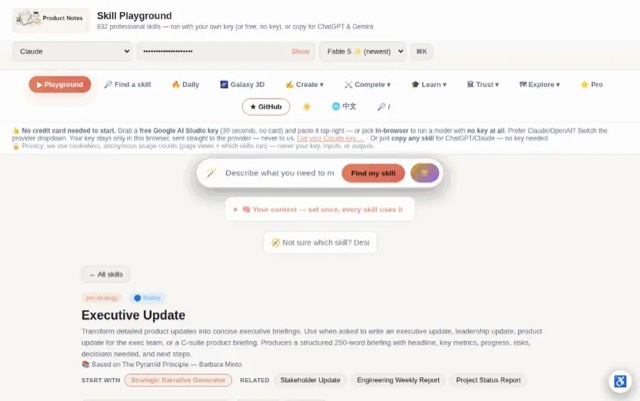

From the mohitagw15856/pm-claude-skills README — shows the whole collection, not only this skill. · view on GitHub
How to use it
Claude Code
- Run the line below. It pulls the whole folder into
~/.claude/skills/ambiguity-resolver. - Describe your job in plain words. Claude Code follows the skill from there.
npx degit mohitagw15856/pm-claude-skills/skills/ambiguity-resolver#main ~/.claude/skills/ambiguity-resolverFor one project only, change the path to .claude/skills/ambiguity-resolver.
Claude (web or desktop app)
- On this page open ⋯ → Download .md.
- Save it as SKILL.md in a folder, zip the folder, then Customize → Skills → + → Create skill → Upload a skill.
- Pick the file and Save. Claude shows the name and description and runs a security scan.
- Check the skill is switched on.
- Start a new chat and describe your job in plain words. The AI follows the skill from there.
ChatGPT or another app
- ChatGPT: make a Project and paste it into Instructions.
- Neither? Paste it at the top of a new chat — it works for that chat.
Not working?
- Check which app you pasted it into — the steps above name the right one.
- Some skills need the paid tier of Claude or ChatGPT.
Paste into Claude, ChatGPT or Cursor.
Source of Ambiguity Resolver Skill
Show the full text88 lines
| name | description |
|---|---|
| ambiguity-resolver | Structure vague opportunities and unclear briefs into actionable one-page problem statements. Use when asked to clarify a vague brief, frame an undefined problem, make sense of an unclear opportunity, or when the user says 'we need to figure out what to do about X' or 'I've been asked to look into Y'. Produces a structured problem brief with reframed questions, scoped boundaries, and a minimum viable research plan. |
Ambiguity Resolver Skill
Turn vague briefs and half-formed opportunities into structured, actionable problem statements — so you can reply with clarity instead of asking for three more meetings.
Required Inputs
Ask the user for these if not provided:
- The vague brief or opportunity description (even a single sentence is enough)
- Who asked for this (stakeholder context shapes the framing)
- Known constraints (timeline, budget, team size — if any are known)
Three-Stage Process
Stage 1: Reframe
- Restate the vague input as 3-5 explicit questions that need answering
- Identify the unstated assumptions hidden in the brief
- Surface the real decision this feeds into (what will someone do differently once this is resolved?)
Stage 2: Scope
- Define what is explicitly IN scope
- Define what is explicitly OUT of scope (equally important)
- Identify the deadline pressure: is this urgent/important, important/not urgent, or unclear?
- Name who owns the final decision and who needs to be consulted
Stage 3: Action
- Define the minimum viable research: 2-3 activities maximum that would give enough signal to move forward with confidence
- Time estimate for each activity
- What each activity would tell you (and what it wouldn't)
- Proposed check-in point: when to regroup before committing to more
Validate — Confirm every reframed question maps to at least one research activity. Verify scope boundaries are specific enough to say "no" to something concrete.
Output Structure
Problem Brief: [Opportunity Area]
Restated as questions:
- [Question 1]
- [Question 2]
- [Question 3]
Unstated assumptions we should surface:
- [Assumption 1]
- [Assumption 2]
In scope: [Clear boundary] Out of scope: [Clear boundary] Decision owner: [Name/role] Timeline: [Real deadline if known, or "unclear — recommend setting one"]
Minimum viable research:
| Activity | Time required | What it tells us | What it won't tell us |
|---|---|---|---|
| [activity] | [time] | [insight] | [limitation] |
Proposed check-in: After [activity], regroup to decide whether to proceed or pivot.
Example (Partial)
Input: "We need to figure out what to do about our enterprise customers."
Restated as questions:
- Are enterprise customers churning, underperforming on expansion, or both?
- Is this a product gap, a support/service gap, or a pricing/packaging issue?
- What does "do something" look like — a new initiative, a policy change, or a resource shift?
In scope: Enterprise accounts ($50K+ ARR) showing declining health scores in the last two quarters Out of scope: SMB segment, new enterprise acquisition strategy
Anti-Patterns
- Do not reframe the brief into questions that are still too broad to research — each reframed question must be answerable by a specific activity
- Do not list a research activity without stating what it would tell you and what it would NOT tell you
- Do not leave the decision owner as "leadership" or "the team" — name a specific person or role
- Do not omit an explicit out-of-scope boundary — without it, scope will expand organically and the brief becomes meaningless
Quality Checks
- Every reframed question is specific enough to research (not "how do we improve things?")
- Scope boundaries name something concrete that is excluded
- Research activities are achievable within the stated timeline
- Decision owner is identified (not "leadership" — a specific person or role)
| 1 | |
| 2 | name ambiguity-resolver |
| 3 | description "Structure vague opportunities and unclear briefs into actionable one-page problem statements. Use when asked to clarify a vague brief, frame an undefined problem, make sense of an unclear opportunity, or when the user says 'we need to figure out what to do about X' or 'I've been asked to look into Y'. Produces a structured problem brief with reframed questions, scoped boundaries, and a minimum viable research plan." |
| 4 | |
| 5 | |
| 6 | # Ambiguity Resolver Skill |
| 7 | |
| 8 | Turn vague briefs and half-formed opportunities into structured, actionable problem statements — so you can reply with clarity instead of asking for three more meetings. |
| 9 | |
| 10 | ## Required Inputs |
| 11 | |
| 12 | Ask the user for these if not provided: |
| 13 | **The vague brief or opportunity description** (even a single sentence is enough) |
| 14 | **Who asked for this** (stakeholder context shapes the framing) |
| 15 | **Known constraints** (timeline, budget, team size — if any are known) |
| 16 | |
| 17 | ## Three-Stage Process |
| 18 | |
| 19 | ### Stage 1: Reframe |
| 20 | Restate the vague input as 3-5 explicit questions that need answering |
| 21 | Identify the unstated assumptions hidden in the brief |
| 22 | Surface the real decision this feeds into (what will someone do differently once this is resolved?) |
| 23 | |
| 24 | ### Stage 2: Scope |
| 25 | Define what is explicitly IN scope |
| 26 | Define what is explicitly OUT of scope (equally important) |
| 27 | Identify the deadline pressure: is this urgent/important, important/not urgent, or unclear? |
| 28 | Name who owns the final decision and who needs to be consulted |
| 29 | |
| 30 | ### Stage 3: Action |
| 31 | Define the minimum viable research: 2-3 activities maximum that would give enough signal to move forward with confidence |
| 32 | Time estimate for each activity |
| 33 | What each activity would tell you (and what it wouldn't) |
| 34 | Proposed check-in point: when to regroup before committing to more |
| 35 | |
| 36 | **Validate** — Confirm every reframed question maps to at least one research activity. Verify scope boundaries are specific enough to say "no" to something concrete. |
| 37 | |
| 38 | ## Output Structure |
| 39 | |
| 40 | ### Problem Brief: [Opportunity Area] |
| 41 | |
| 42 | **Restated as questions:** |
| 43 | [Question 1] |
| 44 | [Question 2] |
| 45 | [Question 3] |
| 46 | |
| 47 | **Unstated assumptions we should surface:** |
| 48 | [Assumption 1] |
| 49 | [Assumption 2] |
| 50 | |
| 51 | **In scope:** [Clear boundary] |
| 52 | **Out of scope:** [Clear boundary] |
| 53 | **Decision owner:** [Name/role] |
| 54 | **Timeline:** [Real deadline if known, or "unclear — recommend setting one"] |
| 55 | |
| 56 | **Minimum viable research:** |
| 57 | | Activity | Time required | What it tells us | What it won't tell us | |
| 58 | |----------|--------------|------------------|-----------------------| |
| 59 | | [activity] | [time] | [insight] | [limitation] | |
| 60 | |
| 61 | **Proposed check-in:** After [activity], regroup to decide whether to proceed or pivot. |
| 62 | |
| 63 | ## Example (Partial) |
| 64 | |
| 65 | Input: *"We need to figure out what to do about our enterprise customers."* |
| 66 | |
| 67 | **Restated as questions:** |
| 68 | Are enterprise customers churning, underperforming on expansion, or both? |
| 69 | Is this a product gap, a support/service gap, or a pricing/packaging issue? |
| 70 | What does "do something" look like — a new initiative, a policy change, or a resource shift? |
| 71 | |
| 72 | **In scope:** Enterprise accounts ($50K+ ARR) showing declining health scores in the last two quarters |
| 73 | **Out of scope:** SMB segment, new enterprise acquisition strategy |
| 74 | |
| 75 | ## Anti-Patterns |
| 76 | |
| 77 | [ ] Do not reframe the brief into questions that are still too broad to research — each reframed question must be answerable by a specific activity |
| 78 | [ ] Do not list a research activity without stating what it would tell you and what it would NOT tell you |
| 79 | [ ] Do not leave the decision owner as "leadership" or "the team" — name a specific person or role |
| 80 | [ ] Do not omit an explicit out-of-scope boundary — without it, scope will expand organically and the brief becomes meaningless |
| 81 | |
| 82 | ## Quality Checks |
| 83 | |
| 84 | [ ] Every reframed question is specific enough to research (not "how do we improve things?") |
| 85 | [ ] Scope boundaries name something concrete that is excluded |
| 86 | [ ] Research activities are achievable within the stated timeline |
| 87 | [ ] Decision owner is identified (not "leadership" — a specific person or role) |
| 88 |
Discussion
Browse more free Claude skills.