Team Offsite Planner Skill
Plan a team offsite that earns its cost — the purpose split (connection vs decisions vs planning, weighted deliberately), an agenda that alternates work and air, the logistics runbook, and the follow-through that makes Monday different.
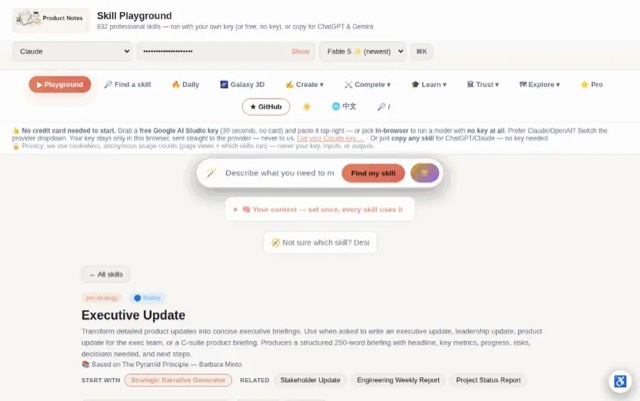
From the mohitagw15856/pm-claude-skills README — shows the whole collection, not only this skill. · view on GitHub
How to use it
Claude Code
- Run the line below. It pulls the whole folder into
~/.claude/skills/team-offsite-planner. - Describe your job in plain words. Claude Code follows the skill from there.
npx degit mohitagw15856/pm-claude-skills/skills/team-offsite-planner#main ~/.claude/skills/team-offsite-plannerFor one project only, change the path to .claude/skills/team-offsite-planner.
Claude (web or desktop app)
- On this page open ⋯ → Download .md.
- Save it as SKILL.md in a folder, zip the folder, then Customize → Skills → + → Create skill → Upload a skill.
- Pick the file and Save. Claude shows the name and description and runs a security scan.
- Check the skill is switched on.
- Start a new chat and describe your job in plain words. The AI follows the skill from there.
ChatGPT or another app
- ChatGPT: make a Project and paste it into Instructions.
- Neither? Paste it at the top of a new chat — it works for that chat.
Not working?
- Check which app you pasted it into — the steps above name the right one.
- Some skills need the paid tier of Claude or ChatGPT.
Paste into Claude, ChatGPT or Cursor.
Source of Team Offsite Planner Skill
Show the full text153 lines
| name | description |
|---|---|
| team-offsite-planner | Plan a team offsite that earns its cost — the purpose split (connection vs decisions vs planning, weighted deliberately), an agenda that alternates work and air, the logistics runbook, and the follow-through that makes Monday different. Use when asked to plan a team offsite, away day, team retreat, quarterly offsite, design two days for the team, or make this offsite not a waste. Produces the purpose weighting, a full agenda with session designs, facilitation notes, a logistics checklist, and the follow-through plan. |
Team Offsite Planner Skill
This skill designs a complete team offsite — from goals to minute-by-minute agenda, including session facilitation guides and a logistics checklist.
Required Inputs
Ask the user for these if not provided:
- Team size (number of people)
- Duration (half day / full day / 1.5 days / 2 days)
- Primary goal (e.g. Q3 planning / team bonding / strategy alignment / retrospective / all of the above)
- Location type (office / external venue / remote-first hybrid)
- Key topics to cover (if known)
- Any constraints (budget, accessibility, team dynamics to be aware of)
- Remote attendees? (Yes/No — affects session design significantly)
Output Structure
Team Offsite Plan: [Team Name]
Date: [TBD or as provided] Duration: [X days] Attendees: [X people] Goal: [Primary goal from inputs]
1. Offsite Objectives
State 3–5 clear objectives. Each objective should be answerable at the end of the offsite — the team should be able to say "we achieved this" or "we didn't."
- By the end of this offsite, we will have [specific outcome].
2. Full Agenda
For each time block, produce:
[Time] — [Session Title] (Duration: X min)
- Type: [Opening / Working session / Workshop / Decision / Social / Break]
- Owner: [Who runs this — Facilitator / Specific person / Group]
- Goal: [What this session produces or achieves]
- Format: [How it runs — e.g. "Whole group discussion", "4 breakout groups of 3", "Silent async doc read + Q&A"]
- Output: [What leaves the room — e.g. "Agreed list of H2 priorities", "Updated team norms doc", "Go/No-go decision on X"]
Day 1 Example Structure:
| Time | Session | Duration | Type |
|---|---|---|---|
| 09:00 | Arrival & coffee | 30 min | Social |
| 09:30 | Opening & objectives | 20 min | Framing |
| 09:50 | [Strategic session 1] | 90 min | Working |
| 11:20 | Break | 15 min | — |
| 11:35 | [Workshop or decision] | 75 min | Workshop |
| 13:00 | Lunch | 60 min | Social |
| 14:00 | [Working session 2] | 90 min | Working |
| 15:30 | Break | 15 min | — |
| 15:45 | [Team session / retro] | 60 min | Team |
| 16:45 | Day close — commitments | 30 min | Close |
| 17:15 | Social / dinner | Open | Social |
Adapt timing to duration and goals.
3. Session Facilitation Notes
For each working session, provide:
Session: [Name]
Time needed: [X minutes] Materials: [Post-its, Miro board, printed docs, etc.]
Step-by-step facilitation:
- [What the facilitator says/does to open — 2–3 min]
- [Core activity — describe in detail]
- [How to gather/consolidate output]
- [Closing move — decision, vote, or commitment]
If the group gets stuck: [One facilitation technique to unstick — e.g. "Dot voting if no consensus", "Parking lot for off-topic items"]
Watch out for: [Common pitfall for this session type — e.g. "The loudest voices dominating. Use silent individual writing first."]
4. Pre-Offsite Prep Checklist
For the organiser to complete before the offsite:
2 weeks before:
- Book venue and confirm capacity and AV
- Send calendar invites with travel info
- Share pre-read or pre-work doc (if any)
- Confirm dietary requirements and accessibility needs
1 week before:
- Send agenda to all attendees
- Assign session owners and brief them
- Prepare materials (print, Miro boards, name cards)
- Confirm remote setup if hybrid
Day before:
- Test AV and video conferencing setup
- Prepare room layout
- Confirm headcount and catering
5. Post-Offsite Actions
Template for the summary document to send within 48 hours:
[Team] Offsite Summary — [Date]
- Decisions made: [List]
- Actions and owners: [Table: Action | Owner | Due date]
- Parking lot items: [Topics deferred for follow-up]
- Next check-in: [When the team will review offsite commitments]
Quality Checks
- Objectives are measurable at end of day
- Sessions alternate between high-energy and reflective
- No single session runs longer than 90 minutes without a break
- Remote attendees have equal participation in working sessions
- Each working session has a stated output
- Agenda has social/informal time built in
Anti-Patterns
- Do not fill the entire agenda with structured sessions — unstructured social time is essential for team bonding and must be built in
- Do not schedule more than 90 minutes of intensive working sessions without a break
- Do not design an offsite without clearly linking each session to the stated goals — purpose must be explicit
- Do not neglect logistics — venue, travel, dietary requirements, and accessibility must be confirmed before the agenda is finalised
- Do not plan without an energy management arc — high-energy collaboration sessions should not appear directly after lunch
Example Trigger Phrases
- "Plan a 1-day offsite for my team of [size]"
- "Design a 2-day team retreat for [goal]"
- "Build an agenda for our Q[N] team planning day"
- "Help me plan a hybrid offsite for [team size] people"
| 1 | |
| 2 | name team-offsite-planner |
| 3 | description "Plan a team offsite that earns its cost — the purpose split (connection vs decisions vs planning, weighted deliberately), an agenda that alternates work and air, the logistics runbook, and the follow-through that makes Monday different. Use when asked to plan a team offsite, away day, team retreat, quarterly offsite, design two days for the team, or make this offsite not a waste. Produces the purpose weighting, a full agenda with session designs, facilitation notes, a logistics checklist, and the follow-through plan." |
| 4 | |
| 5 | |
| 6 | # Team Offsite Planner Skill |
| 7 | |
| 8 | This skill designs a complete team offsite — from goals to minute-by-minute agenda, including session facilitation guides and a logistics checklist. |
| 9 | |
| 10 | ## Required Inputs |
| 11 | |
| 12 | Ask the user for these if not provided: |
| 13 | **Team size** (number of people) |
| 14 | **Duration** (half day / full day / 1.5 days / 2 days) |
| 15 | **Primary goal** (e.g. Q3 planning / team bonding / strategy alignment / retrospective / all of the above) |
| 16 | **Location type** (office / external venue / remote-first hybrid) |
| 17 | **Key topics to cover** (if known) |
| 18 | **Any constraints** (budget, accessibility, team dynamics to be aware of) |
| 19 | **Remote attendees?** (Yes/No — affects session design significantly) |
| 20 | |
| 21 | ## Output Structure |
| 22 | |
| 23 | |
| 24 | |
| 25 | # Team Offsite Plan: [Team Name] |
| 26 | **Date:** [TBD or as provided] |
| 27 | **Duration:** [X days] |
| 28 | **Attendees:** [X people] |
| 29 | **Goal:** [Primary goal from inputs] |
| 30 | |
| 31 | |
| 32 | |
| 33 | ## 1. Offsite Objectives |
| 34 | |
| 35 | State 3–5 clear objectives. Each objective should be answerable at the end of the offsite — the team should be able to say "we achieved this" or "we didn't." |
| 36 | |
| 37 | By the end of this offsite, we will have [specific outcome]. |
| 38 | |
| 39 | |
| 40 | |
| 41 | ## 2. Full Agenda |
| 42 | |
| 43 | For each time block, produce: |
| 44 | |
| 45 | **[Time] — [Session Title]** *(Duration: X min)* |
| 46 | **Type:** [Opening / Working session / Workshop / Decision / Social / Break] |
| 47 | **Owner:** [Who runs this — Facilitator / Specific person / Group] |
| 48 | **Goal:** [What this session produces or achieves] |
| 49 | **Format:** [How it runs — e.g. "Whole group discussion", "4 breakout groups of 3", "Silent async doc read + Q&A"] |
| 50 | **Output:** [What leaves the room — e.g. "Agreed list of H2 priorities", "Updated team norms doc", "Go/No-go decision on X"] |
| 51 | |
| 52 | |
| 53 | |
| 54 | **Day 1 Example Structure:** |
| 55 | |
| 56 | | Time | Session | Duration | Type | |
| 57 | |---|---|---|---| |
| 58 | | 09:00 | Arrival & coffee | 30 min | Social | |
| 59 | | 09:30 | Opening & objectives | 20 min | Framing | |
| 60 | | 09:50 | [Strategic session 1] | 90 min | Working | |
| 61 | | 11:20 | Break | 15 min | — | |
| 62 | | 11:35 | [Workshop or decision] | 75 min | Workshop | |
| 63 | | 13:00 | Lunch | 60 min | Social | |
| 64 | | 14:00 | [Working session 2] | 90 min | Working | |
| 65 | | 15:30 | Break | 15 min | — | |
| 66 | | 15:45 | [Team session / retro] | 60 min | Team | |
| 67 | | 16:45 | Day close — commitments | 30 min | Close | |
| 68 | | 17:15 | Social / dinner | Open | Social | |
| 69 | |
| 70 | Adapt timing to duration and goals. |
| 71 | |
| 72 | |
| 73 | |
| 74 | ## 3. Session Facilitation Notes |
| 75 | |
| 76 | For each working session, provide: |
| 77 | |
| 78 | ### Session: [Name] |
| 79 | |
| 80 | **Time needed:** [X minutes] |
| 81 | **Materials:** [Post-its, Miro board, printed docs, etc.] |
| 82 | |
| 83 | **Step-by-step facilitation:** |
| 84 | [What the facilitator says/does to open — 2–3 min] |
| 85 | [Core activity — describe in detail] |
| 86 | [How to gather/consolidate output] |
| 87 | [Closing move — decision, vote, or commitment] |
| 88 | |
| 89 | **If the group gets stuck:** [One facilitation technique to unstick — e.g. "Dot voting if no consensus", "Parking lot for off-topic items"] |
| 90 | |
| 91 | **Watch out for:** [Common pitfall for this session type — e.g. "The loudest voices dominating. Use silent individual writing first."] |
| 92 | |
| 93 | |
| 94 | |
| 95 | ## 4. Pre-Offsite Prep Checklist |
| 96 | |
| 97 | For the organiser to complete before the offsite: |
| 98 | |
| 99 | **2 weeks before:** |
| 100 | [ ] Book venue and confirm capacity and AV |
| 101 | [ ] Send calendar invites with travel info |
| 102 | [ ] Share pre-read or pre-work doc (if any) |
| 103 | [ ] Confirm dietary requirements and accessibility needs |
| 104 | |
| 105 | **1 week before:** |
| 106 | [ ] Send agenda to all attendees |
| 107 | [ ] Assign session owners and brief them |
| 108 | [ ] Prepare materials (print, Miro boards, name cards) |
| 109 | [ ] Confirm remote setup if hybrid |
| 110 | |
| 111 | **Day before:** |
| 112 | [ ] Test AV and video conferencing setup |
| 113 | [ ] Prepare room layout |
| 114 | [ ] Confirm headcount and catering |
| 115 | |
| 116 | |
| 117 | |
| 118 | ## 5. Post-Offsite Actions |
| 119 | |
| 120 | Template for the summary document to send within 48 hours: |
| 121 | |
| 122 | **[Team] Offsite Summary — [Date]** |
| 123 | **Decisions made:** [List] |
| 124 | **Actions and owners:** [Table: Action | Owner | Due date] |
| 125 | **Parking lot items:** [Topics deferred for follow-up] |
| 126 | **Next check-in:** [When the team will review offsite commitments] |
| 127 | |
| 128 | |
| 129 | |
| 130 | ## Quality Checks |
| 131 | |
| 132 | [ ] Objectives are measurable at end of day |
| 133 | [ ] Sessions alternate between high-energy and reflective |
| 134 | [ ] No single session runs longer than 90 minutes without a break |
| 135 | [ ] Remote attendees have equal participation in working sessions |
| 136 | [ ] Each working session has a stated output |
| 137 | [ ] Agenda has social/informal time built in |
| 138 | |
| 139 | ## Anti-Patterns |
| 140 | |
| 141 | [ ] Do not fill the entire agenda with structured sessions — unstructured social time is essential for team bonding and must be built in |
| 142 | [ ] Do not schedule more than 90 minutes of intensive working sessions without a break |
| 143 | [ ] Do not design an offsite without clearly linking each session to the stated goals — purpose must be explicit |
| 144 | [ ] Do not neglect logistics — venue, travel, dietary requirements, and accessibility must be confirmed before the agenda is finalised |
| 145 | [ ] Do not plan without an energy management arc — high-energy collaboration sessions should not appear directly after lunch |
| 146 | |
| 147 | ## Example Trigger Phrases |
| 148 | |
| 149 | "Plan a 1-day offsite for my team of [size]" |
| 150 | "Design a 2-day team retreat for [goal]" |
| 151 | "Build an agenda for our Q[N] team planning day" |
| 152 | "Help me plan a hybrid offsite for [team size] people" |
| 153 |
Discussion
Browse more free Claude skills or everything in Operations.