Security Threat Model Skill
Write a STRIDE-based threat model for a service or feature.
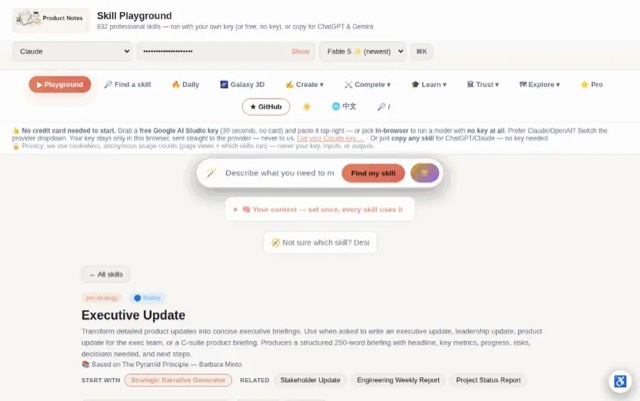
From the mohitagw15856/pm-claude-skills README — shows the whole collection, not only this skill. · view on GitHub
How to use it
Claude Code
- Run the line below. It pulls the whole folder into
~/.claude/skills/security-threat-model. - Describe your job in plain words. Claude Code follows the skill from there.
npx degit mohitagw15856/pm-claude-skills/skills/security-threat-model#main ~/.claude/skills/security-threat-modelFor one project only, change the path to .claude/skills/security-threat-model.
Claude (web or desktop app)
- On this page open ⋯ → Download .md.
- Save it as SKILL.md in a folder, zip the folder, then Customize → Skills → + → Create skill → Upload a skill.
- Pick the file and Save. Claude shows the name and description and runs a security scan.
- Check the skill is switched on.
- Start a new chat and describe your job in plain words. The AI follows the skill from there.
ChatGPT or another app
- ChatGPT: make a Project and paste it into Instructions.
- Neither? Paste it at the top of a new chat — it works for that chat.
Not working?
- Check which app you pasted it into — the steps above name the right one.
- Some skills need the paid tier of Claude or ChatGPT.
Paste into Claude, ChatGPT or Cursor.
Source of Security Threat Model Skill
Show the full text264 lines
| name | description | deprecated | supersededBy |
|---|---|---|---|
| security-threat-model | Write a STRIDE-based threat model for a service or feature. Use when asked to produce a threat model, document security risks, identify attack vectors, assess a service's security posture, or prepare for a security design review. Produces a structured threat model covering assets, trust boundaries, STRIDE threat enumeration per component, risk scores, mitigation controls, and residual risk sign-off. | 2026-08-21 | threat-model |
Security Threat Model Skill
Produce a complete STRIDE-based threat model for a service or feature. A threat model is not a list of things that could go wrong — it is a structured analysis of attackers, assets, boundaries, and controls that lets an engineering team make informed, documented security decisions.
A good threat model is specific enough that a new engineer can understand what is being protected, why each control exists, and what risk the team has accepted.
Required Inputs
Ask for these if not already provided:
- Service name and description — what the service does, who uses it
- Architecture overview — components, dependencies, data flows (a diagram description or ASCII diagram is fine)
- Deployment environment — cloud provider, VPC/network topology, where it runs (Kubernetes, ECS, VMs, serverless)
- Data sensitivity — what data does this service handle? PII, payment data, credentials, internal-only?
- Existing controls — authentication method, encryption in transit/at rest, current WAF/firewall, existing security scanning
- Trust levels — who are the principals? (anonymous public, authenticated users, internal services, admins)
Output Format
Security Threat Model: [Service Name]
Service: [Name] | Team: [Team name] Author: [Name] | Reviewed by: [Security lead / peer] Date: [Date] | Next review: [Date — recommend 6 months or after major architecture change] Classification: [Internal / Confidential]
1. Overview
[2–3 sentences describing the service, its role in the system, and the scope of this threat model. State what is in scope and what is explicitly out of scope.]
In scope:
- [Component or data flow]
- [Component or data flow]
Out of scope:
- [e.g. Third-party payment processor internals]
- [e.g. Corporate network / end-user devices]
2. Asset Register
Assets are the things worth protecting — data, capabilities, and reputational value.
| Asset | Description | Sensitivity | Owner |
|---|---|---|---|
| [e.g. User PII] | Names, email addresses, profile data | High — GDPR-regulated | [Team] |
| [e.g. API credentials] | Service-to-service auth tokens | Critical | [Team] |
| [e.g. Session tokens] | User authentication state | High | [Team] |
| [e.g. Audit logs] | Record of user and admin actions | Medium | [Team] |
| [e.g. Service availability] | Uptime of the [X] endpoint | Medium | [Team] |
Data classification key:
- Critical — Credential material; exposure enables direct system compromise
- High — PII, financial data, health data; regulated or high reputational impact
- Medium — Internal configuration, non-sensitive business data
- Low — Public information, anonymised data
3. Trust Boundaries and Architecture
Trust boundaries are the lines that separate zones with different trust levels. Threats often occur when data or requests cross a boundary.
  ┌─────────────────────────────────────────────────────────────────┐
  │  INTERNET (Untrusted)                                           │
  │                                                                 │
  │   [Public User]          [Bot / Attacker]                       │
  └──────────────────────────────┬──────────────────────────────────┘
                                 │ HTTPS
                    ─ ─ ─ ─ ─ ─ ─│─ ─ ─ ─ ─ ─ ─ ─
                    Trust Boundary: Public → DMZ
                    ─ ─ ─ ─ ─ ─ ─│─ ─ ─ ─ ─ ─ ─ ─
                                 ▼
  ┌──────────────────────────────────────────────────────────────────┐
  │  DMZ / Edge Layer                                                │
  │   ┌────────────┐     ┌──────────────┐                           │
  │   │  WAF / CDN │────▶│  API Gateway │                           │
  │   └────────────┘     └──────┬───────┘                           │
  └──────────────────────────────┼───────────────────────────────────┘
                    ─ ─ ─ ─ ─ ─ ─│─ ─ ─ ─ ─ ─ ─ ─
                    Trust Boundary: Edge → Application VPC
                    ─ ─ ─ ─ ─ ─ ─│─ ─ ─ ─ ─ ─ ─ ─
                                 ▼
  ┌──────────────────────────────────────────────────────────────────┐
  │  Application VPC (Private)                                       │
  │   ┌──────────────┐     ┌────────────┐     ┌──────────────────┐  │
  │   │  [Service A] │────▶│ [Service B]│────▶│  [Database]      │  │
  │   └──────────────┘     └────────────┘     └──────────────────┘  │
  │                                ▲                                  │
  │                                │                                  │
  │   ┌──────────────┐             │                                  │
  │   │  Admin (IAM) │─────────────┘                                 │
  └──────────────────────────────────────────────────────────────────┘
Trust Boundaries identified:
| Boundary | From | To | Auth mechanism | Encrypted |
|---|---|---|---|---|
| TB-1 | Public internet | API Gateway | [JWT / OAuth / API key] | TLS 1.2+ |
| TB-2 | API Gateway | Service A | [mTLS / internal JWT / IAM role] | [Yes/No] |
| TB-3 | Service A | Database | [Connection string + IAM / username+password] | [Yes/No] |
| TB-4 | Admin | Service B | [IAM role / VPN + MFA] | TLS |
4. STRIDE Threat Analysis
STRIDE is a threat classification framework. For each significant component, enumerate threats in each category.
STRIDE key:
- S — Spoofing: Impersonating another user, service, or system
- T — Tampering: Modifying data or code without authorisation
- R — Repudiation: Denying an action occurred; insufficient audit trail
- I — Information Disclosure: Exposing data to unauthorised parties
- D — Denial of Service: Making the service unavailable
- E — Elevation of Privilege: Gaining capabilities beyond what is authorised
Component: [API Gateway / Auth Layer]
| ID | Category | Threat | Attack vector | Existing control |
|---|---|---|---|---|
| T-001 | S | Attacker forges a JWT token to authenticate as another user | Weak signing key or algorithm confusion (alg:none) | [e.g. RS256 with key rotation / none] |
| T-002 | S | Attacker replays a stolen session token | Theft via XSS or network sniff | [e.g. Token expiry + refresh rotation] |
| T-003 | T | Attacker modifies request headers to bypass tenant isolation | Missing validation of tenant ID header | [e.g. Server-side tenant resolution / none] |
| T-004 | R | No audit trail for admin authentication events | Logging not configured for auth failures | [e.g. CloudTrail enabled / none] |
| T-005 | I | Auth error messages reveal whether an email exists | Verbose error responses | [e.g. Normalised error responses / none] |
| T-006 | D | Credential stuffing exhausts rate limits and blocks legitimate users | Automated login attempts | [e.g. Rate limiting per IP + CAPTCHA / none] |
| T-007 | E | Compromised low-privilege token used to call admin endpoint | Missing role check on admin routes | [e.g. RBAC middleware on all routes / none] |
Component: [Application Service / Business Logic]
| ID | Category | Threat | Attack vector | Existing control |
|---|---|---|---|---|
| T-008 | T | SQL/NoSQL injection via unsanitised user input | Unparameterised queries | [e.g. ORM with parameterised queries / none] |
| T-009 | T | Mass assignment — attacker sets fields they should not (e.g. isAdmin: true) |
API accepts extra fields without allowlist | [e.g. Input validation / none] |
| T-010 | I | Insecure direct object reference — user accesses another user's resource | Missing ownership check on resource ID | [e.g. Ownership middleware / none] |
| T-011 | I | Sensitive data in application logs (PII, tokens) | Over-logging in debug mode | [e.g. Log scrubbing / none] |
| T-012 | D | Unprotected expensive endpoint triggers large DB scan | No pagination or query cost limit | [e.g. Pagination enforced / none] |
| T-013 | R | Business-critical state changes not logged | No audit event on [operation] | [e.g. Audit log table / none] |
Component: [Database]
| ID | Category | Threat | Attack vector | Existing control |
|---|---|---|---|---|
| T-014 | I | Database exposed to internet (misconfigured security group) | Direct connection from outside VPC | [e.g. No public IP, security group restricts to app subnet] |
| T-015 | I | Backup snapshots not encrypted or accessible to wrong accounts | Unencrypted snapshot, public S3 | [e.g. Encrypted snapshots, private S3 bucket] |
| T-016 | T | Privilege escalation via DB account with excessive permissions | App uses a superuser DB account | [e.g. Least-privilege DB role per service / none] |
| T-017 | D | Runaway query or bulk delete causes data loss or outage | No query timeout or soft-delete | [e.g. Statement timeout, soft-delete on critical tables / none] |
Component: [Internal Service-to-Service Communication]
| ID | Category | Threat | Attack vector | Existing control |
|---|---|---|---|---|
| T-018 | S | Rogue internal service impersonates a trusted service | No mutual authentication between services | [e.g. mTLS / service mesh / none] |
| T-019 | I | Internal traffic sniffed on shared network | Unencrypted service-to-service calls | [e.g. Service mesh with TLS / none] |
| T-020 | E | Compromised internal service calls privileged endpoints | No scoping on internal tokens | [e.g. Scoped service tokens / none] |
5. Risk Register
Score each threat: Likelihood (1–5) × Impact (1–5) = Risk Score (1–25)
Priority bands: Critical (20–25) | High (12–19) | Medium (6–11) | Low (1–5)
| ID | Threat summary | Likelihood | Impact | Score | Priority | Status |
|---|---|---|---|---|---|---|
| T-001 | JWT forgery — auth bypass | 2 | 5 | 10 | Medium | [Open / Mitigated / Accepted] |
| T-002 | Session token replay | 3 | 4 | 12 | High | [Open / Mitigated / Accepted] |
| T-007 | Privilege escalation via missing role check | 3 | 5 | 15 | High | [Open / Mitigated / Accepted] |
| T-008 | SQL injection | 2 | 5 | 10 | Medium | [Open / Mitigated / Accepted] |
| T-010 | IDOR — cross-user data access | 3 | 4 | 12 | High | [Open / Mitigated / Accepted] |
| T-014 | Database exposed to internet | 1 | 5 | 5 | Low | [Open / Mitigated / Accepted] |
| T-018 | Rogue internal service impersonation | 2 | 4 | 8 | Medium | [Open / Mitigated / Accepted] |
6. Mitigations Table
For every Open threat with priority Medium or above, define a specific mitigation.
| ID | Threat | Mitigation | Owner | Target date | Ticket |
|---|---|---|---|---|---|
| T-002 | Session token replay | Implement token rotation on refresh — invalidate old token server-side immediately | [Engineer name] | [Date] | [JIRA-123] |
| T-007 | Privilege escalation | Add RBAC middleware to all /admin/* routes; write integration test for role boundary |
[Engineer name] | [Date] | [JIRA-124] |
| T-010 | IDOR | Add ownership assertion to all resource-fetching service methods; add to code review checklist | [Engineer name] | [Date] | [JIRA-125] |
| T-011 | PII in logs | Audit logging calls for PII fields; add scrubbing to logger middleware | [Engineer name] | [Date] | [JIRA-126] |
| T-018 | Rogue service impersonation | Enable mTLS via service mesh or issue scoped service tokens per service | [Engineer name] | [Date] | [JIRA-127] |
7. Accepted Risks
Accepted risks are threats the team has decided not to mitigate right now. Every accepted risk must have a named owner and a review date.
| ID | Threat | Reason for acceptance | Risk owner | Review date |
|---|---|---|---|---|
| T-014 | Database public exposure | Database has no public IP assigned; control already in place — accepted as low likelihood | [Name] | [Date] |
| [ID] | [Threat] | [Reason — e.g. "Effort exceeds risk at current scale; re-evaluate at 10× traffic"] | [Name] | [Date] |
8. Security Controls Summary
| Control | Type | Covers threats | Implemented |
|---|---|---|---|
| JWT RS256 with 15-min expiry | Preventive | T-001, T-002 | [Yes / Partial / No] |
| RBAC middleware on all routes | Preventive | T-007, T-020 | [Yes / Partial / No] |
| Parameterised queries (ORM) | Preventive | T-008 | [Yes / Partial / No] |
| Rate limiting (100 req/min per IP) | Preventive | T-006, T-012 | [Yes / Partial / No] |
| CloudTrail / audit logging | Detective | T-004, T-013 | [Yes / Partial / No] |
| Automated SAST in CI pipeline | Detective | T-008, T-009 | [Yes / Partial / No] |
| Encrypted backups + private S3 | Preventive | T-015 | [Yes / Partial / No] |
| Least-privilege DB role | Preventive | T-016 | [Yes / Partial / No] |
| Incident response runbook | Corrective | All | [Yes / Partial / No] |
9. Review Cadence
| Trigger | Action |
|---|---|
| Every 6 months | Full threat model review — update risk scores, close mitigated items |
| Major architecture change | Update trust boundary diagram and re-run STRIDE for new components |
| Security incident | Review relevant threats; add any newly discovered vectors |
| New data classification | Add assets to register; assess whether new STRIDE categories apply |
| Third-party dependency added | Assess supply chain threats for the new dependency |
Next scheduled review: [Date] Review owner: [Name / Security lead]
Quality Checks
- Every trust boundary is named and its authentication mechanism is specified — not left as "TBD"
- Every Critical and High risk in the risk register has a mitigation with a named owner and a target date
- Every accepted risk has a named risk owner and a review date — no unowned accepted risks
- The asset register includes data sensitivity levels and at least one entry for credential material
- STRIDE analysis covers all major components — not just the API layer
- Mitigation actions are specific enough to become a ticket (not "improve security")
- The ASCII trust boundary diagram matches the architecture description provided
Anti-Patterns
- Do not restrict STRIDE analysis to only the API layer — threats exist at every component including the database and internal services
- Do not leave mitigations as vague directives like "improve security" — every mitigation must be specific enough to become a ticket
- Do not accept risks without a named owner and a review date — unowned accepted risks are not managed risks
- Do not write a threat model that covers only theoretical threats — prioritise by likelihood and impact using the risk register
- Do not omit the asset register — without knowing what is being protected, the STRIDE analysis has no anchor
| 1 | |
| 2 | name security-threat-model |
| 3 | description "Write a STRIDE-based threat model for a service or feature. Use when asked to produce a threat model, document security risks, identify attack vectors, assess a service's security posture, or prepare for a security design review. Produces a structured threat model covering assets, trust boundaries, STRIDE threat enumeration per component, risk scores, mitigation controls, and residual risk sign-off." |
| 4 | deprecated 2026-08-21 |
| 5 | supersededBy threat-model |
| 6 | |
| 7 | |
| 8 | # Security Threat Model Skill |
| 9 | |
| 10 | Produce a complete STRIDE-based threat model for a service or feature. A threat model is not a list of things that could go wrong — it is a structured analysis of attackers, assets, boundaries, and controls that lets an engineering team make informed, documented security decisions. |
| 11 | |
| 12 | A good threat model is specific enough that a new engineer can understand what is being protected, why each control exists, and what risk the team has accepted. |
| 13 | |
| 14 | ## Required Inputs |
| 15 | |
| 16 | Ask for these if not already provided: |
| 17 | **Service name and description** — what the service does, who uses it |
| 18 | **Architecture overview** — components, dependencies, data flows (a diagram description or ASCII diagram is fine) |
| 19 | **Deployment environment** — cloud provider, VPC/network topology, where it runs (Kubernetes, ECS, VMs, serverless) |
| 20 | **Data sensitivity** — what data does this service handle? PII, payment data, credentials, internal-only? |
| 21 | **Existing controls** — authentication method, encryption in transit/at rest, current WAF/firewall, existing security scanning |
| 22 | **Trust levels** — who are the principals? (anonymous public, authenticated users, internal services, admins) |
| 23 | |
| 24 | ## Output Format |
| 25 | |
| 26 | |
| 27 | |
| 28 | # Security Threat Model: [Service Name] |
| 29 | |
| 30 | **Service:** [Name] | **Team:** [Team name] |
| 31 | **Author:** [Name] | **Reviewed by:** [Security lead / peer] |
| 32 | **Date:** [Date] | **Next review:** [Date — recommend 6 months or after major architecture change] |
| 33 | **Classification:** [Internal / Confidential] |
| 34 | |
| 35 | |
| 36 | |
| 37 | ## 1. Overview |
| 38 | |
| 39 | [2–3 sentences describing the service, its role in the system, and the scope of this threat model. State what is in scope and what is explicitly out of scope.] |
| 40 | |
| 41 | **In scope:** |
| 42 | [Component or data flow] |
| 43 | [Component or data flow] |
| 44 | |
| 45 | **Out of scope:** |
| 46 | [e.g. Third-party payment processor internals] |
| 47 | [e.g. Corporate network / end-user devices] |
| 48 | |
| 49 | |
| 50 | |
| 51 | ## 2. Asset Register |
| 52 | |
| 53 | Assets are the things worth protecting — data, capabilities, and reputational value. |
| 54 | |
| 55 | | Asset | Description | Sensitivity | Owner | |
| 56 | |---|---|---|---| |
| 57 | | [e.g. User PII] | Names, email addresses, profile data | High — GDPR-regulated | [Team] | |
| 58 | | [e.g. API credentials] | Service-to-service auth tokens | Critical | [Team] | |
| 59 | | [e.g. Session tokens] | User authentication state | High | [Team] | |
| 60 | | [e.g. Audit logs] | Record of user and admin actions | Medium | [Team] | |
| 61 | | [e.g. Service availability] | Uptime of the [X] endpoint | Medium | [Team] | |
| 62 | |
| 63 | **Data classification key:** |
| 64 | **Critical** — Credential material; exposure enables direct system compromise |
| 65 | **High** — PII, financial data, health data; regulated or high reputational impact |
| 66 | **Medium** — Internal configuration, non-sensitive business data |
| 67 | **Low** — Public information, anonymised data |
| 68 | |
| 69 | |
| 70 | |
| 71 | ## 3. Trust Boundaries and Architecture |
| 72 | |
| 73 | Trust boundaries are the lines that separate zones with different trust levels. Threats often occur when data or requests cross a boundary. |
| 74 | |
| 75 | |
| 76 | ┌─────────────────────────────────────────────────────────────────┐ |
| 77 | │ INTERNET (Untrusted) │ |
| 78 | │ │ |
| 79 | │ [Public User] [Bot / Attacker] │ |
| 80 | └──────────────────────────────┬──────────────────────────────────┘ |
| 81 | │ HTTPS |
| 82 | ─ ─ ─ ─ ─ ─ ─│─ ─ ─ ─ ─ ─ ─ ─ |
| 83 | Trust Boundary: Public → DMZ |
| 84 | ─ ─ ─ ─ ─ ─ ─│─ ─ ─ ─ ─ ─ ─ ─ |
| 85 | ▼ |
| 86 | ┌──────────────────────────────────────────────────────────────────┐ |
| 87 | │ DMZ / Edge Layer │ |
| 88 | │ ┌────────────┐ ┌──────────────┐ │ |
| 89 | │ │ WAF / CDN │────▶│ API Gateway │ │ |
| 90 | │ └────────────┘ └──────┬───────┘ │ |
| 91 | └──────────────────────────────┼───────────────────────────────────┘ |
| 92 | ─ ─ ─ ─ ─ ─ ─│─ ─ ─ ─ ─ ─ ─ ─ |
| 93 | Trust Boundary: Edge → Application VPC |
| 94 | ─ ─ ─ ─ ─ ─ ─│─ ─ ─ ─ ─ ─ ─ ─ |
| 95 | ▼ |
| 96 | ┌──────────────────────────────────────────────────────────────────┐ |
| 97 | │ Application VPC (Private) │ |
| 98 | │ ┌──────────────┐ ┌────────────┐ ┌──────────────────┐ │ |
| 99 | │ │ [Service A] │────▶│ [Service B]│────▶│ [Database] │ │ |
| 100 | │ └──────────────┘ └────────────┘ └──────────────────┘ │ |
| 101 | │ ▲ │ |
| 102 | │ │ │ |
| 103 | │ ┌──────────────┐ │ │ |
| 104 | │ │ Admin (IAM) │─────────────┘ │ |
| 105 | └──────────────────────────────────────────────────────────────────┘ |
| 106 | |
| 107 | |
| 108 | **Trust Boundaries identified:** |
| 109 | |
| 110 | | Boundary | From | To | Auth mechanism | Encrypted | |
| 111 | |---|---|---|---|---| |
| 112 | | TB-1 | Public internet | API Gateway | [JWT / OAuth / API key] | TLS 1.2+ | |
| 113 | | TB-2 | API Gateway | Service A | [mTLS / internal JWT / IAM role] | [Yes/No] | |
| 114 | | TB-3 | Service A | Database | [Connection string + IAM / username+password] | [Yes/No] | |
| 115 | | TB-4 | Admin | Service B | [IAM role / VPN + MFA] | TLS | |
| 116 | |
| 117 | |
| 118 | |
| 119 | ## 4. STRIDE Threat Analysis |
| 120 | |
| 121 | STRIDE is a threat classification framework. For each significant component, enumerate threats in each category. |
| 122 | |
| 123 | **STRIDE key:** |
| 124 | **S** — Spoofing: Impersonating another user, service, or system |
| 125 | **T** — Tampering: Modifying data or code without authorisation |
| 126 | **R** — Repudiation: Denying an action occurred; insufficient audit trail |
| 127 | **I** — Information Disclosure: Exposing data to unauthorised parties |
| 128 | **D** — Denial of Service: Making the service unavailable |
| 129 | **E** — Elevation of Privilege: Gaining capabilities beyond what is authorised |
| 130 | |
| 131 | ### Component: [API Gateway / Auth Layer] |
| 132 | |
| 133 | | ID | Category | Threat | Attack vector | Existing control | |
| 134 | |---|---|---|---|---| |
| 135 | | T-001 | S | Attacker forges a JWT token to authenticate as another user | Weak signing key or algorithm confusion (alg:none) | [e.g. RS256 with key rotation / none] | |
| 136 | | T-002 | S | Attacker replays a stolen session token | Theft via XSS or network sniff | [e.g. Token expiry + refresh rotation] | |
| 137 | | T-003 | T | Attacker modifies request headers to bypass tenant isolation | Missing validation of tenant ID header | [e.g. Server-side tenant resolution / none] | |
| 138 | | T-004 | R | No audit trail for admin authentication events | Logging not configured for auth failures | [e.g. CloudTrail enabled / none] | |
| 139 | | T-005 | I | Auth error messages reveal whether an email exists | Verbose error responses | [e.g. Normalised error responses / none] | |
| 140 | | T-006 | D | Credential stuffing exhausts rate limits and blocks legitimate users | Automated login attempts | [e.g. Rate limiting per IP + CAPTCHA / none] | |
| 141 | | T-007 | E | Compromised low-privilege token used to call admin endpoint | Missing role check on admin routes | [e.g. RBAC middleware on all routes / none] | |
| 142 | |
| 143 | ### Component: [Application Service / Business Logic] |
| 144 | |
| 145 | | ID | Category | Threat | Attack vector | Existing control | |
| 146 | |---|---|---|---|---| |
| 147 | | T-008 | T | SQL/NoSQL injection via unsanitised user input | Unparameterised queries | [e.g. ORM with parameterised queries / none] | |
| 148 | | T-009 | T | Mass assignment — attacker sets fields they should not (e.g. `isAdmin: true`) | API accepts extra fields without allowlist | [e.g. Input validation / none] | |
| 149 | | T-010 | I | Insecure direct object reference — user accesses another user's resource | Missing ownership check on resource ID | [e.g. Ownership middleware / none] | |
| 150 | | T-011 | I | Sensitive data in application logs (PII, tokens) | Over-logging in debug mode | [e.g. Log scrubbing / none] | |
| 151 | | T-012 | D | Unprotected expensive endpoint triggers large DB scan | No pagination or query cost limit | [e.g. Pagination enforced / none] | |
| 152 | | T-013 | R | Business-critical state changes not logged | No audit event on [operation] | [e.g. Audit log table / none] | |
| 153 | |
| 154 | ### Component: [Database] |
| 155 | |
| 156 | | ID | Category | Threat | Attack vector | Existing control | |
| 157 | |---|---|---|---|---| |
| 158 | | T-014 | I | Database exposed to internet (misconfigured security group) | Direct connection from outside VPC | [e.g. No public IP, security group restricts to app subnet] | |
| 159 | | T-015 | I | Backup snapshots not encrypted or accessible to wrong accounts | Unencrypted snapshot, public S3 | [e.g. Encrypted snapshots, private S3 bucket] | |
| 160 | | T-016 | T | Privilege escalation via DB account with excessive permissions | App uses a superuser DB account | [e.g. Least-privilege DB role per service / none] | |
| 161 | | T-017 | D | Runaway query or bulk delete causes data loss or outage | No query timeout or soft-delete | [e.g. Statement timeout, soft-delete on critical tables / none] | |
| 162 | |
| 163 | ### Component: [Internal Service-to-Service Communication] |
| 164 | |
| 165 | | ID | Category | Threat | Attack vector | Existing control | |
| 166 | |---|---|---|---|---| |
| 167 | | T-018 | S | Rogue internal service impersonates a trusted service | No mutual authentication between services | [e.g. mTLS / service mesh / none] | |
| 168 | | T-019 | I | Internal traffic sniffed on shared network | Unencrypted service-to-service calls | [e.g. Service mesh with TLS / none] | |
| 169 | | T-020 | E | Compromised internal service calls privileged endpoints | No scoping on internal tokens | [e.g. Scoped service tokens / none] | |
| 170 | |
| 171 | |
| 172 | |
| 173 | ## 5. Risk Register |
| 174 | |
| 175 | Score each threat: **Likelihood (1–5)** × **Impact (1–5)** = **Risk Score (1–25)** |
| 176 | |
| 177 | Priority bands: Critical (20–25) | High (12–19) | Medium (6–11) | Low (1–5) |
| 178 | |
| 179 | | ID | Threat summary | Likelihood | Impact | Score | Priority | Status | |
| 180 | |---|---|---|---|---|---|---| |
| 181 | | T-001 | JWT forgery — auth bypass | 2 | 5 | 10 | Medium | [Open / Mitigated / Accepted] | |
| 182 | | T-002 | Session token replay | 3 | 4 | 12 | High | [Open / Mitigated / Accepted] | |
| 183 | | T-007 | Privilege escalation via missing role check | 3 | 5 | 15 | High | [Open / Mitigated / Accepted] | |
| 184 | | T-008 | SQL injection | 2 | 5 | 10 | Medium | [Open / Mitigated / Accepted] | |
| 185 | | T-010 | IDOR — cross-user data access | 3 | 4 | 12 | High | [Open / Mitigated / Accepted] | |
| 186 | | T-014 | Database exposed to internet | 1 | 5 | 5 | Low | [Open / Mitigated / Accepted] | |
| 187 | | T-018 | Rogue internal service impersonation | 2 | 4 | 8 | Medium | [Open / Mitigated / Accepted] | |
| 188 | |
| 189 | |
| 190 | |
| 191 | ## 6. Mitigations Table |
| 192 | |
| 193 | For every Open threat with priority Medium or above, define a specific mitigation. |
| 194 | |
| 195 | | ID | Threat | Mitigation | Owner | Target date | Ticket | |
| 196 | |---|---|---|---|---|---| |
| 197 | | T-002 | Session token replay | Implement token rotation on refresh — invalidate old token server-side immediately | [Engineer name] | [Date] | [JIRA-123] | |
| 198 | | T-007 | Privilege escalation | Add RBAC middleware to all `/admin/*` routes; write integration test for role boundary | [Engineer name] | [Date] | [JIRA-124] | |
| 199 | | T-010 | IDOR | Add ownership assertion to all resource-fetching service methods; add to code review checklist | [Engineer name] | [Date] | [JIRA-125] | |
| 200 | | T-011 | PII in logs | Audit logging calls for PII fields; add scrubbing to logger middleware | [Engineer name] | [Date] | [JIRA-126] | |
| 201 | | T-018 | Rogue service impersonation | Enable mTLS via service mesh or issue scoped service tokens per service | [Engineer name] | [Date] | [JIRA-127] | |
| 202 | |
| 203 | |
| 204 | |
| 205 | ## 7. Accepted Risks |
| 206 | |
| 207 | Accepted risks are threats the team has decided not to mitigate right now. Every accepted risk must have a named owner and a review date. |
| 208 | |
| 209 | | ID | Threat | Reason for acceptance | Risk owner | Review date | |
| 210 | |---|---|---|---|---| |
| 211 | | T-014 | Database public exposure | Database has no public IP assigned; control already in place — accepted as low likelihood | [Name] | [Date] | |
| 212 | | [ID] | [Threat] | [Reason — e.g. "Effort exceeds risk at current scale; re-evaluate at 10× traffic"] | [Name] | [Date] | |
| 213 | |
| 214 | |
| 215 | |
| 216 | ## 8. Security Controls Summary |
| 217 | |
| 218 | | Control | Type | Covers threats | Implemented | |
| 219 | |---|---|---|---| |
| 220 | | JWT RS256 with 15-min expiry | Preventive | T-001, T-002 | [Yes / Partial / No] | |
| 221 | | RBAC middleware on all routes | Preventive | T-007, T-020 | [Yes / Partial / No] | |
| 222 | | Parameterised queries (ORM) | Preventive | T-008 | [Yes / Partial / No] | |
| 223 | | Rate limiting (100 req/min per IP) | Preventive | T-006, T-012 | [Yes / Partial / No] | |
| 224 | | CloudTrail / audit logging | Detective | T-004, T-013 | [Yes / Partial / No] | |
| 225 | | Automated SAST in CI pipeline | Detective | T-008, T-009 | [Yes / Partial / No] | |
| 226 | | Encrypted backups + private S3 | Preventive | T-015 | [Yes / Partial / No] | |
| 227 | | Least-privilege DB role | Preventive | T-016 | [Yes / Partial / No] | |
| 228 | | Incident response runbook | Corrective | All | [Yes / Partial / No] | |
| 229 | |
| 230 | |
| 231 | |
| 232 | ## 9. Review Cadence |
| 233 | |
| 234 | | Trigger | Action | |
| 235 | |---|---| |
| 236 | | Every 6 months | Full threat model review — update risk scores, close mitigated items | |
| 237 | | Major architecture change | Update trust boundary diagram and re-run STRIDE for new components | |
| 238 | | Security incident | Review relevant threats; add any newly discovered vectors | |
| 239 | | New data classification | Add assets to register; assess whether new STRIDE categories apply | |
| 240 | | Third-party dependency added | Assess supply chain threats for the new dependency | |
| 241 | |
| 242 | **Next scheduled review:** [Date] |
| 243 | **Review owner:** [Name / Security lead] |
| 244 | |
| 245 | |
| 246 | |
| 247 | ## Quality Checks |
| 248 | |
| 249 | [ ] Every trust boundary is named and its authentication mechanism is specified — not left as "TBD" |
| 250 | [ ] Every Critical and High risk in the risk register has a mitigation with a named owner and a target date |
| 251 | [ ] Every accepted risk has a named risk owner and a review date — no unowned accepted risks |
| 252 | [ ] The asset register includes data sensitivity levels and at least one entry for credential material |
| 253 | [ ] STRIDE analysis covers all major components — not just the API layer |
| 254 | [ ] Mitigation actions are specific enough to become a ticket (not "improve security") |
| 255 | [ ] The ASCII trust boundary diagram matches the architecture description provided |
| 256 | |
| 257 | ## Anti-Patterns |
| 258 | |
| 259 | [ ] Do not restrict STRIDE analysis to only the API layer — threats exist at every component including the database and internal services |
| 260 | [ ] Do not leave mitigations as vague directives like "improve security" — every mitigation must be specific enough to become a ticket |
| 261 | [ ] Do not accept risks without a named owner and a review date — unowned accepted risks are not managed risks |
| 262 | [ ] Do not write a threat model that covers only theoretical threats — prioritise by likelihood and impact using the risk register |
| 263 | [ ] Do not omit the asset register — without knowing what is being protected, the STRIDE analysis has no anchor |
| 264 |
Discussion
Browse more free Claude skills or everything in Development.