Risk Register Skill
Build and maintain a project or product risk register.
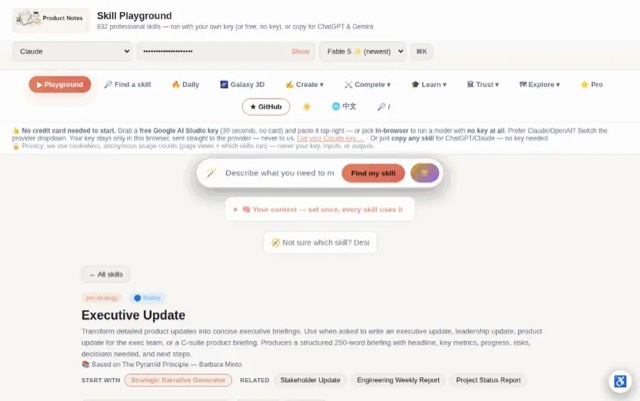

From the mohitagw15856/pm-claude-skills README — shows the whole collection, not only this skill. · view on GitHub
How to use it
Claude Code
- Run the line below. It pulls the whole folder into
~/.claude/skills/risk-register. - Describe your job in plain words. Claude Code follows the skill from there.
npx degit mohitagw15856/pm-claude-skills/skills/risk-register#main ~/.claude/skills/risk-registerFor one project only, change the path to .claude/skills/risk-register.
Claude (web or desktop app)
- On this page open ⋯ → Download .md.
- Save it as SKILL.md in a folder, zip the folder, then Customize → Skills → + → Create skill → Upload a skill.
- Pick the file and Save. Claude shows the name and description and runs a security scan.
- Check the skill is switched on.
- Start a new chat and describe your job in plain words. The AI follows the skill from there.
ChatGPT or another app
- ChatGPT: make a Project and paste it into Instructions.
- Neither? Paste it at the top of a new chat — it works for that chat.
Not working?
- Check which app you pasted it into — the steps above name the right one.
- Some skills need the paid tier of Claude or ChatGPT.
Paste into Claude, ChatGPT or Cursor.
Source of Risk Register Skill
Show the full text220 lines
| name | description |
|---|---|
| risk-register | Build and maintain a project or product risk register. Use when asked to create a risk register, identify project risks, build a risk matrix, or document risks and mitigations for a programme. Produces a complete risk register with likelihood/impact scoring, RAG status, ownership, and prioritised mitigations. |
Risk Register Skill
This skill produces a complete risk register for a project, programme, or product. Output follows standard risk management practice with likelihood × impact scoring, RAG status, a risk heat map, and specific mitigation and contingency plans. Ready to share with a project board, steering committee, or programme office.
Required Inputs
Ask the user for these if not provided:
- Project or product name
- Project stage (discovery / delivery / launch / live / programme-level)
- Key objectives — what is the project trying to achieve?
- Known risks — anything already on the team's radar (even informal concerns count)
- Key dependencies — external vendors, teams, systems, or regulatory approvals
- Deadline or milestone sensitivity — are there hard dates that cannot move?
- Audience — who will read this? (internal team / executive steering / external board / regulator)
Output Structure
Risk Register: [Project / Product Name]
Project stage: [Discovery / Delivery / Launch / Live / Programme] Version: [1.0] Owner: [PM / Programme Manager / Risk Lead] Last reviewed: [Date] Next review: [Date — recommend weekly during delivery, monthly during discovery] Status: [Active / Archived]
1. Risk Scoring Framework
Likelihood (L)
| Score | Label | Definition |
|---|---|---|
| 5 | Almost certain | >80% probability of occurring |
| 4 | Likely | 60–80% probability |
| 3 | Possible | 40–60% probability |
| 2 | Unlikely | 20–40% probability |
| 1 | Rare | <20% probability |
Impact (I)
| Score | Label | Definition |
|---|---|---|
| 5 | Critical | Programme failure, regulatory breach, major financial loss, safety event |
| 4 | High | Significant schedule delay (>4 weeks), scope reduction, reputational damage |
| 3 | Medium | Moderate delay (1–4 weeks), cost overrun, reduced quality |
| 2 | Low | Minor delay (<1 week), manageable cost increase |
| 1 | Negligible | Minimal impact, easily absorbed |
Risk Score = L × I
| Score | RAG | Action |
|---|---|---|
| 20–25 | 🔴 Critical | Immediate escalation; active management required |
| 12–19 | 🔴 High | Owner-assigned mitigation; weekly review |
| 8–11 | 🟡 Medium | Mitigation planned; fortnightly review |
| 4–7 | 🟡 Low | Monitor; monthly review |
| 1–3 | 🟢 Negligible | Accept; review if context changes |
2. Risk Register
| ID | Risk | Category | L | I | Score | RAG | Owner | Status | Mitigation | Contingency | Review date |
|---|---|---|---|---|---|---|---|---|---|---|---|
| R01 | [Risk description — be specific: "Third-party API may not support required volume, causing X to fail"] | [Schedule / Technical / Resource / Commercial / Compliance / External] | [1–5] | [1–5] | [L×I] | 🔴/🟡/🟢 | [Name] | [Open / Mitigating / Closed] | [What are we doing to reduce likelihood or impact?] | [What do we do if it happens?] | [Date] |
| R02 | [...] | [...] | [...] | [...] | [...] | [...] | [...] | [...] | [...] | [...] | [...] |
3. Risk Categories — Common Risks by Type
Use these to prompt risk identification. Add, remove, or customise for your project.
Schedule & Delivery
- Key milestone depends on a dependency that has not confirmed availability
- Team capacity reduced by planned or unplanned absence during critical period
- Technical complexity is underestimated — story points consistently overrun
- External approval (regulator, legal, procurement) takes longer than planned
Technical
- Integration with a third-party system not yet prototyped or agreed
- Existing technical debt makes the change harder or riskier than estimated
- Security or compliance review required before launch has not been scoped
- Performance under production load untested
- Key technical knowledge held by one person (single point of failure)
Resource & People
- Key SME or engineer leaving or unavailable during critical phase
- Budget not confirmed for Phase 2 of the project
- Stakeholder sponsor changes role or leaves the organisation
- Team not yet at full capacity (hiring lag, access issues, onboarding time)
Commercial & Financial
- Vendor or partner contract not yet signed
- Cost estimate based on assumptions that have not been validated
- Revenue or savings case depends on assumptions outside the team's control
- Currency exposure or exchange rate risk for international projects
Compliance & Regulatory
- Data privacy impact assessment (DPIA) not yet complete
- Regulatory approval required and timeline is uncertain
- GDPR, HIPAA, SOC 2, or sector-specific compliance requirement not yet mapped
- Legal review of terms of service or contracts pending
Stakeholder & Adoption
- Key user group has low awareness or motivation to adopt the change
- Internal resistance from a team that will be affected by the change
- Executive sponsor not consistently engaged — decisions are slow
- Communications plan not yet agreed with change management team
External
- Market or competitive change could undermine the business case
- Macroeconomic conditions affect budget or priority
- Supplier or infrastructure provider risk (e.g. cloud provider, hardware)
- Geopolitical or regulatory environment change
4. Risk Heat Map
Plot risks by likelihood (Y axis) and impact (X axis):
         │  Low     Medium    High    Critical
         │  (1)      (2-3)    (4)      (5)
─────────┼────────────────────────────────────
Almost   │  🟡        🟡       🔴       🔴
certain  │
(5)      │
─────────┼────────────────────────────────────
Likely   │  🟡        🟡       🔴       🔴
(4)      │
─────────┼────────────────────────────────────
Possible │  🟢        🟡       🟡       🔴
(3)      │
─────────┼────────────────────────────────────
Unlikely │  🟢        🟢       🟡       🟡
(2)      │
─────────┼────────────────────────────────────
Rare     │  🟢        🟢       🟢       🟡
(1)      │
[Plot each risk ID on this grid — e.g. R01 lands at L4/I5 = 🔴 Critical]
5. Top Risks — Executive Summary
For steering committee or board-level reporting:
| Rank | Risk | Score | RAG | Owner | Mitigation status |
|---|---|---|---|---|---|
| 1 | [Most critical risk — plain English description] | [X] | 🔴 | [Owner] | [Active / Planned / Not started] |
| 2 | [...] | [...] | 🔴 | [...] | [...] |
| 3 | [...] | [...] | 🟡 | [...] | [...] |
| 4 | [...] | [...] | 🟡 | [...] | [...] |
| 5 | [...] | [...] | 🟡 | [...] | [...] |
Decisions required from steering:
- [Any risk that requires budget, scope, or timeline decision to mitigate]
6. Risk Changes Since Last Review
| Risk ID | Change | Detail |
|---|---|---|
| [R03] | Score increased | [L moved from 2 → 4 — vendor confirmed delay in API availability] |
| [R07] | Risk closed | [Legal sign-off received on 12 May] |
| [NEW] | New risk identified | [R09 — budget freeze announcement affects Phase 2 funding] |
7. Risk Closure Criteria
A risk is closed when:
- The risk event can no longer occur (e.g. milestone passed, contract signed), OR
- The residual risk score drops to Negligible (1–3) AND the team formally accepts it, OR
- The risk has materialised and transitioned to an issue (tracked separately)
Issues log: [Link to issues log — risks that have materialised and are now active problems being managed]
Quality Checks
- Every risk has a specific owner — not "the team" or "TBD"
- Mitigations describe what is actively being done — not "monitor and review"
- Contingency plans exist for all Critical and High risks
- Risk descriptions are specific — "vendor may be late" is not specific enough; name the vendor and the dependency
- Register has been reviewed in the last [X] days
- Closed risks are archived, not deleted — they provide audit trail
- Risks are distinguished from issues — a risk is something that might happen; an issue is something that has happened
Example Trigger Phrases
- "Build a risk register for our product launch"
- "Create a risk matrix for [project name]"
- "What risks should I document for a data migration project?"
- "Generate a risk register for our steering committee"
- "Help me identify and score risks for our Q3 delivery plan"
Anti-Patterns
- Do not assign risks to "the team" or "TBD" — every risk must have a named individual owner
- Do not write mitigations as "monitor and review" — mitigations must describe what is actively being done to reduce likelihood or impact
- Do not delete closed risks — they provide an audit trail; archive them instead
- Do not confuse risks with issues — a risk is something that might happen; an issue is something that has already happened
- Do not leave Critical or High risks without a contingency plan — what happens if the mitigation fails must be documented
| 1 | |
| 2 | name risk-register |
| 3 | description "Build and maintain a project or product risk register. Use when asked to create a risk register, identify project risks, build a risk matrix, or document risks and mitigations for a programme. Produces a complete risk register with likelihood/impact scoring, RAG status, ownership, and prioritised mitigations." |
| 4 | |
| 5 | |
| 6 | # Risk Register Skill |
| 7 | |
| 8 | This skill produces a complete risk register for a project, programme, or product. Output follows standard risk management practice with likelihood × impact scoring, RAG status, a risk heat map, and specific mitigation and contingency plans. Ready to share with a project board, steering committee, or programme office. |
| 9 | |
| 10 | ## Required Inputs |
| 11 | |
| 12 | Ask the user for these if not provided: |
| 13 | **Project or product name** |
| 14 | **Project stage** (discovery / delivery / launch / live / programme-level) |
| 15 | **Key objectives** — what is the project trying to achieve? |
| 16 | **Known risks** — anything already on the team's radar (even informal concerns count) |
| 17 | **Key dependencies** — external vendors, teams, systems, or regulatory approvals |
| 18 | **Deadline or milestone sensitivity** — are there hard dates that cannot move? |
| 19 | **Audience** — who will read this? (internal team / executive steering / external board / regulator) |
| 20 | |
| 21 | ## Output Structure |
| 22 | |
| 23 | |
| 24 | |
| 25 | # Risk Register: [Project / Product Name] |
| 26 | |
| 27 | **Project stage:** [Discovery / Delivery / Launch / Live / Programme] |
| 28 | **Version:** [1.0] |
| 29 | **Owner:** [PM / Programme Manager / Risk Lead] |
| 30 | **Last reviewed:** [Date] |
| 31 | **Next review:** [Date — recommend weekly during delivery, monthly during discovery] |
| 32 | **Status:** [Active / Archived] |
| 33 | |
| 34 | |
| 35 | |
| 36 | ## 1. Risk Scoring Framework |
| 37 | |
| 38 | **Likelihood (L)** |
| 39 | |
| 40 | | Score | Label | Definition | |
| 41 | |---|---|---| |
| 42 | | 5 | Almost certain | >80% probability of occurring | |
| 43 | | 4 | Likely | 60–80% probability | |
| 44 | | 3 | Possible | 40–60% probability | |
| 45 | | 2 | Unlikely | 20–40% probability | |
| 46 | | 1 | Rare | <20% probability | |
| 47 | |
| 48 | **Impact (I)** |
| 49 | |
| 50 | | Score | Label | Definition | |
| 51 | |---|---|---| |
| 52 | | 5 | Critical | Programme failure, regulatory breach, major financial loss, safety event | |
| 53 | | 4 | High | Significant schedule delay (>4 weeks), scope reduction, reputational damage | |
| 54 | | 3 | Medium | Moderate delay (1–4 weeks), cost overrun, reduced quality | |
| 55 | | 2 | Low | Minor delay (<1 week), manageable cost increase | |
| 56 | | 1 | Negligible | Minimal impact, easily absorbed | |
| 57 | |
| 58 | **Risk Score = L × I** |
| 59 | |
| 60 | | Score | RAG | Action | |
| 61 | |---|---|---| |
| 62 | | 20–25 | 🔴 Critical | Immediate escalation; active management required | |
| 63 | | 12–19 | 🔴 High | Owner-assigned mitigation; weekly review | |
| 64 | | 8–11 | 🟡 Medium | Mitigation planned; fortnightly review | |
| 65 | | 4–7 | 🟡 Low | Monitor; monthly review | |
| 66 | | 1–3 | 🟢 Negligible | Accept; review if context changes | |
| 67 | |
| 68 | |
| 69 | |
| 70 | ## 2. Risk Register |
| 71 | |
| 72 | | ID | Risk | Category | L | I | Score | RAG | Owner | Status | Mitigation | Contingency | Review date | |
| 73 | |---|---|---|---|---|---|---|---|---|---|---|---| |
| 74 | | R01 | [Risk description — be specific: "Third-party API may not support required volume, causing X to fail"] | [Schedule / Technical / Resource / Commercial / Compliance / External] | [1–5] | [1–5] | [L×I] | 🔴/🟡/🟢 | [Name] | [Open / Mitigating / Closed] | [What are we doing to reduce likelihood or impact?] | [What do we do if it happens?] | [Date] | |
| 75 | | R02 | [...] | [...] | [...] | [...] | [...] | [...] | [...] | [...] | [...] | [...] | [...] | |
| 76 | |
| 77 | |
| 78 | |
| 79 | ## 3. Risk Categories — Common Risks by Type |
| 80 | |
| 81 | Use these to prompt risk identification. Add, remove, or customise for your project. |
| 82 | |
| 83 | ### Schedule & Delivery |
| 84 | Key milestone depends on a dependency that has not confirmed availability |
| 85 | Team capacity reduced by planned or unplanned absence during critical period |
| 86 | Technical complexity is underestimated — story points consistently overrun |
| 87 | External approval (regulator, legal, procurement) takes longer than planned |
| 88 | |
| 89 | ### Technical |
| 90 | Integration with a third-party system not yet prototyped or agreed |
| 91 | Existing technical debt makes the change harder or riskier than estimated |
| 92 | Security or compliance review required before launch has not been scoped |
| 93 | Performance under production load untested |
| 94 | Key technical knowledge held by one person (single point of failure) |
| 95 | |
| 96 | ### Resource & People |
| 97 | Key SME or engineer leaving or unavailable during critical phase |
| 98 | Budget not confirmed for Phase 2 of the project |
| 99 | Stakeholder sponsor changes role or leaves the organisation |
| 100 | Team not yet at full capacity (hiring lag, access issues, onboarding time) |
| 101 | |
| 102 | ### Commercial & Financial |
| 103 | Vendor or partner contract not yet signed |
| 104 | Cost estimate based on assumptions that have not been validated |
| 105 | Revenue or savings case depends on assumptions outside the team's control |
| 106 | Currency exposure or exchange rate risk for international projects |
| 107 | |
| 108 | ### Compliance & Regulatory |
| 109 | Data privacy impact assessment (DPIA) not yet complete |
| 110 | Regulatory approval required and timeline is uncertain |
| 111 | GDPR, HIPAA, SOC 2, or sector-specific compliance requirement not yet mapped |
| 112 | Legal review of terms of service or contracts pending |
| 113 | |
| 114 | ### Stakeholder & Adoption |
| 115 | Key user group has low awareness or motivation to adopt the change |
| 116 | Internal resistance from a team that will be affected by the change |
| 117 | Executive sponsor not consistently engaged — decisions are slow |
| 118 | Communications plan not yet agreed with change management team |
| 119 | |
| 120 | ### External |
| 121 | Market or competitive change could undermine the business case |
| 122 | Macroeconomic conditions affect budget or priority |
| 123 | Supplier or infrastructure provider risk (e.g. cloud provider, hardware) |
| 124 | Geopolitical or regulatory environment change |
| 125 | |
| 126 | |
| 127 | |
| 128 | ## 4. Risk Heat Map |
| 129 | |
| 130 | Plot risks by likelihood (Y axis) and impact (X axis): |
| 131 | |
| 132 | |
| 133 | │ Low Medium High Critical |
| 134 | │ (1) (2-3) (4) (5) |
| 135 | ─────────┼──────────────────────────────────── |
| 136 | Almost │ 🟡 🟡 🔴 🔴 |
| 137 | certain │ |
| 138 | (5) │ |
| 139 | ─────────┼──────────────────────────────────── |
| 140 | Likely │ 🟡 🟡 🔴 🔴 |
| 141 | (4) │ |
| 142 | ─────────┼──────────────────────────────────── |
| 143 | Possible │ 🟢 🟡 🟡 🔴 |
| 144 | (3) │ |
| 145 | ─────────┼──────────────────────────────────── |
| 146 | Unlikely │ 🟢 🟢 🟡 🟡 |
| 147 | (2) │ |
| 148 | ─────────┼──────────────────────────────────── |
| 149 | Rare │ 🟢 🟢 🟢 🟡 |
| 150 | (1) │ |
| 151 | |
| 152 | |
| 153 | [Plot each risk ID on this grid — e.g. R01 lands at L4/I5 = 🔴 Critical] |
| 154 | |
| 155 | |
| 156 | |
| 157 | ## 5. Top Risks — Executive Summary |
| 158 | |
| 159 | For steering committee or board-level reporting: |
| 160 | |
| 161 | | Rank | Risk | Score | RAG | Owner | Mitigation status | |
| 162 | |---|---|---|---|---|---| |
| 163 | | 1 | [Most critical risk — plain English description] | [X] | 🔴 | [Owner] | [Active / Planned / Not started] | |
| 164 | | 2 | [...] | [...] | 🔴 | [...] | [...] | |
| 165 | | 3 | [...] | [...] | 🟡 | [...] | [...] | |
| 166 | | 4 | [...] | [...] | 🟡 | [...] | [...] | |
| 167 | | 5 | [...] | [...] | 🟡 | [...] | [...] | |
| 168 | |
| 169 | **Decisions required from steering:** |
| 170 | [Any risk that requires budget, scope, or timeline decision to mitigate] |
| 171 | |
| 172 | |
| 173 | |
| 174 | ## 6. Risk Changes Since Last Review |
| 175 | |
| 176 | | Risk ID | Change | Detail | |
| 177 | |---|---|---| |
| 178 | | [R03] | Score increased | [L moved from 2 → 4 — vendor confirmed delay in API availability] | |
| 179 | | [R07] | Risk closed | [Legal sign-off received on 12 May] | |
| 180 | | [NEW] | New risk identified | [R09 — budget freeze announcement affects Phase 2 funding] | |
| 181 | |
| 182 | |
| 183 | |
| 184 | ## 7. Risk Closure Criteria |
| 185 | |
| 186 | A risk is closed when: |
| 187 | The risk event can no longer occur (e.g. milestone passed, contract signed), OR |
| 188 | The residual risk score drops to Negligible (1–3) AND the team formally accepts it, OR |
| 189 | The risk has materialised and transitioned to an **issue** (tracked separately) |
| 190 | |
| 191 | **Issues log:** [Link to issues log — risks that have materialised and are now active problems being managed] |
| 192 | |
| 193 | |
| 194 | |
| 195 | ## Quality Checks |
| 196 | |
| 197 | [ ] Every risk has a specific owner — not "the team" or "TBD" |
| 198 | [ ] Mitigations describe what is actively being done — not "monitor and review" |
| 199 | [ ] Contingency plans exist for all Critical and High risks |
| 200 | [ ] Risk descriptions are specific — "vendor may be late" is not specific enough; name the vendor and the dependency |
| 201 | [ ] Register has been reviewed in the last [X] days |
| 202 | [ ] Closed risks are archived, not deleted — they provide audit trail |
| 203 | [ ] Risks are distinguished from issues — a risk is something that might happen; an issue is something that has happened |
| 204 | |
| 205 | ## Example Trigger Phrases |
| 206 | |
| 207 | "Build a risk register for our product launch" |
| 208 | "Create a risk matrix for [project name]" |
| 209 | "What risks should I document for a data migration project?" |
| 210 | "Generate a risk register for our steering committee" |
| 211 | "Help me identify and score risks for our Q3 delivery plan" |
| 212 | |
| 213 | ## Anti-Patterns |
| 214 | |
| 215 | [ ] Do not assign risks to "the team" or "TBD" — every risk must have a named individual owner |
| 216 | [ ] Do not write mitigations as "monitor and review" — mitigations must describe what is actively being done to reduce likelihood or impact |
| 217 | [ ] Do not delete closed risks — they provide an audit trail; archive them instead |
| 218 | [ ] Do not confuse risks with issues — a risk is something that might happen; an issue is something that has already happened |
| 219 | [ ] Do not leave Critical or High risks without a contingency plan — what happens if the mitigation fails must be documented |
| 220 |
Discussion
Browse more free Claude skills.