Renewal Playbook Skill
Build a structured renewal playbook for a customer account.
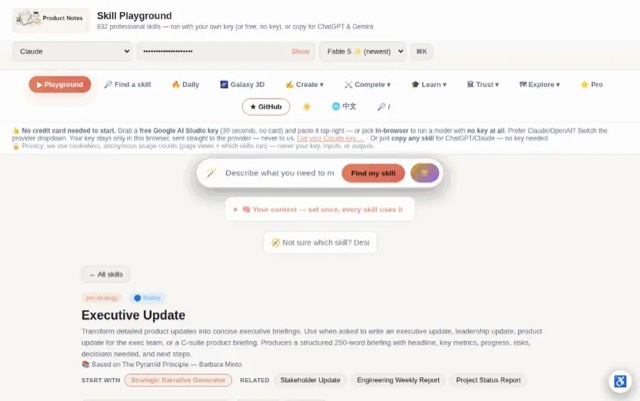

From the mohitagw15856/pm-claude-skills README — shows the whole collection, not only this skill. · view on GitHub
How to use it
Claude Code
- Run the line below. It pulls the whole folder into
~/.claude/skills/renewal-playbook. - Describe your job in plain words. Claude Code follows the skill from there.
npx degit mohitagw15856/pm-claude-skills/skills/renewal-playbook#main ~/.claude/skills/renewal-playbookFor one project only, change the path to .claude/skills/renewal-playbook.
Claude (web or desktop app)
- On this page open ⋯ → Download .md.
- Save it as SKILL.md in a folder, zip the folder, then Customize → Skills → + → Create skill → Upload a skill.
- Pick the file and Save. Claude shows the name and description and runs a security scan.
- Check the skill is switched on.
- Start a new chat and describe your job in plain words. The AI follows the skill from there.
ChatGPT or another app
- ChatGPT: make a Project and paste it into Instructions.
- Neither? Paste it at the top of a new chat — it works for that chat.
Not working?
- Check which app you pasted it into — the steps above name the right one.
- Some skills need the paid tier of Claude or ChatGPT.
Paste into Claude, ChatGPT or Cursor.
Source of Renewal Playbook Skill
Show the full text217 lines
| name | description |
|---|---|
| renewal-playbook | Build a structured renewal playbook for a customer account. Use when asked to plan a renewal, structure a renewal negotiation, prepare for an expansion conversation, or build a renewal strategy for at-risk or healthy accounts. Produces a renewal brief with health assessment, negotiation strategy, objection responses, expansion levers, and a timeline. |
Renewal Playbook Skill
This skill produces a complete renewal playbook for a specific customer account, covering health assessment, commercial strategy, negotiation preparation, expansion opportunity mapping, and a step-by-step timeline. Output is ready for the CSM or account team to execute 90–180 days before renewal.
Required Inputs
Ask the user for these if not provided:
- Account name
- Renewal date
- Current ARR and proposed renewal ARR (if different)
- Account health — RAG status and main reasons (or describe the account situation)
- Key stakeholders — economic buyer, champion, and any detractors
- Renewal risk factors — budget pressure, low adoption, competitive threat, champion departure, etc.
- Expansion opportunity — any upsell or cross-sell potential?
- Contract terms — current plan, duration, and any terms up for renegotiation
Output Structure
Renewal Playbook: [Account Name]
Renewal date: [Date] Current ARR: [£/$/€ X] Target renewal ARR: [£/$/€ X — flat / +X% expansion / contraction risk] Health status: [Green / Amber / Red] CSM: [Name] Account executive: [Name] Days to renewal: [X days]
1. Account Health Snapshot
| Dimension | Score (1–5) | Evidence |
|---|---|---|
| Product adoption | [X/5] | [e.g. 3 of 5 purchased seats active; core feature used weekly] |
| Business outcomes | [X/5] | [e.g. Customer reports X% improvement in [metric]; no formal ROI review done] |
| Relationship depth | [X/5] | [e.g. Strong champion in [name/role]; limited exec sponsorship] |
| Support & satisfaction | [X/5] | [e.g. 2 open P2 tickets; last NPS 7; no escalations in 6 months] |
| Commercial engagement | [X/5] | [e.g. Invoice paid on time; no discount pressure raised yet] |
| Overall health | [X/5 — weighted] | [Green / Amber / Red] |
Renewal thesis: [One sentence: why this account will renew — or what must change for it to renew.]
2. Stakeholder Map
| Stakeholder | Role | Influence | Sentiment | Our relationship |
|---|---|---|---|---|
| [Name] | Economic buyer | High | [Positive / Neutral / Negative] | [Warm / Cold / Unknown] |
| [Name] | Champion | High | [Positive] | [Warm] |
| [Name] | End user | Low | [Neutral] | [Limited] |
| [Name] | IT / procurement | Medium | [Neutral] | [Transactional] |
Champion risk: [Is our champion secure in their role? Any signals of departure or reorganisation?]
Multi-thread plan: [Who else do we need relationships with before renewal? How do we get there?]
3. Risk Register
| Risk | Likelihood (H/M/L) | Impact (H/M/L) | Mitigation |
|---|---|---|---|
| [Budget pressure / cost-cutting] | [H] | [H] | [Build ROI case 90 days out; identify budget holder's priorities] |
| [Low adoption in [department]] | [M] | [H] | [Run targeted enablement session; tie to champion's OKRs] |
| [Competitor evaluation] | [M] | [M] | [Request competitive intelligence; schedule exec-level call] |
| [Champion departure] | [L] | [H] | [Map two additional stakeholders; executive intro call] |
4. Value Story
Build the ROI narrative for the renewal conversation:
Headline result: [e.g. "[Account] saved X hours/week or reduced [metric] by X% using [product]"]
Evidence sources:
- Product usage data (logins, features used, seat utilisation)
- Business metric improvement (pull from QBR deck or success plan)
- Support resolution time improvement
- Customer-provided testimonial or case study quotes
Value gaps to close before renewal: [Are there outcomes the customer expected but hasn't seen yet? What's the plan to close these?]
5. Expansion Opportunity
Map upside beyond flat renewal:
| Opportunity | Type | Estimated value | Likelihood | Timing |
|---|---|---|---|---|
| [Seat expansion — [dept] wants to add 10 users] | Upsell | [+£X ARR] | [High] | [Renewal or +3M] |
| [Cross-sell — [Product B] use case identified] | Cross-sell | [+£X ARR] | [Medium] | [+6M] |
| [Multi-year commitment] | Discount for term | [+£X TCV / -X% discount] | [Low] | [At renewal] |
Expansion play: [Which opportunity to lead with, and the sequence for raising it in the renewal conversation]
6. Commercial Strategy
Renewal scenario planning:
| Scenario | Probability | ARR outcome | Response strategy |
|---|---|---|---|
| Flat renewal | [X%] | [£X — same as current] | [Accept; plant seeds for +6M expansion] |
| Expansion | [X%] | [£X] | [Lead with ROI evidence; pitch seat or feature expansion] |
| Contraction risk | [X%] | [£X — downgrade to lower tier] | [Propose phased commitment; demonstrate path to full adoption] |
| Churn risk | [X%] | [£0] | [Escalate to leadership; executive sponsor engagement] |
Discount guardrails:
- Floor discount: [X% — do not go below without VP approval]
- Triggers for discount: [Multi-year / volume / reference customer commitment]
- What to ask for in return: [Reference case study / G2 review / executive intro / case study participation]
Pricing flexibility:
- [e.g. Can offer monthly billing in exchange for 24-month commit]
- [e.g. Can offer X seats free in exchange for expansion commitment]
7. Objection Responses
Prepare for the most likely objections:
"The price is too high"
Anchor on value delivered: "[Customer] achieved [X outcome] — at [£X ARR], that's [£Y per outcome / hour saved / user]. What would it cost to deliver that outcome without us?" If budget is genuinely constrained, explore: phased payment, reduction in scope rather than full churn, multi-year pricing.
"We're not seeing enough adoption"
Acknowledge, then commit: "You're right — [X seats] are actively using [core feature] out of [Y]. We want to fix this. Here's our 60-day plan: [exec sponsor on enablement call / training session / in-product nudge campaign]."
"We're evaluating [Competitor]"
Don't panic. Ask: "What's driving the evaluation — is it specific features, pricing, or something else?" Then map gaps honestly. Offer a feature roadmap preview if relevant. Get clarity on their criteria and timeline before responding defensively.
"We need to reduce spend this quarter"
Separate the commercial conversation from the value conversation. Offer to protect the relationship with a reduced scope today with a committed expansion trigger at a business milestone. Avoid discounting without a reason.
8. Renewal Timeline
| Week | Action | Owner | Notes |
|---|---|---|---|
| W–16 (4 months out) | Internal renewal review — health, expansion opportunity, risk | CSM | Flag to leadership if Red |
| W–12 | QBR / executive business review — ROI evidence delivered | CSM + AE | Book 45–60 min with economic buyer |
| W–10 | Champion 1:1 — pulse check on satisfaction and upcoming priorities | CSM | Uncover internal dynamics before commercial discussion |
| W–8 | Expansion conversation — plant seeds, share roadmap | AE | Do not lead with pricing |
| W–6 | Send renewal proposal — pricing, terms, options | AE | Include multi-year option |
| W–4 | Negotiation — address objections, finalise commercial terms | AE + CSM | Escalate to VP if >X% discount required |
| W–2 | Legal / procurement — contract redlines, signature process | AE + Legal | |
| W–0 | Signed. Handoff to post-renewal success plan | CSM | Thank the champion; begin next cycle |
9. Success Criteria
- Renewal signed before deadline
- ARR outcome within target range
- Champion relationship maintained or improved
- At least one expansion conversation started
- ROI evidence documented and accepted by customer
Deeper Materials
This skill ships with support files — use them when they are available:
references/risk-timeline.md— The Renewal Clock: What Happens at T-minus-When. Apply it while producing the output; it carries the calibration and judgment calls the method summary above compresses.templates/renewal-plan.md— a fill-in version of the deliverable with the quality gates inline. Offer it when the user wants to work the document themselves rather than have it generated.
Scoring Rubric (0–40)
Score any output of this skill before handing it over; 32+ is ship-quality.
| Dimension | 0 | 5 | 10 |
|---|---|---|---|
| Health honesty | Target ARR asserted with no health assessment, or a Red/Amber account given a flat-renewal plan on hope | Health snapshot present with evidence, but the renewal thesis and target ARR don't fully follow from it (e.g. shelfware acknowledged, target still flat) | Every dimension score cites evidence, the renewal thesis follows from the health picture, and the target ARR reflects reality — including recommending contraction or right-sizing when that is the honest play |
| Stakeholder & risk coverage | Champion-only view; economic buyer unmapped; risks are generic labels without mitigations | Economic buyer mapped but relationship gaps unaddressed; H/H risks listed but some mitigations are vague or unowned | Economic buyer, detractors, and champion risk all assessed with a concrete multi-thread plan; every H/H risk has a dated, owned, pre-emptive mitigation that reappears in the timeline |
| Commercial rigor | No scenario planning; discounting is the first and only lever; no floor or approval gate | Scenarios present but probabilities don't sum to 100% or ARR figures don't reconcile to contract components; floor exists but no ask-in-return framework | Scenario probabilities sum to 100%, every ARR figure decomposes into real contract line items, discount floor and escalation gate are explicit, and each concession names what we get in return |
| Timeline & objection specificity | No timeline, or one starting under 90 days without acknowledgment; objection responses are boilerplate | Timeline covers 90+ days with owners, but objections could apply to any account; genuine dissatisfaction and negotiating tactics handled identically | Timeline starts 90+ days out (or explicitly flags and compresses when late) with owners per step, and every objection response uses this account's actual numbers, distinguishing real dissatisfaction to resolve from tactics to negotiate |
Quality Checks
- Stakeholder map includes the economic buyer — not just the champion
- Risk register has a mitigation for every H/H risk
- Value story uses product data and business outcomes, not just feature lists
- Commercial strategy includes a floor discount and a reason-to-discount framework
- Timeline starts at least 90 days before renewal date
- Objection responses are specific to this account, not generic
Anti-Patterns
- Do not start renewal conversations less than 90 days before the renewal date for accounts over $50K ARR
- Do not build a renewal strategy without first honestly assessing account health — wishful thinking leads to last-minute churn
- Do not treat all renewal objections as negotiating tactics — some objections signal genuine dissatisfaction that requires resolution first
- Do not offer discounts as the first response to price objections — explore value gaps before reducing price
- Do not close the renewal without confirming the expansion opportunity — every renewal is also an expansion conversation
Example Trigger Phrases
- "Build a renewal playbook for [Account Name] renewing in [Month]"
- "Help me plan the renewal strategy for an at-risk customer"
- "Prepare a renewal brief for my QBR with [Company]"
- "What's my renewal strategy for a Red account coming up in 60 days?"
- "Create a renewal and expansion plan for [Account]"
| 1 | |
| 2 | name renewal-playbook |
| 3 | description "Build a structured renewal playbook for a customer account. Use when asked to plan a renewal, structure a renewal negotiation, prepare for an expansion conversation, or build a renewal strategy for at-risk or healthy accounts. Produces a renewal brief with health assessment, negotiation strategy, objection responses, expansion levers, and a timeline." |
| 4 | |
| 5 | |
| 6 | # Renewal Playbook Skill |
| 7 | |
| 8 | This skill produces a complete renewal playbook for a specific customer account, covering health assessment, commercial strategy, negotiation preparation, expansion opportunity mapping, and a step-by-step timeline. Output is ready for the CSM or account team to execute 90–180 days before renewal. |
| 9 | |
| 10 | ## Required Inputs |
| 11 | |
| 12 | Ask the user for these if not provided: |
| 13 | **Account name** |
| 14 | **Renewal date** |
| 15 | **Current ARR** and proposed renewal ARR (if different) |
| 16 | **Account health** — RAG status and main reasons (or describe the account situation) |
| 17 | **Key stakeholders** — economic buyer, champion, and any detractors |
| 18 | **Renewal risk factors** — budget pressure, low adoption, competitive threat, champion departure, etc. |
| 19 | **Expansion opportunity** — any upsell or cross-sell potential? |
| 20 | **Contract terms** — current plan, duration, and any terms up for renegotiation |
| 21 | |
| 22 | ## Output Structure |
| 23 | |
| 24 | |
| 25 | |
| 26 | # Renewal Playbook: [Account Name] |
| 27 | |
| 28 | **Renewal date:** [Date] |
| 29 | **Current ARR:** [£/$/€ X] |
| 30 | **Target renewal ARR:** [£/$/€ X — flat / +X% expansion / contraction risk] |
| 31 | **Health status:** [Green / Amber / Red] |
| 32 | **CSM:** [Name] |
| 33 | **Account executive:** [Name] |
| 34 | **Days to renewal:** [X days] |
| 35 | |
| 36 | |
| 37 | |
| 38 | ## 1. Account Health Snapshot |
| 39 | |
| 40 | | Dimension | Score (1–5) | Evidence | |
| 41 | |---|---|---| |
| 42 | | **Product adoption** | [X/5] | [e.g. 3 of 5 purchased seats active; core feature used weekly] | |
| 43 | | **Business outcomes** | [X/5] | [e.g. Customer reports X% improvement in [metric]; no formal ROI review done] | |
| 44 | | **Relationship depth** | [X/5] | [e.g. Strong champion in [name/role]; limited exec sponsorship] | |
| 45 | | **Support & satisfaction** | [X/5] | [e.g. 2 open P2 tickets; last NPS 7; no escalations in 6 months] | |
| 46 | | **Commercial engagement** | [X/5] | [e.g. Invoice paid on time; no discount pressure raised yet] | |
| 47 | | **Overall health** | [X/5 — weighted] | [Green / Amber / Red] | |
| 48 | |
| 49 | **Renewal thesis:** [One sentence: why this account will renew — or what must change for it to renew.] |
| 50 | |
| 51 | |
| 52 | |
| 53 | ## 2. Stakeholder Map |
| 54 | |
| 55 | | Stakeholder | Role | Influence | Sentiment | Our relationship | |
| 56 | |---|---|---|---|---| |
| 57 | | [Name] | Economic buyer | High | [Positive / Neutral / Negative] | [Warm / Cold / Unknown] | |
| 58 | | [Name] | Champion | High | [Positive] | [Warm] | |
| 59 | | [Name] | End user | Low | [Neutral] | [Limited] | |
| 60 | | [Name] | IT / procurement | Medium | [Neutral] | [Transactional] | |
| 61 | |
| 62 | **Champion risk:** [Is our champion secure in their role? Any signals of departure or reorganisation?] |
| 63 | |
| 64 | **Multi-thread plan:** [Who else do we need relationships with before renewal? How do we get there?] |
| 65 | |
| 66 | |
| 67 | |
| 68 | ## 3. Risk Register |
| 69 | |
| 70 | | Risk | Likelihood (H/M/L) | Impact (H/M/L) | Mitigation | |
| 71 | |---|---|---|---| |
| 72 | | [Budget pressure / cost-cutting] | [H] | [H] | [Build ROI case 90 days out; identify budget holder's priorities] | |
| 73 | | [Low adoption in [department]] | [M] | [H] | [Run targeted enablement session; tie to champion's OKRs] | |
| 74 | | [Competitor evaluation] | [M] | [M] | [Request competitive intelligence; schedule exec-level call] | |
| 75 | | [Champion departure] | [L] | [H] | [Map two additional stakeholders; executive intro call] | |
| 76 | |
| 77 | |
| 78 | |
| 79 | ## 4. Value Story |
| 80 | |
| 81 | Build the ROI narrative for the renewal conversation: |
| 82 | |
| 83 | **Headline result:** [e.g. "[Account] saved X hours/week or reduced [metric] by X% using [product]"] |
| 84 | |
| 85 | **Evidence sources:** |
| 86 | [ ] Product usage data (logins, features used, seat utilisation) |
| 87 | [ ] Business metric improvement (pull from QBR deck or success plan) |
| 88 | [ ] Support resolution time improvement |
| 89 | [ ] Customer-provided testimonial or case study quotes |
| 90 | |
| 91 | **Value gaps to close before renewal:** [Are there outcomes the customer expected but hasn't seen yet? What's the plan to close these?] |
| 92 | |
| 93 | |
| 94 | |
| 95 | ## 5. Expansion Opportunity |
| 96 | |
| 97 | Map upside beyond flat renewal: |
| 98 | |
| 99 | | Opportunity | Type | Estimated value | Likelihood | Timing | |
| 100 | |---|---|---|---|---| |
| 101 | | [Seat expansion — [dept] wants to add 10 users] | Upsell | [+£X ARR] | [High] | [Renewal or +3M] | |
| 102 | | [Cross-sell — [Product B] use case identified] | Cross-sell | [+£X ARR] | [Medium] | [+6M] | |
| 103 | | [Multi-year commitment] | Discount for term | [+£X TCV / -X% discount] | [Low] | [At renewal] | |
| 104 | |
| 105 | **Expansion play:** [Which opportunity to lead with, and the sequence for raising it in the renewal conversation] |
| 106 | |
| 107 | |
| 108 | |
| 109 | ## 6. Commercial Strategy |
| 110 | |
| 111 | **Renewal scenario planning:** |
| 112 | |
| 113 | | Scenario | Probability | ARR outcome | Response strategy | |
| 114 | |---|---|---|---| |
| 115 | | **Flat renewal** | [X%] | [£X — same as current] | [Accept; plant seeds for +6M expansion] | |
| 116 | | **Expansion** | [X%] | [£X] | [Lead with ROI evidence; pitch seat or feature expansion] | |
| 117 | | **Contraction risk** | [X%] | [£X — downgrade to lower tier] | [Propose phased commitment; demonstrate path to full adoption] | |
| 118 | | **Churn risk** | [X%] | [£0] | [Escalate to leadership; executive sponsor engagement] | |
| 119 | |
| 120 | **Discount guardrails:** |
| 121 | Floor discount: [X% — do not go below without VP approval] |
| 122 | Triggers for discount: [Multi-year / volume / reference customer commitment] |
| 123 | What to ask for in return: [Reference case study / G2 review / executive intro / case study participation] |
| 124 | |
| 125 | **Pricing flexibility:** |
| 126 | [e.g. Can offer monthly billing in exchange for 24-month commit] |
| 127 | [e.g. Can offer X seats free in exchange for expansion commitment] |
| 128 | |
| 129 | |
| 130 | |
| 131 | ## 7. Objection Responses |
| 132 | |
| 133 | Prepare for the most likely objections: |
| 134 | |
| 135 | **"The price is too high"** |
| 136 | > Anchor on value delivered: "[Customer] achieved [X outcome] — at [£X ARR], that's [£Y per outcome / hour saved / user]. What would it cost to deliver that outcome without us?" |
| 137 | > If budget is genuinely constrained, explore: phased payment, reduction in scope rather than full churn, multi-year pricing. |
| 138 | |
| 139 | **"We're not seeing enough adoption"** |
| 140 | > Acknowledge, then commit: "You're right — [X seats] are actively using [core feature] out of [Y]. We want to fix this. Here's our 60-day plan: [exec sponsor on enablement call / training session / in-product nudge campaign]." |
| 141 | |
| 142 | **"We're evaluating [Competitor]"** |
| 143 | > Don't panic. Ask: "What's driving the evaluation — is it specific features, pricing, or something else?" Then map gaps honestly. Offer a feature roadmap preview if relevant. Get clarity on their criteria and timeline before responding defensively. |
| 144 | |
| 145 | **"We need to reduce spend this quarter"** |
| 146 | > Separate the commercial conversation from the value conversation. Offer to protect the relationship with a reduced scope today with a committed expansion trigger at a business milestone. Avoid discounting without a reason. |
| 147 | |
| 148 | |
| 149 | |
| 150 | ## 8. Renewal Timeline |
| 151 | |
| 152 | | Week | Action | Owner | Notes | |
| 153 | |---|---|---|---| |
| 154 | | **W–16** (4 months out) | Internal renewal review — health, expansion opportunity, risk | CSM | Flag to leadership if Red | |
| 155 | | **W–12** | QBR / executive business review — ROI evidence delivered | CSM + AE | Book 45–60 min with economic buyer | |
| 156 | | **W–10** | Champion 1:1 — pulse check on satisfaction and upcoming priorities | CSM | Uncover internal dynamics before commercial discussion | |
| 157 | | **W–8** | Expansion conversation — plant seeds, share roadmap | AE | Do not lead with pricing | |
| 158 | | **W–6** | Send renewal proposal — pricing, terms, options | AE | Include multi-year option | |
| 159 | | **W–4** | Negotiation — address objections, finalise commercial terms | AE + CSM | Escalate to VP if >X% discount required | |
| 160 | | **W–2** | Legal / procurement — contract redlines, signature process | AE + Legal | | |
| 161 | | **W–0** | Signed. Handoff to post-renewal success plan | CSM | Thank the champion; begin next cycle | |
| 162 | |
| 163 | |
| 164 | |
| 165 | ## 9. Success Criteria |
| 166 | |
| 167 | [ ] Renewal signed before deadline |
| 168 | [ ] ARR outcome within target range |
| 169 | [ ] Champion relationship maintained or improved |
| 170 | [ ] At least one expansion conversation started |
| 171 | [ ] ROI evidence documented and accepted by customer |
| 172 | |
| 173 | |
| 174 | |
| 175 | ## Deeper Materials |
| 176 | |
| 177 | This skill ships with support files — use them when they are available: |
| 178 | |
| 179 | **`references/risk-timeline.md`** — The Renewal Clock: What Happens at T-minus-When. Apply it while producing the output; it carries the calibration and judgment calls the method summary above compresses. |
| 180 | **`templates/renewal-plan.md`** — a fill-in version of the deliverable with the quality gates inline. Offer it when the user wants to work the document themselves rather than have it generated. |
| 181 | |
| 182 | ## Scoring Rubric (0–40) |
| 183 | |
| 184 | Score any output of this skill before handing it over; 32+ is ship-quality. |
| 185 | |
| 186 | | Dimension | 0 | 5 | 10 | |
| 187 | |---|---|---|---| |
| 188 | | Health honesty | Target ARR asserted with no health assessment, or a Red/Amber account given a flat-renewal plan on hope | Health snapshot present with evidence, but the renewal thesis and target ARR don't fully follow from it (e.g. shelfware acknowledged, target still flat) | Every dimension score cites evidence, the renewal thesis follows from the health picture, and the target ARR reflects reality — including recommending contraction or right-sizing when that is the honest play | |
| 189 | | Stakeholder & risk coverage | Champion-only view; economic buyer unmapped; risks are generic labels without mitigations | Economic buyer mapped but relationship gaps unaddressed; H/H risks listed but some mitigations are vague or unowned | Economic buyer, detractors, and champion risk all assessed with a concrete multi-thread plan; every H/H risk has a dated, owned, pre-emptive mitigation that reappears in the timeline | |
| 190 | | Commercial rigor | No scenario planning; discounting is the first and only lever; no floor or approval gate | Scenarios present but probabilities don't sum to 100% or ARR figures don't reconcile to contract components; floor exists but no ask-in-return framework | Scenario probabilities sum to 100%, every ARR figure decomposes into real contract line items, discount floor and escalation gate are explicit, and each concession names what we get in return | |
| 191 | | Timeline & objection specificity | No timeline, or one starting under 90 days without acknowledgment; objection responses are boilerplate | Timeline covers 90+ days with owners, but objections could apply to any account; genuine dissatisfaction and negotiating tactics handled identically | Timeline starts 90+ days out (or explicitly flags and compresses when late) with owners per step, and every objection response uses this account's actual numbers, distinguishing real dissatisfaction to resolve from tactics to negotiate | |
| 192 | |
| 193 | ## Quality Checks |
| 194 | |
| 195 | [ ] Stakeholder map includes the economic buyer — not just the champion |
| 196 | [ ] Risk register has a mitigation for every H/H risk |
| 197 | [ ] Value story uses product data and business outcomes, not just feature lists |
| 198 | [ ] Commercial strategy includes a floor discount and a reason-to-discount framework |
| 199 | [ ] Timeline starts at least 90 days before renewal date |
| 200 | [ ] Objection responses are specific to this account, not generic |
| 201 | |
| 202 | ## Anti-Patterns |
| 203 | |
| 204 | [ ] Do not start renewal conversations less than 90 days before the renewal date for accounts over $50K ARR |
| 205 | [ ] Do not build a renewal strategy without first honestly assessing account health — wishful thinking leads to last-minute churn |
| 206 | [ ] Do not treat all renewal objections as negotiating tactics — some objections signal genuine dissatisfaction that requires resolution first |
| 207 | [ ] Do not offer discounts as the first response to price objections — explore value gaps before reducing price |
| 208 | [ ] Do not close the renewal without confirming the expansion opportunity — every renewal is also an expansion conversation |
| 209 | |
| 210 | ## Example Trigger Phrases |
| 211 | |
| 212 | "Build a renewal playbook for [Account Name] renewing in [Month]" |
| 213 | "Help me plan the renewal strategy for an at-risk customer" |
| 214 | "Prepare a renewal brief for my QBR with [Company]" |
| 215 | "What's my renewal strategy for a Red account coming up in 60 days?" |
| 216 | "Create a renewal and expansion plan for [Account]" |
| 217 |
Discussion
Browse more free Claude skills or everything in Customer support.