Pricing Strategy Skill
Structure pricing strategy decisions, packaging options, and tier design for SaaS and digital products.
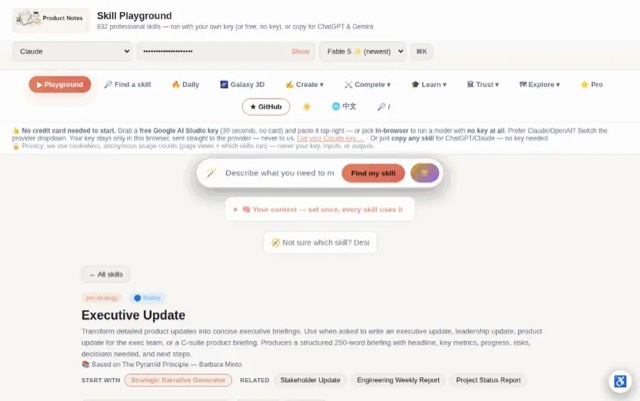


From the mohitagw15856/pm-claude-skills README — shows the whole collection, not only this skill. · view on GitHub
How to use it
Claude Code
- Run the line below. It pulls the whole folder into
~/.claude/skills/pricing-strategy. - Describe your job in plain words. Claude Code follows the skill from there.
npx degit mohitagw15856/pm-claude-skills/skills/pricing-strategy#main ~/.claude/skills/pricing-strategyFor one project only, change the path to .claude/skills/pricing-strategy.
Claude (web or desktop app)
- On this page open ⋯ → Download .md.
- Save it as SKILL.md in a folder, zip the folder, then Customize → Skills → + → Create skill → Upload a skill.
- Pick the file and Save. Claude shows the name and description and runs a security scan.
- Check the skill is switched on.
- Start a new chat and describe your job in plain words. The AI follows the skill from there.
ChatGPT or another app
- ChatGPT: make a Project and paste it into Instructions.
- Neither? Paste it at the top of a new chat — it works for that chat.
Not working?
- Check which app you pasted it into — the steps above name the right one.
- Some skills need the paid tier of Claude or ChatGPT.
Paste into Claude, ChatGPT or Cursor.
Source of Pricing Strategy Skill
Show the full text150 lines
| name | description |
|---|---|
| pricing-strategy | Structure pricing strategy decisions, packaging options, and tier design for SaaS and digital products. Use when reviewing or setting pricing, designing pricing tiers, evaluating freemium vs paid, or preparing a pricing change. Produces a pricing strategy recommendation with model rationale, tier structure, competitive positioning, and rollout plan. |
Pricing Strategy Skill
Build pricing that reflects value delivered — not cost to build. Structure every pricing decision with customer segmentation, value metric identification, competitive context, and a packaging recommendation.
Pricing Foundations
Three questions to answer before any pricing decision:
- Who is our buyer? (Role, company size, willingness to pay)
- What value do we deliver? (Quantifiable outcome — time saved, revenue generated, risk reduced)
- What is our pricing model? (Per seat, usage-based, flat, hybrid)
Pricing Models
| Model | Best For | Risk |
|---|---|---|
| Per Seat | Collaboration tools, team software | Disincentivises adoption as team grows |
| Usage-Based | APIs, infrastructure, consumption tools | Revenue unpredictability for both sides |
| Flat Rate | Simple tools, early-stage | Leaves money on table from power users |
| Tiered | Products with clear user segments | Feature gatekeeping frustrates users |
| Freemium | Viral/PLG products with low marginal cost | Conversion to paid is hard to engineer |
| Value-Based | Enterprise, outcomes-driven products | Requires strong ROI story |
Freemium Decision Framework
Use freemium when:
- ✅ Marginal cost per free user is near zero
- ✅ Product is inherently viral (network effects or sharing)
- ✅ Free tier creates genuine value (not just a demo)
- ✅ Clear upgrade trigger exists (feature, volume, or team size)
- ✅ Conversion benchmark is realistic (2–5% free-to-paid is typical)
Avoid freemium when:
- ❌ Support cost per free user is high
- ❌ No natural upgrade trigger in the product
- ❌ Core value requires features you'd need to gate
Packaging / Tiering Framework
Recommended 3-tier structure for SaaS:
| Tier | Target | Price Signal | Key Features | Lock-in Mechanism |
|---|---|---|---|---|
| Free / Starter | Individual, early discovery | $0 | Core value, usage-limited | Invite colleagues, export limit |
| Pro / Growth | SMB, growing teams | $[X]/seat/mo | Full features, higher limits | Team collaboration, integrations |
| Business / Enterprise | Mid-market, enterprise | $[X]/seat/mo or custom | Admin, SSO, SLAs, dedicated support | Security, compliance, volume |
Tier design rules:
- Each tier should be genuinely sufficient for its target segment
- The upgrade trigger should be felt naturally — not manufactured
- Price jumps of 3–5x between tiers are normal and defensible
Competitive Pricing Context
| Competitor | Model | Price | Key Differentiator |
|---|---|---|---|
| [Name] | [Model] | [Price] | [What they lead with] |
Positioning options:
- Premium: Price 20–40% above market. Justify with enterprise features, support, or brand.
- Parity: Match the market leader. Win on product or distribution.
- Value: Price below market. Win on volume. Dangerous without strong unit economics.
Output Format
Pricing Strategy Recommendation — [Product] — [Date]
Current State: [What pricing exists today, if any] Problem to Solve: [Why pricing is being reviewed]
Recommended Pricing Model: [Model name + rationale]
Value Metric: [The single unit that scales with customer value — e.g., "active users", "API calls", "documents processed"]
Proposed Tiers:
[Table using 3-tier structure above]
Free-to-Paid Upgrade Trigger: [Specific moment or threshold that creates natural upgrade pressure]
Competitive Position: [Premium / Parity / Value + reasoning]
Pricing Change Rollout (if applicable):
- Grandfathering: [Yes / No — recommendation and rationale]
- Communication plan: [How to tell customers + timing]
- Rollback plan: [Under what conditions you'd revert]
Risks:
- [Risk] → Mitigation: [Action]
Metrics to Monitor Post-Change:
- Conversion rate (free to paid)
- Churn rate by tier
- Average revenue per user (ARPU)
- Expansion revenue
Required Inputs
Ask the user for these if not provided:
- Product or service being priced
- Current pricing (if any — and why it's being reviewed)
- Target customer segments (size, role, willingness to pay)
- Key competitors and their pricing (if known)
- Business model (SaaS / Marketplace / Usage-based / Other)
- Primary goal (grow adoption / increase ARPU / reduce churn / new market entry)
Deeper Materials
references/model-selection.md— the model-selection decision tree and the regrets table from each model's veterans
Quality Checks
- Value metric is defined (the unit that scales with customer value)
- Free-to-paid upgrade trigger is specific (not "when they need more")
- Competitive positioning is chosen and justified (premium / parity / value)
- Pricing change rollout plan includes grandfathering decision
- Counter-metrics are defined to catch perverse incentives
- Risks have specific mitigations (not just listed)
Anti-Patterns
- Do not base pricing solely on cost-plus — pricing must reflect value delivered to the customer
- Do not design tiers where the middle tier is clearly worse value — it undermines trust and pushes customers to extremes
- Do not change pricing without a migration plan for existing customers — surprise price changes cause churn
- Do not set enterprise pricing as "contact us" without a floor — it deters self-serve evaluation and qualification
- Do not skip competitive positioning — pricing in isolation from the market is incomplete strategy
Guidelines
- Never price based on cost — price based on value delivered to the customer
- Always A/B test price changes where possible; use geographic holdouts if A/B isn't feasible
- Recommend annual pricing with 15–20% discount — improves cash flow and reduces churn
- If enterprise pricing is "contact us", recommend adding a price floor to qualify inbound
| 1 | |
| 2 | name pricing-strategy |
| 3 | description "Structure pricing strategy decisions, packaging options, and tier design for SaaS and digital products. Use when reviewing or setting pricing, designing pricing tiers, evaluating freemium vs paid, or preparing a pricing change. Produces a pricing strategy recommendation with model rationale, tier structure, competitive positioning, and rollout plan." |
| 4 | |
| 5 | |
| 6 | # Pricing Strategy Skill |
| 7 | |
| 8 | Build pricing that reflects value delivered — not cost to build. Structure every pricing decision with customer segmentation, value metric identification, competitive context, and a packaging recommendation. |
| 9 | |
| 10 | ## Pricing Foundations |
| 11 | |
| 12 | Three questions to answer before any pricing decision: |
| 13 | **Who is our buyer?** (Role, company size, willingness to pay) |
| 14 | **What value do we deliver?** (Quantifiable outcome — time saved, revenue generated, risk reduced) |
| 15 | **What is our pricing model?** (Per seat, usage-based, flat, hybrid) |
| 16 | |
| 17 | |
| 18 | |
| 19 | ## Pricing Models |
| 20 | |
| 21 | | Model | Best For | Risk | |
| 22 | |---|---|---| |
| 23 | | **Per Seat** | Collaboration tools, team software | Disincentivises adoption as team grows | |
| 24 | | **Usage-Based** | APIs, infrastructure, consumption tools | Revenue unpredictability for both sides | |
| 25 | | **Flat Rate** | Simple tools, early-stage | Leaves money on table from power users | |
| 26 | | **Tiered** | Products with clear user segments | Feature gatekeeping frustrates users | |
| 27 | | **Freemium** | Viral/PLG products with low marginal cost | Conversion to paid is hard to engineer | |
| 28 | | **Value-Based** | Enterprise, outcomes-driven products | Requires strong ROI story | |
| 29 | |
| 30 | |
| 31 | |
| 32 | ## Freemium Decision Framework |
| 33 | |
| 34 | Use freemium when: |
| 35 | ✅ Marginal cost per free user is near zero |
| 36 | ✅ Product is inherently viral (network effects or sharing) |
| 37 | ✅ Free tier creates genuine value (not just a demo) |
| 38 | ✅ Clear upgrade trigger exists (feature, volume, or team size) |
| 39 | ✅ Conversion benchmark is realistic (2–5% free-to-paid is typical) |
| 40 | |
| 41 | Avoid freemium when: |
| 42 | ❌ Support cost per free user is high |
| 43 | ❌ No natural upgrade trigger in the product |
| 44 | ❌ Core value requires features you'd need to gate |
| 45 | |
| 46 | |
| 47 | |
| 48 | ## Packaging / Tiering Framework |
| 49 | |
| 50 | Recommended 3-tier structure for SaaS: |
| 51 | |
| 52 | | Tier | Target | Price Signal | Key Features | Lock-in Mechanism | |
| 53 | |---|---|---|---|---| |
| 54 | | **Free / Starter** | Individual, early discovery | $0 | Core value, usage-limited | Invite colleagues, export limit | |
| 55 | | **Pro / Growth** | SMB, growing teams | $[X]/seat/mo | Full features, higher limits | Team collaboration, integrations | |
| 56 | | **Business / Enterprise** | Mid-market, enterprise | $[X]/seat/mo or custom | Admin, SSO, SLAs, dedicated support | Security, compliance, volume | |
| 57 | |
| 58 | Tier design rules: |
| 59 | Each tier should be genuinely sufficient for its target segment |
| 60 | The upgrade trigger should be felt naturally — not manufactured |
| 61 | Price jumps of 3–5x between tiers are normal and defensible |
| 62 | |
| 63 | |
| 64 | |
| 65 | ## Competitive Pricing Context |
| 66 | |
| 67 | | Competitor | Model | Price | Key Differentiator | |
| 68 | |---|---|---|---| |
| 69 | | [Name] | [Model] | [Price] | [What they lead with] | |
| 70 | |
| 71 | Positioning options: |
| 72 | **Premium:** Price 20–40% above market. Justify with enterprise features, support, or brand. |
| 73 | **Parity:** Match the market leader. Win on product or distribution. |
| 74 | **Value:** Price below market. Win on volume. Dangerous without strong unit economics. |
| 75 | |
| 76 | |
| 77 | |
| 78 | ## Output Format |
| 79 | |
| 80 | ### Pricing Strategy Recommendation — [Product] — [Date] |
| 81 | |
| 82 | **Current State:** [What pricing exists today, if any] |
| 83 | **Problem to Solve:** [Why pricing is being reviewed] |
| 84 | |
| 85 | **Recommended Pricing Model:** [Model name + rationale] |
| 86 | |
| 87 | **Value Metric:** [The single unit that scales with customer value — e.g., "active users", "API calls", "documents processed"] |
| 88 | |
| 89 | **Proposed Tiers:** |
| 90 | |
| 91 | [Table using 3-tier structure above] |
| 92 | |
| 93 | **Free-to-Paid Upgrade Trigger:** [Specific moment or threshold that creates natural upgrade pressure] |
| 94 | |
| 95 | **Competitive Position:** [Premium / Parity / Value + reasoning] |
| 96 | |
| 97 | **Pricing Change Rollout (if applicable):** |
| 98 | Grandfathering: [Yes / No — recommendation and rationale] |
| 99 | Communication plan: [How to tell customers + timing] |
| 100 | Rollback plan: [Under what conditions you'd revert] |
| 101 | |
| 102 | **Risks:** |
| 103 | [Risk] → Mitigation: [Action] |
| 104 | |
| 105 | **Metrics to Monitor Post-Change:** |
| 106 | Conversion rate (free to paid) |
| 107 | Churn rate by tier |
| 108 | Average revenue per user (ARPU) |
| 109 | Expansion revenue |
| 110 | |
| 111 | |
| 112 | |
| 113 | ## Required Inputs |
| 114 | |
| 115 | Ask the user for these if not provided: |
| 116 | **Product or service** being priced |
| 117 | **Current pricing** (if any — and why it's being reviewed) |
| 118 | **Target customer segments** (size, role, willingness to pay) |
| 119 | **Key competitors and their pricing** (if known) |
| 120 | **Business model** (SaaS / Marketplace / Usage-based / Other) |
| 121 | **Primary goal** (grow adoption / increase ARPU / reduce churn / new market entry) |
| 122 | |
| 123 | ## Deeper Materials |
| 124 | |
| 125 | [`references/model-selection.md`] — the model-selection decision tree and the regrets table from each model's veterans |
| 126 | |
| 127 | ## Quality Checks |
| 128 | |
| 129 | [ ] Value metric is defined (the unit that scales with customer value) |
| 130 | [ ] Free-to-paid upgrade trigger is specific (not "when they need more") |
| 131 | [ ] Competitive positioning is chosen and justified (premium / parity / value) |
| 132 | [ ] Pricing change rollout plan includes grandfathering decision |
| 133 | [ ] Counter-metrics are defined to catch perverse incentives |
| 134 | [ ] Risks have specific mitigations (not just listed) |
| 135 | |
| 136 | ## Anti-Patterns |
| 137 | |
| 138 | [ ] Do not base pricing solely on cost-plus — pricing must reflect value delivered to the customer |
| 139 | [ ] Do not design tiers where the middle tier is clearly worse value — it undermines trust and pushes customers to extremes |
| 140 | [ ] Do not change pricing without a migration plan for existing customers — surprise price changes cause churn |
| 141 | [ ] Do not set enterprise pricing as "contact us" without a floor — it deters self-serve evaluation and qualification |
| 142 | [ ] Do not skip competitive positioning — pricing in isolation from the market is incomplete strategy |
| 143 | |
| 144 | ## Guidelines |
| 145 | |
| 146 | Never price based on cost — price based on value delivered to the customer |
| 147 | Always A/B test price changes where possible; use geographic holdouts if A/B isn't feasible |
| 148 | Recommend annual pricing with 15–20% discount — improves cash flow and reduces churn |
| 149 | If enterprise pricing is "contact us", recommend adding a price floor to qualify inbound |
| 150 |
Discussion
Browse more free Claude skills or everything in Sales.