Investor Pitch Deck Skill
Build the narrative and slide structure for an investor pitch deck.
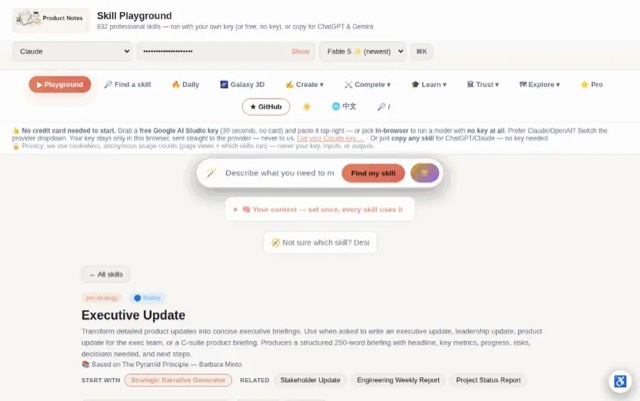
From the mohitagw15856/pm-claude-skills README — shows the whole collection, not only this skill. · view on GitHub
How to use it
Claude Code
- Run the line below. It pulls the whole folder into
~/.claude/skills/investor-pitch-deck. - Describe your job in plain words. Claude Code follows the skill from there.
npx degit mohitagw15856/pm-claude-skills/skills/investor-pitch-deck#main ~/.claude/skills/investor-pitch-deckFor one project only, change the path to .claude/skills/investor-pitch-deck.
Claude (web or desktop app)
- On this page open ⋯ → Download .md.
- Save it as SKILL.md in a folder, zip the folder, then Customize → Skills → + → Create skill → Upload a skill.
- Pick the file and Save. Claude shows the name and description and runs a security scan.
- Check the skill is switched on.
- Start a new chat and describe your job in plain words. The AI follows the skill from there.
ChatGPT or another app
- ChatGPT: make a Project and paste it into Instructions.
- Neither? Paste it at the top of a new chat — it works for that chat.
Not working?
- Check which app you pasted it into — the steps above name the right one.
- Some skills need the paid tier of Claude or ChatGPT.
Paste into Claude, ChatGPT or Cursor.
Source of Investor Pitch Deck Skill
Show the full text66 lines
| name | description |
|---|---|
| investor-pitch-deck | Build the narrative and slide structure for an investor pitch deck. Use when asked to create a pitch deck, investor presentation, fundraising deck, or startup pitch. Produces a slide-by-slide structure with narrative beats, key messages, and what each slide must prove to an investor. |
Investor Pitch Deck Skill
Builds the complete narrative and slide structure for an investor pitch deck — focused on what investors need to see, not what founders want to show.
Required Inputs
- Company name and one-line description
- Stage (Pre-seed / Seed / Series A / Series B)
- Ask (how much raising and what for)
- Key metrics (revenue, growth, users, retention)
- Target investors (generalist / sector-specific / angels)
- Deck length (10 / 12 / 15 slides)
Output Structure
For each slide:
- What this slide must prove (the investor question it answers)
- Content guidance (specific, not generic)
- Common mistake to avoid
Slide 1: Cover — Proves you can say what you do in one sentence. Slide 2: Problem — Proves the problem is real, painful, and large. Lead with the human problem, not market size. Slide 3: Solution — Proves your solution is meaningfully better. Focus on outcome, not features. Slide 4: Product — Proves this is real and works. Show the actual product. Slide 5: Traction — Proves people want this. Show retention and revenue, not signups. Slide 6: Market — Proves the market is large enough. Use bottoms-up TAM where possible. Slide 7: Business Model — Proves you understand unit economics. Include CAC and LTV. Slide 8: Go-To-Market — Proves you can acquire customers efficiently. Focus on what is actually working. Slide 9: Competition — Proves you understand the landscape. Never say "no competitors." Slide 10: Team — Proves this team can execute this opportunity. One sentence per person, specific. Slide 11: Financials — Proves you understand your business. Show assumptions, not just projections. Slide 12: The Ask — Proves you know exactly what you need. Specific use of funds and 18-month milestones.
Narrative Principles
- Every slide answers one investor question
- Investors decide go/no-go on slides 1-5 — front-load evidence
- Keep to 10-12 slides for a first meeting
Quality Checks
- Each slide answers one specific investor question
- Slides 1-5 front-load the strongest evidence
- Traction slide shows retention and revenue, not just signups
- Competition slide does not say "no competitors"
- Ask slide specifies use of funds and 18-month milestones
- TAM is bottoms-up where possible
Anti-Patterns
- Do not include a "no real competitors" slide — every company has competition and investors will discount founders who claim otherwise
- Do not use a top-down TAM calculation without a bottoms-up validation — investors distrust pure top-down market sizing
- Do not leave the ask vague — specify the amount, use of funds, and 18-month milestones the funding enables
- Do not let traction slides show vanity metrics — focus on revenue, retention, and growth rate over downloads and signups
- Do not bury the problem slide — investors must understand and feel the pain before they care about the solution
Example Trigger Phrases
- "Build a pitch deck structure for [company]"
- "Help me structure my Series A deck"
- "What slides should my investor pitch have?"
| 1 | |
| 2 | name investor-pitch-deck |
| 3 | description "Build the narrative and slide structure for an investor pitch deck. Use when asked to create a pitch deck, investor presentation, fundraising deck, or startup pitch. Produces a slide-by-slide structure with narrative beats, key messages, and what each slide must prove to an investor." |
| 4 | |
| 5 | |
| 6 | # Investor Pitch Deck Skill |
| 7 | |
| 8 | Builds the complete narrative and slide structure for an investor pitch deck — focused on what investors need to see, not what founders want to show. |
| 9 | |
| 10 | ## Required Inputs |
| 11 | **Company name and one-line description** |
| 12 | **Stage** (Pre-seed / Seed / Series A / Series B) |
| 13 | **Ask** (how much raising and what for) |
| 14 | **Key metrics** (revenue, growth, users, retention) |
| 15 | **Target investors** (generalist / sector-specific / angels) |
| 16 | **Deck length** (10 / 12 / 15 slides) |
| 17 | |
| 18 | ## Output Structure |
| 19 | |
| 20 | For each slide: |
| 21 | **What this slide must prove** (the investor question it answers) |
| 22 | **Content guidance** (specific, not generic) |
| 23 | **Common mistake to avoid** |
| 24 | |
| 25 | |
| 26 | |
| 27 | **Slide 1: Cover** — Proves you can say what you do in one sentence. |
| 28 | **Slide 2: Problem** — Proves the problem is real, painful, and large. Lead with the human problem, not market size. |
| 29 | **Slide 3: Solution** — Proves your solution is meaningfully better. Focus on outcome, not features. |
| 30 | **Slide 4: Product** — Proves this is real and works. Show the actual product. |
| 31 | **Slide 5: Traction** — Proves people want this. Show retention and revenue, not signups. |
| 32 | **Slide 6: Market** — Proves the market is large enough. Use bottoms-up TAM where possible. |
| 33 | **Slide 7: Business Model** — Proves you understand unit economics. Include CAC and LTV. |
| 34 | **Slide 8: Go-To-Market** — Proves you can acquire customers efficiently. Focus on what is actually working. |
| 35 | **Slide 9: Competition** — Proves you understand the landscape. Never say "no competitors." |
| 36 | **Slide 10: Team** — Proves this team can execute this opportunity. One sentence per person, specific. |
| 37 | **Slide 11: Financials** — Proves you understand your business. Show assumptions, not just projections. |
| 38 | **Slide 12: The Ask** — Proves you know exactly what you need. Specific use of funds and 18-month milestones. |
| 39 | |
| 40 | ## Narrative Principles |
| 41 | Every slide answers one investor question |
| 42 | Investors decide go/no-go on slides 1-5 — front-load evidence |
| 43 | Keep to 10-12 slides for a first meeting |
| 44 | |
| 45 | ## Quality Checks |
| 46 | |
| 47 | [ ] Each slide answers one specific investor question |
| 48 | [ ] Slides 1-5 front-load the strongest evidence |
| 49 | [ ] Traction slide shows retention and revenue, not just signups |
| 50 | [ ] Competition slide does not say "no competitors" |
| 51 | [ ] Ask slide specifies use of funds and 18-month milestones |
| 52 | [ ] TAM is bottoms-up where possible |
| 53 | |
| 54 | ## Anti-Patterns |
| 55 | |
| 56 | [ ] Do not include a "no real competitors" slide — every company has competition and investors will discount founders who claim otherwise |
| 57 | [ ] Do not use a top-down TAM calculation without a bottoms-up validation — investors distrust pure top-down market sizing |
| 58 | [ ] Do not leave the ask vague — specify the amount, use of funds, and 18-month milestones the funding enables |
| 59 | [ ] Do not let traction slides show vanity metrics — focus on revenue, retention, and growth rate over downloads and signups |
| 60 | [ ] Do not bury the problem slide — investors must understand and feel the pain before they care about the solution |
| 61 | |
| 62 | ## Example Trigger Phrases |
| 63 | "Build a pitch deck structure for [company]" |
| 64 | "Help me structure my Series A deck" |
| 65 | "What slides should my investor pitch have?" |
| 66 |
Discussion
Browse more free Claude skills or everything in Design.