Executive Update Skill
Transform detailed product updates into concise executive briefings.
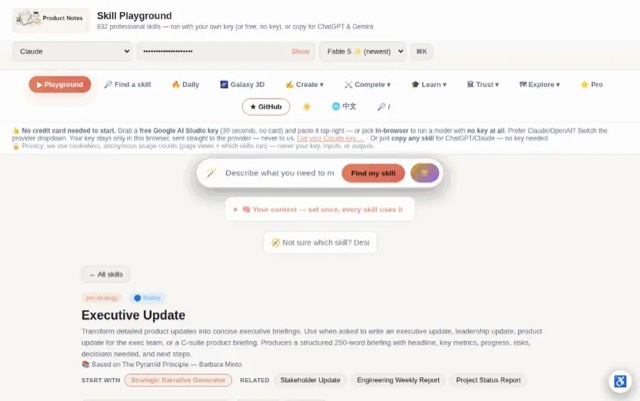


From the mohitagw15856/pm-claude-skills README — shows the whole collection, not only this skill. · view on GitHub
How to use it
Claude Code
- Run the line below. It pulls the whole folder into
~/.claude/skills/executive-update, including the files SKILL.md points to. - Describe your job in plain words. Claude Code follows the skill from there.
npx degit mohitagw15856/pm-claude-skills/skills/executive-update#main ~/.claude/skills/executive-updateFor one project only, change the path to .claude/skills/executive-update. This skill also uses context.md — copying SKILL.md alone won't be enough. See the folder on GitHub.
Claude (web or desktop app)
- On this page open ⋯ → Download .md.
- Save it as SKILL.md in a folder, zip the folder, then Customize → Skills → + → Create skill → Upload a skill.
- Pick the file and Save. Claude shows the name and description and runs a security scan.
- Check the skill is switched on.
- Start a new chat and describe your job in plain words. The AI follows the skill from there.
ChatGPT or another app
- ChatGPT: make a Project and paste it into Instructions.
- Neither? Paste it at the top of a new chat — it works for that chat.
Not working?
- Check which app you pasted it into — the steps above name the right one.
- Some skills need the paid tier of Claude or ChatGPT.
Paste into Claude, ChatGPT or Cursor.
Source of Executive Update Skill
Show the full text76 lines
| name | description |
|---|---|
| executive-update | Transform detailed product updates into concise executive briefings. Use when asked to write an executive update, leadership update, product update for the exec team, or a C-suite product briefing. Produces a structured 250-word briefing with headline, key metrics, progress, risks, decisions needed, and next steps. |
Executive Update Skill
Produce a stakeholder update that busy executives will actually read — structured around what they care about: decisions, risks, and numbers.
Reads from / Writes to the Brain
If a professional-brain (brain/) exists, ground in it instead of re-asking for what you already know:
- Read first: recent
decisions/,knowledge/(the headline numbers + their definitions), andcontext.md(voice). Runpython3 ../professional-brain/scripts/brain_query.py ./brain "<period or initiative>"and carry provenance through — flag a metric that's only[verbal]. - 📥 Propose to the Brain: the update mostly reads — but propose recording any new decision or commitment it surfaces to
decisions/, provenance-tagged. Show it, get a yes, then write with../professional-brain/scripts/brain_write.py … --commit(append-only, dry-run by default).
Required Inputs
Ask the user for these if not provided:
- Product update or notes (raw input to transform — even bullet points work)
- Audience (CEO, board, specific exec, or general leadership)
- Period (this week / sprint / month / quarter)
- Key metrics (what numbers matter to this audience)
Executive Communication Principles
- Lead with the headline, not the context
- Every update should answer: "So what does this mean for the business?"
- Flag decisions needed clearly — don't bury asks in paragraphs
- Be honest about risks — executives hate surprises more than bad news
Process
- Read the full product update provided
- Identify: key metric movements, decisions required, risks to flag, wins to celebrate
- Write in reverse pyramid style — most important first
- Limit to 250 words maximum for the main body
- Add a "Decisions Needed" section with clear options and your recommendation
- Validate — Confirm every decision needed has a specific option and recommendation (not just "TBD"), and every risk has a mitigation or watch plan
Output Structure
Product Update — [Date / Sprint / Month]
Headline: [One sentence on the most important thing]
By the Numbers:
Progress This Period: [3-4 bullet points, outcome-focused not activity-focused]
Risks & Watch Items: [2-3 bullets — be direct, include mitigation]
Decisions Needed:
- [Decision] — Options: [A] or [B] — Recommendation: [your view] — Needed by: [date]
What's Next: [2-3 bullets on next period priorities]
Quality Checks
- Whole update is under 250 words (if not, cut ruthlessly)
- Every metric includes a comparison point (vs. target or last period)
- Every risk has a mitigation or watch action
- Every decision needed has at least two options and a recommendation
- Written for a CFO or CEO — no jargon, all outcomes
Anti-Patterns
- Do not lead with context or background — executives read the headline first; bury the important thing below two sentences of setup and they will miss it
- Do not present metrics without a comparison point — a number without context (vs. target, vs. last period) cannot be interpreted and will prompt follow-up questions
- Do not soften or spin risks — executives rely on these updates to make resource and escalation decisions; sanitised risk sections destroy the update's utility
- Do not present a "Decisions Needed" item without a recommendation — asking an executive to decide without your view forces them to do the analytical work the PM should have done
- Do not exceed 250 words in the main body — length signals the author has not done the compression work; every word over 250 reduces the chance the update is read
| 1 | |
| 2 | name executive-update |
| 3 | description "Transform detailed product updates into concise executive briefings. Use when asked to write an executive update, leadership update, product update for the exec team, or a C-suite product briefing. Produces a structured 250-word briefing with headline, key metrics, progress, risks, decisions needed, and next steps." |
| 4 | |
| 5 | |
| 6 | # Executive Update Skill |
| 7 | |
| 8 | Produce a stakeholder update that busy executives will actually read — structured around what they care about: decisions, risks, and numbers. |
| 9 | |
| 10 | ## Reads from / Writes to the Brain |
| 11 | |
| 12 | If a [`professional-brain`] (`brain/`) exists, ground in it instead of re-asking for what you already know: |
| 13 | |
| 14 | **Read first:** recent `decisions/`, `knowledge/` (the headline numbers + their definitions), and `context.md` (voice). Run `python3 ../professional-brain/scripts/brain_query.py ./brain "<period or initiative>"` and carry provenance through — flag a metric that's only `[verbal]`. |
| 15 | **📥 Propose to the Brain:** the update mostly *reads* — but propose recording any **new** decision or commitment it surfaces to `decisions/`, provenance-tagged. Show it, get a yes, then write with `../professional-brain/scripts/brain_write.py … --commit` (append-only, dry-run by default). |
| 16 | |
| 17 | ## Required Inputs |
| 18 | |
| 19 | Ask the user for these if not provided: |
| 20 | **Product update or notes** (raw input to transform — even bullet points work) |
| 21 | **Audience** (CEO, board, specific exec, or general leadership) |
| 22 | **Period** (this week / sprint / month / quarter) |
| 23 | **Key metrics** (what numbers matter to this audience) |
| 24 | |
| 25 | ## Executive Communication Principles |
| 26 | Lead with the headline, not the context |
| 27 | Every update should answer: "So what does this mean for the business?" |
| 28 | Flag decisions needed clearly — don't bury asks in paragraphs |
| 29 | Be honest about risks — executives hate surprises more than bad news |
| 30 | |
| 31 | ## Process |
| 32 | Read the full product update provided |
| 33 | Identify: key metric movements, decisions required, risks to flag, wins to celebrate |
| 34 | Write in reverse pyramid style — most important first |
| 35 | Limit to 250 words maximum for the main body |
| 36 | Add a "Decisions Needed" section with clear options and your recommendation |
| 37 | **Validate** — Confirm every decision needed has a specific option and recommendation (not just "TBD"), and every risk has a mitigation or watch plan |
| 38 | |
| 39 | ## Output Structure |
| 40 | |
| 41 | ### Product Update — [Date / Sprint / Month] |
| 42 | **Headline:** [One sentence on the most important thing] |
| 43 | |
| 44 | **By the Numbers:** |
| 45 | [Metric 1]: [value] ([vs. target / last period]) |
| 46 | [Metric 2]: [value] ([vs. target / last period]) |
| 47 | [Metric 3]: [value] ([vs. target / last period]) |
| 48 | |
| 49 | **Progress This Period:** |
| 50 | [3-4 bullet points, outcome-focused not activity-focused] |
| 51 | |
| 52 | **Risks & Watch Items:** |
| 53 | [2-3 bullets — be direct, include mitigation] |
| 54 | |
| 55 | **Decisions Needed:** |
| 56 | [Decision] — Options: [A] or [B] — Recommendation: [your view] — Needed by: [date] |
| 57 | |
| 58 | **What's Next:** |
| 59 | [2-3 bullets on next period priorities] |
| 60 | |
| 61 | ## Quality Checks |
| 62 | |
| 63 | [ ] Whole update is under 250 words (if not, cut ruthlessly) |
| 64 | [ ] Every metric includes a comparison point (vs. target or last period) |
| 65 | [ ] Every risk has a mitigation or watch action |
| 66 | [ ] Every decision needed has at least two options and a recommendation |
| 67 | [ ] Written for a CFO or CEO — no jargon, all outcomes |
| 68 | |
| 69 | ## Anti-Patterns |
| 70 | |
| 71 | [ ] Do not lead with context or background — executives read the headline first; bury the important thing below two sentences of setup and they will miss it |
| 72 | [ ] Do not present metrics without a comparison point — a number without context (vs. target, vs. last period) cannot be interpreted and will prompt follow-up questions |
| 73 | [ ] Do not soften or spin risks — executives rely on these updates to make resource and escalation decisions; sanitised risk sections destroy the update's utility |
| 74 | [ ] Do not present a "Decisions Needed" item without a recommendation — asking an executive to decide without your view forces them to do the analytical work the PM should have done |
| 75 | [ ] Do not exceed 250 words in the main body — length signals the author has not done the compression work; every word over 250 reduces the chance the update is read |
| 76 |
Discussion
Browse more free Claude skills.