Strategic Narrative Generator Skill
Generate the strategic story connecting a product roadmap to company goals in a form non-technical stakeholders can repeat.
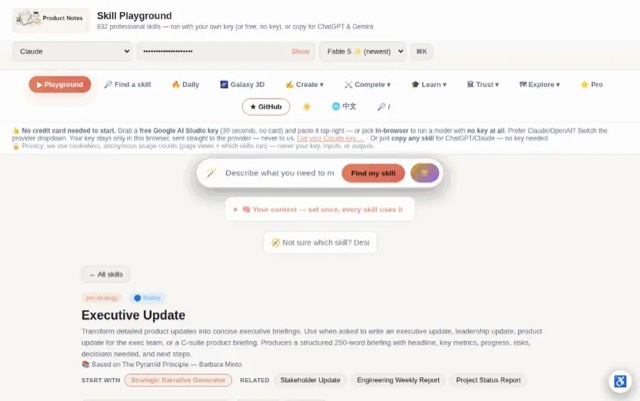

From the mohitagw15856/pm-claude-skills README — shows the whole collection, not only this skill. · view on GitHub
How to use it
Claude Code
- Run the line below. It pulls the whole folder into
~/.claude/skills/strategic-narrative-generator. - Describe your job in plain words. Claude Code follows the skill from there.
npx degit mohitagw15856/pm-claude-skills/skills/strategic-narrative-generator#main ~/.claude/skills/strategic-narrative-generatorFor one project only, change the path to .claude/skills/strategic-narrative-generator.
Claude (web or desktop app)
- On this page open ⋯ → Download .md.
- Save it as SKILL.md in a folder, zip the folder, then Customize → Skills → + → Create skill → Upload a skill.
- Pick the file and Save. Claude shows the name and description and runs a security scan.
- Check the skill is switched on.
- Start a new chat and describe your job in plain words. The AI follows the skill from there.
ChatGPT or another app
- ChatGPT: make a Project and paste it into Instructions.
- Neither? Paste it at the top of a new chat — it works for that chat.
Not working?
- Check which app you pasted it into — the steps above name the right one.
- Some skills need the paid tier of Claude or ChatGPT.
Paste into Claude, ChatGPT or Cursor.
Source of Strategic Narrative Generator Skill
Show the full text78 lines
| name | description |
|---|---|
| strategic-narrative-generator | Generate the strategic story connecting a product roadmap to company goals in a form non-technical stakeholders can repeat. Use when asked to explain the roadmap, present strategy to leadership or the board, write the why behind the roadmap, create a narrative for all-hands, or make the roadmap tell a story. Produces a themed narrative with executive summary, progression arc, hard-question preparation, and what's-not-on-the-roadmap section. |
Strategic Narrative Generator Skill
Turn a prioritised initiative list into a strategic narrative — the story that explains not just what you're building but why, why now, and why this sequence.
Required Inputs
Ask the user for these if not provided:
- Prioritised initiative list (with rough timelines)
- Current OKRs or strategic priorities (1-3)
- Audience (board, leadership team, all-hands, investors)
- Competitive or market context (optional but improves output significantly)
Process
- Identify 2-3 natural strategic themes from the initiative list
- For each theme: articulate the problem, the customer it serves, and the metric it moves
- Build the progression narrative: how does Q1 set up Q2? How does H1 set up H2?
- Write executive summary in under 100 words (the version someone can repeat)
- Anticipate the 3 hardest questions a sceptical board member would ask — draft answers
- Identify what's NOT on the roadmap and why
- Validate — Confirm every initiative maps to a theme. If an initiative is orphaned, either create a theme for it or flag it as a narrative gap.
Output Structure
Product Strategy Narrative: [Period]
The One-Paragraph Context: [Market moment + key challenge + our response — for the CFO, not the engineer]
Strategic Theme 1: [Name]
- The problem: [customer pain in plain language]
- Our response: [initiatives in this theme]
- The metric it moves: [specific and measurable]
- Why now: [timing rationale]
Strategic Theme 2: [Name] [Same structure]
The Progression Story: [How each quarter sets up the next — this is the narrative arc]
Executive Summary (under 100 words — shareable): [Version someone can quote at a board meeting]
Questions to Prepare For:
- [Hard question] → [Prepared answer]
- [Hard question] → [Prepared answer]
- [Hard question] → [Prepared answer]
What's Not on the Roadmap (and Why): [2-3 items — shows strategic discipline, not just prioritisation]
Tone
- Write for a CFO, not an engineer
- Lead with outcomes, not features
- Every sentence should answer "so what?"
- Avoid jargon — if you can't say it plainly, the strategy isn't clear enough yet
Quality Checks
- Executive summary is under 100 words and can stand alone
- Every initiative in the input maps to a strategic theme
- Each theme has a specific, measurable metric (not "improve engagement")
- Progression story shows causal links between quarters, not just chronological listing
- "Not on the roadmap" section includes at least 2 items with clear rationale
Anti-Patterns
- Do not produce a narrative that lists initiatives chronologically without showing causal progression — the story must show why each phase enables the next
- Do not use abstract strategic language that cannot be repeated by a non-technical listener — test whether someone could explain it back without the document
- Do not omit the "what's not on the roadmap" section — what you are choosing not to do is as important as what you are doing
- Do not set themes without measurable metrics — a theme without a metric cannot be tracked or held to account
- Do not skip the hard questions section — preparing for objections in advance is the purpose of the narrative exercise
| 1 | |
| 2 | name strategic-narrative-generator |
| 3 | description "Generate the strategic story connecting a product roadmap to company goals in a form non-technical stakeholders can repeat. Use when asked to explain the roadmap, present strategy to leadership or the board, write the why behind the roadmap, create a narrative for all-hands, or make the roadmap tell a story. Produces a themed narrative with executive summary, progression arc, hard-question preparation, and what's-not-on-the-roadmap section." |
| 4 | |
| 5 | |
| 6 | # Strategic Narrative Generator Skill |
| 7 | |
| 8 | Turn a prioritised initiative list into a strategic narrative — the story that explains not just what you're building but why, why now, and why this sequence. |
| 9 | |
| 10 | ## Required Inputs |
| 11 | |
| 12 | Ask the user for these if not provided: |
| 13 | **Prioritised initiative list** (with rough timelines) |
| 14 | **Current OKRs or strategic priorities** (1-3) |
| 15 | **Audience** (board, leadership team, all-hands, investors) |
| 16 | **Competitive or market context** (optional but improves output significantly) |
| 17 | |
| 18 | ## Process |
| 19 | Identify 2-3 natural strategic themes from the initiative list |
| 20 | For each theme: articulate the problem, the customer it serves, and the metric it moves |
| 21 | Build the progression narrative: how does Q1 set up Q2? How does H1 set up H2? |
| 22 | Write executive summary in under 100 words (the version someone can repeat) |
| 23 | Anticipate the 3 hardest questions a sceptical board member would ask — draft answers |
| 24 | Identify what's NOT on the roadmap and why |
| 25 | **Validate** — Confirm every initiative maps to a theme. If an initiative is orphaned, either create a theme for it or flag it as a narrative gap. |
| 26 | |
| 27 | ## Output Structure |
| 28 | |
| 29 | ### Product Strategy Narrative: [Period] |
| 30 | |
| 31 | **The One-Paragraph Context:** |
| 32 | [Market moment + key challenge + our response — for the CFO, not the engineer] |
| 33 | |
| 34 | **Strategic Theme 1: [Name]** |
| 35 | The problem: [customer pain in plain language] |
| 36 | Our response: [initiatives in this theme] |
| 37 | The metric it moves: [specific and measurable] |
| 38 | Why now: [timing rationale] |
| 39 | |
| 40 | **Strategic Theme 2: [Name]** |
| 41 | [Same structure] |
| 42 | |
| 43 | **The Progression Story:** |
| 44 | [How each quarter sets up the next — this is the narrative arc] |
| 45 | |
| 46 | **Executive Summary (under 100 words — shareable):** |
| 47 | [Version someone can quote at a board meeting] |
| 48 | |
| 49 | **Questions to Prepare For:** |
| 50 | [Hard question] → [Prepared answer] |
| 51 | [Hard question] → [Prepared answer] |
| 52 | [Hard question] → [Prepared answer] |
| 53 | |
| 54 | **What's Not on the Roadmap (and Why):** |
| 55 | [2-3 items — shows strategic discipline, not just prioritisation] |
| 56 | |
| 57 | ## Tone |
| 58 | Write for a CFO, not an engineer |
| 59 | Lead with outcomes, not features |
| 60 | Every sentence should answer "so what?" |
| 61 | Avoid jargon — if you can't say it plainly, the strategy isn't clear enough yet |
| 62 | |
| 63 | ## Quality Checks |
| 64 | |
| 65 | [ ] Executive summary is under 100 words and can stand alone |
| 66 | [ ] Every initiative in the input maps to a strategic theme |
| 67 | [ ] Each theme has a specific, measurable metric (not "improve engagement") |
| 68 | [ ] Progression story shows causal links between quarters, not just chronological listing |
| 69 | [ ] "Not on the roadmap" section includes at least 2 items with clear rationale |
| 70 | |
| 71 | ## Anti-Patterns |
| 72 | |
| 73 | [ ] Do not produce a narrative that lists initiatives chronologically without showing causal progression — the story must show why each phase enables the next |
| 74 | [ ] Do not use abstract strategic language that cannot be repeated by a non-technical listener — test whether someone could explain it back without the document |
| 75 | [ ] Do not omit the "what's not on the roadmap" section — what you are choosing not to do is as important as what you are doing |
| 76 | [ ] Do not set themes without measurable metrics — a theme without a metric cannot be tracked or held to account |
| 77 | [ ] Do not skip the hard questions section — preparing for objections in advance is the purpose of the narrative exercise |
| 78 |
Discussion
Browse more free Claude skills or everything in Product.