Saying No Skill
Decline a request, push back on scope, or protect priorities without burning the relationship.
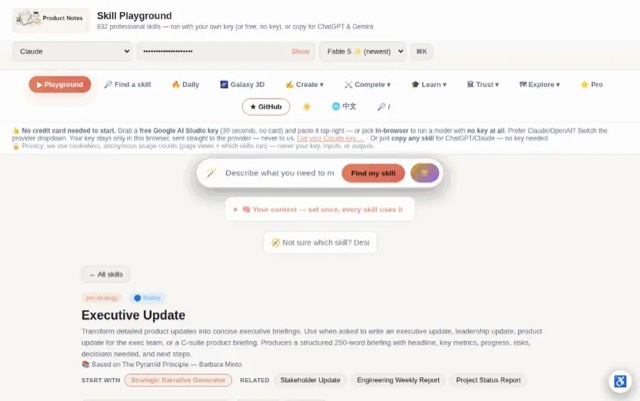

From the mohitagw15856/pm-claude-skills README — shows the whole collection, not only this skill. · view on GitHub
How to use it
Claude Code
- Run the line below. It pulls the whole folder into
~/.claude/skills/saying-no. - Describe your job in plain words. Claude Code follows the skill from there.
npx degit mohitagw15856/pm-claude-skills/skills/saying-no#main ~/.claude/skills/saying-noFor one project only, change the path to .claude/skills/saying-no.
Claude (web or desktop app)
- On this page open ⋯ → Download .md.
- Save it as SKILL.md in a folder, zip the folder, then Customize → Skills → + → Create skill → Upload a skill.
- Pick the file and Save. Claude shows the name and description and runs a security scan.
- Check the skill is switched on.
- Start a new chat and describe your job in plain words. The AI follows the skill from there.
ChatGPT or another app
- ChatGPT: make a Project and paste it into Instructions.
- Neither? Paste it at the top of a new chat — it works for that chat.
Not working?
- Check which app you pasted it into — the steps above name the right one.
- Some skills need the paid tier of Claude or ChatGPT.
Paste into Claude, ChatGPT or Cursor.
Source of Saying No Skill
Show the full text62 lines
| name | description | deprecated | supersededBy |
|---|---|---|---|
| saying-no | Decline a request, push back on scope, or protect priorities without burning the relationship. Use when asked how to say no, turn down a request, push back on your boss/stakeholder, decline extra work, or protect the roadmap from a pet feature. Produces a graceful, firm response — the no, the honest why, an alternative or trade-off, and the exact wording, tuned to who's asking. | 2026-08-25 | saying-no-kindly |
Saying No Skill
Most people say yes to things they should decline because they don't know how to say no without seeming difficult — and then over-commit, miss what matters, or resent it. A good no is clear, respectful, and offers a path: it declines the request while honouring the relationship and, often, reframes it as a trade-off rather than a flat refusal. This skill writes that no.
Required Inputs
Ask for these only if they aren't already provided:
- The request — what's being asked, by whom (boss, peer, customer, exec), and the relationship/power dynamic.
- Why you want to decline — capacity, priorities, fit, or it's the wrong call (the honest reason shapes the no).
- Constraints — can you offer an alternative, a later yes, or a trade-off? Is a flat no required?
- Stakes — how important the relationship and the request are.
Output Format
Saying No: [the request] from [who]
1. The frame — is this a flat no, a "not now," a "yes if [trade-off]," or a "no, but here's another way"? Pick the honest one. Most good nos are trade-offs, not refusals.
2. The response — the actual wording, structured:
- Acknowledge — show you understand the request and why it matters to them.
- The no — clear and unambiguous (no false maybes that breed false hope).
- The why — honest and brief; tie it to priorities or capacity, not excuses ("to do this well I'd have to drop X — is that the trade you want?").
- The path — an alternative, a later date, a smaller version, or who else could help.
3. For "no" to a boss / stakeholder — frame it as protecting their goal: surface the trade-off and let them choose ("I can take this on, but the launch slips a week — your call"). This makes the cost visible without insubordination.
4. Hold the line — a prepared response if they push back, so you don't cave into a reluctant yes.
Tone note — warm and firm; brief beats over-justified (a pile of reasons invites negotiation of each).
Quality Checks
- The no is unambiguous — no false "maybe" that creates false hope
- It acknowledges the request and the person before declining
- The reason is honest and tied to priorities/trade-offs, not excuses
- It offers a path (alternative, later, smaller, someone else) where possible
- For upward nos, it frames the trade-off and leaves the decision with them
- There's a prepared line to hold the boundary if pushed
Anti-Patterns
- Do not give a false maybe — "let me see" to avoid the moment creates a worse letdown later
- Do not over-justify — a long list of reasons sounds defensive and invites picking each apart
- Do not say a flat "no" to a boss when a trade-off works better — make the cost visible, let them choose
- Do not apologise excessively — "I can't take this on" is fine; grovelling undermines the boundary
- Do not cave on first pushback — decide the line beforehand and have a response ready
Based On
Boundary-setting and negotiation practice — the "positive no" (William Ury), trade-off framing, and protecting priorities.
| 1 | |
| 2 | name saying-no |
| 3 | description "Decline a request, push back on scope, or protect priorities without burning the relationship. Use when asked how to say no, turn down a request, push back on your boss/stakeholder, decline extra work, or protect the roadmap from a pet feature. Produces a graceful, firm response — the no, the honest why, an alternative or trade-off, and the exact wording, tuned to who's asking." |
| 4 | deprecated 2026-08-25 |
| 5 | supersededBy saying-no-kindly |
| 6 | |
| 7 | |
| 8 | # Saying No Skill |
| 9 | |
| 10 | Most people say yes to things they should decline because they don't know how to say no without seeming |
| 11 | difficult — and then over-commit, miss what matters, or resent it. A good no is clear, respectful, and |
| 12 | offers a path: it declines the request while honouring the relationship and, often, reframes it as a |
| 13 | trade-off rather than a flat refusal. This skill writes that no. |
| 14 | |
| 15 | ## Required Inputs |
| 16 | |
| 17 | Ask for these only if they aren't already provided: |
| 18 | |
| 19 | **The request** — what's being asked, by whom (boss, peer, customer, exec), and the relationship/power dynamic. |
| 20 | **Why you want to decline** — capacity, priorities, fit, or it's the wrong call (the honest reason shapes the no). |
| 21 | **Constraints** — can you offer an alternative, a later yes, or a trade-off? Is a flat no required? |
| 22 | **Stakes** — how important the relationship and the request are. |
| 23 | |
| 24 | ## Output Format |
| 25 | |
| 26 | ### Saying No: [the request] from [who] |
| 27 | |
| 28 | **1. The frame** — is this a flat no, a "not now," a "yes if [trade-off]," or a "no, but here's another way"? Pick the honest one. Most good nos are trade-offs, not refusals. |
| 29 | |
| 30 | **2. The response** — the actual wording, structured: |
| 31 | **Acknowledge** — show you understand the request and why it matters to them. |
| 32 | **The no** — clear and unambiguous (no false maybes that breed false hope). |
| 33 | **The why** — honest and brief; tie it to priorities or capacity, not excuses ("to do this well I'd have to drop X — is that the trade you want?"). |
| 34 | **The path** — an alternative, a later date, a smaller version, or who else could help. |
| 35 | |
| 36 | **3. For "no" to a boss / stakeholder** — frame it as protecting *their* goal: surface the trade-off and let them choose ("I can take this on, but the launch slips a week — your call"). This makes the cost visible without insubordination. |
| 37 | |
| 38 | **4. Hold the line** — a prepared response if they push back, so you don't cave into a reluctant yes. |
| 39 | |
| 40 | **Tone note** — warm and firm; brief beats over-justified (a pile of reasons invites negotiation of each). |
| 41 | |
| 42 | ## Quality Checks |
| 43 | |
| 44 | [ ] The no is unambiguous — no false "maybe" that creates false hope |
| 45 | [ ] It acknowledges the request and the person before declining |
| 46 | [ ] The reason is honest and tied to priorities/trade-offs, not excuses |
| 47 | [ ] It offers a path (alternative, later, smaller, someone else) where possible |
| 48 | [ ] For upward nos, it frames the trade-off and leaves the decision with them |
| 49 | [ ] There's a prepared line to hold the boundary if pushed |
| 50 | |
| 51 | ## Anti-Patterns |
| 52 | |
| 53 | [ ] Do not give a false maybe — "let me see" to avoid the moment creates a worse letdown later |
| 54 | [ ] Do not over-justify — a long list of reasons sounds defensive and invites picking each apart |
| 55 | [ ] Do not say a flat "no" to a boss when a trade-off works better — make the cost visible, let them choose |
| 56 | [ ] Do not apologise excessively — "I can't take this on" is fine; grovelling undermines the boundary |
| 57 | [ ] Do not cave on first pushback — decide the line beforehand and have a response ready |
| 58 | |
| 59 | ## Based On |
| 60 | |
| 61 | Boundary-setting and negotiation practice — the "positive no" (William Ury), trade-off framing, and protecting priorities. |
| 62 |
Discussion
Browse more free Claude skills or everything in Product.