Saying No Kindly Skill
Decline requests without damaging relationships or your standing — the fast-clear-warm formula, the alternative-attached no, the no-to-the-boss version (tradeoffs, not refusal), and scripts for the asks that recur.
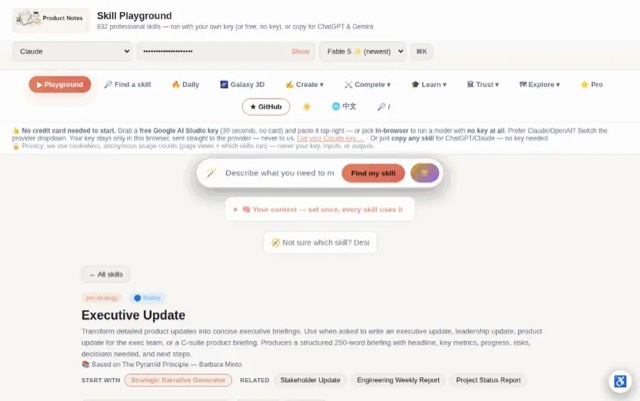

From the mohitagw15856/pm-claude-skills README — shows the whole collection, not only this skill. · view on GitHub
How to use it
Claude Code
- Run the line below. It pulls the whole folder into
~/.claude/skills/saying-no-kindly. - Describe your job in plain words. Claude Code follows the skill from there.
npx degit mohitagw15856/pm-claude-skills/skills/saying-no-kindly#main ~/.claude/skills/saying-no-kindlyFor one project only, change the path to .claude/skills/saying-no-kindly.
Claude (web or desktop app)
- On this page open ⋯ → Download .md.
- Save it as SKILL.md in a folder, zip the folder, then Customize → Skills → + → Create skill → Upload a skill.
- Pick the file and Save. Claude shows the name and description and runs a security scan.
- Check the skill is switched on.
- Start a new chat and describe your job in plain words. The AI follows the skill from there.
ChatGPT or another app
- ChatGPT: make a Project and paste it into Instructions.
- Neither? Paste it at the top of a new chat — it works for that chat.
Not working?
- Check which app you pasted it into — the steps above name the right one.
- Some skills need the paid tier of Claude or ChatGPT.
Paste into Claude, ChatGPT or Cursor.
Source of Saying No Kindly Skill
Show the full text64 lines
| name | description |
|---|---|
| saying-no-kindly | Decline requests without damaging relationships or your standing — the fast-clear-warm formula, the alternative-attached no, the no-to-the-boss version (tradeoffs, not refusal), and scripts for the asks that recur. Use when asked how do I say no to this, turn down a request, decline extra work politely, I say yes to everything and drown, push back on my manager, or protect the roadmap from a pet feature. Produces the decline scripts by relationship, the tradeoff framing, and the exact wording tuned to who is asking. |
Saying No Kindly Skill
Chronic yes is a scheduling decision made by fear — each yes reasonable, the sum unworkable, and the real casualties are the commitments already made (every new yes quietly taxes them). The working no is fast (a slow no wastes the asker's planning time and reads worse than the decline itself), clear (soft-nos — "maybe later," "let me think" — are heard as yes-pending and return with interest), and warm (the relationship is preserved by tone and alternatives, not by capitulation). Upward, the form changes entirely: nos to the boss are tradeoff conversations — "yes is available; here's what it displaces; you pick."
What This Skill Produces
- The scripts — the decline by relationship (peer, report, boss, external), each fast-clear-warm
- The alternative menu — the smaller yes, the later yes, the redirect, the resource — attached where honest
- The upward version — the tradeoff frame that converts refusal into prioritization the boss owns
- The yes-audit — the current commitments reviewed for the over-capacity that made no necessary (task-triage-matrix supplies the evidence)
Required Inputs
Ask for these if not provided:
- The ask and the asker — what's requested, by whom, with what relationship and power direction; the script's form follows
- The real reason — capacity? Wrong person? Wrong project? The no's honesty level calibrates (capacity-nos can say so; judgment-nos need more care)
- What's honestly offerable — the smaller/later/redirect alternatives that exist; alternatives invented to soften become new commitments, which is the disease again
- The pattern, if any — recurring asks from the same source get the structural answer (the norm conversation), not the fifteenth artisanal decline
Framework: The Decline Rules
- Fast beats polished: the no within a day — "I can't take this on" today outperforms the perfect decline on Thursday, because the asker's alternative plans age by the hour. Sitting on asks to avoid the discomfort transfers the cost to them, with interest.
- Clear kills the zombie: "I'm not able to do this" — complete sentence, no "right now" unless later is a real offer, no "maybe" as anesthesia. Soft-nos return; every returned ask costs the decline and the resentment of having to repeat it.
- Warm is tone plus (honest) alternatives: "I can't own this — but [name] has the context, or I could do the 30-minute review version" — the alternative converts a door closing into a door pointing. The discipline: only alternatives that are true (a fake redirect burns the third party; an unaffordable smaller-yes is the original problem in a smaller size).
- Upward nos are tradeoff menus: never "no," always "here's the board: taking X means Y slips to [date] or Z drops — which trade do you want?" — the boss keeps the priority call (their job), the capacity truth lands (your job), and the meeting-prep-pack-grade specificity ("X costs the two Thursday blocks that ship the launch") is what separates this from whining. Most bosses pick sanely when shown the board; the ones who say "all of it" have now chosen the overload — on the record, revisitable.
- The audit ends the era: the standing commitments get the same treatment as new asks — which current yeses would be nos today? (recurring-meeting-pruner for meetings; the drop-list ceremony for tasks) — because saying no at the door of a full house is maintenance, and the audit is the renovation.
Output Format
The No: [ask] from [asker/relationship]
The Script
[The decline, verbatim: fast-clear-warm · the alternative if honest · the full-stop where none is]
If Upward: The Tradeoff Board
["Yes to X displaces: [specific costs with dates] — which trade?" · the on-the-record note if overridden]
The Pattern Answer (if recurring)
[The structural fix: the norm, the routing, the office-hours lane — instead of decline #15]
The Yes-Audit
[Current commitments that would be nos today → their exit moves]
Quality Checks
- The no ships within a day of the ask
- No soft-no language survives unless later is a real offer
- Every attached alternative is honestly affordable or honestly routed
- Upward nos present specific tradeoffs, never bare refusal
- Recurring asks got the structural answer
Anti-Patterns
- Do not slow-no — the delay is a cost you're charging the asker to spare yourself
- Do not soften into zombie-maybes — they return, with interest and a grudge
- Do not invent alternatives as anesthetic — fake redirects and unaffordable smaller-yeses are new debts
- Do not say bare no upward — the tradeoff board is both more honest and more survivable
- Do not decline the new while hoarding the old — the audit is where capacity actually returns
| 1 | |
| 2 | name saying-no-kindly |
| 3 | description "Decline requests without damaging relationships or your standing — the fast-clear-warm formula, the alternative-attached no, the no-to-the-boss version (tradeoffs, not refusal), and scripts for the asks that recur. Use when asked how do I say no to this, turn down a request, decline extra work politely, I say yes to everything and drown, push back on my manager, or protect the roadmap from a pet feature. Produces the decline scripts by relationship, the tradeoff framing, and the exact wording tuned to who is asking." |
| 4 | |
| 5 | |
| 6 | # Saying No Kindly Skill |
| 7 | |
| 8 | Chronic yes is a scheduling decision made by fear — each yes reasonable, the sum unworkable, and the real casualties are the commitments already made (every new yes quietly taxes them). The working no is *fast* (a slow no wastes the asker's planning time and reads worse than the decline itself), *clear* (soft-nos — "maybe later," "let me think" — are heard as yes-pending and return with interest), and *warm* (the relationship is preserved by tone and alternatives, not by capitulation). Upward, the form changes entirely: nos to the boss are *tradeoff conversations* — "yes is available; here's what it displaces; you pick." |
| 9 | |
| 10 | ## What This Skill Produces |
| 11 | |
| 12 | **The scripts** — the decline by relationship (peer, report, boss, external), each fast-clear-warm |
| 13 | **The alternative menu** — the smaller yes, the later yes, the redirect, the resource — attached where honest |
| 14 | **The upward version** — the tradeoff frame that converts refusal into prioritization the boss owns |
| 15 | **The yes-audit** — the current commitments reviewed for the over-capacity that made no necessary ([task-triage-matrix] supplies the evidence) |
| 16 | |
| 17 | ## Required Inputs |
| 18 | |
| 19 | Ask for these if not provided: |
| 20 | **The ask and the asker** — what's requested, by whom, with what relationship and power direction; the script's form follows |
| 21 | **The real reason** — capacity? Wrong person? Wrong project? The no's honesty level calibrates (capacity-nos can say so; judgment-nos need more care) |
| 22 | **What's honestly offerable** — the smaller/later/redirect alternatives that exist; alternatives invented to soften become new commitments, which is the disease again |
| 23 | **The pattern, if any** — recurring asks from the same source get the structural answer (the norm conversation), not the fifteenth artisanal decline |
| 24 | |
| 25 | ## Framework: The Decline Rules |
| 26 | |
| 27 | **Fast beats polished:** the no within a day — "I can't take this on" today outperforms the perfect decline on Thursday, because the asker's alternative plans age by the hour. Sitting on asks to avoid the discomfort transfers the cost to them, with interest. |
| 28 | **Clear kills the zombie:** "I'm not able to do this" — complete sentence, no "right now" unless *later* is a real offer, no "maybe" as anesthesia. Soft-nos return; every returned ask costs the decline *and* the resentment of having to repeat it. |
| 29 | **Warm is tone plus (honest) alternatives:** "I can't own this — but [name] has the context, or I could do the 30-minute review version" — the alternative converts a door closing into a door pointing. The discipline: only alternatives that are *true* (a fake redirect burns the third party; an unaffordable smaller-yes is the original problem in a smaller size). |
| 30 | **Upward nos are tradeoff menus:** never "no," always "here's the board: taking X means Y slips to [date] or Z drops — which trade do you want?" — the boss keeps the priority call (their job), the capacity truth lands (your job), and the [meeting-prep-pack]-grade specificity ("X costs the two Thursday blocks that ship the launch") is what separates this from whining. Most bosses pick sanely when shown the board; the ones who say "all of it" have now *chosen* the overload — on the record, revisitable. |
| 31 | **The audit ends the era:** the standing commitments get the same treatment as new asks — which current yeses would be nos today? ([recurring-meeting-pruner] for meetings; the drop-list ceremony for tasks) — because saying no at the door of a full house is maintenance, and the audit is the renovation. |
| 32 | |
| 33 | ## Output Format |
| 34 | |
| 35 | # The No: [ask] from [asker/relationship] |
| 36 | |
| 37 | ## The Script |
| 38 | [The decline, verbatim: fast-clear-warm · the alternative if honest · the full-stop where none is] |
| 39 | |
| 40 | ## If Upward: The Tradeoff Board |
| 41 | ["Yes to X displaces: [specific costs with dates] — which trade?" · the on-the-record note if overridden] |
| 42 | |
| 43 | ## The Pattern Answer (if recurring) |
| 44 | [The structural fix: the norm, the routing, the [office-hours] lane — instead of decline #15] |
| 45 | |
| 46 | ## The Yes-Audit |
| 47 | [Current commitments that would be nos today → their exit moves] |
| 48 | |
| 49 | ## Quality Checks |
| 50 | |
| 51 | [ ] The no ships within a day of the ask |
| 52 | [ ] No soft-no language survives unless later is a real offer |
| 53 | [ ] Every attached alternative is honestly affordable or honestly routed |
| 54 | [ ] Upward nos present specific tradeoffs, never bare refusal |
| 55 | [ ] Recurring asks got the structural answer |
| 56 | |
| 57 | ## Anti-Patterns |
| 58 | |
| 59 | [ ] Do not slow-no — the delay is a cost you're charging the asker to spare yourself |
| 60 | [ ] Do not soften into zombie-maybes — they return, with interest and a grudge |
| 61 | [ ] Do not invent alternatives as anesthetic — fake redirects and unaffordable smaller-yeses are new debts |
| 62 | [ ] Do not say bare no upward — the tradeoff board is both more honest and more survivable |
| 63 | [ ] Do not decline the new while hoarding the old — the audit is where capacity actually returns |
| 64 |
Discussion
Browse more free Claude skills or everything in Product.