RICE Prioritisation Skill
Scores and ranks product initiatives using the RICE framework.
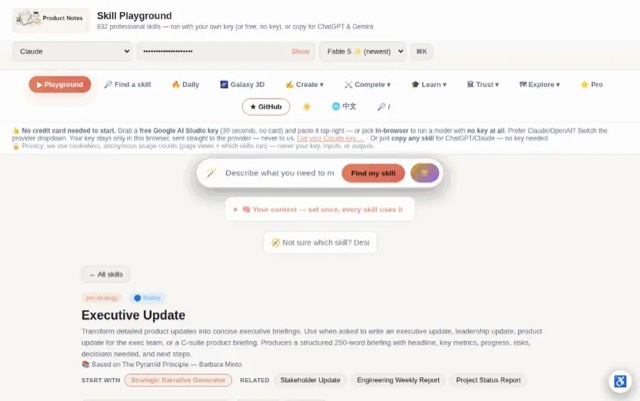


From the mohitagw15856/pm-claude-skills README — shows the whole collection, not only this skill. · view on GitHub
How to use it
Claude Code
- Run the line below. It pulls the whole folder into
~/.claude/skills/rice-prioritisation, including the files SKILL.md points to. - Describe your job in plain words. Claude Code follows the skill from there.
npx degit mohitagw15856/pm-claude-skills/skills/rice-prioritisation#main ~/.claude/skills/rice-prioritisationFor one project only, change the path to .claude/skills/rice-prioritisation. This skill also uses initiatives.json — copying SKILL.md alone won't be enough. See the folder on GitHub.
Claude (web or desktop app)
- On this page open ⋯ → Download .md.
- Save it as SKILL.md in a folder, zip the folder, then Customize → Skills → + → Create skill → Upload a skill.
- Pick the file and Save. Claude shows the name and description and runs a security scan.
- Check the skill is switched on.
- Start a new chat and describe your job in plain words. The AI follows the skill from there.
ChatGPT or another app
- ChatGPT: make a Project and paste it into Instructions.
- Neither? Paste it at the top of a new chat — it works for that chat.
Not working?
- Check which app you pasted it into — the steps above name the right one.
- Some skills need the paid tier of Claude or ChatGPT.
Paste into Claude, ChatGPT or Cursor.
Source of RICE Prioritisation Skill
Show the full text137 lines
| name | description |
|---|---|
| rice-prioritisation | Scores and ranks product initiatives using the RICE framework. Use when asked to prioritise features, rank a backlog using RICE, score initiatives for quarterly planning, or apply an objective framework to a list of competing ideas. Produces a ranked RICE table with scores, quick wins and moonshot flags, dependency notes, and a recommended sequencing order. |
RICE Prioritisation Skill
Apply consistent, criteria-based RICE scoring to a list of features or initiatives to produce an objective prioritisation ranking.
Reads from / Writes to the Brain
If a professional-brain (brain/) exists, ground in it instead of re-asking for what you already know:
- Read first:
knowledge/strategy.md(so the ranking serves the direction), the items asentities/, and impacthypotheses/. Runpython3 ../professional-brain/scripts/brain_query.py ./brain "<initiative theme>"and carry each fact's provenance tag through — an impact estimate is usually a[hunch], not[data]. - 📥 Propose to the Brain: after producing, propose recording the ranking decision to
decisions/and the reach/impact estimates ashypotheses/tagged by evidence strength. Show them, get a yes, then write with../professional-brain/scripts/brain_write.py … --commit(append-only, dry-run by default).
Required Inputs
Ask the user for these if not provided:
- List of initiatives or features to score (names and brief descriptions)
- Reach estimates (users affected per quarter — from analytics if available)
- Impact estimates (use the standard scale below)
- Effort estimates (person-months — from engineering if available)
- Quarter or planning period
RICE Definitions (adapt to your context)
- Reach: Number of users affected per quarter (use actual DAU/MAU data where available)
- Impact: Effect on your primary metric — use scale: 3=massive, 2=high, 1=medium, 0.5=low, 0.25=minimal
- Confidence: How certain are we about R and I estimates? 100%=high, 80%=medium, 50%=low
- Effort: Person-months required across all functions
RICE Formula
RICE Score = (Reach × Impact × Confidence) / Effort
Programmatic Helper
This skill ships with a stdlib-only Python script that calculates and ranks RICE scores so the maths is consistent and the quick-win / moonshot flags are applied by rule, not by feel. Feed it the initiatives once R, I, C, and E are gathered.
# From a JSON file (confidence accepts 0.8 or 80)
python3 scripts/rice_calculator.py initiatives.json

# Or from a CSV with header: name,reach,impact,confidence,effort
python3 scripts/rice_calculator.py initiatives.csv --format csv

# Or piped in
echo '[{"name":"Onboarding","reach":5000,"impact":2,"confidence":0.8,"effort":3}]' \
  | python3 scripts/rice_calculator.py -
It outputs a ranked table with computed RICE scores and auto-flags quick-win (strong score, low relative effort), moonshot (high impact, high effort), and low-confidence (≤50%) items. Use the computed ranking as the starting point, then apply the validation step below — never accept a surprising top rank without checking the estimates behind it.
Deeper Materials
references/estimate-calibration.md— how to anchor each of the four estimates (reach sources, the impact scale with reserve-it-for examples, evidence-based confidence, cross-functional effort) and the cross-checks to run on the finished ranking. Apply it when challenging the user's inputs.templates/scoring-worksheet.md— a fill-in worksheet whose evidence columns force each score to name its source. Offer it when a team wants to score together rather than have the ranking generated.
Where this sits — scoring on the spine
Third in the product-decision spine: /assumption-mapper → /prd-template →
rice-prioritisation → /roadmap-narrative. It receives the success metric from
each initiative's PRD — RICE's Impact is the estimated move on that baselined number,
not a fresh guess — and hands /roadmap-narrative the ranked initiatives with their
scores to group into themes. The four RICE terms are defined once in
docs/craft/product-decisions.md; Confidence
there is the honesty valve, and this skill lives or dies on using it.
The loop
RICE fails when estimates are invented to produce a desired ranking. The loop's job is to keep every score honest; Phase 2 is where that happens.
- Gather the four estimates per initiative. Reach (real count per period), Impact (magnitude on the PRD's success metric), Confidence (0–1), Effort (person-months). Pull Impact from the upstream PRD's metric where it exists. Done when: every initiative has all four, and each carries a provenance tag on its source.
- Interrogate confidence — the anti-gaming phase. For each estimate, confidence must reflect evidence, not enthusiasm: a bold impact with no data gets a low confidence, and the score self-corrects. Challenge weak inputs and name what data would raise them (the disclosed estimate-calibration reference is the how). Done when: no [hunch] estimate wears a high confidence, and the person who owns the estimate would defend each number out loud.
- Score, rank, and stress the top. Compute RICE, rank, flag quick wins (high score, low effort) and moonshots (high impact, high effort), note dependencies. Then the cross-check: if the top item surprises the team, an estimate is probably inflated — RICE is a tool, not a verdict. Done when: the ranking is computed and the top result has survived one honest "does this feel right, and if not, which estimate is lying?"
- Hand off. Pass the ranked table (with scores and dependencies) to
/roadmap-narrativeso it groups by theme rather than re-deriving priorities. Done when:/roadmap-narrativecould theme these without re-scoring.
Output Structure
RICE Prioritisation: [Backlog/Quarter]
| Initiative | Reach | Impact | Confidence | Effort | RICE Score | Notes |
|---|---|---|---|---|---|---|
| [name] | [n] | [score] | [%] | [months] | [score] | [flags] |
Recommended Sequence
[Top 5 initiatives with rationale]
Quick Wins (high score, low effort)
[Items to pick up alongside bigger bets]
Data Gaps to Address
[What information would most improve scoring accuracy]
Scoring Rubric (0–40)
Score any output of this skill before handing it over; 32+ is ship-quality.
| Dimension | 0 | 5 | 10 |
|---|---|---|---|
| Estimate credibility | Round-number guesses at 100% confidence; effort estimated by PM alone | Reach grounded in analytics but confidence uniform across items regardless of evidence | Each estimate names its source; anything without data sits at 50% confidence; effort comes from engineering, and the doc says so |
| Impact discrimination | Everything scored 2–3 — the scale produces no signal | Some spread across the scale but anchors undefined, so scores aren't comparable | Full scale used with a stated anchor for each level; "massive" reserved for genuinely rare items |
| Ranking interrogation | Raw sorted output accepted as the verdict | Quick wins and moonshots flagged, but surprising ranks and dependencies unexamined | Surprising top ranks investigated with the inflated estimate found or defended; dependencies noted where they change sequencing |
| Actionable sequencing | A scored table with no recommendation | Table plus a top-5 list, but no rationale or data-gap follow-ups | Recommended sequence with per-item rationale, quick wins slotted alongside bigger bets, and named data gaps that would sharpen the next pass |
Quality Checks
- Every initiative has all four RICE components estimated (even roughly)
- Confidence is 50% for anything without data backing (not 100% as a default)
- Quick wins and moonshots are explicitly called out
- Dependencies that affect sequencing are noted
- Any surprising ranking is investigated before accepting it
Anti-Patterns
- Do not default to 100% confidence on estimates that lack supporting data — this inflates scores and misleads planning
- Do not treat RICE scores as a final decision — a ranking that surprises the team must be investigated before it is accepted
- Do not omit effort estimates from engineering — PM-only effort estimates are frequently optimistic and skew results
- Do not forget to note dependencies that would change the sequencing even if RICE scores suggest otherwise
- Do not score every initiative at the same impact level — if everything is "high impact," the framework produces no useful signal
| 1 | |
| 2 | name rice-prioritisation |
| 3 | description "Scores and ranks product initiatives using the RICE framework. Use when asked to prioritise features, rank a backlog using RICE, score initiatives for quarterly planning, or apply an objective framework to a list of competing ideas. Produces a ranked RICE table with scores, quick wins and moonshot flags, dependency notes, and a recommended sequencing order." |
| 4 | |
| 5 | |
| 6 | # RICE Prioritisation Skill |
| 7 | |
| 8 | Apply consistent, criteria-based RICE scoring to a list of features or initiatives to produce an objective prioritisation ranking. |
| 9 | |
| 10 | ## Reads from / Writes to the Brain |
| 11 | |
| 12 | If a [`professional-brain`] (`brain/`) exists, ground in it instead of re-asking for what you already know: |
| 13 | |
| 14 | **Read first:** `knowledge/strategy.md` (so the ranking serves the direction), the items as `entities/`, and impact `hypotheses/`. Run `python3 ../professional-brain/scripts/brain_query.py ./brain "<initiative theme>"` and carry each fact's provenance tag through — an impact estimate is usually a `[hunch]`, not `[data]`. |
| 15 | **📥 Propose to the Brain:** after producing, propose recording the ranking decision to `decisions/` and the reach/impact estimates as `hypotheses/` tagged by evidence strength. Show them, get a yes, then write with `../professional-brain/scripts/brain_write.py … --commit` (append-only, dry-run by default). |
| 16 | |
| 17 | ## Required Inputs |
| 18 | |
| 19 | Ask the user for these if not provided: |
| 20 | **List of initiatives or features to score** (names and brief descriptions) |
| 21 | **Reach estimates** (users affected per quarter — from analytics if available) |
| 22 | **Impact estimates** (use the standard scale below) |
| 23 | **Effort estimates** (person-months — from engineering if available) |
| 24 | **Quarter or planning period** |
| 25 | |
| 26 | ## RICE Definitions (adapt to your context) |
| 27 | **Reach:** Number of users affected per quarter (use actual DAU/MAU data where available) |
| 28 | **Impact:** Effect on your primary metric — use scale: 3=massive, 2=high, 1=medium, 0.5=low, 0.25=minimal |
| 29 | **Confidence:** How certain are we about R and I estimates? 100%=high, 80%=medium, 50%=low |
| 30 | **Effort:** Person-months required across all functions |
| 31 | |
| 32 | ## RICE Formula |
| 33 | RICE Score = (Reach × Impact × Confidence) / Effort |
| 34 | |
| 35 | ## Programmatic Helper |
| 36 | |
| 37 | This skill ships with a stdlib-only Python script that calculates and ranks RICE scores so the maths is consistent and the quick-win / moonshot flags are applied by rule, not by feel. Feed it the initiatives once R, I, C, and E are gathered. |
| 38 | |
| 39 | |
| 40 | # From a JSON file (confidence accepts 0.8 or 80) |
| 41 | python3 scripts/rice_calculator.py initiatives.json |
| 42 | |
| 43 | # Or from a CSV with header: name,reach,impact,confidence,effort |
| 44 | python3 scripts/rice_calculator.py initiatives.csv --format csv |
| 45 | |
| 46 | # Or piped in |
| 47 | echo '[{"name":"Onboarding","reach":5000,"impact":2,"confidence":0.8,"effort":3}]' \ |
| 48 | | python3 scripts/rice_calculator.py - |
| 49 | |
| 50 | |
| 51 | It outputs a ranked table with computed RICE scores and auto-flags **quick-win** (strong score, low relative effort), **moonshot** (high impact, high effort), and **low-confidence** (≤50%) items. Use the computed ranking as the starting point, then apply the validation step below — never accept a surprising top rank without checking the estimates behind it. |
| 52 | |
| 53 | ## Deeper Materials |
| 54 | |
| 55 | **`references/estimate-calibration.md`** — how to anchor each of the four estimates (reach sources, the impact scale with reserve-it-for examples, evidence-based confidence, cross-functional effort) and the cross-checks to run on the finished ranking. Apply it when challenging the user's inputs. |
| 56 | **`templates/scoring-worksheet.md`** — a fill-in worksheet whose evidence columns force each score to name its source. Offer it when a team wants to score together rather than have the ranking generated. |
| 57 | |
| 58 | ## Where this sits — scoring on the spine |
| 59 | |
| 60 | Third in the product-decision spine: **`/assumption-mapper` → `/prd-template` → |
| 61 | `rice-prioritisation` → `/roadmap-narrative`**. It receives **the success metric** from |
| 62 | each initiative's PRD — RICE's *Impact* is the estimated move on *that* baselined number, |
| 63 | not a fresh guess — and hands `/roadmap-narrative` **the ranked initiatives with their |
| 64 | scores** to group into themes. The four RICE terms are defined once in |
| 65 | [`docs/craft/product-decisions.md`]; *Confidence* |
| 66 | there is the honesty valve, and this skill lives or dies on using it. |
| 67 | |
| 68 | ## The loop |
| 69 | |
| 70 | RICE fails when estimates are invented to produce a desired ranking. The loop's job is |
| 71 | to keep every score honest; Phase 2 is where that happens. |
| 72 | |
| 73 | **Gather the four estimates per initiative.** Reach (real count per period), Impact |
| 74 | (magnitude on the PRD's success metric), Confidence (0–1), Effort (person-months). |
| 75 | Pull Impact from the upstream PRD's metric where it exists. |
| 76 | **Done when:** every initiative has all four, and each carries a provenance tag on |
| 77 | its source. |
| 78 | **Interrogate confidence — the anti-gaming phase.** For each estimate, confidence |
| 79 | must reflect *evidence*, not enthusiasm: a bold impact with no data gets a low |
| 80 | confidence, and the score self-corrects. Challenge weak inputs and name what data |
| 81 | would raise them (the disclosed [estimate-calibration] |
| 82 | reference is the how). |
| 83 | **Done when:** no [hunch] estimate wears a high confidence, and the person who owns |
| 84 | the estimate would defend each number out loud. |
| 85 | **Score, rank, and stress the top.** Compute RICE, rank, flag *quick wins* (high |
| 86 | score, low effort) and *moonshots* (high impact, high effort), note dependencies. |
| 87 | Then the cross-check: if the top item surprises the team, an estimate is probably |
| 88 | inflated — RICE is a tool, not a verdict. |
| 89 | **Done when:** the ranking is computed and the top result has survived one honest |
| 90 | "does this feel right, and if not, which estimate is lying?" |
| 91 | **Hand off.** Pass the ranked table (with scores and dependencies) to |
| 92 | `/roadmap-narrative` so it groups by theme rather than re-deriving priorities. |
| 93 | **Done when:** `/roadmap-narrative` could theme these without re-scoring. |
| 94 | |
| 95 | ## Output Structure |
| 96 | |
| 97 | ### RICE Prioritisation: [Backlog/Quarter] |
| 98 | | Initiative | Reach | Impact | Confidence | Effort | RICE Score | Notes | |
| 99 | |------------|-------|--------|------------|--------|------------|-------| |
| 100 | | [name] | [n] | [score] | [%] | [months] | [score] | [flags] | |
| 101 | |
| 102 | #### Recommended Sequence |
| 103 | [Top 5 initiatives with rationale] |
| 104 | |
| 105 | #### Quick Wins (high score, low effort) |
| 106 | [Items to pick up alongside bigger bets] |
| 107 | |
| 108 | #### Data Gaps to Address |
| 109 | [What information would most improve scoring accuracy] |
| 110 | |
| 111 | ## Scoring Rubric (0–40) |
| 112 | |
| 113 | Score any output of this skill before handing it over; 32+ is ship-quality. |
| 114 | |
| 115 | | Dimension | 0 | 5 | 10 | |
| 116 | |---|---|---|---| |
| 117 | | Estimate credibility | Round-number guesses at 100% confidence; effort estimated by PM alone | Reach grounded in analytics but confidence uniform across items regardless of evidence | Each estimate names its source; anything without data sits at 50% confidence; effort comes from engineering, and the doc says so | |
| 118 | | Impact discrimination | Everything scored 2–3 — the scale produces no signal | Some spread across the scale but anchors undefined, so scores aren't comparable | Full scale used with a stated anchor for each level; "massive" reserved for genuinely rare items | |
| 119 | | Ranking interrogation | Raw sorted output accepted as the verdict | Quick wins and moonshots flagged, but surprising ranks and dependencies unexamined | Surprising top ranks investigated with the inflated estimate found or defended; dependencies noted where they change sequencing | |
| 120 | | Actionable sequencing | A scored table with no recommendation | Table plus a top-5 list, but no rationale or data-gap follow-ups | Recommended sequence with per-item rationale, quick wins slotted alongside bigger bets, and named data gaps that would sharpen the next pass | |
| 121 | |
| 122 | ## Quality Checks |
| 123 | |
| 124 | [ ] Every initiative has all four RICE components estimated (even roughly) |
| 125 | [ ] Confidence is 50% for anything without data backing (not 100% as a default) |
| 126 | [ ] Quick wins and moonshots are explicitly called out |
| 127 | [ ] Dependencies that affect sequencing are noted |
| 128 | [ ] Any surprising ranking is investigated before accepting it |
| 129 | |
| 130 | ## Anti-Patterns |
| 131 | |
| 132 | [ ] Do not default to 100% confidence on estimates that lack supporting data — this inflates scores and misleads planning |
| 133 | [ ] Do not treat RICE scores as a final decision — a ranking that surprises the team must be investigated before it is accepted |
| 134 | [ ] Do not omit effort estimates from engineering — PM-only effort estimates are frequently optimistic and skew results |
| 135 | [ ] Do not forget to note dependencies that would change the sequencing even if RICE scores suggest otherwise |
| 136 | [ ] Do not score every initiative at the same impact level — if everything is "high impact," the framework produces no useful signal |
| 137 |
Discussion
Browse more free Claude skills or everything in Product.