RACI Matrix Skill
Define a RACI matrix for a cross-functional project or process.
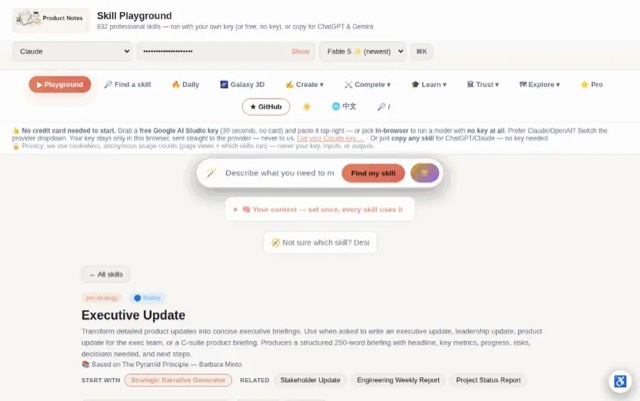

From the mohitagw15856/pm-claude-skills README — shows the whole collection, not only this skill. · view on GitHub
How to use it
Claude Code
- Run the line below. It pulls the whole folder into
~/.claude/skills/raci-matrix. - Describe your job in plain words. Claude Code follows the skill from there.
npx degit mohitagw15856/pm-claude-skills/skills/raci-matrix#main ~/.claude/skills/raci-matrixFor one project only, change the path to .claude/skills/raci-matrix.
Claude (web or desktop app)
- On this page open ⋯ → Download .md.
- Save it as SKILL.md in a folder, zip the folder, then Customize → Skills → + → Create skill → Upload a skill.
- Pick the file and Save. Claude shows the name and description and runs a security scan.
- Check the skill is switched on.
- Start a new chat and describe your job in plain words. The AI follows the skill from there.
ChatGPT or another app
- ChatGPT: make a Project and paste it into Instructions.
- Neither? Paste it at the top of a new chat — it works for that chat.
Not working?
- Check which app you pasted it into — the steps above name the right one.
- Some skills need the paid tier of Claude or ChatGPT.
Paste into Claude, ChatGPT or Cursor.
Source of RACI Matrix Skill
Show the full text169 lines
| name | description |
|---|---|
| raci-matrix | Define a RACI matrix for a cross-functional project or process. Use when asked to build a RACI, create a responsibility matrix, clarify ownership across teams, or document decision rights. Produces a complete RACI matrix with role definitions, decision mapping, and a process for resolving conflicts. |
RACI Matrix Skill
This skill produces a complete RACI (Responsible, Accountable, Consulted, Informed) matrix for a project, product launch, or ongoing process. Output is ready to share with teams to clarify ownership, reduce decision bottlenecks, and eliminate duplication of effort.
Required Inputs
Ask the user for these if not provided:
- Project or process name
- Key activities or decisions to map (or the user can describe the project and the skill will derive them)
- Teams or roles involved (list team names and key individuals if helpful)
- Primary purpose — clarifying launch ownership / onboarding a new team / reducing bottlenecks / governance documentation
- RACI variant — standard RACI, or RASCI (adds Supportive), or DACI (Driver, Approver, Contributors, Informed)?
Output Structure
RACI Matrix: [Project / Process Name]
Version: [1.0] Owner: [Programme lead / PM] Date: [Date] Teams involved: [List teams]
1. Role Definitions
Before reading the matrix, agree on what each letter means for this project:
| Letter | Role | Definition | Rules |
|---|---|---|---|
| R | Responsible | Does the work. One or more people actually execute the task. | Multiple Rs are allowed — but if there are many, consider splitting the task |
| A | Accountable | Owns the outcome. Signs off on decisions. Answers if something goes wrong. | There must be exactly one A per row. Never two. Never zero. |
| C | Consulted | Provides expertise or input before work is done. Two-way communication. | Consulted parties must be engaged — not just available. Cap at 3 per row or it becomes noise |
| I | Informed | Notified of progress or outcomes. One-way communication. | Informed only — they don't review or approve |
Golden rules:
- Every row has exactly one A
- The same person or team should not be A for more than [X] rows — spreads accountability too thin
- C is expensive — consulting someone means they must respond. Use it intentionally
- If someone is R they cannot also be A for the same task unless they are the decision-maker (common in small teams)
2. RACI Matrix
Columns = teams or roles. Rows = activities or decisions.
| Activity / Decision | [Role 1] | [Role 2] | [Role 3] | [Role 4] | [Role 5] | Notes |
|---|---|---|---|---|---|---|
| [Phase 1: Discovery] | ||||||
| Define project scope and objectives | A/R | C | I | I | — | PM leads; engineering consulted on technical feasibility |
| Conduct user research | R | A | C | I | — | UX researcher executes; PM accountable |
| Approve discovery findings | C | A | I | R | — | |
| [Phase 2: Design] | ||||||
| Define solution approach | A | R | C | I | I | |
| Design system / UI designs | C | A/R | I | I | — | |
| Design review and sign-off | C | R | A | I | — | |
| Accessibility review | I | R | A | C | — | |
| [Phase 3: Build] | ||||||
| Technical architecture decision | C | C | A/R | I | — | |
| Sprint planning | A | C | R | I | I | |
| Code review and merge | I | C | R | A | — | |
| Security review | I | C | C | A/R | — | |
| [Phase 4: Launch] | ||||||
| Launch go / no-go decision | A | C | C | R | I | PM holds final authority |
| Release to production | C | I | A/R | I | — | |
| Customer communications | A/R | I | I | I | C | |
| Post-launch monitoring | C | I | R | A | — | |
| [Ongoing / BAU] | ||||||
| Incident response | I | C | R | A | — | |
| Feature prioritisation | A/R | C | C | I | I | |
| Stakeholder reporting | A/R | I | I | I | C |
3. Decision Map
For high-stakes decisions, document the decision type, who holds authority, and how disagreements are resolved:
| Decision | Authority (A) | Must consult (C) | Escalation path if disagreed |
|---|---|---|---|
| Scope change >20% effort | [Exec sponsor / Programme lead] | [PM, Engineering lead] | [Steering committee] |
| Budget overrun >10% | [Finance / Exec] | [PM, Programme lead] | [CFO / Board] |
| Architecture pattern change | [Engineering lead] | [Tech lead, Security] | [CTO] |
| Go-live date change | [PM] | [Engineering, Comms, CS] | [Programme sponsor] |
| Feature cut from scope | [PM] | [Product, UX, Engineering] | [CPO] |
4. Common RACI Anti-Patterns — and Fixes
Review the completed matrix against these failure modes:
| Anti-pattern | Symptom | Fix |
|---|---|---|
| Multiple As | Two teams both think they own an outcome | Agree one A; the other becomes C or I |
| No A | Decisions stall; no one feels responsible | Assign the most senior stakeholder as A |
| Everyone is C | Every decision goes to a committee | Audit each C — does this person actually provide input that changes outcomes? If not, move to I |
| R without A | Work gets done but no one owns quality | Add an A; usually the manager of the R |
| A without R | Accountability without execution — manager is disconnected | Add an R from the team; or combine A/R if appropriate |
| Too many Rs | Diffusion of responsibility | Split the task into sub-tasks, each with one clear R |
| Key team missing from matrix | They're affected but not in the RACI | Add them; assign at minimum I for relevant rows |
5. Communication Template
Once the RACI is agreed, use this template to communicate it to all involved teams:
Subject: [Project Name] — Roles and Responsibilities Agreed
We've finalised the RACI matrix for [Project Name]. Here's what it means for you:
[Role 1 team]: You are Accountable for [X, Y, Z activities]. This means you make the final call on those decisions and answer if outcomes are not met.
[Role 2 team]: You are Responsible for [A, B, C]. You execute the work. For [D], you are Consulted — we need your input before decisions are finalised.
[Role 3 team]: You are Informed on [E, F] — we'll send you updates at [weekly / milestone / launch]. No action required unless you see something that needs escalation.
Please review the full matrix here: [Link]. Raise any concerns by [Date] — after that, we'll treat it as agreed.
6. RACI Review Cadence
| Trigger | Action |
|---|---|
| New team member joins | Review rows relevant to their role — update R as needed |
| Phase change (e.g. discovery → delivery) | Review full matrix — some Rs and As will shift |
| Escalation or confusion about ownership | Use the matrix to diagnose — find the missing A |
| 3 months into a long programme | Full RACI review — roles drift over time |
| Team restructure or reorganisation | Full rebuild — ownership assumptions change |
Quality Checks
- Every row has exactly one A
- No individual or team is A for more than their realistic sphere of authority
- C columns are sparse — consulting everyone dilutes the process
- Matrix was reviewed and agreed by at least one representative from each role column
- A communication plan exists to share the RACI with all involved parties
- Decision map covers the top 5–10 highest-stakes decisions in the project
Anti-Patterns
- Do not assign more than one Accountable per task — shared accountability means no accountability
- Do not create a RACI with more than 5–6 roles — it becomes unreadable and unenforceable
- Do not include tasks so broad that the RACI cannot be acted upon — break down to decision-level granularity
- Do not skip the conflict resolution process — RACI matrices without a process for disputes are unused after the first disagreement
- Do not confuse Responsible with Accountable — document the distinction clearly for each role
Example Trigger Phrases
- "Build a RACI matrix for our product launch"
- "Create a responsibility matrix for our new cross-functional project"
- "Who owns what on this initiative? Help me build a RACI"
- "Map out decision rights for our engineering and product teams"
- "Generate a RACI for a [migration / launch / process] involving [teams]"
| 1 | |
| 2 | name raci-matrix |
| 3 | description "Define a RACI matrix for a cross-functional project or process. Use when asked to build a RACI, create a responsibility matrix, clarify ownership across teams, or document decision rights. Produces a complete RACI matrix with role definitions, decision mapping, and a process for resolving conflicts." |
| 4 | |
| 5 | |
| 6 | # RACI Matrix Skill |
| 7 | |
| 8 | This skill produces a complete RACI (Responsible, Accountable, Consulted, Informed) matrix for a project, product launch, or ongoing process. Output is ready to share with teams to clarify ownership, reduce decision bottlenecks, and eliminate duplication of effort. |
| 9 | |
| 10 | ## Required Inputs |
| 11 | |
| 12 | Ask the user for these if not provided: |
| 13 | **Project or process name** |
| 14 | **Key activities or decisions** to map (or the user can describe the project and the skill will derive them) |
| 15 | **Teams or roles involved** (list team names and key individuals if helpful) |
| 16 | **Primary purpose** — clarifying launch ownership / onboarding a new team / reducing bottlenecks / governance documentation |
| 17 | **RACI variant** — standard RACI, or RASCI (adds Supportive), or DACI (Driver, Approver, Contributors, Informed)? |
| 18 | |
| 19 | ## Output Structure |
| 20 | |
| 21 | |
| 22 | |
| 23 | # RACI Matrix: [Project / Process Name] |
| 24 | |
| 25 | **Version:** [1.0] |
| 26 | **Owner:** [Programme lead / PM] |
| 27 | **Date:** [Date] |
| 28 | **Teams involved:** [List teams] |
| 29 | |
| 30 | |
| 31 | |
| 32 | ## 1. Role Definitions |
| 33 | |
| 34 | Before reading the matrix, agree on what each letter means for this project: |
| 35 | |
| 36 | | Letter | Role | Definition | Rules | |
| 37 | |---|---|---|---| |
| 38 | | **R** | Responsible | Does the work. One or more people actually execute the task. | Multiple Rs are allowed — but if there are many, consider splitting the task | |
| 39 | | **A** | Accountable | Owns the outcome. Signs off on decisions. Answers if something goes wrong. | **There must be exactly one A per row.** Never two. Never zero. | |
| 40 | | **C** | Consulted | Provides expertise or input before work is done. Two-way communication. | Consulted parties must be engaged — not just available. Cap at 3 per row or it becomes noise | |
| 41 | | **I** | Informed | Notified of progress or outcomes. One-way communication. | Informed only — they don't review or approve | |
| 42 | |
| 43 | **Golden rules:** |
| 44 | Every row has exactly one **A** |
| 45 | The same person or team should not be **A** for more than [X] rows — spreads accountability too thin |
| 46 | **C** is expensive — consulting someone means they must respond. Use it intentionally |
| 47 | If someone is **R** they cannot also be **A** for the same task unless they are the decision-maker (common in small teams) |
| 48 | |
| 49 | |
| 50 | |
| 51 | ## 2. RACI Matrix |
| 52 | |
| 53 | Columns = teams or roles. Rows = activities or decisions. |
| 54 | |
| 55 | | Activity / Decision | [Role 1] | [Role 2] | [Role 3] | [Role 4] | [Role 5] | Notes | |
| 56 | |---|---|---|---|---|---|---| |
| 57 | | **[Phase 1: Discovery]** | | | | | | | |
| 58 | | Define project scope and objectives | A/R | C | I | I | — | PM leads; engineering consulted on technical feasibility | |
| 59 | | Conduct user research | R | A | C | I | — | UX researcher executes; PM accountable | |
| 60 | | Approve discovery findings | C | A | I | R | — | | |
| 61 | | **[Phase 2: Design]** | | | | | | | |
| 62 | | Define solution approach | A | R | C | I | I | | |
| 63 | | Design system / UI designs | C | A/R | I | I | — | | |
| 64 | | Design review and sign-off | C | R | A | I | — | | |
| 65 | | Accessibility review | I | R | A | C | — | | |
| 66 | | **[Phase 3: Build]** | | | | | | | |
| 67 | | Technical architecture decision | C | C | A/R | I | — | | |
| 68 | | Sprint planning | A | C | R | I | I | | |
| 69 | | Code review and merge | I | C | R | A | — | | |
| 70 | | Security review | I | C | C | A/R | — | | |
| 71 | | **[Phase 4: Launch]** | | | | | | | |
| 72 | | Launch go / no-go decision | A | C | C | R | I | PM holds final authority | |
| 73 | | Release to production | C | I | A/R | I | — | | |
| 74 | | Customer communications | A/R | I | I | I | C | | |
| 75 | | Post-launch monitoring | C | I | R | A | — | | |
| 76 | | **[Ongoing / BAU]** | | | | | | | |
| 77 | | Incident response | I | C | R | A | — | | |
| 78 | | Feature prioritisation | A/R | C | C | I | I | | |
| 79 | | Stakeholder reporting | A/R | I | I | I | C | | |
| 80 | |
| 81 | |
| 82 | |
| 83 | ## 3. Decision Map |
| 84 | |
| 85 | For high-stakes decisions, document the decision type, who holds authority, and how disagreements are resolved: |
| 86 | |
| 87 | | Decision | Authority (A) | Must consult (C) | Escalation path if disagreed | |
| 88 | |---|---|---|---| |
| 89 | | Scope change >20% effort | [Exec sponsor / Programme lead] | [PM, Engineering lead] | [Steering committee] | |
| 90 | | Budget overrun >10% | [Finance / Exec] | [PM, Programme lead] | [CFO / Board] | |
| 91 | | Architecture pattern change | [Engineering lead] | [Tech lead, Security] | [CTO] | |
| 92 | | Go-live date change | [PM] | [Engineering, Comms, CS] | [Programme sponsor] | |
| 93 | | Feature cut from scope | [PM] | [Product, UX, Engineering] | [CPO] | |
| 94 | |
| 95 | |
| 96 | |
| 97 | ## 4. Common RACI Anti-Patterns — and Fixes |
| 98 | |
| 99 | Review the completed matrix against these failure modes: |
| 100 | |
| 101 | | Anti-pattern | Symptom | Fix | |
| 102 | |---|---|---| |
| 103 | | **Multiple As** | Two teams both think they own an outcome | Agree one A; the other becomes C or I | |
| 104 | | **No A** | Decisions stall; no one feels responsible | Assign the most senior stakeholder as A | |
| 105 | | **Everyone is C** | Every decision goes to a committee | Audit each C — does this person actually provide input that changes outcomes? If not, move to I | |
| 106 | | **R without A** | Work gets done but no one owns quality | Add an A; usually the manager of the R | |
| 107 | | **A without R** | Accountability without execution — manager is disconnected | Add an R from the team; or combine A/R if appropriate | |
| 108 | | **Too many Rs** | Diffusion of responsibility | Split the task into sub-tasks, each with one clear R | |
| 109 | | **Key team missing from matrix** | They're affected but not in the RACI | Add them; assign at minimum I for relevant rows | |
| 110 | |
| 111 | |
| 112 | |
| 113 | ## 5. Communication Template |
| 114 | |
| 115 | Once the RACI is agreed, use this template to communicate it to all involved teams: |
| 116 | |
| 117 | |
| 118 | |
| 119 | **Subject:** [Project Name] — Roles and Responsibilities Agreed |
| 120 | |
| 121 | We've finalised the RACI matrix for [Project Name]. Here's what it means for you: |
| 122 | |
| 123 | **[Role 1 team]:** You are **Accountable** for [X, Y, Z activities]. This means you make the final call on those decisions and answer if outcomes are not met. |
| 124 | |
| 125 | **[Role 2 team]:** You are **Responsible** for [A, B, C]. You execute the work. For [D], you are **Consulted** — we need your input before decisions are finalised. |
| 126 | |
| 127 | **[Role 3 team]:** You are **Informed** on [E, F] — we'll send you updates at [weekly / milestone / launch]. No action required unless you see something that needs escalation. |
| 128 | |
| 129 | Please review the full matrix here: [Link]. Raise any concerns by [Date] — after that, we'll treat it as agreed. |
| 130 | |
| 131 | |
| 132 | |
| 133 | ## 6. RACI Review Cadence |
| 134 | |
| 135 | | Trigger | Action | |
| 136 | |---|---| |
| 137 | | New team member joins | Review rows relevant to their role — update R as needed | |
| 138 | | Phase change (e.g. discovery → delivery) | Review full matrix — some Rs and As will shift | |
| 139 | | Escalation or confusion about ownership | Use the matrix to diagnose — find the missing A | |
| 140 | | 3 months into a long programme | Full RACI review — roles drift over time | |
| 141 | | Team restructure or reorganisation | Full rebuild — ownership assumptions change | |
| 142 | |
| 143 | |
| 144 | |
| 145 | ## Quality Checks |
| 146 | |
| 147 | [ ] Every row has exactly one **A** |
| 148 | [ ] No individual or team is **A** for more than their realistic sphere of authority |
| 149 | [ ] **C** columns are sparse — consulting everyone dilutes the process |
| 150 | [ ] Matrix was reviewed and agreed by at least one representative from each role column |
| 151 | [ ] A communication plan exists to share the RACI with all involved parties |
| 152 | [ ] Decision map covers the top 5–10 highest-stakes decisions in the project |
| 153 | |
| 154 | ## Anti-Patterns |
| 155 | |
| 156 | [ ] Do not assign more than one Accountable per task — shared accountability means no accountability |
| 157 | [ ] Do not create a RACI with more than 5–6 roles — it becomes unreadable and unenforceable |
| 158 | [ ] Do not include tasks so broad that the RACI cannot be acted upon — break down to decision-level granularity |
| 159 | [ ] Do not skip the conflict resolution process — RACI matrices without a process for disputes are unused after the first disagreement |
| 160 | [ ] Do not confuse Responsible with Accountable — document the distinction clearly for each role |
| 161 | |
| 162 | ## Example Trigger Phrases |
| 163 | |
| 164 | "Build a RACI matrix for our product launch" |
| 165 | "Create a responsibility matrix for our new cross-functional project" |
| 166 | "Who owns what on this initiative? Help me build a RACI" |
| 167 | "Map out decision rights for our engineering and product teams" |
| 168 | "Generate a RACI for a [migration / launch / process] involving [teams]" |
| 169 |
Discussion
Browse more free Claude skills or everything in Product.