Write a product positioning document and messaging framework
Product Positioning Doc Skill
Write a product positioning document and messaging framework. Use when asked to define product positioning, write a positioning statement, build a messaging framework, or create a messaging hierarchy.
---
name: product-positioning-doc
description: "Write a product positioning document and messaging framework. Use when asked to define product positioning, write a positioning statement, build a messaging framework, or create a messaging hierarchy. Produces a complete positioning doc with category definition, target customer, differentiation, proof points, messaging pillars, and persona-specific messaging."
---

# Product Positioning Doc Skill

This skill produces a complete product positioning document following the April Dunford positioning methodology. Output covers category definition, target customer, unique attributes, proof points, and a messaging hierarchy — ready to align GTM, marketing, sales, and product teams.

## Required Inputs

Ask the user for these if not provided:
- **Product name** and what it does
- **Target customer** — who is it for? (role, company type, size)
- **Problem it solves** — what pain or goal does it address?
- **Key alternatives** — what do customers use today instead? (not just direct competitors — include status quo, spreadsheets, DIY)
- **Differentiation** — what does this product do that alternatives cannot? (not features — capabilities that produce different outcomes)
- **Proof points** — any customer data, case studies, metrics, or validation?
Overview
This skill produces a complete product positioning document following the April Dunford positioning methodology. Output covers category definition, target customer, unique attributes, proof points, and a messaging hierarchy — ready to align GTM, marketing, sales, and product teams.
Manual install (npx, ZIP)
npx skills add mohitagw15856/pm-claude-skills --skill product-positioning-doc -g -a claude-codemkdir -p ~/.claude/skills && curl -sL https://codeload.github.com/mohitagw15856/pm-claude-skills/tar.gz/f6ca79348c55 \
| tar -xz -C ~/.claude/skills --strip-components=2 pm-claude-skills-f6ca79348c55/skills/product-positioning-docNew-Item -ItemType Directory -Force "$HOME\.claude\skills" | Out-Null; Invoke-WebRequest "https://m.agentalley.io/zip/364b4c3f08d9d172f134/product-positioning-doc.zip" -OutFile "$env:TEMP\product-positioning-doc.zip"; Expand-Archive "$env:TEMP\product-positioning-doc.zip" -DestinationPath "$HOME\.claude\skills" -ForceConnects with Agent Alley MCP · agentalley.io/mcp
Files included
SKILL.md14.1 KBreferences/2 files · 16.0 KBtemplates/1 file · 1.2 KB
Read the files here
mohitagw15856/
Show the full text248 lines
Product Positioning Doc Skill
This skill produces a complete product positioning document following the April Dunford positioning methodology. Output covers category definition, target customer, unique attributes, proof points, and a messaging hierarchy — ready to align GTM, marketing, sales, and product teams.
Required Inputs
Ask the user for these if not provided:
- Product name and what it does
- Target customer — who is it for? (role, company type, size)
- Problem it solves — what pain or goal does it address?
- Key alternatives — what do customers use today instead? (not just direct competitors — include status quo, spreadsheets, DIY)
- Differentiation — what does this product do that alternatives cannot? (not features — capabilities that produce different outcomes)
- Proof points — any customer data, case studies, metrics, or validation?
- Business goal — is positioning for a new category, expansion into new segment, or repositioning away from a declining category?
Output Structure
Positioning Document: [Product Name]
Version: [1.0] Owner: [PMM / Founder / Marketing lead] Date: [Date] Status: [Draft / Reviewed / Approved] Approved by: [Names — this document must be signed off by product, marketing, and sales leadership before use]
1. Background & Context
[2–3 sentences describing why positioning is being done now. Is this a new product, a pivot, a segment expansion, or a rebrand? What triggered this work?]
Positioning objective: [e.g. Move from being perceived as a reporting tool to being the category leader in revenue intelligence for mid-market SaaS]
2. Market Category
What category does this product compete in?
This is the frame of reference your customer uses to understand what the product is. Choose the wrong category and everything downstream — competitors, value, messaging — is wrong.
Category: [e.g. Customer data platform / Revenue intelligence / No-code automation / Modern data stack]
Why this category, not [alternative category]? [1–2 sentences on why this framing serves the customer's understanding better than adjacent categories]
Category maturity:
- New category (we are creating it — high education burden, high upside if it works)
- Growing category (fast-growing segment — compete on differentiation)
- Mature category (well-understood — must disrupt with clear superiority or narrower niche)
3. Target Customer
Be precise. Vague targeting produces vague positioning.
| Dimension | Description |
|---|---|
| Primary buyer / decision-maker | [e.g. VP of Revenue Operations at B2B SaaS companies with 100–500 employees] |
| Primary user | [e.g. Revenue operations analysts and sales ops managers] |
| Company profile | [Industry, size, growth stage, technology stack] |
| Business context | [What is happening in their world that makes them a buyer right now?] |
| Trigger event | [What just happened that makes them start looking for a solution? — e.g. Sales team grew past 20 reps, forecast accuracy became a board question] |
Who this is NOT for: [Be explicit about who to exclude — this sharpens the positioning for those who are a fit]
4. Competitive Alternatives
What do buyers use today when they don't have your product? List all real alternatives — not just direct competitors.
| Alternative | Who uses it | Why buyers choose it | What they sacrifice |
|---|---|---|---|
| [Direct competitor — e.g. Gong] | [Enterprise sales teams] | [Market leader, strong brand, sales coaching features] | [Price, complexity, implementation time] |
| [Adjacent tool — e.g. Salesforce reports] | [CRM-native users] | [Already have it, no additional cost] | [No AI analysis, manual reporting, siloed data] |
| [Status quo — e.g. spreadsheets + manual tracking] | [SMB, early-stage] | [Free, flexible, no change management] | [Time-consuming, error-prone, not scalable] |
| [Build in-house] | [Tech companies with data teams] | [Custom to their exact needs] | [Engineering cost, maintenance burden, 12+ month timeline] |
Key insight: [What does this competitive landscape tell you about what your positioning must emphasise? e.g. "Every alternative either costs too much or requires too much manual work — positioning must nail 'fast time to value' and 'right-sized for mid-market'"]
5. Unique Differentiated Attributes
These are the features or capabilities your product has that alternatives genuinely cannot match — or cannot match at the same level. Do not list features that competitors also have.
| Attribute | What it is | What it enables (outcome) | Why competitors can't match it |
|---|---|---|---|
| [e.g. Real-time CRM sync] | [Bidirectional sync with any CRM in <5 min] | [Reps see clean data in the tools they already use — no toggle between systems] | [Legacy competitors require 3-month integration projects; Salesforce-native tools only work in SFDC] |
| [e.g. Natural language querying] | [Ask questions in plain English, get data visualisations] | [Anyone on the revenue team can answer their own questions without SQL or waiting for an analyst] | [BI tools require analyst training; direct competitors have rigid dashboards] |
| [...] | [...] | [...] | [...] |
The core differentiation thesis: [1–2 sentences that unite the above attributes into a single "why we win" statement — this is internal language, not customer-facing yet]
6. Value Proof Points
Back up the differentiation claims with evidence:
| Claim | Proof point | Source |
|---|---|---|
| [Fastest time to value] | [Average customer is live in 4 hours vs 3 months for legacy alternatives] | [Customer data — average across [X] accounts] |
| [Better forecast accuracy] | [Customers achieve X% improvement in forecast accuracy within 90 days] | [Case study: [Company Name] — link] |
| [Loved by operators, not just managers] | [NPS of X among end users; 4.8/5 on G2 for ease of use] | [G2 reviews, internal NPS survey] |
Proof gaps: [Are there claims you're making that you don't yet have evidence for? List them — they are either research projects or risks to the positioning]
7. Positioning Statement
The classic positioning template — internal only, never used verbatim in marketing:
For [target customer] who [trigger event or problem statement], [Product name] is a [category] that [primary differentiated value — the outcome, not the feature]. Unlike [primary alternative], [Product name] [the key thing that makes you different and better].
Draft positioning statement:
For [VP Revenue Ops at B2B SaaS companies with 50–500 reps] who [struggle to forecast accurately as the sales team scales], [Product Name] is a [revenue intelligence platform] that [gives every rep and manager accurate, real-time pipeline visibility without any analyst overhead]. Unlike [Salesforce dashboards and manual reporting], [Product Name] [syncs automatically, surfaces risks before they become missed quarters, and needs no configuration by IT or data teams].
8. Messaging Hierarchy
Translate the positioning into customer-facing language at three levels:
Tagline (5–8 words)
[The simplest possible statement of what you do and for whom. Used in ads, hero sections, email signatures.]
Options to test:
- [e.g. "Revenue intelligence for scaling sales teams"]
- [e.g. "Forecast with confidence. Close with clarity."]
- [e.g. "The revenue platform your whole team will actually use"]
Value Proposition (1–2 sentences)
[Used in the hero section of the website, email subject lines, and sales decks. Must be instantly clear.]
[e.g. "[Product Name] gives revenue teams real-time pipeline visibility and accurate forecasting — without spreadsheets, custom reports, or waiting for an analyst. Get live in 4 hours, not 4 months."]
Full Description (3–5 sentences)
[Used in PR, partnership briefs, longer sales emails, and About Us pages.]
[e.g. "[Product Name] is the revenue intelligence platform built for mid-market SaaS teams. Unlike legacy BI tools that require analyst configuration or CRM dashboards that only show what's already happened, [Product Name] automatically syncs your entire revenue stack, surfaces AI-driven risk signals, and lets any rep or manager ask questions in plain English. [X] customers use [Product Name] to call their quarters with confidence. Average time to live: 4 hours."]
9. Persona-Specific Messaging
The core positioning is the same, but different buyers care about different aspects:
| Persona | Their primary concern | Lead message | Proof point to use |
|---|---|---|---|
| VP Revenue Operations | Forecast accuracy, board credibility | "Call your quarter with confidence" | [X% improvement in forecast accuracy across N customers] |
| Head of Sales | Rep productivity, pipeline visibility | "Your reps close more, not admin more" | [X hours/week saved per rep] |
| CEO / CFO | Revenue predictability, cost | "Stop being surprised by quarters" | [ROI: £X saved vs X headcount required to replicate manually] |
| Sales Rep | Ease of use, not adding to workload | "It works in the tools you already use" | [Ease of use NPS, G2 reviews] |
10. Messaging Do's and Don'ts
Do say:
- [Specific, outcome-focused language — what the customer achieves]
- [Comparative language grounded in evidence]
- [Language your target buyer uses to describe their problem — not language you invented]
Don't say:
- ["Best-in-class", "innovative", "cutting-edge", "game-changing" — unless followed by evidence]
- [Feature lists without outcome context]
- [Jargon your buyer doesn't use themselves]
- [Claims your competitors could also make]
11. Distribution Plan
Positioning only works if it's implemented consistently:
| Team | What they need | Format | Owner | When |
|---|---|---|---|---|
| Marketing | Tagline, value prop, messaging hierarchy | This doc + messaging playbook | PMM | [Date] |
| Sales | Competitive positioning, objection responses | One-pager + deck | Sales enablement | [Date] |
| Product | Category definition, target customer | Shared doc + roadmap input | PMM + PM | [Date] |
| Leadership | Full positioning narrative | This doc | PMM | [Date] |
Deeper Materials
This skill ships with support files — use them when they are available:
references/category-choice.md— Choosing Your Category: the Highest-Leverage Positioning Decision. Apply it while producing the output; it carries the calibration and judgment calls the method summary above compresses.templates/positioning-canvas.md— a fill-in version of the deliverable with the quality gates inline. Offer it when the user wants to work the document themselves rather than have it generated.
Scoring Rubric (0–40)
Score any output of this skill before handing it over; 32+ is ship-quality.
| Dimension | 0 | 5 | 10 |
|---|---|---|---|
| Differentiation specificity | Positioning could describe any competitor; attributes are feature names | Some genuinely unique attributes, but mixed with table-stakes features and no "why competitors can't match it" reasoning | Every attribute is an outcome, provable, paired with why alternatives can't copy it, and traceable to one primary claim |
| Category & alternatives honesty | Category asserted without justification; alternatives list only named competitors | Category justified, but status quo/DIY missing from alternatives or the key insight is generic | Category argued against a named adjacent category, alternatives include the status quo, and the key insight visibly drives the messaging |
| Evidence discipline | Proof points are unsourced claims ("customers say…") | Most claims sourced, but proof gaps unacknowledged and stale data undated | Every proof point cites a dated source, and gaps are listed with what sales may not claim until they close |
| Persona message fit | Same headline for every persona, written in company jargon | Personas differ but wording is internal vocabulary, or the "not for" section is missing | Each persona has a distinct lead message in the buyer's own words with a matched proof point, and "not for" works as a qualification tool |
Quality Checks
- Positioning statement has exactly one A — the product is accountable to exactly one primary differentiated claim
- Competitive alternatives include the status quo — not just named competitors
- Differentiated attributes describe outcomes, not features
- Every proof point cites a source — not "customers say…"
- Persona messaging uses the buyer's language, not the company's
- At least two people from product, marketing, and sales have reviewed and approved
Anti-Patterns
- Do not write positioning that could describe any competitor — differentiation must be specific, provable, and hard to copy
- Do not mix category design with category entry — know whether you are creating a new category or competing in an existing one
- Do not create persona messaging that uses the same headline for all personas — each persona has different priorities
- Do not include proof points that are claims without evidence — every proof point needs a supporting data point or reference
- Do not skip the "not for" section — defining who this is not for sharpens targeting and prevents off-persona deals
Example Trigger Phrases
- "Write a positioning document for [product]"
- "Build a messaging framework for our B2B SaaS tool"
- "Define our product positioning — who is this for and why should they care?"
- "Create a positioning statement and messaging hierarchy for [launch]"
- "Help me articulate our differentiation vs [Competitor]"
| 1 | |
| 2 | name product-positioning-doc |
| 3 | description "Write a product positioning document and messaging framework. Use when asked to define product positioning, write a positioning statement, build a messaging framework, or create a messaging hierarchy. Produces a complete positioning doc with category definition, target customer, differentiation, proof points, messaging pillars, and persona-specific messaging." |
| 4 | |
| 5 | |
| 6 | # Product Positioning Doc Skill |
| 7 | |
| 8 | This skill produces a complete product positioning document following the April Dunford positioning methodology. Output covers category definition, target customer, unique attributes, proof points, and a messaging hierarchy — ready to align GTM, marketing, sales, and product teams. |
| 9 | |
| 10 | ## Required Inputs |
| 11 | |
| 12 | Ask the user for these if not provided: |
| 13 | **Product name** and what it does |
| 14 | **Target customer** — who is it for? (role, company type, size) |
| 15 | **Problem it solves** — what pain or goal does it address? |
| 16 | **Key alternatives** — what do customers use today instead? (not just direct competitors — include status quo, spreadsheets, DIY) |
| 17 | **Differentiation** — what does this product do that alternatives cannot? (not features — capabilities that produce different outcomes) |
| 18 | **Proof points** — any customer data, case studies, metrics, or validation? |
| 19 | **Business goal** — is positioning for a new category, expansion into new segment, or repositioning away from a declining category? |
| 20 | |
| 21 | ## Output Structure |
| 22 | |
| 23 | |
| 24 | |
| 25 | # Positioning Document: [Product Name] |
| 26 | |
| 27 | **Version:** [1.0] |
| 28 | **Owner:** [PMM / Founder / Marketing lead] |
| 29 | **Date:** [Date] |
| 30 | **Status:** [Draft / Reviewed / Approved] |
| 31 | **Approved by:** [Names — this document must be signed off by product, marketing, and sales leadership before use] |
| 32 | |
| 33 | |
| 34 | |
| 35 | ## 1. Background & Context |
| 36 | |
| 37 | [2–3 sentences describing why positioning is being done now. Is this a new product, a pivot, a segment expansion, or a rebrand? What triggered this work?] |
| 38 | |
| 39 | **Positioning objective:** [e.g. Move from being perceived as a reporting tool to being the category leader in revenue intelligence for mid-market SaaS] |
| 40 | |
| 41 | |
| 42 | |
| 43 | ## 2. Market Category |
| 44 | |
| 45 | **What category does this product compete in?** |
| 46 | |
| 47 | This is the frame of reference your customer uses to understand what the product is. Choose the wrong category and everything downstream — competitors, value, messaging — is wrong. |
| 48 | |
| 49 | **Category:** [e.g. Customer data platform / Revenue intelligence / No-code automation / Modern data stack] |
| 50 | |
| 51 | **Why this category, not [alternative category]?** |
| 52 | [1–2 sentences on why this framing serves the customer's understanding better than adjacent categories] |
| 53 | |
| 54 | **Category maturity:** |
| 55 | [ ] New category (we are creating it — high education burden, high upside if it works) |
| 56 | [ ] Growing category (fast-growing segment — compete on differentiation) |
| 57 | [ ] Mature category (well-understood — must disrupt with clear superiority or narrower niche) |
| 58 | |
| 59 | |
| 60 | |
| 61 | ## 3. Target Customer |
| 62 | |
| 63 | **Be precise. Vague targeting produces vague positioning.** |
| 64 | |
| 65 | | Dimension | Description | |
| 66 | |---|---| |
| 67 | | **Primary buyer / decision-maker** | [e.g. VP of Revenue Operations at B2B SaaS companies with 100–500 employees] | |
| 68 | | **Primary user** | [e.g. Revenue operations analysts and sales ops managers] | |
| 69 | | **Company profile** | [Industry, size, growth stage, technology stack] | |
| 70 | | **Business context** | [What is happening in their world that makes them a buyer right now?] | |
| 71 | | **Trigger event** | [What just happened that makes them start looking for a solution? — e.g. Sales team grew past 20 reps, forecast accuracy became a board question] | |
| 72 | |
| 73 | **Who this is NOT for:** |
| 74 | [Be explicit about who to exclude — this sharpens the positioning for those who are a fit] |
| 75 | |
| 76 | |
| 77 | |
| 78 | ## 4. Competitive Alternatives |
| 79 | |
| 80 | What do buyers use today when they don't have your product? List all real alternatives — not just direct competitors. |
| 81 | |
| 82 | | Alternative | Who uses it | Why buyers choose it | What they sacrifice | |
| 83 | |---|---|---|---| |
| 84 | | **[Direct competitor — e.g. Gong]** | [Enterprise sales teams] | [Market leader, strong brand, sales coaching features] | [Price, complexity, implementation time] | |
| 85 | | **[Adjacent tool — e.g. Salesforce reports]** | [CRM-native users] | [Already have it, no additional cost] | [No AI analysis, manual reporting, siloed data] | |
| 86 | | **[Status quo — e.g. spreadsheets + manual tracking]** | [SMB, early-stage] | [Free, flexible, no change management] | [Time-consuming, error-prone, not scalable] | |
| 87 | | **[Build in-house]** | [Tech companies with data teams] | [Custom to their exact needs] | [Engineering cost, maintenance burden, 12+ month timeline] | |
| 88 | |
| 89 | **Key insight:** [What does this competitive landscape tell you about what your positioning must emphasise? e.g. "Every alternative either costs too much or requires too much manual work — positioning must nail 'fast time to value' and 'right-sized for mid-market'"] |
| 90 | |
| 91 | |
| 92 | |
| 93 | ## 5. Unique Differentiated Attributes |
| 94 | |
| 95 | These are the features or capabilities your product has that alternatives genuinely cannot match — or cannot match at the same level. Do not list features that competitors also have. |
| 96 | |
| 97 | | Attribute | What it is | What it enables (outcome) | Why competitors can't match it | |
| 98 | |---|---|---|---| |
| 99 | | [e.g. Real-time CRM sync] | [Bidirectional sync with any CRM in <5 min] | [Reps see clean data in the tools they already use — no toggle between systems] | [Legacy competitors require 3-month integration projects; Salesforce-native tools only work in SFDC] | |
| 100 | | [e.g. Natural language querying] | [Ask questions in plain English, get data visualisations] | [Anyone on the revenue team can answer their own questions without SQL or waiting for an analyst] | [BI tools require analyst training; direct competitors have rigid dashboards] | |
| 101 | | [...] | [...] | [...] | [...] | |
| 102 | |
| 103 | **The core differentiation thesis:** |
| 104 | [1–2 sentences that unite the above attributes into a single "why we win" statement — this is internal language, not customer-facing yet] |
| 105 | |
| 106 | |
| 107 | |
| 108 | ## 6. Value Proof Points |
| 109 | |
| 110 | Back up the differentiation claims with evidence: |
| 111 | |
| 112 | | Claim | Proof point | Source | |
| 113 | |---|---|---| |
| 114 | | [Fastest time to value] | [Average customer is live in 4 hours vs 3 months for legacy alternatives] | [Customer data — average across [X] accounts] | |
| 115 | | [Better forecast accuracy] | [Customers achieve X% improvement in forecast accuracy within 90 days] | [Case study: [Company Name] — link] | |
| 116 | | [Loved by operators, not just managers] | [NPS of X among end users; 4.8/5 on G2 for ease of use] | [G2 reviews, internal NPS survey] | |
| 117 | |
| 118 | **Proof gaps:** [Are there claims you're making that you don't yet have evidence for? List them — they are either research projects or risks to the positioning] |
| 119 | |
| 120 | |
| 121 | |
| 122 | ## 7. Positioning Statement |
| 123 | |
| 124 | The classic positioning template — internal only, never used verbatim in marketing: |
| 125 | |
| 126 | > **For** [target customer] |
| 127 | > **who** [trigger event or problem statement], |
| 128 | > **[Product name]** is a **[category]** |
| 129 | > **that** [primary differentiated value — the outcome, not the feature]. |
| 130 | > **Unlike** [primary alternative], |
| 131 | > **[Product name]** [the key thing that makes you different and better]. |
| 132 | |
| 133 | **Draft positioning statement:** |
| 134 | > For [VP Revenue Ops at B2B SaaS companies with 50–500 reps] who [struggle to forecast accurately as the sales team scales], [Product Name] is a [revenue intelligence platform] that [gives every rep and manager accurate, real-time pipeline visibility without any analyst overhead]. Unlike [Salesforce dashboards and manual reporting], [Product Name] [syncs automatically, surfaces risks before they become missed quarters, and needs no configuration by IT or data teams]. |
| 135 | |
| 136 | |
| 137 | |
| 138 | ## 8. Messaging Hierarchy |
| 139 | |
| 140 | Translate the positioning into customer-facing language at three levels: |
| 141 | |
| 142 | ### Tagline (5–8 words) |
| 143 | |
| 144 | [The simplest possible statement of what you do and for whom. Used in ads, hero sections, email signatures.] |
| 145 | |
| 146 | Options to test: |
| 147 | [e.g. "Revenue intelligence for scaling sales teams"] |
| 148 | [e.g. "Forecast with confidence. Close with clarity."] |
| 149 | [e.g. "The revenue platform your whole team will actually use"] |
| 150 | |
| 151 | ### Value Proposition (1–2 sentences) |
| 152 | |
| 153 | [Used in the hero section of the website, email subject lines, and sales decks. Must be instantly clear.] |
| 154 | |
| 155 | > [e.g. "[Product Name] gives revenue teams real-time pipeline visibility and accurate forecasting — without spreadsheets, custom reports, or waiting for an analyst. Get live in 4 hours, not 4 months."] |
| 156 | |
| 157 | ### Full Description (3–5 sentences) |
| 158 | |
| 159 | [Used in PR, partnership briefs, longer sales emails, and About Us pages.] |
| 160 | |
| 161 | > [e.g. "[Product Name] is the revenue intelligence platform built for mid-market SaaS teams. Unlike legacy BI tools that require analyst configuration or CRM dashboards that only show what's already happened, [Product Name] automatically syncs your entire revenue stack, surfaces AI-driven risk signals, and lets any rep or manager ask questions in plain English. [X] customers use [Product Name] to call their quarters with confidence. Average time to live: 4 hours."] |
| 162 | |
| 163 | |
| 164 | |
| 165 | ## 9. Persona-Specific Messaging |
| 166 | |
| 167 | The core positioning is the same, but different buyers care about different aspects: |
| 168 | |
| 169 | | Persona | Their primary concern | Lead message | Proof point to use | |
| 170 | |---|---|---|---| |
| 171 | | **VP Revenue Operations** | Forecast accuracy, board credibility | "Call your quarter with confidence" | [X% improvement in forecast accuracy across N customers] | |
| 172 | | **Head of Sales** | Rep productivity, pipeline visibility | "Your reps close more, not admin more" | [X hours/week saved per rep] | |
| 173 | | **CEO / CFO** | Revenue predictability, cost | "Stop being surprised by quarters" | [ROI: £X saved vs X headcount required to replicate manually] | |
| 174 | | **Sales Rep** | Ease of use, not adding to workload | "It works in the tools you already use" | [Ease of use NPS, G2 reviews] | |
| 175 | |
| 176 | |
| 177 | |
| 178 | ## 10. Messaging Do's and Don'ts |
| 179 | |
| 180 | **Do say:** |
| 181 | [Specific, outcome-focused language — what the customer achieves] |
| 182 | [Comparative language grounded in evidence] |
| 183 | [Language your target buyer uses to describe their problem — not language you invented] |
| 184 | |
| 185 | **Don't say:** |
| 186 | ["Best-in-class", "innovative", "cutting-edge", "game-changing" — unless followed by evidence] |
| 187 | [Feature lists without outcome context] |
| 188 | [Jargon your buyer doesn't use themselves] |
| 189 | [Claims your competitors could also make] |
| 190 | |
| 191 | |
| 192 | |
| 193 | ## 11. Distribution Plan |
| 194 | |
| 195 | Positioning only works if it's implemented consistently: |
| 196 | |
| 197 | | Team | What they need | Format | Owner | When | |
| 198 | |---|---|---|---|---| |
| 199 | | Marketing | Tagline, value prop, messaging hierarchy | This doc + messaging playbook | PMM | [Date] | |
| 200 | | Sales | Competitive positioning, objection responses | One-pager + deck | Sales enablement | [Date] | |
| 201 | | Product | Category definition, target customer | Shared doc + roadmap input | PMM + PM | [Date] | |
| 202 | | Leadership | Full positioning narrative | This doc | PMM | [Date] | |
| 203 | |
| 204 | |
| 205 | |
| 206 | ## Deeper Materials |
| 207 | |
| 208 | This skill ships with support files — use them when they are available: |
| 209 | |
| 210 | **`references/category-choice.md`** — Choosing Your Category: the Highest-Leverage Positioning Decision. Apply it while producing the output; it carries the calibration and judgment calls the method summary above compresses. |
| 211 | **`templates/positioning-canvas.md`** — a fill-in version of the deliverable with the quality gates inline. Offer it when the user wants to work the document themselves rather than have it generated. |
| 212 | |
| 213 | ## Scoring Rubric (0–40) |
| 214 | |
| 215 | Score any output of this skill before handing it over; 32+ is ship-quality. |
| 216 | |
| 217 | | Dimension | 0 | 5 | 10 | |
| 218 | |---|---|---|---| |
| 219 | | **Differentiation specificity** | Positioning could describe any competitor; attributes are feature names | Some genuinely unique attributes, but mixed with table-stakes features and no "why competitors can't match it" reasoning | Every attribute is an outcome, provable, paired with why alternatives can't copy it, and traceable to one primary claim | |
| 220 | | **Category & alternatives honesty** | Category asserted without justification; alternatives list only named competitors | Category justified, but status quo/DIY missing from alternatives or the key insight is generic | Category argued against a named adjacent category, alternatives include the status quo, and the key insight visibly drives the messaging | |
| 221 | | **Evidence discipline** | Proof points are unsourced claims ("customers say…") | Most claims sourced, but proof gaps unacknowledged and stale data undated | Every proof point cites a dated source, and gaps are listed with what sales may not claim until they close | |
| 222 | | **Persona message fit** | Same headline for every persona, written in company jargon | Personas differ but wording is internal vocabulary, or the "not for" section is missing | Each persona has a distinct lead message in the buyer's own words with a matched proof point, and "not for" works as a qualification tool | |
| 223 | |
| 224 | ## Quality Checks |
| 225 | |
| 226 | [ ] Positioning statement has exactly one A — the product is accountable to exactly one primary differentiated claim |
| 227 | [ ] Competitive alternatives include the status quo — not just named competitors |
| 228 | [ ] Differentiated attributes describe outcomes, not features |
| 229 | [ ] Every proof point cites a source — not "customers say…" |
| 230 | [ ] Persona messaging uses the buyer's language, not the company's |
| 231 | [ ] At least two people from product, marketing, and sales have reviewed and approved |
| 232 | |
| 233 | ## Anti-Patterns |
| 234 | |
| 235 | [ ] Do not write positioning that could describe any competitor — differentiation must be specific, provable, and hard to copy |
| 236 | [ ] Do not mix category design with category entry — know whether you are creating a new category or competing in an existing one |
| 237 | [ ] Do not create persona messaging that uses the same headline for all personas — each persona has different priorities |
| 238 | [ ] Do not include proof points that are claims without evidence — every proof point needs a supporting data point or reference |
| 239 | [ ] Do not skip the "not for" section — defining who this is not for sharpens targeting and prevents off-persona deals |
| 240 | |
| 241 | ## Example Trigger Phrases |
| 242 | |
| 243 | "Write a positioning document for [product]" |
| 244 | "Build a messaging framework for our B2B SaaS tool" |
| 245 | "Define our product positioning — who is this for and why should they care?" |
| 246 | "Create a positioning statement and messaging hierarchy for [launch]" |
| 247 | "Help me articulate our differentiation vs [Competitor]" |
| 248 |
Details
- Updated
- Sep 23, 2026
- License
- MIT
- Stars on the repo
- ★ 1,395
- Checked
- Source
- mohitagw15856/pm-claude-skills ↗
- Creator
- mohitagw15856 · 193 listings
Made with product-positioning-doc
Similar skills
See all → SkillBrand voice, visual identity, messaging frameworks
 nextlevelbuilder/ui-ux-pro-max-skill · by nextlevelbuilderBrand voice, visual identity, messaging frameworks, asset management, brand consistency. Activate for branded content, tone of voice, marketing assets, brand compliance, style guides.★ 130k GitHub stars
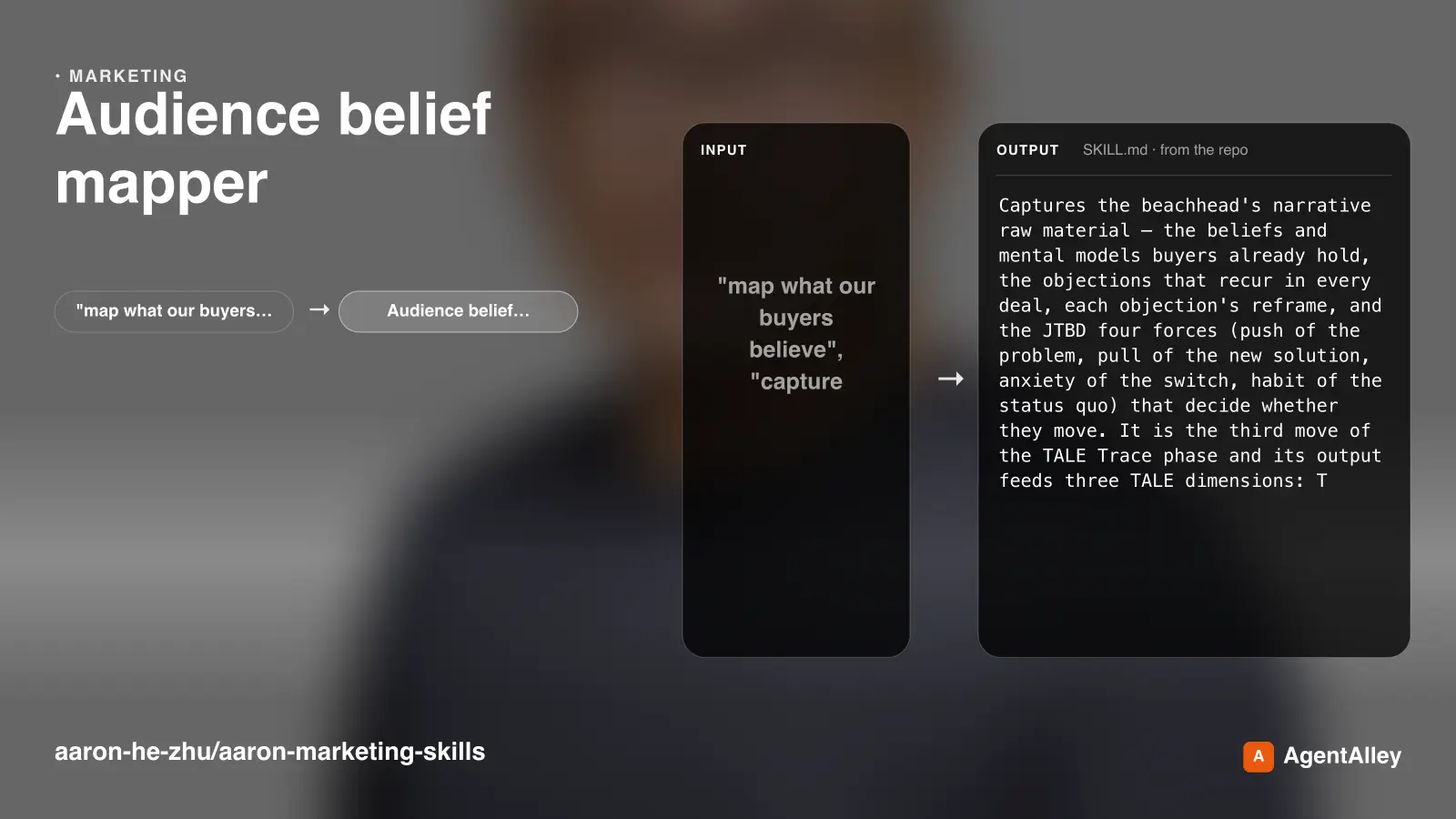 SkillMap what our buyers believeAudience belief mapper
 aaron-he-zhu/aaron-marketing-skills · by aaron-he-zhuUse when the user asks to "map what our buyers believe", "capture the objections we keep hearing", or "find the switching forces that move the beachhead"; produces a belief map of the beachhead — held beliefs and mental models, the recurring objections and their reframes, and the JTBD four forces (push of the problem, pull of the new, anxiety of switching, habit of the present) — each item sourced from interviews or win-loss notes (User-provided) and labeled Measured / User-provided / Estimated, with any unverified quote or comparative claim marked "[needs source]" and routed to the claims candidates, never adjudicated here. Not for demographic or persona profiling — use audience-mapper; not for the positioning canvas — use positioning-truth-tracer. 受众信念/异议地图/切换四力/流失语言★ 2.9k GitHub stars
 SkillPaste in your website and marketing copyBrand Voice Analysis and Guidelines Generation
 zubair-trabzada/ai-marketing-claude · by zubair-trabzadaPaste in your website and marketing copy, and get back a clear guide anyone on your team can follow to sound like your brand every time.★ 2.7k GitHub stars
 SkillYour brand designerFounder brand
 Jakeschincariol/founder-skill · by JakeschincariolYour brand designer. Names the business (with the trademark, domain and handle checks to run before falling in love with a name), writes the voice, a one-line promise and a tagline, and briefs the look: colours, type, logo and the first things a customer sees, so they match the positioning the marketing director chose. Use when the user says "name my business", "brand this", "logo", "brand identity", "what should it look like", "tagline", or "brand voice".★ 322 GitHub stars
 SkillAnalyze and rewrite content to strict brand voice guidelinesBrand voice enforcer
 writer/skills · by writerAnalyze and rewrite content to strict brand voice guidelines, scoring adherence across tone, vocabulary, syntax patterns, and persona alignment for CPG and retail brands.★ 7 GitHub stars
 SkillAdapt one core brand voice coherently across every adBrand voice ad adaptation
 gmmh1/claude-paid-media-skills · by gmmh1Adapt one core brand voice coherently across every ad platform's native register — professional on LinkedIn, native/casual on TikTok, conversational on Meta, direct on Google Search. Triggers on 'does this still sound like us', 'adapt our brand voice for TikTok', 'keep our voice consistent across ad platforms', or 'this ad doesn't sound on-brand'. Cross-platform consistency layer feeding every platform's copywriting skill.New listing
More from mohitagw15856
 SkillDesign a 360-degree feedback survey or write a structured360-Degree Feedback Template Skill
 mohitagw15856/pm-claude-skills · by mohitagw15856Design a 360-degree feedback survey or write a structured 360 feedback report. Use when asked to build a 360 feedback process, write 360 feedback for a colleague, design a feedback survey, or produce a feedback report. Produces either a complete survey instrument with rating scales and open-ended questions, or a structured narrative feedback report with themes, strengths, and development areas.★ 1.4k GitHub stars
 SkillDesign statistically rigorous A/B tests for product featuresA/B Test Planner Skillmohitagw15856/pm-claude-skills · by mohitagw15856Design statistically rigorous A/B tests for product features, UI changes, onboarding flows, and pricing experiments. Use when asked to set up an experiment, design an A/B test, calculate sample size, or interpret test results. Produces a complete test plan with hypothesis, variant definitions, sample size, duration estimate, guardrail metrics, and a results interpretation guide.★ 1.4k GitHub stars
 SkillGenerate a WCAG 2.2 accessibility audit checklistAccessibility Audit Skillmohitagw15856/pm-claude-skills · by mohitagw15856Generate a WCAG 2.2 accessibility audit checklist and remediation suggestions for any UI or design. Use when asked to audit for accessibility, check WCAG compliance, review a design for a11y issues, or create an accessibility remediation plan. Produces a prioritised checklist with pass/fail assessments and specific fixes.★ 1.4k GitHub stars
 SkillBuild a structured account plan for any key customerAccount Plan Skillmohitagw15856/pm-claude-skills · by mohitagw15856Build a structured account plan for any key customer or target account. Use when asked to create an account plan, key account strategy, strategic account review, or territory plan. Produces a complete account plan with relationship map, growth opportunities, risks, and 90-day action plan.★ 1.4k GitHub stars
 SkillOptimize an article for Answer Engine Optimization so AIAEO Optimizer Skillmohitagw15856/pm-claude-skills · by mohitagw15856Optimize an article for Answer Engine Optimization (AEO) so AI engines like ChatGPT, Perplexity, and Claude can extract, quote, and cite it. Use when asked to AEO-optimize, make content AI-readable, improve AI citation chances, or adapt an article for answer engines. Produces an AEO-optimised rewrite with question headings, 50–80 word answer capsules, a paragraph-length audit, and flagged trust signals.★ 1.4k GitHub stars
 SkillConduct a structured ethical review of an AI or ML featureAI Ethics Review Skillmohitagw15856/pm-claude-skills · by mohitagw15856Conduct a structured ethical review of an AI or ML feature, model, or product. Use when preparing to deploy an AI system, assessing algorithmic risk, auditing a model for bias, or producing a responsible AI impact assessment. Produces a structured ethics review covering fairness, transparency, privacy, safety, accountability, and societal impact with a risk tier score, pre-deployment checklist, and prioritised mitigations.★ 1.4k GitHub stars