Partnership Proposal Skill
Write a B2B partnership proposal or business case.
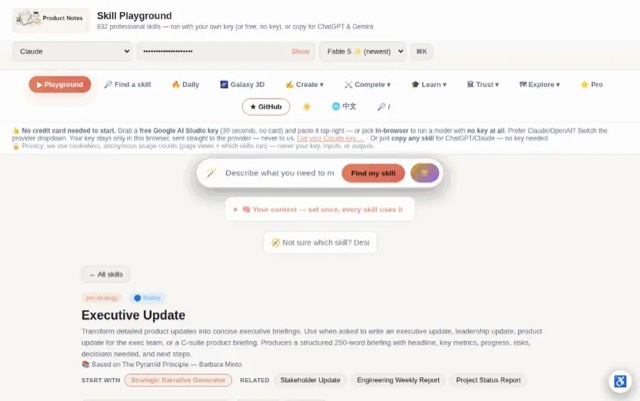

From the mohitagw15856/pm-claude-skills README — shows the whole collection, not only this skill. · view on GitHub
How to use it
Claude Code
- Run the line below. It pulls the whole folder into
~/.claude/skills/partnership-proposal. - Describe your job in plain words. Claude Code follows the skill from there.
npx degit mohitagw15856/pm-claude-skills/skills/partnership-proposal#main ~/.claude/skills/partnership-proposalFor one project only, change the path to .claude/skills/partnership-proposal.
Claude (web or desktop app)
- On this page open ⋯ → Download .md.
- Save it as SKILL.md in a folder, zip the folder, then Customize → Skills → + → Create skill → Upload a skill.
- Pick the file and Save. Claude shows the name and description and runs a security scan.
- Check the skill is switched on.
- Start a new chat and describe your job in plain words. The AI follows the skill from there.
ChatGPT or another app
- ChatGPT: make a Project and paste it into Instructions.
- Neither? Paste it at the top of a new chat — it works for that chat.
Not working?
- Check which app you pasted it into — the steps above name the right one.
- Some skills need the paid tier of Claude or ChatGPT.
Paste into Claude, ChatGPT or Cursor.
Source of Partnership Proposal Skill
Show the full text237 lines
| name | description |
|---|---|
| partnership-proposal | Write a B2B partnership proposal or business case. Use when asked to write a partnership proposal, draft a partnership brief, structure a co-marketing proposal, or create a business case for a strategic partnership. Produces a structured proposal with value proposition, partnership model, commercial terms, and mutual commitments. |
Partnership Proposal Skill
This skill produces a complete B2B partnership proposal covering the partnership rationale, mutual value, partnership model, commercial terms, governance, and a joint go-to-market plan. Output is ready to share with a prospective partner or use as the basis for a business case to internal stakeholders.
Required Inputs
Ask the user for these if not provided:
- Your company — name, what you do, and the audience you serve
- Prospective partner — name, what they do, and their audience
- Partnership type — technology integration / co-marketing / reseller / referral / strategic alliance / OEM
- Partnership goal — what does each party get? (new customers / revenue / product capability / market reach)
- Proposed commercial model — revenue share, referral fee, licensing, co-investment?
- Urgency or context — is there a specific event, product launch, or competitive reason for this partnership?
Output Structure
Partnership Proposal: [Your Company] × [Partner Company]
Prepared by: [Name, Role at Your Company] Date: [Date] Partnership type: [Technology / Co-marketing / Reseller / Referral / Strategic Alliance] Proposal status: [Initial proposal / For negotiation / Final]
Executive Summary
[3–5 sentences. Answer: what are we proposing, why now, and what does each party stand to gain? Write this so a busy executive can understand the proposal in 60 seconds without reading further.]
Headline value for [Partner]:
[One sentence — the most compelling thing this partnership does for them]
Headline value for [Your Company]:
[One sentence — the most compelling thing this partnership does for you]
1. The Opportunity
Market context: [Why does this partnership make sense now? What's happening in the market that creates a window for this to work?]
Shared customer: [Describe the customer both organisations serve — the overlap that makes this logical. Include size of the shared addressable market if you have it.]
Problem neither of us solves alone: [What can't either party do for the shared customer independently that the partnership would enable?]
2. What We're Proposing
Partnership model:
| Element | Description |
|---|---|
| Type | [Technology integration / Co-marketing / Reseller / Referral / OEM] |
| Scope | [What specifically are we partnering on? — product features, joint campaigns, distribution, etc.] |
| Exclusivity | [Exclusive in [region/segment] / Non-exclusive / Right of first refusal] |
| Duration | [Initial term — e.g. 12 months, renewable] |
| Geographic scope | [UK / EMEA / Global / Specific markets] |
What this looks like in practice:
[3–5 bullet points describing what the partnership actually means day-to-day. Make it concrete and operational — not abstract. e.g.:]
- [Our product will natively integrate with [Partner's product] — the integration will be live in [timeframe]]
- [We will co-market to each other's customer bases — joint webinar, co-authored content, shared newsletter placement]
- [Each company will train a dedicated partnership contact who manages the relationship]
- [[Partner] will list [Your product] in their marketplace / app directory / referral programme]
3. Value Proposition — What Each Party Gets
For [Partner]
| Value | Evidence / Basis |
|---|---|
| [New customer reach] | [e.g. Access to [Your Company]'s [X,000] [role] customers — [X%] of whom have expressed interest in [Partner's category]] |
| [Product capability] | [e.g. [Partner]'s product gains [capability] that [X%] of their customers have requested — based on [source]] |
| [Revenue opportunity] | [e.g. Estimated [£/$/€ X] in referral revenue in Year 1 based on [X%] conversion from shared pipeline] |
| [Market differentiation] | [e.g. The integration creates a meaningful competitive moat vs [Competitor] who lacks this capability] |
For [Your Company]
| Value | Evidence / Basis |
|---|---|
| [Distribution] | [e.g. Access to [Partner]'s [X,000] customers in [segment] — a segment where we currently have [X] customers] |
| [Credibility] | [e.g. Association with [Partner]'s brand accelerates enterprise sales cycles — [Partner] is trusted by [X] of the Fortune 500] |
| [Revenue] | [e.g. Target [X] referral customers in Year 1 at average ACV of [£X] = [£X ARR]] |
| [Product] | [e.g. [Partner]'s data / capability enhances [specific part of our product] — improving [user outcome]] |
4. Commercial Model
Proposed commercial terms:
| Term | Proposal | Notes |
|---|---|---|
| Revenue share | [e.g. [X%] of ARR from customers referred by [Partner]] | [Standard in this category: [X–Y%] range] |
| Referral fee | [e.g. £[X] per qualified lead that converts] | [Or: flat fee per introduction vs % of closed deal] |
| Licensing / access | [e.g. [Partner] provides API access at no cost in exchange for integration and co-marketing] | [...] |
| Co-marketing investment | [e.g. Each party commits [£X] to joint marketing activities per quarter] | [...] |
| Minimum commitment | [e.g. [X] qualified referrals per quarter / [£X] GMV per year] | [Optional — only if there's a meaningful minimum that makes sense] |
Payment terms: [Monthly / Quarterly in arrears / Annual true-up]
What we're not proposing: [Be explicit about what's off the table — e.g. equity / exclusivity in all markets / upfront payment]
5. Joint Go-to-Market Plan
Phase 1: Foundation (Months 1–2)
| Activity | Owner | Timeline |
|---|---|---|
| Technical integration scoped and resourced | [Engineering at both companies] | [Month 1] |
| Partnership launch announcement drafted | [Marketing at both companies] | [Month 1] |
| Joint customer case study identified | [CSM at both companies] | [Month 2] |
| Partner enablement — each team trained on the other's product | [Partnership lead, both sides] | [Month 2] |
Phase 2: Launch (Month 3)
| Activity | Owner | Timeline |
|---|---|---|
| Integration live in both products / marketplace | [Engineering] | [Month 3] |
| Joint press release / blog post / email announcement | [Marketing] | [Month 3] |
| First joint webinar | [Both companies] | [Month 3] |
| First joint pipeline reviewed | [Partnership leads] | [Month 3] |
Phase 3: Scale (Months 4–12)
| Activity | Owner | Cadence |
|---|---|---|
| Co-sell on named accounts | [AE at both companies] | [Monthly] |
| Joint content (blog, webinar, case study) | [Marketing] | [Quarterly] |
| Pipeline and revenue review | [Partnership leads] | [Monthly] |
| Partnership QBR | [VP level, both companies] | [Quarterly] |
6. Success Metrics
How we'll know the partnership is working:
| Metric | Year 1 target | Measurement |
|---|---|---|
| Customers referred (each direction) | [X] | [CRM tracking — tagged as partner-sourced] |
| Revenue from partnership | [£/$/€ X ARR] | [CRM + finance reporting] |
| Integration adoption | [X% of mutual customers using integration] | [Product analytics] |
| Customer satisfaction with integration | [NPS ≥ X] | [Post-integration survey] |
| Joint pipeline generated | [£X] | [Quarterly pipeline review] |
Review cadence: Monthly partnership lead check-in + Quarterly business review at VP level
7. Governance & Operations
Partnership contacts:
| Role | [Your Company] | [Partner] |
|---|---|---|
| Partnership lead (day-to-day) | [Name, email] | [TBC] |
| Executive sponsor | [Name, title] | [TBC] |
| Technical lead | [Name] | [TBC] |
| Marketing lead | [Name] | [TBC] |
Decision-making:
- Day-to-day partnership operations: partnership leads
- Commercial term changes: VP-level approval from both parties
- Partnership termination: CEO/MD sign-off + [X days] written notice
Legal framework:
- Partnership agreement / MOU to be drafted by [Company]'s legal team
- Data processing agreement (if personal data is shared)
- NDAs: [already in place / to be signed before detailed discussions]
- IP ownership: [Clarify who owns jointly developed materials, integrations, content]
8. Risks & Mitigations
| Risk | Likelihood | Mitigation |
|---|---|---|
| Partnership champion leaves [Partner] | M | Ensure VP-level sponsorship; build multiple relationships |
| Integration takes longer than planned | M | Scope technical work in Phase 1; set realistic launch commitment |
| Low adoption of the integration | M | Include in onboarding for both products; co-market to existing customers not just new |
| Partner signs with our competitor | L | Discuss exclusivity options; prioritise quick launch to create switching costs |
| Commercial model becomes imbalanced | L | Quarterly review with clear exit terms if targets are consistently missed |
9. Proposed Next Steps
| # | Action | Owner | By when |
|---|---|---|---|
| 1 | [Partner] reviews this proposal and provides feedback | [[Partner name]] | [Date] |
| 2 | Both parties sign NDA (if not already in place) | [Legal, both sides] | [Before next meeting] |
| 3 | Technical discovery call — assess integration feasibility | [Engineering leads] | [Date] |
| 4 | Commercial terms negotiation | [Partnership leads / VP] | [Date] |
| 5 | MOU / partnership agreement drafted and signed | [Legal] | [Date] |
| 6 | Integration and launch planning begins | [Both teams] | [Date] |
Quality Checks
- Value proposition for the partner is written from their perspective — not yours
- Commercial model includes specific numbers, not just structure
- "What we're not proposing" section prevents misaligned expectations
- Go-to-market plan has named owners and dates, not "TBD"
- Success metrics are agreed bilaterally — not set unilaterally
- Risks section includes the most uncomfortable risk (partner signs with a competitor)
Example Trigger Phrases
- "Write a partnership proposal for [Company] to partner with [Partner]"
- "Draft a co-marketing partnership brief between us and [Partner]"
- "Create a reseller partnership proposal for [Company]"
- "Build the business case for a strategic partnership with [Partner]"
- "Structure a technology integration partnership proposal"
Anti-Patterns
- Do not write the value proposition from your own perspective — the "For Partner" section must be written from the partner's point of view, in the language of their goals and their customers
- Do not leave commercial terms as structure without numbers — a proposal that says "revenue share" without stating the percentage is not a proposal, it is a conversation opener
- Do not omit the "What we're not proposing" section — leaving unstated assumptions creates misaligned expectations that derail negotiations later
- Do not set success metrics unilaterally — metrics that only your company controls or cares about will not earn partner commitment
- Do not write a go-to-market plan with "TBD" owners — every activity must have a named owner on at least one side before the proposal goes out
| 1 | |
| 2 | name partnership-proposal |
| 3 | description "Write a B2B partnership proposal or business case. Use when asked to write a partnership proposal, draft a partnership brief, structure a co-marketing proposal, or create a business case for a strategic partnership. Produces a structured proposal with value proposition, partnership model, commercial terms, and mutual commitments." |
| 4 | |
| 5 | |
| 6 | # Partnership Proposal Skill |
| 7 | |
| 8 | This skill produces a complete B2B partnership proposal covering the partnership rationale, mutual value, partnership model, commercial terms, governance, and a joint go-to-market plan. Output is ready to share with a prospective partner or use as the basis for a business case to internal stakeholders. |
| 9 | |
| 10 | ## Required Inputs |
| 11 | |
| 12 | Ask the user for these if not provided: |
| 13 | **Your company** — name, what you do, and the audience you serve |
| 14 | **Prospective partner** — name, what they do, and their audience |
| 15 | **Partnership type** — technology integration / co-marketing / reseller / referral / strategic alliance / OEM |
| 16 | **Partnership goal** — what does each party get? (new customers / revenue / product capability / market reach) |
| 17 | **Proposed commercial model** — revenue share, referral fee, licensing, co-investment? |
| 18 | **Urgency or context** — is there a specific event, product launch, or competitive reason for this partnership? |
| 19 | |
| 20 | ## Output Structure |
| 21 | |
| 22 | |
| 23 | |
| 24 | # Partnership Proposal: [Your Company] × [Partner Company] |
| 25 | |
| 26 | **Prepared by:** [Name, Role at Your Company] |
| 27 | **Date:** [Date] |
| 28 | **Partnership type:** [Technology / Co-marketing / Reseller / Referral / Strategic Alliance] |
| 29 | **Proposal status:** [Initial proposal / For negotiation / Final] |
| 30 | |
| 31 | |
| 32 | |
| 33 | ## Executive Summary |
| 34 | |
| 35 | [3–5 sentences. Answer: what are we proposing, why now, and what does each party stand to gain? Write this so a busy executive can understand the proposal in 60 seconds without reading further.] |
| 36 | |
| 37 | **Headline value for [Partner]:** |
| 38 | > [One sentence — the most compelling thing this partnership does for them] |
| 39 | |
| 40 | **Headline value for [Your Company]:** |
| 41 | > [One sentence — the most compelling thing this partnership does for you] |
| 42 | |
| 43 | |
| 44 | |
| 45 | ## 1. The Opportunity |
| 46 | |
| 47 | **Market context:** [Why does this partnership make sense now? What's happening in the market that creates a window for this to work?] |
| 48 | |
| 49 | **Shared customer:** [Describe the customer both organisations serve — the overlap that makes this logical. Include size of the shared addressable market if you have it.] |
| 50 | |
| 51 | **Problem neither of us solves alone:** [What can't either party do for the shared customer independently that the partnership would enable?] |
| 52 | |
| 53 | |
| 54 | |
| 55 | ## 2. What We're Proposing |
| 56 | |
| 57 | **Partnership model:** |
| 58 | |
| 59 | | Element | Description | |
| 60 | |---|---| |
| 61 | | **Type** | [Technology integration / Co-marketing / Reseller / Referral / OEM] | |
| 62 | | **Scope** | [What specifically are we partnering on? — product features, joint campaigns, distribution, etc.] | |
| 63 | | **Exclusivity** | [Exclusive in [region/segment] / Non-exclusive / Right of first refusal] | |
| 64 | | **Duration** | [Initial term — e.g. 12 months, renewable] | |
| 65 | | **Geographic scope** | [UK / EMEA / Global / Specific markets] | |
| 66 | |
| 67 | **What this looks like in practice:** |
| 68 | |
| 69 | [3–5 bullet points describing what the partnership actually means day-to-day. Make it concrete and operational — not abstract. e.g.:] |
| 70 | [Our product will natively integrate with [Partner's product] — the integration will be live in [timeframe]] |
| 71 | [We will co-market to each other's customer bases — joint webinar, co-authored content, shared newsletter placement] |
| 72 | [Each company will train a dedicated partnership contact who manages the relationship] |
| 73 | [[Partner] will list [Your product] in their marketplace / app directory / referral programme] |
| 74 | |
| 75 | |
| 76 | |
| 77 | ## 3. Value Proposition — What Each Party Gets |
| 78 | |
| 79 | ### For [Partner] |
| 80 | |
| 81 | | Value | Evidence / Basis | |
| 82 | |---|---| |
| 83 | | **[New customer reach]** | [e.g. Access to [Your Company]'s [X,000] [role] customers — [X%] of whom have expressed interest in [Partner's category]] | |
| 84 | | **[Product capability]** | [e.g. [Partner]'s product gains [capability] that [X%] of their customers have requested — based on [source]] | |
| 85 | | **[Revenue opportunity]** | [e.g. Estimated [£/$/€ X] in referral revenue in Year 1 based on [X%] conversion from shared pipeline] | |
| 86 | | **[Market differentiation]** | [e.g. The integration creates a meaningful competitive moat vs [Competitor] who lacks this capability] | |
| 87 | |
| 88 | ### For [Your Company] |
| 89 | |
| 90 | | Value | Evidence / Basis | |
| 91 | |---|---| |
| 92 | | **[Distribution]** | [e.g. Access to [Partner]'s [X,000] customers in [segment] — a segment where we currently have [X] customers] | |
| 93 | | **[Credibility]** | [e.g. Association with [Partner]'s brand accelerates enterprise sales cycles — [Partner] is trusted by [X] of the Fortune 500] | |
| 94 | | **[Revenue]** | [e.g. Target [X] referral customers in Year 1 at average ACV of [£X] = [£X ARR]] | |
| 95 | | **[Product]** | [e.g. [Partner]'s data / capability enhances [specific part of our product] — improving [user outcome]] | |
| 96 | |
| 97 | |
| 98 | |
| 99 | ## 4. Commercial Model |
| 100 | |
| 101 | **Proposed commercial terms:** |
| 102 | |
| 103 | | Term | Proposal | Notes | |
| 104 | |---|---|---| |
| 105 | | **Revenue share** | [e.g. [X%] of ARR from customers referred by [Partner]] | [Standard in this category: [X–Y%] range] | |
| 106 | | **Referral fee** | [e.g. £[X] per qualified lead that converts] | [Or: flat fee per introduction vs % of closed deal] | |
| 107 | | **Licensing / access** | [e.g. [Partner] provides API access at no cost in exchange for integration and co-marketing] | [...] | |
| 108 | | **Co-marketing investment** | [e.g. Each party commits [£X] to joint marketing activities per quarter] | [...] | |
| 109 | | **Minimum commitment** | [e.g. [X] qualified referrals per quarter / [£X] GMV per year] | [Optional — only if there's a meaningful minimum that makes sense] | |
| 110 | |
| 111 | **Payment terms:** [Monthly / Quarterly in arrears / Annual true-up] |
| 112 | |
| 113 | **What we're not proposing:** [Be explicit about what's off the table — e.g. equity / exclusivity in all markets / upfront payment] |
| 114 | |
| 115 | |
| 116 | |
| 117 | ## 5. Joint Go-to-Market Plan |
| 118 | |
| 119 | **Phase 1: Foundation (Months 1–2)** |
| 120 | |
| 121 | | Activity | Owner | Timeline | |
| 122 | |---|---|---| |
| 123 | | Technical integration scoped and resourced | [Engineering at both companies] | [Month 1] | |
| 124 | | Partnership launch announcement drafted | [Marketing at both companies] | [Month 1] | |
| 125 | | Joint customer case study identified | [CSM at both companies] | [Month 2] | |
| 126 | | Partner enablement — each team trained on the other's product | [Partnership lead, both sides] | [Month 2] | |
| 127 | |
| 128 | **Phase 2: Launch (Month 3)** |
| 129 | |
| 130 | | Activity | Owner | Timeline | |
| 131 | |---|---|---| |
| 132 | | Integration live in both products / marketplace | [Engineering] | [Month 3] | |
| 133 | | Joint press release / blog post / email announcement | [Marketing] | [Month 3] | |
| 134 | | First joint webinar | [Both companies] | [Month 3] | |
| 135 | | First joint pipeline reviewed | [Partnership leads] | [Month 3] | |
| 136 | |
| 137 | **Phase 3: Scale (Months 4–12)** |
| 138 | |
| 139 | | Activity | Owner | Cadence | |
| 140 | |---|---|---| |
| 141 | | Co-sell on named accounts | [AE at both companies] | [Monthly] | |
| 142 | | Joint content (blog, webinar, case study) | [Marketing] | [Quarterly] | |
| 143 | | Pipeline and revenue review | [Partnership leads] | [Monthly] | |
| 144 | | Partnership QBR | [VP level, both companies] | [Quarterly] | |
| 145 | |
| 146 | |
| 147 | |
| 148 | ## 6. Success Metrics |
| 149 | |
| 150 | How we'll know the partnership is working: |
| 151 | |
| 152 | | Metric | Year 1 target | Measurement | |
| 153 | |---|---|---| |
| 154 | | Customers referred (each direction) | [X] | [CRM tracking — tagged as partner-sourced] | |
| 155 | | Revenue from partnership | [£/$/€ X ARR] | [CRM + finance reporting] | |
| 156 | | Integration adoption | [X% of mutual customers using integration] | [Product analytics] | |
| 157 | | Customer satisfaction with integration | [NPS ≥ X] | [Post-integration survey] | |
| 158 | | Joint pipeline generated | [£X] | [Quarterly pipeline review] | |
| 159 | |
| 160 | **Review cadence:** Monthly partnership lead check-in + Quarterly business review at VP level |
| 161 | |
| 162 | |
| 163 | |
| 164 | ## 7. Governance & Operations |
| 165 | |
| 166 | **Partnership contacts:** |
| 167 | |
| 168 | | Role | [Your Company] | [Partner] | |
| 169 | |---|---|---| |
| 170 | | Partnership lead (day-to-day) | [Name, email] | [TBC] | |
| 171 | | Executive sponsor | [Name, title] | [TBC] | |
| 172 | | Technical lead | [Name] | [TBC] | |
| 173 | | Marketing lead | [Name] | [TBC] | |
| 174 | |
| 175 | **Decision-making:** |
| 176 | Day-to-day partnership operations: partnership leads |
| 177 | Commercial term changes: VP-level approval from both parties |
| 178 | Partnership termination: CEO/MD sign-off + [X days] written notice |
| 179 | |
| 180 | **Legal framework:** |
| 181 | [ ] Partnership agreement / MOU to be drafted by [Company]'s legal team |
| 182 | [ ] Data processing agreement (if personal data is shared) |
| 183 | [ ] NDAs: [already in place / to be signed before detailed discussions] |
| 184 | [ ] IP ownership: [Clarify who owns jointly developed materials, integrations, content] |
| 185 | |
| 186 | |
| 187 | |
| 188 | ## 8. Risks & Mitigations |
| 189 | |
| 190 | | Risk | Likelihood | Mitigation | |
| 191 | |---|---|---| |
| 192 | | Partnership champion leaves [Partner] | M | Ensure VP-level sponsorship; build multiple relationships | |
| 193 | | Integration takes longer than planned | M | Scope technical work in Phase 1; set realistic launch commitment | |
| 194 | | Low adoption of the integration | M | Include in onboarding for both products; co-market to existing customers not just new | |
| 195 | | Partner signs with our competitor | L | Discuss exclusivity options; prioritise quick launch to create switching costs | |
| 196 | | Commercial model becomes imbalanced | L | Quarterly review with clear exit terms if targets are consistently missed | |
| 197 | |
| 198 | |
| 199 | |
| 200 | ## 9. Proposed Next Steps |
| 201 | |
| 202 | | # | Action | Owner | By when | |
| 203 | |---|---|---|---| |
| 204 | | 1 | [Partner] reviews this proposal and provides feedback | [[Partner name]] | [Date] | |
| 205 | | 2 | Both parties sign NDA (if not already in place) | [Legal, both sides] | [Before next meeting] | |
| 206 | | 3 | Technical discovery call — assess integration feasibility | [Engineering leads] | [Date] | |
| 207 | | 4 | Commercial terms negotiation | [Partnership leads / VP] | [Date] | |
| 208 | | 5 | MOU / partnership agreement drafted and signed | [Legal] | [Date] | |
| 209 | | 6 | Integration and launch planning begins | [Both teams] | [Date] | |
| 210 | |
| 211 | |
| 212 | |
| 213 | ## Quality Checks |
| 214 | |
| 215 | [ ] Value proposition for the partner is written from their perspective — not yours |
| 216 | [ ] Commercial model includes specific numbers, not just structure |
| 217 | [ ] "What we're not proposing" section prevents misaligned expectations |
| 218 | [ ] Go-to-market plan has named owners and dates, not "TBD" |
| 219 | [ ] Success metrics are agreed bilaterally — not set unilaterally |
| 220 | [ ] Risks section includes the most uncomfortable risk (partner signs with a competitor) |
| 221 | |
| 222 | ## Example Trigger Phrases |
| 223 | |
| 224 | "Write a partnership proposal for [Company] to partner with [Partner]" |
| 225 | "Draft a co-marketing partnership brief between us and [Partner]" |
| 226 | "Create a reseller partnership proposal for [Company]" |
| 227 | "Build the business case for a strategic partnership with [Partner]" |
| 228 | "Structure a technology integration partnership proposal" |
| 229 | |
| 230 | ## Anti-Patterns |
| 231 | |
| 232 | [ ] Do not write the value proposition from your own perspective — the "For Partner" section must be written from the partner's point of view, in the language of their goals and their customers |
| 233 | [ ] Do not leave commercial terms as structure without numbers — a proposal that says "revenue share" without stating the percentage is not a proposal, it is a conversation opener |
| 234 | [ ] Do not omit the "What we're not proposing" section — leaving unstated assumptions creates misaligned expectations that derail negotiations later |
| 235 | [ ] Do not set success metrics unilaterally — metrics that only your company controls or cares about will not earn partner commitment |
| 236 | [ ] Do not write a go-to-market plan with "TBD" owners — every activity must have a named owner on at least one side before the proposal goes out |
| 237 |
Discussion
Browse more free Claude skills or everything in Marketing.