OKR Builder Skill
Create well-structured OKRs (Objectives and Key Results) for product teams, startups, and individuals.
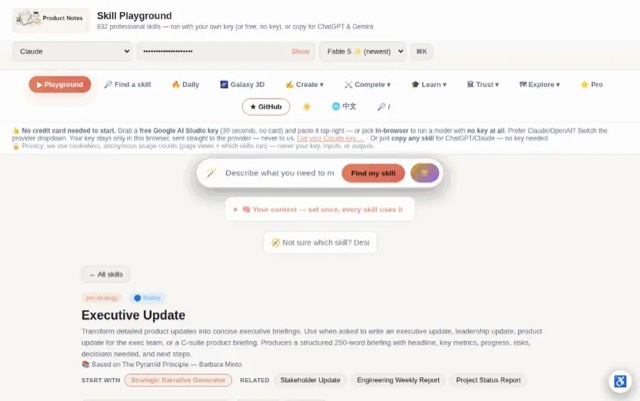
From the mohitagw15856/pm-claude-skills README — shows the whole collection, not only this skill. · view on GitHub
How to use it
Claude Code
- Run the line below. It pulls the whole folder into
~/.claude/skills/okr-builder, including the files SKILL.md points to. - Describe your job in plain words. Claude Code follows the skill from there.
npx degit mohitagw15856/pm-claude-skills/skills/okr-builder#main ~/.claude/skills/okr-builderFor one project only, change the path to .claude/skills/okr-builder. This skill also uses context.md — copying SKILL.md alone won't be enough. See the folder on GitHub.
Claude (web or desktop app)
- On this page open ⋯ → Download .md.
- Save it as SKILL.md in a folder, zip the folder, then Customize → Skills → + → Create skill → Upload a skill.
- Pick the file and Save. Claude shows the name and description and runs a security scan.
- Check the skill is switched on.
- Start a new chat and describe your job in plain words. The AI follows the skill from there.
ChatGPT or another app
- ChatGPT: make a Project and paste it into Instructions.
- Neither? Paste it at the top of a new chat — it works for that chat.
Not working?
- Check which app you pasted it into — the steps above name the right one.
- Some skills need the paid tier of Claude or ChatGPT.
Paste into Claude, ChatGPT or Cursor.
Source of OKR Builder Skill
Show the full text121 lines
| name | description |
|---|---|
| okr-builder | Create well-structured OKRs (Objectives and Key Results) for product teams, startups, and individuals. Use when asked to write OKRs, set quarterly goals, define key results, or review existing OKRs. Produces a complete OKR set with objectives, measurable key results, baselines, and a scoring guide. |
OKR Builder Skill
Write ambitious, measurable OKRs that connect product work to company strategy. Avoid vanity metrics, output-focused key results, and objectives that sound like task lists.
Reads from / Writes to the Brain
If a professional-brain (brain/) exists, ground in it instead of re-asking for what you already know:
- Read first:
context.md(metric definitions),knowledge/strategy.md(where the product is going), and any openhypotheses/. Runpython3 ../professional-brain/scripts/brain_query.py ./brain "<objective theme>"and carry each fact's provenance tag through — don't set a key result off a[hunch]as if it were[data]. - 📥 Propose to the Brain: after producing, propose logging the chosen objectives + KR targets as a
decisions/record (the period's bet) and any new metric definitions toknowledge/, each provenance-tagged. Show them, get a yes, then write with../professional-brain/scripts/brain_write.py … --commit(append-only, dry-run by default).
Working from a brief
You will often get a short brief without every detail (no baselines, no exact numbers). Always deliver a complete, specific OKR set anyway — do not stop to ask questions and do not leave bracketed placeholders like [target]. Where a baseline or number is missing, infer a realistic value from the brief and the domain, and mark it (assumed — confirm). A clearly-labelled assumed baseline (e.g. "activation 40% (assumed) → 60%") is always better than a blank or an invented-as-fact figure.
Deeper Materials
references/bad-okr-gallery.md— six realistic bad OKRs with diagnosis and rewrite (disguised roadmap, unfalsifiable objective, sandbagging, uncontrollable KR, metric zoo, missing guardrail), ending in a 5-question diagnostic. Use it when reviewing existing OKRs — match against the gallery before writing feedback.templates/okr-worksheet.md— a fill-in worksheet whose columns enforce the quality gates (baseline source, drift test, control test, guardrail) plus a pre-committed quarter-end scoring rubric. Offer it when a team wants to draft OKRs themselves.
OKR Fundamentals
Objective: Qualitative, inspiring, time-bound. Answers "where are we going?" Key Result: Quantitative, specific, measurable. Answers "how will we know we've arrived?"
The Test for a Good KR
- Can it be scored 0.0–1.0 at the end of the period?
- Does it measure outcome, not output? ("Revenue from new customers increased by 30%" not "Launch 3 features")
- Is it ambitious but achievable? (Aim for 70% attainment as the gold standard)
- Is it within the team's control?
Common OKR Anti-Patterns to Flag and Fix
| Anti-Pattern | Example | Better Version |
|---|---|---|
| Task masquerading as KR | "Launch onboarding redesign" | "New user activation rate increases from 42% to 65%" |
| Vanity metric | "Get 10,000 app downloads" | "30-day retention for new users reaches 40%" |
| Binary KR | "Ship API v2" | "API v2 adopted by 80% of active integrations" |
| Too many KRs | 6+ per objective | Max 3–4 KRs per objective |
| No baseline | "Improve NPS" | "NPS increases from 32 to 50" |
Always flag anti-patterns and offer a rewrite.
Output Format
[Quarter] OKRs — [Team/Product Area]
Objective 1: [Inspiring, qualitative statement]
Why this matters: [1–2 sentence strategic context]
| # | Key Result | Baseline | Target | Measurement Method |
|---|---|---|---|---|
| KR1 | [Measurable outcome] | [Current state] | [Target] | [How measured] |
| KR2 | [Measurable outcome] | [Current state] | [Target] | [How measured] |
| KR3 | [Measurable outcome] | [Current state] | [Target] | [How measured] |
Owner: [Name/Role] Check-in cadence: Weekly
Repeat for each objective. Recommend 2–4 objectives per team per quarter.
Scoring Guide to Include
At quarter end, score each KR:
- 0.7–1.0 = Excellent (0.7 is the "sweet spot" — if all KRs score 1.0, they weren't ambitious enough)
- 0.4–0.6 = Made progress but missed
- 0.0–0.3 = Missed — needs retrospective discussion
Inputs (infer any not provided — label assumptions)
- Team or individual the OKRs are for
- Quarter and year
- Company or product North Star metric (OKRs should connect to this — if not given, infer a plausible one and label it (assumed))
- Top 3 priorities or goals for this quarter (rough notes are fine)
- Any existing OKRs to review or improve (optional)
Guidelines
- Connect OKRs to the company/product North Star; if it isn't given, infer a plausible one and label it (assumed) rather than asking
- Recommend no more than 3 objectives per team per quarter
- If user provides output-based goals, always reframe as outcomes
- Include a "health check" section flagging which KRs have no current baseline data
- Remind user: OKRs are not performance reviews — they should be ambitious enough that missing them is okay
Scoring Rubric (0–40)
Score any output of this skill before handing it over; 32+ is ship-quality.
| Dimension | 0 | 5 | 10 |
|---|---|---|---|
| Outcome orientation | KRs are a shipped-feature task list ("launch X", "complete Y") | Mostly outcomes, but one or more KRs are outputs or binary ship/no-ship | Every KR is an outcome metric scorable 0.0–1.0 by degree of achievement |
| Baseline & measurability | No baselines or measurement methods; KRs cannot be scored at quarter end | Targets present but several baselines missing or unsourced, with no health-check flag | Every KR has baseline, target, and measurement method; missing data is flagged in a health check with a plan to instrument |
| Ambition calibration | Targets are last quarter's trendline (sandbagged) or pure fantasy with no path | Some stretch, but nobody could say what a 0.7 score looks like | Calibrated so 0.7 attainment is the expected good quarter; sandbagged proposals and moonshots are called out and corrected |
| Strategic focus & control | No link to a North Star; 5+ objectives or KR zoo; KRs depend on other teams' work | Ladders loosely to strategy but objectives are overloaded or one KR fails the control test | ≤3 objectives with ≤4 KRs each, every objective explicitly ladders to the North Star, and every KR is within the team's control |
Quality Checks
- Each KR is measurable with a baseline and target
- No output-based KRs (no "launch X" or "complete Y")
- Maximum 4 KRs per objective
- OKRs connect to the company or product North Star
- Ambitious enough that 0.7 attainment is the expected score
Anti-Patterns
- Do not accept output-based key results — any KR phrased as "launch X" or "complete Y" must be rewritten as an outcome with a baseline and target
- Do not write OKRs without asking for the company or product North Star — OKRs disconnected from the strategic context are just a goal-setting exercise
- Do not write more than 4 KRs per objective — too many KRs dilute focus and make scoring ambiguous at quarter end
- Do not use binary KRs (ship/don't ship) — every KR must be scorable on a 0.0–1.0 scale based on degree of achievement
- Do not skip the health check section on baselines — OKRs without current baselines cannot be scored objectively at quarter end
| 1 | |
| 2 | name okr-builder |
| 3 | description "Create well-structured OKRs (Objectives and Key Results) for product teams, startups, and individuals. Use when asked to write OKRs, set quarterly goals, define key results, or review existing OKRs. Produces a complete OKR set with objectives, measurable key results, baselines, and a scoring guide." |
| 4 | |
| 5 | |
| 6 | # OKR Builder Skill |
| 7 | |
| 8 | Write ambitious, measurable OKRs that connect product work to company strategy. Avoid vanity metrics, output-focused key results, and objectives that sound like task lists. |
| 9 | |
| 10 | ## Reads from / Writes to the Brain |
| 11 | |
| 12 | If a [`professional-brain`] (`brain/`) exists, ground in it instead of re-asking for what you already know: |
| 13 | |
| 14 | **Read first:** `context.md` (metric definitions), `knowledge/strategy.md` (where the product is going), and any open `hypotheses/`. Run `python3 ../professional-brain/scripts/brain_query.py ./brain "<objective theme>"` and carry each fact's provenance tag through — don't set a key result off a `[hunch]` as if it were `[data]`. |
| 15 | **📥 Propose to the Brain:** after producing, propose logging the chosen objectives + KR targets as a `decisions/` record (the period's bet) and any new metric definitions to `knowledge/`, each provenance-tagged. Show them, get a yes, then write with `../professional-brain/scripts/brain_write.py … --commit` (append-only, dry-run by default). |
| 16 | |
| 17 | ## Working from a brief |
| 18 | |
| 19 | You will often get a short brief without every detail (no baselines, no exact numbers). **Always deliver a complete, specific OKR set anyway** — do not stop to ask questions and do not leave bracketed placeholders like `[target]`. Where a baseline or number is missing, infer a realistic value from the brief and the domain, and mark it *(assumed — confirm)*. A clearly-labelled assumed baseline (e.g. "activation 40% *(assumed)* → 60%") is always better than a blank or an invented-as-fact figure. |
| 20 | |
| 21 | ## Deeper Materials |
| 22 | |
| 23 | **`references/bad-okr-gallery.md`** — six realistic bad OKRs with diagnosis and rewrite (disguised roadmap, unfalsifiable objective, sandbagging, uncontrollable KR, metric zoo, missing guardrail), ending in a 5-question diagnostic. Use it when *reviewing* existing OKRs — match against the gallery before writing feedback. |
| 24 | **`templates/okr-worksheet.md`** — a fill-in worksheet whose columns enforce the quality gates (baseline source, drift test, control test, guardrail) plus a pre-committed quarter-end scoring rubric. Offer it when a team wants to draft OKRs themselves. |
| 25 | |
| 26 | ## OKR Fundamentals |
| 27 | |
| 28 | **Objective:** Qualitative, inspiring, time-bound. Answers "where are we going?" |
| 29 | **Key Result:** Quantitative, specific, measurable. Answers "how will we know we've arrived?" |
| 30 | |
| 31 | ### The Test for a Good KR |
| 32 | Can it be scored 0.0–1.0 at the end of the period? |
| 33 | Does it measure outcome, not output? ("Revenue from new customers increased by 30%" not "Launch 3 features") |
| 34 | Is it ambitious but achievable? (Aim for 70% attainment as the gold standard) |
| 35 | Is it within the team's control? |
| 36 | |
| 37 | ## Common OKR Anti-Patterns to Flag and Fix |
| 38 | |
| 39 | | Anti-Pattern | Example | Better Version | |
| 40 | |---|---|---| |
| 41 | | Task masquerading as KR | "Launch onboarding redesign" | "New user activation rate increases from 42% to 65%" | |
| 42 | | Vanity metric | "Get 10,000 app downloads" | "30-day retention for new users reaches 40%" | |
| 43 | | Binary KR | "Ship API v2" | "API v2 adopted by 80% of active integrations" | |
| 44 | | Too many KRs | 6+ per objective | Max 3–4 KRs per objective | |
| 45 | | No baseline | "Improve NPS" | "NPS increases from 32 to 50" | |
| 46 | |
| 47 | Always flag anti-patterns and offer a rewrite. |
| 48 | |
| 49 | ## Output Format |
| 50 | |
| 51 | ### [Quarter] OKRs — [Team/Product Area] |
| 52 | |
| 53 | |
| 54 | |
| 55 | **Objective 1: [Inspiring, qualitative statement]** |
| 56 | |
| 57 | *Why this matters:* [1–2 sentence strategic context] |
| 58 | |
| 59 | | # | Key Result | Baseline | Target | Measurement Method | |
| 60 | |---|---|---|---|---| |
| 61 | | KR1 | [Measurable outcome] | [Current state] | [Target] | [How measured] | |
| 62 | | KR2 | [Measurable outcome] | [Current state] | [Target] | [How measured] | |
| 63 | | KR3 | [Measurable outcome] | [Current state] | [Target] | [How measured] | |
| 64 | |
| 65 | *Owner:* [Name/Role] |
| 66 | *Check-in cadence:* Weekly |
| 67 | |
| 68 | |
| 69 | |
| 70 | Repeat for each objective. Recommend 2–4 objectives per team per quarter. |
| 71 | |
| 72 | ## Scoring Guide to Include |
| 73 | |
| 74 | At quarter end, score each KR: |
| 75 | 0.7–1.0 = Excellent (0.7 is the "sweet spot" — if all KRs score 1.0, they weren't ambitious enough) |
| 76 | 0.4–0.6 = Made progress but missed |
| 77 | 0.0–0.3 = Missed — needs retrospective discussion |
| 78 | |
| 79 | ## Inputs (infer any not provided — label assumptions) |
| 80 | |
| 81 | **Team or individual** the OKRs are for |
| 82 | **Quarter and year** |
| 83 | **Company or product North Star metric** (OKRs should connect to this — if not given, infer a plausible one and label it *(assumed)*) |
| 84 | **Top 3 priorities or goals for this quarter** (rough notes are fine) |
| 85 | **Any existing OKRs to review or improve** (optional) |
| 86 | |
| 87 | ## Guidelines |
| 88 | |
| 89 | Connect OKRs to the company/product North Star; if it isn't given, infer a plausible one and label it *(assumed)* rather than asking |
| 90 | Recommend no more than 3 objectives per team per quarter |
| 91 | If user provides output-based goals, always reframe as outcomes |
| 92 | Include a "health check" section flagging which KRs have no current baseline data |
| 93 | Remind user: OKRs are not performance reviews — they should be ambitious enough that missing them is okay |
| 94 | |
| 95 | ## Scoring Rubric (0–40) |
| 96 | |
| 97 | Score any output of this skill before handing it over; 32+ is ship-quality. |
| 98 | |
| 99 | | Dimension | 0 | 5 | 10 | |
| 100 | |---|---|---|---| |
| 101 | | Outcome orientation | KRs are a shipped-feature task list ("launch X", "complete Y") | Mostly outcomes, but one or more KRs are outputs or binary ship/no-ship | Every KR is an outcome metric scorable 0.0–1.0 by degree of achievement | |
| 102 | | Baseline & measurability | No baselines or measurement methods; KRs cannot be scored at quarter end | Targets present but several baselines missing or unsourced, with no health-check flag | Every KR has baseline, target, and measurement method; missing data is flagged in a health check with a plan to instrument | |
| 103 | | Ambition calibration | Targets are last quarter's trendline (sandbagged) or pure fantasy with no path | Some stretch, but nobody could say what a 0.7 score looks like | Calibrated so 0.7 attainment is the expected good quarter; sandbagged proposals and moonshots are called out and corrected | |
| 104 | | Strategic focus & control | No link to a North Star; 5+ objectives or KR zoo; KRs depend on other teams' work | Ladders loosely to strategy but objectives are overloaded or one KR fails the control test | ≤3 objectives with ≤4 KRs each, every objective explicitly ladders to the North Star, and every KR is within the team's control | |
| 105 | |
| 106 | ## Quality Checks |
| 107 | |
| 108 | [ ] Each KR is measurable with a baseline and target |
| 109 | [ ] No output-based KRs (no "launch X" or "complete Y") |
| 110 | [ ] Maximum 4 KRs per objective |
| 111 | [ ] OKRs connect to the company or product North Star |
| 112 | [ ] Ambitious enough that 0.7 attainment is the expected score |
| 113 | |
| 114 | ## Anti-Patterns |
| 115 | |
| 116 | [ ] Do not accept output-based key results — any KR phrased as "launch X" or "complete Y" must be rewritten as an outcome with a baseline and target |
| 117 | [ ] Do not write OKRs without asking for the company or product North Star — OKRs disconnected from the strategic context are just a goal-setting exercise |
| 118 | [ ] Do not write more than 4 KRs per objective — too many KRs dilute focus and make scoring ambiguous at quarter end |
| 119 | [ ] Do not use binary KRs (ship/don't ship) — every KR must be scorable on a 0.0–1.0 scale based on degree of achievement |
| 120 | [ ] Do not skip the health check section on baselines — OKRs without current baselines cannot be scored objectively at quarter end |
| 121 |
Discussion
Browse more free Claude skills or everything in Product.