Feature Prioritisation Skill
Apply prioritisation frameworks (RICE, MoSCoW, Kano, ICE, Opportunity Scoring) to rank features and backlog items.
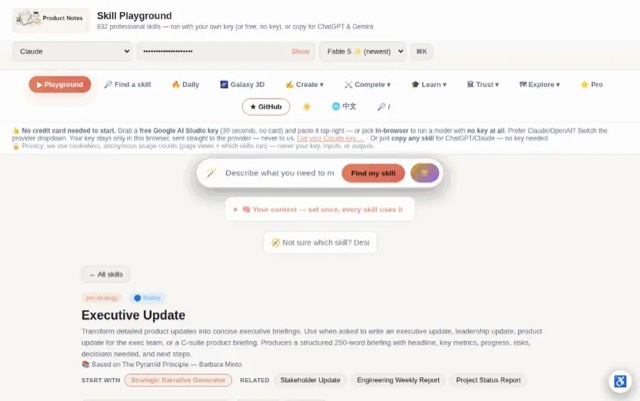


From the mohitagw15856/pm-claude-skills README — shows the whole collection, not only this skill. · view on GitHub
How to use it
Claude Code
- Run the line below. It pulls the whole folder into
~/.claude/skills/feature-prioritisation, including the files SKILL.md points to. - Describe your job in plain words. Claude Code follows the skill from there.
npx degit mohitagw15856/pm-claude-skills/skills/feature-prioritisation#main ~/.claude/skills/feature-prioritisationFor one project only, change the path to .claude/skills/feature-prioritisation. This skill also uses initiatives.json, features.json — copying SKILL.md alone won't be enough. See the folder on GitHub.
Claude (web or desktop app)
- On this page open ⋯ → Download .md.
- Save it as SKILL.md in a folder, zip the folder, then Customize → Skills → + → Create skill → Upload a skill.
- Pick the file and Save. Claude shows the name and description and runs a security scan.
- Check the skill is switched on.
- Start a new chat and describe your job in plain words. The AI follows the skill from there.
ChatGPT or another app
- ChatGPT: make a Project and paste it into Instructions.
- Neither? Paste it at the top of a new chat — it works for that chat.
Not working?
- Check which app you pasted it into — the steps above name the right one.
- Some skills need the paid tier of Claude or ChatGPT.
Paste into Claude, ChatGPT or Cursor.
Source of Feature Prioritisation Skill
Show the full text170 lines
| name | description |
|---|---|
| feature-prioritisation | Apply prioritisation frameworks (RICE, MoSCoW, Kano, ICE, Opportunity Scoring) to rank features and backlog items. Use when asked to prioritise features, rank a backlog, decide what to build next, or evaluate tradeoffs between competing ideas. Produces a scored, ranked feature list with framework-specific tables, recommended build order, deprioritised items, and assumptions made. |
Feature Prioritisation Skill
Apply the right prioritisation framework to any backlog and produce a clear, defensible ranking with rationale — not just a sorted list.
Required Inputs
Ask the user for these if not provided:
- List of features or initiatives to prioritise
- Goal or metric being prioritised against (OKR, launch, sprint)
- Preferred framework (or recommend based on context below)
- Team data: reach estimates, effort estimates, velocity (for RICE)
Framework Selection Guide
Ask the user which framework they prefer, or recommend based on context:
| Situation | Recommended Framework |
|---|---|
| Need a quick, data-driven score | RICE |
| Stakeholder alignment meeting | MoSCoW |
| Understanding customer delight vs expectations | Kano |
| Early-stage startup, fast decisions | ICE |
| Identifying underserved customer needs | Opportunity Scoring |
| Strategic portfolio decisions | Value vs Effort Matrix |
RICE Scoring
Formula: (Reach × Impact × Confidence) ÷ Effort
| Factor | Definition | Scale |
|---|---|---|
| Reach | Users impacted per quarter | Actual number |
| Impact | Effect on goal per user | 0.25 / 0.5 / 1 / 2 / 3 |
| Confidence | How certain are you? | 50% / 80% / 100% |
| Effort | Person-months required | Actual number |
Output table:
| Feature | Reach | Impact | Confidence | Effort | RICE Score | Priority |
|---|
MoSCoW Method
Categorise each feature as:
- Must Have — non-negotiable for launch/sprint; product fails without it
- Should Have — important but not critical; workarounds exist
- Could Have — nice to have; include only if time allows
- Won't Have (this time) — explicitly out of scope now; may revisit
Always ask: "Must have for what?" — define the scope (launch, sprint, quarter) before categorising.
ICE Scoring (Startup/fast mode)
Formula: Impact + Confidence + Ease (each 1–10)
Quick, subjective — good for early decisions before data exists.
Kano Model
Classify features into:
- Basic (Must-be): Expected; absence causes dissatisfaction
- Performance: More = better satisfaction; linear relationship
- Excitement (Delighters): Unexpected; creates delight; absence is neutral
- Indifferent: Users don't care either way
- Reverse: Some users want it, others don't
Recommend building: all Basic features first → Performance features for key use cases → 1–2 Excitement features per release.
Programmatic Helper
This skill ships with a stdlib-only Python script that computes ranking for the math-based frameworks (RICE, ICE) so feature scoring is consistent across sessions.
# RICE from JSON
python3 scripts/feature_prioritisation.py initiatives.json --framework rice

# RICE from CSV
python3 scripts/feature_prioritisation.py initiatives.csv --framework rice --format csv

# ICE from JSON
python3 scripts/feature_prioritisation.py features.json --framework ice

# Pipe into it
printf '%s\n' '[{"name":"API refactor","impact":8,"confidence":80,"ease":5}]' \
  | python3 scripts/feature_prioritisation.py --framework ice -
Use --json to produce machine-readable output for downstream tooling.
Output Format
Feature Prioritisation — [Product/Team] — [Date]
Framework Used: [RICE / MoSCoW / ICE / Kano / Custom] Scope: [Sprint / Quarter / Release] Goal being prioritised against: [Metric or objective]
[Scored table using selected framework]
Recommended Build Order:
- [Feature] — [1-line rationale]
- [Feature] — [1-line rationale]
- ...
Explicitly Deprioritised:
- [Feature] — Reason: [brief]
Assumptions Made:
- [Any estimates or judgements used in scoring]
Guidelines
- Always anchor prioritisation to a specific goal or metric — never prioritise in a vacuum
- Flag when two features have similar scores but very different risk profiles
- If stakeholder politics are influencing prioritisation, name it explicitly and suggest separating the framework score from the final decision
- Recommend revisiting priorities every 2 weeks minimum
- Never produce a single-column ranked list without rationale — explain the top 3 and bottom 3 decisions
Deeper Materials
This skill ships with support files — use them when they are available:
references/framework-selection.md— Picking the Prioritisation Framework (Instead of Defaulting to RICE). Apply it while producing the output; it carries the calibration and judgment calls the method summary above compresses.templates/prioritisation-session.md— a fill-in version of the deliverable with the quality gates inline. Offer it when the user wants to work the document themselves rather than have it generated.
Scoring Rubric (0–40)
Score any output of this skill before handing it over; 32+ is ship-quality.
| Dimension | 0 | 5 | 10 |
|---|---|---|---|
| Goal anchoring | No stated goal, or items silently scored against different objectives | A goal is named but individual scores don't reference it; off-goal items scored anyway | One explicit metric and scope; every score justified against it; items serving a different goal ejected with instructions to resubmit |
| Scoring integrity | Frameworks mixed in one session, arithmetic wrong, or scales invented mid-table | One framework applied consistently, but confidence defaults high and scale anchors are undefined | Consistent framework, verifiable maths, defined impact anchors, confidence honestly reflecting the evidence behind each estimate |
| Transparency of cuts and assumptions | Cut items simply vanish; no record of estimates or their sources | Deprioritised items listed but without reasons; assumptions partial or unsourced | Every cut carries a reason and revisit trigger; assumptions name their sources (analytics, engineering estimates) so the ranking is re-runnable |
| Judgment beyond the number | A sorted table presented as the decision | Top picks get rationale, but near-ties, risk profiles, and politics go unmentioned | Near-ties broken on risk with reasoning shown; political pressure named with framework score separated from final decision; top and bottom of list both explained |
Quality Checks
- Every item is scored against the same goal or metric (not different goals per item)
- Deprioritised items are explicitly listed with reasons (not just absent from the ranked list)
- Assumptions used in scoring are documented
- Stakeholder politics or personal preferences are separated from framework score
- Prioritisation is anchored to a specific scope (sprint / quarter / launch)
Anti-Patterns
- Do not score items against different goals — every item in a prioritisation session must be scored against the same objective
- Do not omit deprioritised items — explicitly listing what was cut and why is as important as the ranked list
- Do not let stakeholder politics override framework scores without documenting the override and reason
- Do not mix RICE, ICE, or MoSCoW scores across frameworks in a single session — pick one framework per prioritisation exercise
- Do not treat the output as final without documenting the assumptions used in scoring — assumptions change, and the list must be revisitable
| 1 | |
| 2 | name feature-prioritisation |
| 3 | description "Apply prioritisation frameworks (RICE, MoSCoW, Kano, ICE, Opportunity Scoring) to rank features and backlog items. Use when asked to prioritise features, rank a backlog, decide what to build next, or evaluate tradeoffs between competing ideas. Produces a scored, ranked feature list with framework-specific tables, recommended build order, deprioritised items, and assumptions made." |
| 4 | |
| 5 | |
| 6 | # Feature Prioritisation Skill |
| 7 | |
| 8 | Apply the right prioritisation framework to any backlog and produce a clear, defensible ranking with rationale — not just a sorted list. |
| 9 | |
| 10 | ## Required Inputs |
| 11 | |
| 12 | Ask the user for these if not provided: |
| 13 | **List of features or initiatives to prioritise** |
| 14 | **Goal or metric** being prioritised against (OKR, launch, sprint) |
| 15 | **Preferred framework** (or recommend based on context below) |
| 16 | **Team data**: reach estimates, effort estimates, velocity (for RICE) |
| 17 | |
| 18 | ## Framework Selection Guide |
| 19 | |
| 20 | Ask the user which framework they prefer, or recommend based on context: |
| 21 | |
| 22 | | Situation | Recommended Framework | |
| 23 | |---|---| |
| 24 | | Need a quick, data-driven score | RICE | |
| 25 | | Stakeholder alignment meeting | MoSCoW | |
| 26 | | Understanding customer delight vs expectations | Kano | |
| 27 | | Early-stage startup, fast decisions | ICE | |
| 28 | | Identifying underserved customer needs | Opportunity Scoring | |
| 29 | | Strategic portfolio decisions | Value vs Effort Matrix | |
| 30 | |
| 31 | |
| 32 | |
| 33 | ## RICE Scoring |
| 34 | |
| 35 | **Formula:** (Reach × Impact × Confidence) ÷ Effort |
| 36 | |
| 37 | | Factor | Definition | Scale | |
| 38 | |---|---|---| |
| 39 | | Reach | Users impacted per quarter | Actual number | |
| 40 | | Impact | Effect on goal per user | 0.25 / 0.5 / 1 / 2 / 3 | |
| 41 | | Confidence | How certain are you? | 50% / 80% / 100% | |
| 42 | | Effort | Person-months required | Actual number | |
| 43 | |
| 44 | Output table: |
| 45 | | Feature | Reach | Impact | Confidence | Effort | RICE Score | Priority | |
| 46 | |---|---|---|---|---|---|---| |
| 47 | |
| 48 | |
| 49 | |
| 50 | ## MoSCoW Method |
| 51 | |
| 52 | Categorise each feature as: |
| 53 | **Must Have** — non-negotiable for launch/sprint; product fails without it |
| 54 | **Should Have** — important but not critical; workarounds exist |
| 55 | **Could Have** — nice to have; include only if time allows |
| 56 | **Won't Have (this time)** — explicitly out of scope now; may revisit |
| 57 | |
| 58 | Always ask: "Must have for *what*?" — define the scope (launch, sprint, quarter) before categorising. |
| 59 | |
| 60 | |
| 61 | |
| 62 | ## ICE Scoring (Startup/fast mode) |
| 63 | |
| 64 | **Formula:** Impact + Confidence + Ease (each 1–10) |
| 65 | |
| 66 | Quick, subjective — good for early decisions before data exists. |
| 67 | |
| 68 | |
| 69 | |
| 70 | ## Kano Model |
| 71 | |
| 72 | Classify features into: |
| 73 | **Basic (Must-be):** Expected; absence causes dissatisfaction |
| 74 | **Performance:** More = better satisfaction; linear relationship |
| 75 | **Excitement (Delighters):** Unexpected; creates delight; absence is neutral |
| 76 | **Indifferent:** Users don't care either way |
| 77 | **Reverse:** Some users want it, others don't |
| 78 | |
| 79 | Recommend building: all Basic features first → Performance features for key use cases → 1–2 Excitement features per release. |
| 80 | |
| 81 | |
| 82 | |
| 83 | ## Programmatic Helper |
| 84 | |
| 85 | This skill ships with a stdlib-only Python script that computes ranking for the math-based frameworks (RICE, ICE) so feature scoring is consistent across sessions. |
| 86 | |
| 87 | |
| 88 | # RICE from JSON |
| 89 | python3 scripts/feature_prioritisation.py initiatives.json --framework rice |
| 90 | |
| 91 | # RICE from CSV |
| 92 | python3 scripts/feature_prioritisation.py initiatives.csv --framework rice --format csv |
| 93 | |
| 94 | # ICE from JSON |
| 95 | python3 scripts/feature_prioritisation.py features.json --framework ice |
| 96 | |
| 97 | # Pipe into it |
| 98 | printf '%s\n' '[{"name":"API refactor","impact":8,"confidence":80,"ease":5}]' \ |
| 99 | | python3 scripts/feature_prioritisation.py --framework ice - |
| 100 | |
| 101 | |
| 102 | Use `--json` to produce machine-readable output for downstream tooling. |
| 103 | |
| 104 | |
| 105 | |
| 106 | ## Output Format |
| 107 | |
| 108 | ### Feature Prioritisation — [Product/Team] — [Date] |
| 109 | |
| 110 | **Framework Used:** [RICE / MoSCoW / ICE / Kano / Custom] |
| 111 | **Scope:** [Sprint / Quarter / Release] |
| 112 | **Goal being prioritised against:** [Metric or objective] |
| 113 | |
| 114 | [Scored table using selected framework] |
| 115 | |
| 116 | **Recommended Build Order:** |
| 117 | [Feature] — [1-line rationale] |
| 118 | [Feature] — [1-line rationale] |
| 119 | ... |
| 120 | |
| 121 | **Explicitly Deprioritised:** |
| 122 | [Feature] — Reason: [brief] |
| 123 | |
| 124 | **Assumptions Made:** |
| 125 | [Any estimates or judgements used in scoring] |
| 126 | |
| 127 | |
| 128 | |
| 129 | ## Guidelines |
| 130 | |
| 131 | Always anchor prioritisation to a specific goal or metric — never prioritise in a vacuum |
| 132 | Flag when two features have similar scores but very different risk profiles |
| 133 | If stakeholder politics are influencing prioritisation, name it explicitly and suggest separating the framework score from the final decision |
| 134 | Recommend revisiting priorities every 2 weeks minimum |
| 135 | Never produce a single-column ranked list without rationale — explain the top 3 and bottom 3 decisions |
| 136 | |
| 137 | ## Deeper Materials |
| 138 | |
| 139 | This skill ships with support files — use them when they are available: |
| 140 | |
| 141 | **`references/framework-selection.md`** — Picking the Prioritisation Framework (Instead of Defaulting to RICE). Apply it while producing the output; it carries the calibration and judgment calls the method summary above compresses. |
| 142 | **`templates/prioritisation-session.md`** — a fill-in version of the deliverable with the quality gates inline. Offer it when the user wants to work the document themselves rather than have it generated. |
| 143 | |
| 144 | ## Scoring Rubric (0–40) |
| 145 | |
| 146 | Score any output of this skill before handing it over; 32+ is ship-quality. |
| 147 | |
| 148 | | Dimension | 0 | 5 | 10 | |
| 149 | |---|---|---|---| |
| 150 | | Goal anchoring | No stated goal, or items silently scored against different objectives | A goal is named but individual scores don't reference it; off-goal items scored anyway | One explicit metric and scope; every score justified against it; items serving a different goal ejected with instructions to resubmit | |
| 151 | | Scoring integrity | Frameworks mixed in one session, arithmetic wrong, or scales invented mid-table | One framework applied consistently, but confidence defaults high and scale anchors are undefined | Consistent framework, verifiable maths, defined impact anchors, confidence honestly reflecting the evidence behind each estimate | |
| 152 | | Transparency of cuts and assumptions | Cut items simply vanish; no record of estimates or their sources | Deprioritised items listed but without reasons; assumptions partial or unsourced | Every cut carries a reason and revisit trigger; assumptions name their sources (analytics, engineering estimates) so the ranking is re-runnable | |
| 153 | | Judgment beyond the number | A sorted table presented as the decision | Top picks get rationale, but near-ties, risk profiles, and politics go unmentioned | Near-ties broken on risk with reasoning shown; political pressure named with framework score separated from final decision; top and bottom of list both explained | |
| 154 | |
| 155 | ## Quality Checks |
| 156 | |
| 157 | [ ] Every item is scored against the same goal or metric (not different goals per item) |
| 158 | [ ] Deprioritised items are explicitly listed with reasons (not just absent from the ranked list) |
| 159 | [ ] Assumptions used in scoring are documented |
| 160 | [ ] Stakeholder politics or personal preferences are separated from framework score |
| 161 | [ ] Prioritisation is anchored to a specific scope (sprint / quarter / launch) |
| 162 | |
| 163 | ## Anti-Patterns |
| 164 | |
| 165 | [ ] Do not score items against different goals — every item in a prioritisation session must be scored against the same objective |
| 166 | [ ] Do not omit deprioritised items — explicitly listing what was cut and why is as important as the ranked list |
| 167 | [ ] Do not let stakeholder politics override framework scores without documenting the override and reason |
| 168 | [ ] Do not mix RICE, ICE, or MoSCoW scores across frameworks in a single session — pick one framework per prioritisation exercise |
| 169 | [ ] Do not treat the output as final without documenting the assumptions used in scoring — assumptions change, and the list must be revisitable |
| 170 |
Discussion
Browse more free Claude skills or everything in Product.