Executive Summary Skill
Write an executive summary for any document, report, or proposal.
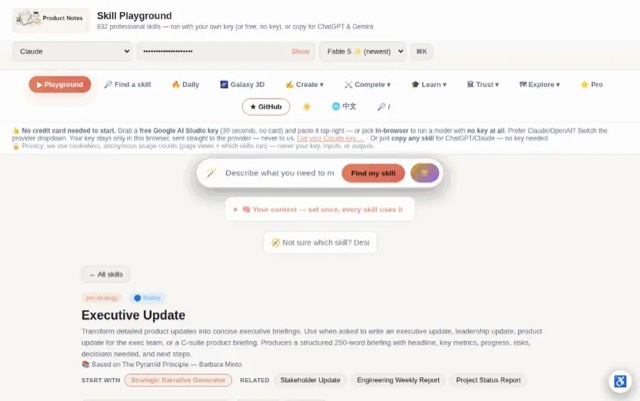

From the mohitagw15856/pm-claude-skills README — shows the whole collection, not only this skill. · view on GitHub
How to use it
Claude Code
- Run the line below. It pulls the whole folder into
~/.claude/skills/executive-summary. - Describe your job in plain words. Claude Code follows the skill from there.
npx degit mohitagw15856/pm-claude-skills/skills/executive-summary#main ~/.claude/skills/executive-summaryFor one project only, change the path to .claude/skills/executive-summary.
Claude (web or desktop app)
- On this page open ⋯ → Download .md.
- Save it as SKILL.md in a folder, zip the folder, then Customize → Skills → + → Create skill → Upload a skill.
- Pick the file and Save. Claude shows the name and description and runs a security scan.
- Check the skill is switched on.
- Start a new chat and describe your job in plain words. The AI follows the skill from there.
ChatGPT or another app
- ChatGPT: make a Project and paste it into Instructions.
- Neither? Paste it at the top of a new chat — it works for that chat.
Not working?
- Check which app you pasted it into — the steps above name the right one.
- Some skills need the paid tier of Claude or ChatGPT.
Paste into Claude, ChatGPT or Cursor.
Source of Executive Summary Skill
Show the full text126 lines
| name | description |
|---|---|
| executive-summary | Write an executive summary for any document, report, or proposal. Use when asked to write an executive summary, management summary, briefing paper, or one-pager for senior stakeholders. Produces a structured summary that busy executives can read in under 3 minutes and act on. |
Executive Summary Skill
Writes executive summaries that busy decision-makers actually read — front-loaded with conclusions, structured for skimming, ruthless about what to include.
Required Inputs
- Source document or topic (paste or describe)
- Audience (CEO / board / investor / minister / client / committee)
- Decision or action needed (what should the reader do after reading?)
- Length limit (1 page / 2 pages / 500 words)
- Format (formal report / slide / email / briefing paper)
Core Principle
An executive summary is NOT a summary of the document. It is a standalone document that:
- States the conclusion upfront — not at the end
- Contains only what the reader needs to make a decision
- Can be understood without reading anything else
- Recommends a specific action
Output Structure
[Title]
Executive Summary Prepared for: [Audience] | Date: [Date] | Author: [Name]
Bottom line up front: [The most important thing. The recommendation or finding. 2-3 sentences. A reader who only reads this should know what you are asking or telling them.]
Background (why this matters): [2-3 sentences. Minimum context to understand the bottom line. Not the history — just what the reader needs now.]
Key findings / analysis:
- [Finding 1]: [One sentence — specific and evidence-based]
- [Finding 2]: [One sentence]
- [Finding 3]: [One sentence]
Options considered: (include only if a decision is being presented)
| Option | Benefit | Risk | Recommendation |
|---|---|---|---|
| [Option A] | [Benefit] | [Risk] | Recommended |
| [Option B] | [Benefit] | [Risk] | Not recommended |
Recommendation: [Specific. "We recommend [action] because [reason]. This will [outcome]." Not "we suggest consideration of options."]
Immediate next steps:
- [Action 1 — specific, with owner and date]
- [Action 2]
Risks of inaction: [What happens if the reader does nothing]
Full report: [Reference to where the full document can be found]
Adapting for Different Audiences
CEO/MD: Lead with financial or strategic impact. 1 page. Make the decision binary. Ask in sentence one. Board: Lead with governance or risk. Frame against organisational objectives. State specifically what you need from them. Investor: Lead with return or opportunity. Specific numbers. 1 page. Anticipate "why now." Minister/senior public sector: Lead with public benefit or policy alignment. Include cost-benefit framing. Client: Lead with their problem. Show you understand before presenting recommendation.
Deeper Materials
This skill ships with support files — use them when they are available:
references/compression-craft.md— Compression Craft: Summaries Executives Actually Absorb. Apply it while producing the output; it carries the calibration and judgment calls the method summary above compresses.templates/summary-frame.md— a fill-in version of the deliverable with the quality gates inline. Offer it when the user wants to work the document themselves rather than have it generated.
Scoring Rubric (0–40)
Score any output of this skill before handing it over; 32+ is ship-quality.
| Dimension | 0 | 5 | 10 |
|---|---|---|---|
| Bottom line placement | Conclusion appears only at the end, after chronological summary | Recommendation appears early but hedged, or split across sections | The ask or finding is unambiguous within the first three sentences and repeated nowhere it doesn't need to be |
| Standalone completeness | Unreadable without the source document; leans on unexplained references | Mostly standalone but assumes context the named audience may lack | A reader with no other material can understand the situation and decide from this page alone |
| Actionability | "Options for consideration" with no owners, dates, or stated ask | Recommendation is specific but next steps lack owners or dates | Specific recommendation, next steps each with owner and date, and risks of inaction quantified |
| Audience fit & length | Author-priority framing, over the length limit | Fits the limit but framing is generic — same summary would go to any audience | Framed to the named audience's decision context (financial/governance/return/policy) and within the limit |
Quality Checks
- Bottom line in first 3 sentences
- Standalone — no need to read full document
- Recommendation is specific
- Fits length limit
- Written for audience priorities not author priorities
- Next steps have owners and dates
Anti-Patterns
- Do not summarise the document chronologically — an executive summary that follows the structure of the source document is not an executive summary, it is an abstract
- Do not bury the recommendation at the end — executives read the first paragraph and skim the rest; the ask must be in sentence one or two
- Do not use the same summary for different audiences — a CEO and a board member have different decision contexts and require different framing
- Do not include background that the reader already knows — every sentence of background must earn its place by making the bottom line more actionable
- Do not leave the "risks of inaction" section vague — a summary that does not quantify what happens if the reader does nothing removes the urgency needed for a decision
Example Trigger Phrases
- "Write an executive summary of this report: [paste]"
- "Summarise this document for the board: [paste]"
- "Create a one-pager from this proposal for the CEO"
- "Turn these findings into an exec summary"
| 1 | |
| 2 | name executive-summary |
| 3 | description "Write an executive summary for any document, report, or proposal. Use when asked to write an executive summary, management summary, briefing paper, or one-pager for senior stakeholders. Produces a structured summary that busy executives can read in under 3 minutes and act on." |
| 4 | |
| 5 | |
| 6 | # Executive Summary Skill |
| 7 | |
| 8 | Writes executive summaries that busy decision-makers actually read — front-loaded with conclusions, structured for skimming, ruthless about what to include. |
| 9 | |
| 10 | ## Required Inputs |
| 11 | **Source document or topic** (paste or describe) |
| 12 | **Audience** (CEO / board / investor / minister / client / committee) |
| 13 | **Decision or action needed** (what should the reader do after reading?) |
| 14 | **Length limit** (1 page / 2 pages / 500 words) |
| 15 | **Format** (formal report / slide / email / briefing paper) |
| 16 | |
| 17 | ## Core Principle |
| 18 | |
| 19 | An executive summary is NOT a summary of the document. It is a standalone document that: |
| 20 | States the conclusion upfront — not at the end |
| 21 | Contains only what the reader needs to make a decision |
| 22 | Can be understood without reading anything else |
| 23 | Recommends a specific action |
| 24 | |
| 25 | ## Output Structure |
| 26 | |
| 27 | |
| 28 | |
| 29 | ### [Title] |
| 30 | **Executive Summary** |
| 31 | *Prepared for: [Audience] | Date: [Date] | Author: [Name]* |
| 32 | |
| 33 | |
| 34 | |
| 35 | **Bottom line up front:** |
| 36 | [The most important thing. The recommendation or finding. 2-3 sentences. A reader who only reads this should know what you are asking or telling them.] |
| 37 | |
| 38 | |
| 39 | |
| 40 | **Background (why this matters):** |
| 41 | [2-3 sentences. Minimum context to understand the bottom line. Not the history — just what the reader needs now.] |
| 42 | |
| 43 | |
| 44 | |
| 45 | **Key findings / analysis:** |
| 46 | **[Finding 1]:** [One sentence — specific and evidence-based] |
| 47 | **[Finding 2]:** [One sentence] |
| 48 | **[Finding 3]:** [One sentence] |
| 49 | |
| 50 | |
| 51 | |
| 52 | **Options considered:** (include only if a decision is being presented) |
| 53 | |
| 54 | | Option | Benefit | Risk | Recommendation | |
| 55 | |---|---|---|---| |
| 56 | | [Option A] | [Benefit] | [Risk] | Recommended | |
| 57 | | [Option B] | [Benefit] | [Risk] | Not recommended | |
| 58 | |
| 59 | |
| 60 | |
| 61 | **Recommendation:** |
| 62 | [Specific. "We recommend [action] because [reason]. This will [outcome]." Not "we suggest consideration of options."] |
| 63 | |
| 64 | |
| 65 | |
| 66 | **Immediate next steps:** |
| 67 | [Action 1 — specific, with owner and date] |
| 68 | [Action 2] |
| 69 | |
| 70 | |
| 71 | |
| 72 | **Risks of inaction:** [What happens if the reader does nothing] |
| 73 | |
| 74 | **Full report:** [Reference to where the full document can be found] |
| 75 | |
| 76 | |
| 77 | |
| 78 | ## Adapting for Different Audiences |
| 79 | |
| 80 | **CEO/MD:** Lead with financial or strategic impact. 1 page. Make the decision binary. Ask in sentence one. |
| 81 | **Board:** Lead with governance or risk. Frame against organisational objectives. State specifically what you need from them. |
| 82 | **Investor:** Lead with return or opportunity. Specific numbers. 1 page. Anticipate "why now." |
| 83 | **Minister/senior public sector:** Lead with public benefit or policy alignment. Include cost-benefit framing. |
| 84 | **Client:** Lead with their problem. Show you understand before presenting recommendation. |
| 85 | |
| 86 | ## Deeper Materials |
| 87 | |
| 88 | This skill ships with support files — use them when they are available: |
| 89 | |
| 90 | **`references/compression-craft.md`** — Compression Craft: Summaries Executives Actually Absorb. Apply it while producing the output; it carries the calibration and judgment calls the method summary above compresses. |
| 91 | **`templates/summary-frame.md`** — a fill-in version of the deliverable with the quality gates inline. Offer it when the user wants to work the document themselves rather than have it generated. |
| 92 | |
| 93 | ## Scoring Rubric (0–40) |
| 94 | |
| 95 | Score any output of this skill before handing it over; 32+ is ship-quality. |
| 96 | |
| 97 | | Dimension | 0 | 5 | 10 | |
| 98 | |---|---|---|---| |
| 99 | | **Bottom line placement** | Conclusion appears only at the end, after chronological summary | Recommendation appears early but hedged, or split across sections | The ask or finding is unambiguous within the first three sentences and repeated nowhere it doesn't need to be | |
| 100 | | **Standalone completeness** | Unreadable without the source document; leans on unexplained references | Mostly standalone but assumes context the named audience may lack | A reader with no other material can understand the situation and decide from this page alone | |
| 101 | | **Actionability** | "Options for consideration" with no owners, dates, or stated ask | Recommendation is specific but next steps lack owners or dates | Specific recommendation, next steps each with owner and date, and risks of inaction quantified | |
| 102 | | **Audience fit & length** | Author-priority framing, over the length limit | Fits the limit but framing is generic — same summary would go to any audience | Framed to the named audience's decision context (financial/governance/return/policy) and within the limit | |
| 103 | |
| 104 | ## Quality Checks |
| 105 | |
| 106 | [ ] Bottom line in first 3 sentences |
| 107 | [ ] Standalone — no need to read full document |
| 108 | [ ] Recommendation is specific |
| 109 | [ ] Fits length limit |
| 110 | [ ] Written for audience priorities not author priorities |
| 111 | [ ] Next steps have owners and dates |
| 112 | |
| 113 | ## Anti-Patterns |
| 114 | |
| 115 | [ ] Do not summarise the document chronologically — an executive summary that follows the structure of the source document is not an executive summary, it is an abstract |
| 116 | [ ] Do not bury the recommendation at the end — executives read the first paragraph and skim the rest; the ask must be in sentence one or two |
| 117 | [ ] Do not use the same summary for different audiences — a CEO and a board member have different decision contexts and require different framing |
| 118 | [ ] Do not include background that the reader already knows — every sentence of background must earn its place by making the bottom line more actionable |
| 119 | [ ] Do not leave the "risks of inaction" section vague — a summary that does not quantify what happens if the reader does nothing removes the urgency needed for a decision |
| 120 | |
| 121 | ## Example Trigger Phrases |
| 122 | "Write an executive summary of this report: [paste]" |
| 123 | "Summarise this document for the board: [paste]" |
| 124 | "Create a one-pager from this proposal for the CEO" |
| 125 | "Turn these findings into an exec summary" |
| 126 |
Discussion
Browse more free Claude skills or everything in Data & analytics.