Pantsing, discovery write, write without an outline
Discovery drafting
This skill should be used when the user asks to "pantsing", "discovery write", "write without an outline", "discovery draft", "write into the dark", "story kernel", "reconcile a chapter", "reverse outline", "cut a subplot", "dead end",…
---
name: discovery-drafting
description: This skill should be used when the user asks to "pantsing", "discovery write", "write without an outline", "discovery draft", "write into the dark", "story kernel", "reconcile a chapter", "reverse outline", "cut a subplot", "dead end", "drafting sprint", "writing cadence", or wants to draft a story by discovery with retrospective bible reconciliation.
---

# Discovery Drafting

## Overview

Draft by discovery ("pantsing"): start from a one-paragraph story kernel
rather than a beat sheet, write forward, then reconcile each chapter back
into the story bible through a structured loop (extract entities → reverse
outline → diff against the bible → reconcile). This is the complement to
chapter-writing's outline-first workflow. The bible is maintained *after*
the prose, not before — which the repo's import-style entity extraction and
continuity checks already support.

## Prerequisites
Overview
Draft by discovery ("pantsing"): start from a one-paragraph story kernel rather than a beat sheet, write forward, then reconcile each chapter back into the story bible through a structured loop (extract entities → reverse outline → diff against the bible → reconcile). This is the complement to chapter-writing's outline-first workflow. The bible is maintained after the prose, not before — which the repo's import-style entity extraction and continuity checks already support.
Manual install (npx, ZIP)
npx skills add danjdewhurst/story-skills --skill discovery-drafting -g -a claude-codemkdir -p ~/.claude/skills && curl -sL https://codeload.github.com/danjdewhurst/story-skills/tar.gz/28817a272657 \
| tar -xz -C ~/.claude/skills --strip-components=2 story-skills-28817a272657/skills/discovery-draftingNew-Item -ItemType Directory -Force "$HOME\.claude\skills" | Out-Null; Invoke-WebRequest "https://m.agentalley.io/zip/5e7b93f82fea9d2182b6/discovery-drafting.zip" -OutFile "$env:TEMP\discovery-drafting.zip"; Expand-Archive "$env:TEMP\discovery-drafting.zip" -DestinationPath "$HOME\.claude\skills" -ForceConnects with Agent Alley MCP · agentalley.io/mcp
Files included
SKILL.md5.5 KBreferences/4 files · 13.5 KB
Read the files here
danjdewhurst/
Shared references4SKILL.md reads these from elsewhere in the repo. Not in the ZIP.
- story.mdexamples/harbor-of-second-light/2.0 KB
- style-sheet.mdexamples/the-last-ember/2.5 KB
- writing-guidelines.mdskills/chapter-writing/references/2.6 KB
- story.jsskills/story-maintenance/scripts/344.6 KB
Show the full text106 lines
Discovery Drafting
Overview
Draft by discovery ("pantsing"): start from a one-paragraph story kernel rather than a beat sheet, write forward, then reconcile each chapter back into the story bible through a structured loop (extract entities → reverse outline → diff against the bible → reconcile). This is the complement to chapter-writing's outline-first workflow. The bible is maintained after the prose, not before — which the repo's import-style entity extraction and continuity checks already support.
Prerequisites
A story project must already exist (created via the story-init skill), with
at least a story.md and one character. No plot structure is required to
start — arcs get built during reconciliation.
When to Use
- The user wants to draft without outlining first, or identifies as a discovery writer
- Starting a project from a situation/character rather than a plot
- NOT for mysteries or other clue-dependent genres where setup must precede
payoff (use chapter-writing; see
genre-craft) - NOT for revising existing chapters (use
revision-continuity) - The user can switch modes per project or per chapter; record the mode so audits know which discipline applies
Workflow
- Write the story kernel. Consult
references/story-kernel.mdand draft the one-paragraph kernel with the user (character in a situation, a want, an obstacle, a tone signal). Store it instory.mdunder## Story Kerneland setdraft-mode: discoveredin frontmatter. - Draft forward. Write the chapter from the kernel using the session
shape in
references/drafting-cadence.md(re-read → write → close with a next-session note). Write forward only; park bible questions as[TODO: check bible]inline rather than stopping. Follow the prose craft inchapter-writing/references/writing-guidelines.mdand the scene-grain tools in thescene-craftskill as usual, and write in the voice and house style recorded instyle-sheet.md— discovery changes planning order, not prose standards. - Run the reconcile loop. After each chapter, follow
references/reconcile-loop.mdexactly:- Extract new entity/promise candidates (import-style, user-approved)
- Reverse-outline the chapter into the chapter file and
scenes/records - Diff against the bible (new / contradiction / enrichment / dangling)
- Reconcile: update the bible or revise the chapter — never neither
- Append post-hoc chapter notes; set chapter frontmatter
mode: discovered
- Batch review every 3–5 chapters. Re-read post-hoc notes, sweep the
promise/question ledgers for dangling setups, and cut dead ends per
references/dead-ends.md(abandoned ledger entries keep a recorded reason; cut characters getstatus: cut, not deletion). - Hold the cadence. Keep the agreed target (see
references/drafting-cadence.md) and log each session withstory progress . --log; at midpoint and draft completion, hand the batch torevision-continuityfor developmental checks before continuing. - Close the loop on mode. When the draft is complete, every
mode: discoveredchapter must have post-hoc notes and a completed diff — flag any that don't as unfinished maintenance, then hand the manuscript torevision-continuityfor revision passes.
Conventions
story.mdfrontmatterdraft-mode: discoveredmarks a discovery project; per-chaptermode: discovered/mode: outlinedtracks mixed projects.- Chapters carry a
## Chapter Notes (post-hoc)section recording what was discovered, what was cut, and open questions — the project's memory of why the bible looks the way it does. - Entity candidates extracted from prose are presented for user approval
before bible files are created (same discipline as
story import). - Cut threads are logged, not erased: abandoned promises/questions keep
status: abandonedwith a reason; cut characters keep their file withstatus: cut. - Bidirectional links and kebab-case ids follow the story-init conventions exactly — discovery changes when the bible is written, not how.
CLI Maintenance
Use the Story CLI when it is available. If story is not installed, use bun run story -- from the Story Skills repository checkout or the bundled fallback node ../story-maintenance/scripts/story.js with the same arguments, resolving the path relative to this skill folder. If no CLI is available, perform the registry, backlink, and word-count checks manually.
After each reconcile loop:
story wordcount . --write
story reindex .
story links .
story validate .
story continuity .
Reference Files
references/story-kernel.md- The one-paragraph kernel: character in a situation, want, obstacle, tone signalreferences/reconcile-loop.md- The core loop: extract entities/promises → reverse-outline → diff against the bible → reconcile;mode: discoveredflagreferences/dead-ends.md- Recognizing and cutting dead ends: cut/fold/prune, abandoned ledger entries, the darling logreferences/drafting-cadence.md- Daily targets, batch reviews, session shape, recovering a broken cadence
| 1 | |
| 2 | name discovery-drafting |
| 3 | description This skill should be used when the user asks to "pantsing", "discovery write", "write without an outline", "discovery draft", "write into the dark", "story kernel", "reconcile a chapter", "reverse outline", "cut a subplot", "dead end", "drafting sprint", "writing cadence", or wants to draft a story by discovery with retrospective bible reconciliation. |
| 4 | |
| 5 | |
| 6 | # Discovery Drafting |
| 7 | |
| 8 | ## Overview |
| 9 | |
| 10 | Draft by discovery ("pantsing"): start from a one-paragraph story kernel |
| 11 | rather than a beat sheet, write forward, then reconcile each chapter back |
| 12 | into the story bible through a structured loop (extract entities → reverse |
| 13 | outline → diff against the bible → reconcile). This is the complement to |
| 14 | chapter-writing's outline-first workflow. The bible is maintained *after* |
| 15 | the prose, not before — which the repo's import-style entity extraction and |
| 16 | continuity checks already support. |
| 17 | |
| 18 | ## Prerequisites |
| 19 | |
| 20 | A story project must already exist (created via the story-init skill), with |
| 21 | at least a `story.md` and one character. No plot structure is required to |
| 22 | start — arcs get built during reconciliation. |
| 23 | |
| 24 | ## When to Use |
| 25 | |
| 26 | The user wants to draft without outlining first, or identifies as a |
| 27 | discovery writer |
| 28 | Starting a project from a situation/character rather than a plot |
| 29 | NOT for mysteries or other clue-dependent genres where setup must precede |
| 30 | payoff (use chapter-writing; see `genre-craft`) |
| 31 | NOT for revising existing chapters (use `revision-continuity`) |
| 32 | The user can switch modes per project or per chapter; record the mode so |
| 33 | audits know which discipline applies |
| 34 | |
| 35 | ## Workflow |
| 36 | |
| 37 | **Write the story kernel.** Consult `references/story-kernel.md` and |
| 38 | draft the one-paragraph kernel with the user (character in a situation, |
| 39 | a want, an obstacle, a tone signal). Store it in `story.md` under |
| 40 | `## Story Kernel` and set `draft-mode: discovered` in frontmatter. |
| 41 | **Draft forward.** Write the chapter from the kernel using the session |
| 42 | shape in `references/drafting-cadence.md` (re-read → write → close with |
| 43 | a next-session note). Write forward only; park bible questions as |
| 44 | `[TODO: check bible]` inline rather than stopping. Follow the prose |
| 45 | craft in `chapter-writing/references/writing-guidelines.md` and the |
| 46 | scene-grain tools in the `scene-craft` skill as usual, and write in the |
| 47 | voice and house style recorded in `style-sheet.md` — discovery changes |
| 48 | *planning order*, not prose standards. |
| 49 | **Run the reconcile loop.** After each chapter, follow |
| 50 | `references/reconcile-loop.md` exactly: |
| 51 | Extract new entity/promise candidates (import-style, user-approved) |
| 52 | Reverse-outline the chapter into the chapter file and `scenes/` records |
| 53 | Diff against the bible (new / contradiction / enrichment / dangling) |
| 54 | Reconcile: update the bible **or** revise the chapter — never neither |
| 55 | Append post-hoc chapter notes; set chapter frontmatter |
| 56 | `mode: discovered` |
| 57 | **Batch review every 3–5 chapters.** Re-read post-hoc notes, sweep the |
| 58 | promise/question ledgers for dangling setups, and cut dead ends per |
| 59 | `references/dead-ends.md` (abandoned ledger entries keep a recorded |
| 60 | reason; cut characters get `status: cut`, not deletion). |
| 61 | **Hold the cadence.** Keep the agreed target (see |
| 62 | `references/drafting-cadence.md`) and log each session with |
| 63 | `story progress . --log`; at midpoint and draft completion, |
| 64 | hand the batch to `revision-continuity` for developmental checks before |
| 65 | continuing. |
| 66 | **Close the loop on mode.** When the draft is complete, every |
| 67 | `mode: discovered` chapter must have post-hoc notes and a completed |
| 68 | diff — flag any that don't as unfinished maintenance, then hand the |
| 69 | manuscript to `revision-continuity` for revision passes. |
| 70 | |
| 71 | ## Conventions |
| 72 | |
| 73 | `story.md` frontmatter `draft-mode: discovered` marks a discovery project; |
| 74 | per-chapter `mode: discovered` / `mode: outlined` tracks mixed projects. |
| 75 | Chapters carry a `## Chapter Notes (post-hoc)` section recording what was |
| 76 | discovered, what was cut, and open questions — the project's memory of |
| 77 | why the bible looks the way it does. |
| 78 | Entity candidates extracted from prose are presented for user approval |
| 79 | before bible files are created (same discipline as `story import`). |
| 80 | Cut threads are logged, not erased: abandoned promises/questions keep |
| 81 | `status: abandoned` with a reason; cut characters keep their file with |
| 82 | `status: cut`. |
| 83 | Bidirectional links and kebab-case ids follow the story-init conventions |
| 84 | exactly — discovery changes when the bible is written, not how. |
| 85 | |
| 86 | ## CLI Maintenance |
| 87 | |
| 88 | Use the Story CLI when it is available. If `story` is not installed, use `bun run story --` from the Story Skills repository checkout or the bundled fallback `node ../story-maintenance/scripts/story.js` with the same arguments, resolving the path relative to this skill folder. If no CLI is available, perform the registry, backlink, and word-count checks manually. |
| 89 | |
| 90 | After each reconcile loop: |
| 91 | |
| 92 | |
| 93 | story wordcount . --write |
| 94 | story reindex . |
| 95 | story links . |
| 96 | story validate . |
| 97 | story continuity . |
| 98 | |
| 99 | |
| 100 | ## Reference Files |
| 101 | |
| 102 | **`references/story-kernel.md`** - The one-paragraph kernel: character in a situation, want, obstacle, tone signal |
| 103 | **`references/reconcile-loop.md`** - The core loop: extract entities/promises → reverse-outline → diff against the bible → reconcile; `mode: discovered` flag |
| 104 | **`references/dead-ends.md`** - Recognizing and cutting dead ends: cut/fold/prune, abandoned ledger entries, the darling log |
| 105 | **`references/drafting-cadence.md`** - Daily targets, batch reviews, session shape, recovering a broken cadence |
| 106 |
Details
- Updated
- Sep 22, 2026
- License
- MIT
- Stars on the repo
- ★ 241
- Checked
- Source
- danjdewhurst/story-skills ↗
- Creator
- danjdewhurst · 13 listings
Similar skills
See all → SkillReverse engineer native, managed, Electron/JavaScriptREA
 morluto/rea · by morlutoReverse engineer native, managed, Electron/JavaScript, packaged, firmware, and browser targets with REA. Use shipped-artifact or requested runtime evidence to explain features, compare versions, decompile code, or guide a reconstruction. Skip REA for ordinary source-repository architecture analysis.★ 316k GitHub stars
 SkillBrainstorms ideas into designs before any creative workBrainstorming Ideas Into Designs
 obra/superpowers · by obraYou MUST use this before any creative work - creating features, building components, adding functionality, or modifying behavior. Explores user intent, requirements and design before implementation.★ 290k GitHub stars
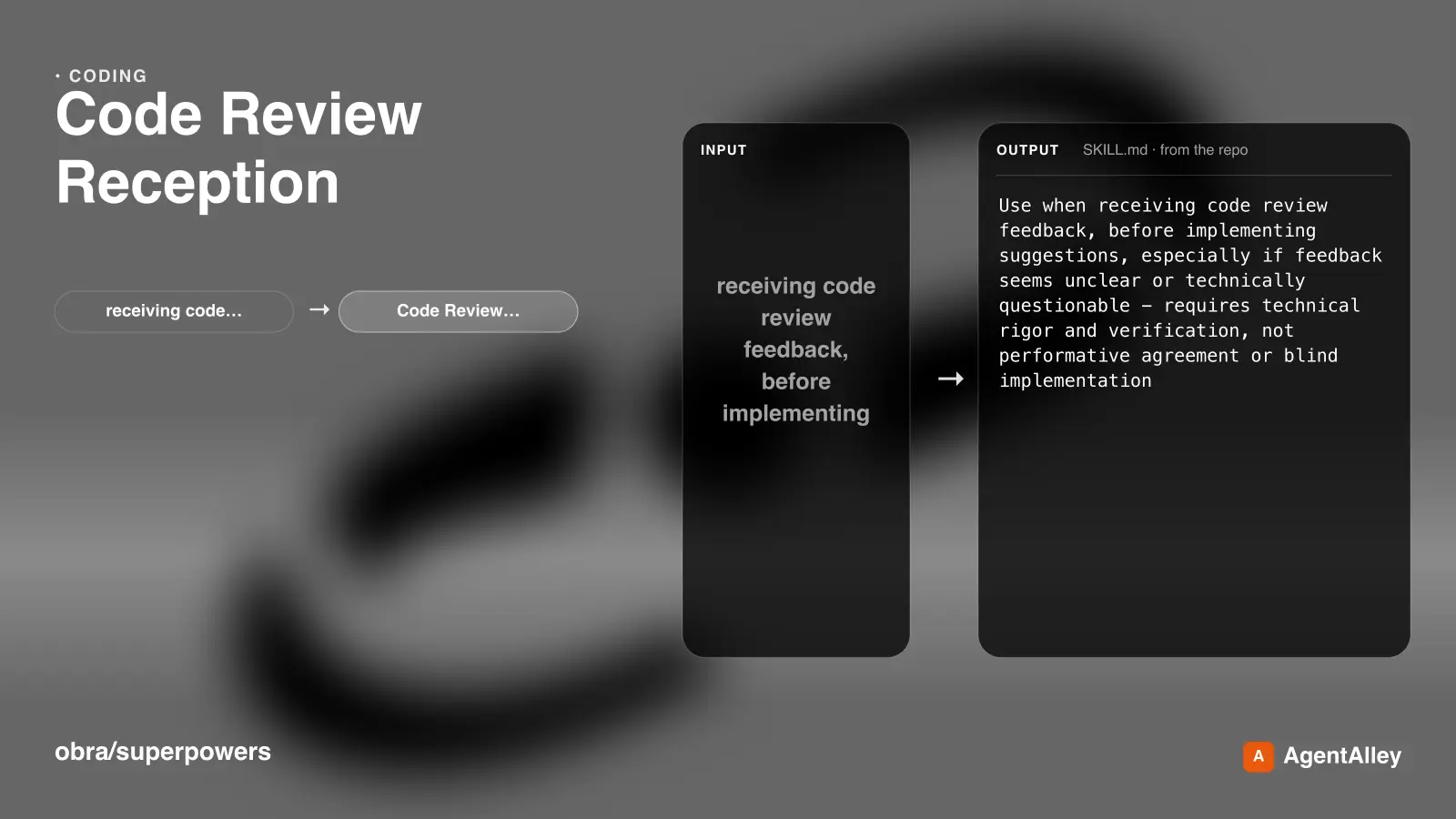 SkillRequires technical rigor and verificationCode Review Receptionobra/superpowers · by obraUse when receiving code review feedback, before implementing suggestions, especially if feedback seems unclear or technically questionable - requires technical rigor and verification, not performative agreement or blind implementation★ 290k GitHub stars
 SkillDiagnosis loop for hard bugs and performance regressionsDiagnosing bugs
 mattpocock/skills · by mattpocockDiagnosis loop for hard bugs and performance regressions. Use when the user says "diagnose"/"debug this", or reports something broken/throwing/failing/slow.★ 267k GitHub stars
 SkillImplement the result of /to-spec and /to-tickets in codeImplement specmattpocock/skills · by mattpocockImplement the result of /to-spec and /to-tickets in code.★ 267k GitHub stars
 SkillWriting a PR bodymattpocock/skills · by mattpocockUse when writing a PR body.★ 267k GitHub stars
More from danjdewhurst
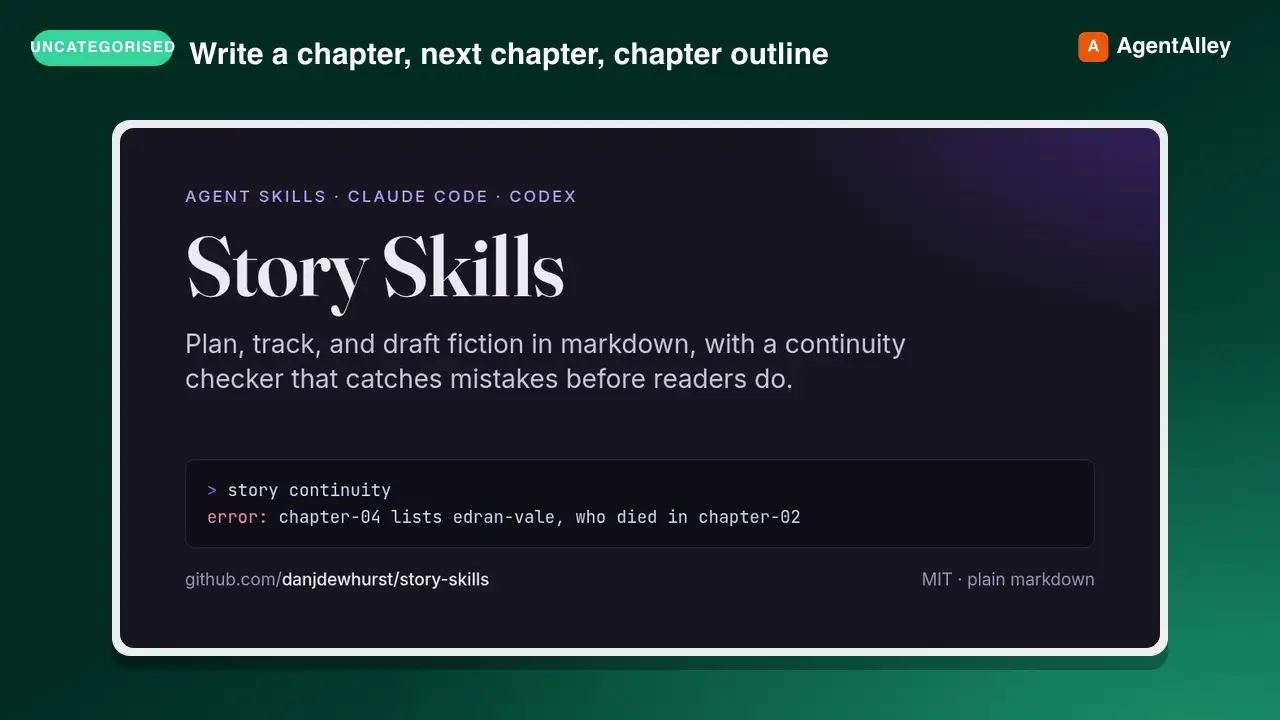 SkillWrite a chapter, next chapter, chapter outlineChapter writing
 danjdewhurst/story-skills · by danjdewhurstThis skill should be used when the user asks to "write a chapter", "next chapter", "chapter outline", "draft chapter", "continue the story", "write a scene", "outline a chapter", or wants to write prose for a story project.★ 241 GitHub stars
 SkillCreate a character, update a character, add a characterCharacter managementdanjdewhurst/story-skills · by danjdewhurstThis skill should be used when the user asks to "create a character", "update a character", "add a character", "build a family tree", "character relationships", "character timeline", "character arc", "character profile", or needs to manage characters in a story project.★ 241 GitHub stars
 SkillProcess beta reader feedback, alpha reader feedbackFeedback triagedanjdewhurst/story-skills · by danjdewhurstThis skill should be used when the user asks to "process beta reader feedback", "alpha reader feedback", "feedback round", "synthesize reader feedback", "reader notes", "beta feedback", "readiness check", or wants to collect, reconcile, and act on external reader feedback for a story project.★ 241 GitHub stars
 SkillMystery, fair play, clue, red herring, romance beats, HEAGenre craftdanjdewhurst/story-skills · by danjdewhurstThis skill should be used when the user asks to "mystery", "fair play", "clue", "red herring", "romance beats", "HEA", "thriller", "ticking clock", "horror", "dread", "MG", "YA", "middle grade", "young adult", "science fiction", "sci-fi", "serial", "episodic", "web serial", "genre conventions", or wants genre-specific structural craft for a story project.★ 241 GitHub stars
 SkillCreate a plot arc, story structure, add a plot pointPlot structuredanjdewhurst/story-skills · by danjdewhurstThis skill should be used when the user asks to "create a plot arc", "story structure", "add a plot point", "story timeline", "track foreshadowing", "pacing", "act structure", "story arc", "plot outline", or wants to plan and manage the narrative structure of a story.★ 241 GitHub stars
 SkillRevise a chapter, edit prose, continuity checkRevision continuitydanjdewhurst/story-skills · by danjdewhurstThis skill should be used when the user asks to revise a chapter, edit prose, continuity check, find inconsistencies, audit character state, check timeline consistency, line edit, developmental edit, polish a draft, or prepare existing story material for the next revision pass.★ 241 GitHub stars