Customer Escalation Brief Skill
Write a structured escalation brief for an at-risk customer account.
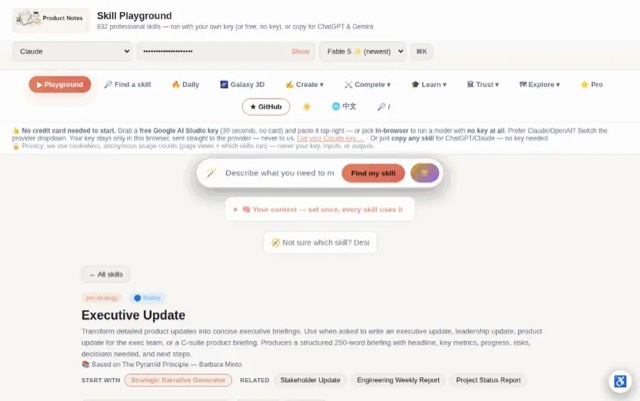


From the mohitagw15856/pm-claude-skills README — shows the whole collection, not only this skill. · view on GitHub
How to use it
Claude Code
- Run the line below. It pulls the whole folder into
~/.claude/skills/cs-escalation-brief. - Describe your job in plain words. Claude Code follows the skill from there.
npx degit mohitagw15856/pm-claude-skills/skills/cs-escalation-brief#main ~/.claude/skills/cs-escalation-briefFor one project only, change the path to .claude/skills/cs-escalation-brief.
Claude (web or desktop app)
- On this page open ⋯ → Download .md.
- Save it as SKILL.md in a folder, zip the folder, then Customize → Skills → + → Create skill → Upload a skill.
- Pick the file and Save. Claude shows the name and description and runs a security scan.
- Check the skill is switched on.
- Start a new chat and describe your job in plain words. The AI follows the skill from there.
ChatGPT or another app
- ChatGPT: make a Project and paste it into Instructions.
- Neither? Paste it at the top of a new chat — it works for that chat.
Not working?
- Check which app you pasted it into — the steps above name the right one.
- Some skills need the paid tier of Claude or ChatGPT.
Paste into Claude, ChatGPT or Cursor.
Source of Customer Escalation Brief Skill
Show the full text203 lines
| name | description |
|---|---|
| cs-escalation-brief | Write a structured escalation brief for an at-risk customer account. Use when an account has escalated, when a customer is threatening churn, when a P1 customer issue needs executive attention, or when preparing an internal save play. Produces a crisp escalation brief with account context, timeline, root cause, business impact, and a clear resolution plan. |
Customer Escalation Brief Skill
Produce a clear, concise escalation brief that gives internal stakeholders — VP CS, CCO, product leadership, or the CEO — everything they need to understand the situation, make decisions, and act fast.
A good escalation brief is not a complaint. It is a professional document that states the facts, assigns accountability honestly, and proposes a specific resolution plan.
Required Inputs
Ask for these if not already provided:
- Account name, tier, and ARR
- CSM name and account owner
- Nature of the escalation — what happened, what the customer is saying
- Timeline of events leading to escalation
- Customer contact who escalated (name, role, influence level)
- What the customer wants — their stated ask
- What we believe the root cause is
- What has already been done to address the situation
- Renewal date and current renewal risk assessment
Escalation Levels
Calibrate urgency and audience based on escalation level:
| Level | Trigger | Audience | Response time |
|---|---|---|---|
| L1 — Account Risk | Customer expressing dissatisfaction; renewal at risk | CSM + CS Manager | 24 hours |
| L2 — Executive Escalation | Customer escalated to their exec; requesting vendor exec involvement | VP CS + Account Exec | 4 hours |
| L3 — Churn Risk | Customer has issued notice or is in active churn conversation | CCO / CEO + Revenue leadership | 1 hour |
| L4 — Public Risk | Customer threatening public escalation, legal, or press | CCO / Legal / Comms | Immediate |
Output Format
Escalation Brief: [Account Name]
Escalation level: L[1/2/3/4] — [Label] Date raised: [Date] Raised by: [CSM name] Escalation owner: [Name of exec or senior stakeholder now leading response]
Account at a Glance
| Field | Detail |
|---|---|
| ARR | £/$/€[X] |
| Tier | Enterprise / Mid-Market / SMB |
| Customer since | [Date] |
| Renewal date | [Date] — [N] days away |
| Renewal risk (pre-escalation) | Green / Amber / Red |
| Renewal risk (current) | Green / Amber / Red |
| Customer contact who escalated | [Name, role, seniority] |
| Executive sponsor (customer) | [Name, role — active / passive / vacant] |
| Executive sponsor (vendor) | [Name, role] |
What Happened — Summary
[3–5 sentences. State the facts plainly. What the customer experienced, how they reacted, and how we learned about the escalation. No editorialising. No blame.]
Timeline
List in chronological order. Each entry: [Date / time] — [What happened. Who did what.]
Include:
- When the original issue or trigger event occurred
- When the customer first raised concerns (informally)
- When it escalated (formal escalation or exec involvement)
- Actions taken since escalation
Root Cause
Primary cause: [One clear sentence. What specifically went wrong.]
Contributing factors:
- [Factor 1 — be honest about internal failures as well as external ones]
- [Factor 2]
Is this a systemic issue or isolated? [ ] Isolated to this account [ ] Pattern seen in other accounts — details: [_______] [ ] Product or process gap that needs fixing
Customer's Stated Position
What the customer says happened: [Their version of events — fair and unfiltered]
What they are asking for: [Their explicit ask — compensation, fix by date, exec call, SLA credit, exit clause]
Sentiment of escalating contact: [Frustrated but constructive / Angry / Seeking exit / Unknown]
Risk of public escalation: Low / Medium / High — [evidence if Medium or High]
Business Impact
| Impact type | Detail |
|---|---|
| ARR at risk | £/$/€[X] |
| Potential churn probability | [X]% |
| Reputational risk | Low / Medium / High |
| Reference / case study status | [Was a reference — now at risk / Not a reference] |
| Expansion pipeline at risk | £/$/€[X] |
What Has Been Done So Far
- [Action taken — by whom — date — outcome]
- [Action taken — by whom — date — outcome]
- [Action taken — by whom — date — outcome]
Has a formal apology or acknowledgement been issued? Yes / No
Proposed Resolution Plan
Immediate actions (next 24–48 hours):
| Action | Owner | By when |
|---|---|---|
| [Action] | [Name] | [Date] |
| [Action] | [Name] | [Date] |
Medium-term actions (next 2–4 weeks):
| Action | Owner | By when |
|---|---|---|
| [Action] | [Name] | [Date] |
What we are NOT offering: [Be explicit about what is not on the table — avoids misaligned expectations]
Success criteria: [How will we know the escalation is resolved? What does the customer need to confirm they are satisfied?]
Decision Required from Escalation Owner
[State clearly what decision or resource the escalation owner needs to provide. Be specific — do not make them ask. E.g.: "We need approval to offer a 20% service credit for Q2" or "We need an exec call with [name] within 48 hours."]
Communication Plan
| Audience | Message | Channel | Owner | By when |
|---|---|---|---|---|
| Escalating customer contact | [Summary of message] | Email / Call | [Name] | [Date] |
| Customer exec sponsor | [Summary] | Call | [Name] | [Date] |
| Internal CS team | [Summary] | Slack / Meeting | CS Manager | [Date] |
Deeper Materials
This skill ships with support files — use them when they are available:
references/deescalation-sequencing.md— De-escalation Sequencing: the Order of Operations When an Account Is on Fire. Apply it while producing the output; it carries the calibration and judgment calls the method summary above compresses.templates/escalation-brief.md— a fill-in version of the deliverable with the quality gates inline. Offer it when the user wants to work the document themselves rather than have it generated.
Scoring Rubric (0–40)
Score any output of this skill before handing it over; 32+ is ship-quality.
| Dimension | 0 | 5 | 10 |
|---|---|---|---|
| Root cause specificity & honesty | Vague ("communication breakdown") or pins blame on individuals | Specific cause named, but internal failures are softened or the systemic-vs-isolated question is skipped | Specific primary cause, contributing factors that own internal failures plainly, and an explicit systemic-vs-isolated call |
| Quantified business impact | No ARR figure; churn risk described in adjectives | ARR stated, but churn probability, expansion pipeline, or reference risk left blank | ARR at risk, churn probability, expansion pipeline, and reference/reputational exposure all quantified |
| Fair representation of the customer | Customer's position missing, minimised, or paraphrased into harmlessness | Their ask is stated, but their version of events is filtered or their sentiment unassessed | Their account of events, explicit ask, sentiment, and public-escalation risk stated fairly and unfiltered |
| Decision-readiness of the plan | No clear ask; brief ends with "what do you think?"; owners TBD | Plan exists but the decision needed is implicit, or some actions lack owners and dates | A specific decision is requested from the escalation owner; every action has an owner and date; what we are NOT offering and success criteria are explicit |
Quality Checks
- Root cause is specific — not "communication breakdown" or "product gap" without detail
- Customer's position is stated fairly — not minimised or dismissed
- A clear decision is requested from the escalation owner — brief does not end with "what do you think?"
- ARR at risk is quantified
- Communication plan has owners and dates — not "TBD"
- Language is professional and blameless toward individuals
Anti-Patterns
- Do not assign blame to individuals — focus on system failures and process gaps
- Do not downplay ARR at risk or describe churn risk vaguely without a number
- Do not leave resolution plan ownership as "TBD" or unassigned
- Do not write the brief without a clear ask from the escalation owner
- Do not omit the customer's own stated position — their perspective must be represented fairly
| 1 | |
| 2 | name cs-escalation-brief |
| 3 | description "Write a structured escalation brief for an at-risk customer account. Use when an account has escalated, when a customer is threatening churn, when a P1 customer issue needs executive attention, or when preparing an internal save play. Produces a crisp escalation brief with account context, timeline, root cause, business impact, and a clear resolution plan." |
| 4 | |
| 5 | |
| 6 | # Customer Escalation Brief Skill |
| 7 | |
| 8 | Produce a clear, concise escalation brief that gives internal stakeholders — VP CS, CCO, product leadership, or the CEO — everything they need to understand the situation, make decisions, and act fast. |
| 9 | |
| 10 | A good escalation brief is not a complaint. It is a professional document that states the facts, assigns accountability honestly, and proposes a specific resolution plan. |
| 11 | |
| 12 | ## Required Inputs |
| 13 | |
| 14 | Ask for these if not already provided: |
| 15 | **Account name**, tier, and ARR |
| 16 | **CSM name** and account owner |
| 17 | **Nature of the escalation** — what happened, what the customer is saying |
| 18 | **Timeline** of events leading to escalation |
| 19 | **Customer contact** who escalated (name, role, influence level) |
| 20 | **What the customer wants** — their stated ask |
| 21 | **What we believe the root cause is** |
| 22 | **What has already been done** to address the situation |
| 23 | **Renewal date** and current renewal risk assessment |
| 24 | |
| 25 | ## Escalation Levels |
| 26 | |
| 27 | Calibrate urgency and audience based on escalation level: |
| 28 | |
| 29 | | Level | Trigger | Audience | Response time | |
| 30 | |---|---|---|---| |
| 31 | | L1 — Account Risk | Customer expressing dissatisfaction; renewal at risk | CSM + CS Manager | 24 hours | |
| 32 | | L2 — Executive Escalation | Customer escalated to their exec; requesting vendor exec involvement | VP CS + Account Exec | 4 hours | |
| 33 | | L3 — Churn Risk | Customer has issued notice or is in active churn conversation | CCO / CEO + Revenue leadership | 1 hour | |
| 34 | | L4 — Public Risk | Customer threatening public escalation, legal, or press | CCO / Legal / Comms | Immediate | |
| 35 | |
| 36 | ## Output Format |
| 37 | |
| 38 | |
| 39 | |
| 40 | # Escalation Brief: [Account Name] |
| 41 | |
| 42 | **Escalation level:** L[1/2/3/4] — [Label] |
| 43 | **Date raised:** [Date] |
| 44 | **Raised by:** [CSM name] |
| 45 | **Escalation owner:** [Name of exec or senior stakeholder now leading response] |
| 46 | |
| 47 | |
| 48 | |
| 49 | ## Account at a Glance |
| 50 | |
| 51 | | Field | Detail | |
| 52 | |---|---| |
| 53 | | ARR | £/$/€[X] | |
| 54 | | Tier | Enterprise / Mid-Market / SMB | |
| 55 | | Customer since | [Date] | |
| 56 | | Renewal date | [Date] — [N] days away | |
| 57 | | Renewal risk (pre-escalation) | Green / Amber / Red | |
| 58 | | Renewal risk (current) | Green / Amber / Red | |
| 59 | | Customer contact who escalated | [Name, role, seniority] | |
| 60 | | Executive sponsor (customer) | [Name, role — active / passive / vacant] | |
| 61 | | Executive sponsor (vendor) | [Name, role] | |
| 62 | |
| 63 | |
| 64 | |
| 65 | ## What Happened — Summary |
| 66 | |
| 67 | [3–5 sentences. State the facts plainly. What the customer experienced, how they reacted, and how we learned about the escalation. No editorialising. No blame.] |
| 68 | |
| 69 | |
| 70 | |
| 71 | ## Timeline |
| 72 | |
| 73 | List in chronological order. Each entry: `[Date / time] — [What happened. Who did what.]` |
| 74 | |
| 75 | Include: |
| 76 | When the original issue or trigger event occurred |
| 77 | When the customer first raised concerns (informally) |
| 78 | When it escalated (formal escalation or exec involvement) |
| 79 | Actions taken since escalation |
| 80 | |
| 81 | |
| 82 | |
| 83 | ## Root Cause |
| 84 | |
| 85 | **Primary cause:** [One clear sentence. What specifically went wrong.] |
| 86 | |
| 87 | **Contributing factors:** |
| 88 | [Factor 1 — be honest about internal failures as well as external ones] |
| 89 | [Factor 2] |
| 90 | |
| 91 | **Is this a systemic issue or isolated?** |
| 92 | [ ] Isolated to this account |
| 93 | [ ] Pattern seen in other accounts — details: [_______] |
| 94 | [ ] Product or process gap that needs fixing |
| 95 | |
| 96 | |
| 97 | |
| 98 | ## Customer's Stated Position |
| 99 | |
| 100 | **What the customer says happened:** [Their version of events — fair and unfiltered] |
| 101 | |
| 102 | **What they are asking for:** [Their explicit ask — compensation, fix by date, exec call, SLA credit, exit clause] |
| 103 | |
| 104 | **Sentiment of escalating contact:** [Frustrated but constructive / Angry / Seeking exit / Unknown] |
| 105 | |
| 106 | **Risk of public escalation:** Low / Medium / High — [evidence if Medium or High] |
| 107 | |
| 108 | |
| 109 | |
| 110 | ## Business Impact |
| 111 | |
| 112 | | Impact type | Detail | |
| 113 | |---|---| |
| 114 | | ARR at risk | £/$/€[X] | |
| 115 | | Potential churn probability | [X]% | |
| 116 | | Reputational risk | Low / Medium / High | |
| 117 | | Reference / case study status | [Was a reference — now at risk / Not a reference] | |
| 118 | | Expansion pipeline at risk | £/$/€[X] | |
| 119 | |
| 120 | |
| 121 | |
| 122 | ## What Has Been Done So Far |
| 123 | |
| 124 | [Action taken — by whom — date — outcome] |
| 125 | [Action taken — by whom — date — outcome] |
| 126 | [Action taken — by whom — date — outcome] |
| 127 | |
| 128 | **Has a formal apology or acknowledgement been issued?** Yes / No |
| 129 | |
| 130 | |
| 131 | |
| 132 | ## Proposed Resolution Plan |
| 133 | |
| 134 | **Immediate actions (next 24–48 hours):** |
| 135 | |
| 136 | | Action | Owner | By when | |
| 137 | |---|---|---| |
| 138 | | [Action] | [Name] | [Date] | |
| 139 | | [Action] | [Name] | [Date] | |
| 140 | |
| 141 | **Medium-term actions (next 2–4 weeks):** |
| 142 | |
| 143 | | Action | Owner | By when | |
| 144 | |---|---|---| |
| 145 | | [Action] | [Name] | [Date] | |
| 146 | |
| 147 | **What we are NOT offering:** [Be explicit about what is not on the table — avoids misaligned expectations] |
| 148 | |
| 149 | **Success criteria:** [How will we know the escalation is resolved? What does the customer need to confirm they are satisfied?] |
| 150 | |
| 151 | |
| 152 | |
| 153 | ## Decision Required from Escalation Owner |
| 154 | |
| 155 | [State clearly what decision or resource the escalation owner needs to provide. Be specific — do not make them ask. E.g.: "We need approval to offer a 20% service credit for Q2" or "We need an exec call with [name] within 48 hours."] |
| 156 | |
| 157 | |
| 158 | |
| 159 | ## Communication Plan |
| 160 | |
| 161 | | Audience | Message | Channel | Owner | By when | |
| 162 | |---|---|---|---|---| |
| 163 | | Escalating customer contact | [Summary of message] | Email / Call | [Name] | [Date] | |
| 164 | | Customer exec sponsor | [Summary] | Call | [Name] | [Date] | |
| 165 | | Internal CS team | [Summary] | Slack / Meeting | CS Manager | [Date] | |
| 166 | |
| 167 | |
| 168 | |
| 169 | ## Deeper Materials |
| 170 | |
| 171 | This skill ships with support files — use them when they are available: |
| 172 | |
| 173 | **`references/deescalation-sequencing.md`** — De-escalation Sequencing: the Order of Operations When an Account Is on Fire. Apply it while producing the output; it carries the calibration and judgment calls the method summary above compresses. |
| 174 | **`templates/escalation-brief.md`** — a fill-in version of the deliverable with the quality gates inline. Offer it when the user wants to work the document themselves rather than have it generated. |
| 175 | |
| 176 | ## Scoring Rubric (0–40) |
| 177 | |
| 178 | Score any output of this skill before handing it over; 32+ is ship-quality. |
| 179 | |
| 180 | | Dimension | 0 | 5 | 10 | |
| 181 | |---|---|---|---| |
| 182 | | **Root cause specificity & honesty** | Vague ("communication breakdown") or pins blame on individuals | Specific cause named, but internal failures are softened or the systemic-vs-isolated question is skipped | Specific primary cause, contributing factors that own internal failures plainly, and an explicit systemic-vs-isolated call | |
| 183 | | **Quantified business impact** | No ARR figure; churn risk described in adjectives | ARR stated, but churn probability, expansion pipeline, or reference risk left blank | ARR at risk, churn probability, expansion pipeline, and reference/reputational exposure all quantified | |
| 184 | | **Fair representation of the customer** | Customer's position missing, minimised, or paraphrased into harmlessness | Their ask is stated, but their version of events is filtered or their sentiment unassessed | Their account of events, explicit ask, sentiment, and public-escalation risk stated fairly and unfiltered | |
| 185 | | **Decision-readiness of the plan** | No clear ask; brief ends with "what do you think?"; owners TBD | Plan exists but the decision needed is implicit, or some actions lack owners and dates | A specific decision is requested from the escalation owner; every action has an owner and date; what we are NOT offering and success criteria are explicit | |
| 186 | |
| 187 | ## Quality Checks |
| 188 | |
| 189 | [ ] Root cause is specific — not "communication breakdown" or "product gap" without detail |
| 190 | [ ] Customer's position is stated fairly — not minimised or dismissed |
| 191 | [ ] A clear decision is requested from the escalation owner — brief does not end with "what do you think?" |
| 192 | [ ] ARR at risk is quantified |
| 193 | [ ] Communication plan has owners and dates — not "TBD" |
| 194 | [ ] Language is professional and blameless toward individuals |
| 195 | |
| 196 | ## Anti-Patterns |
| 197 | |
| 198 | [ ] Do not assign blame to individuals — focus on system failures and process gaps |
| 199 | [ ] Do not downplay ARR at risk or describe churn risk vaguely without a number |
| 200 | [ ] Do not leave resolution plan ownership as "TBD" or unassigned |
| 201 | [ ] Do not write the brief without a clear ask from the escalation owner |
| 202 | [ ] Do not omit the customer's own stated position — their perspective must be represented fairly |
| 203 |
Discussion
Browse more free Claude skills or everything in Customer support.