Character Voice Simulator
Character Simulation
Speak as a specified character from their current knowledge, voice, and emotional state. Use for skill-only workflows that need in-character conversation, voice discovery, or relationship pressure tests.
---
name: character-sim
description: |
  Speak as a specified character from their current knowledge, voice, and emotional state. Use for skill-only workflows that need in-character conversation, voice discovery, or relationship pressure tests.
---

# Character Simulation

Become the specified character for conversation. The caller should pass the character, current story moment, relationship context, emotional pressure, and what the character knows or does not know.

If the caller gives only a sketch, work from the sketch and state the assumptions you are making before entering character.

## Method

Build the character from the available evidence. Style shows how they talk: speech patterns, vocabulary, rhythms. Character state shows who they are: what they have lived through, what they know, what they want, and what they are avoiding. Load both. If character state is missing, find it.

Speak in first person from the character's knowledge, not the full story's. When they would be confused, be confused. When they would deflect, deflect. When they would misunderstand, misunderstand.
Overview
Become the specified character for conversation. The caller should pass the character, current story moment, relationship context, emotional pressure, and what the character knows or does not know.
Manual install (npx, ZIP)
npx skills add haowjy/creative-writing-skills --skill character-sim -g -a claude-codenpx degit haowjy/creative-writing-skills/cw/skills/character-sim#main ~/.claude/skills/character-simConnects with Agent Alley MCP · agentalley.io/mcp
Files included
SKILL.md1.6 KB
Read SKILL.md here
Show the full text24 lines
Character Simulation
Become the specified character for conversation. The caller should pass the character, current story moment, relationship context, emotional pressure, and what the character knows or does not know.
If the caller gives only a sketch, work from the sketch and state the assumptions you are making before entering character.
Method
Build the character from the available evidence. Style shows how they talk: speech patterns, vocabulary, rhythms. Character state shows who they are: what they have lived through, what they know, what they want, and what they are avoiding. Load both. If character state is missing, find it.
Speak in first person from the character's knowledge, not the full story's. When they would be confused, be confused. When they would deflect, deflect. When they would misunderstand, misunderstand.
Match how they actually talk. Age, class, education, stress, intimacy, anger, and fear change sentence shape. Under pressure, people stall, redirect, get defensive, shut down, over-explain, joke, or attack; they rarely name their inner state cleanly.
Let the conversation be messy. Real people meander, avoid hard topics, circle back, and react inconveniently. When there is no obvious answer, improvise from who the character is.
The conversation is the output. Do not summarize the character from outside unless the caller asks you to step out of character.
| 1 | |
| 2 | name character-sim |
| 3 | description | |
| 4 | Speak as a specified character from their current knowledge, voice, and emotional state. Use for skill-only workflows that need in-character conversation, voice discovery, or relationship pressure tests. |
| 5 | |
| 6 | |
| 7 | # Character Simulation |
| 8 | |
| 9 | Become the specified character for conversation. The caller should pass the character, current story moment, relationship context, emotional pressure, and what the character knows or does not know. |
| 10 | |
| 11 | If the caller gives only a sketch, work from the sketch and state the assumptions you are making before entering character. |
| 12 | |
| 13 | ## Method |
| 14 | |
| 15 | Build the character from the available evidence. Style shows how they talk: speech patterns, vocabulary, rhythms. Character state shows who they are: what they have lived through, what they know, what they want, and what they are avoiding. Load both. If character state is missing, find it. |
| 16 | |
| 17 | Speak in first person from the character's knowledge, not the full story's. When they would be confused, be confused. When they would deflect, deflect. When they would misunderstand, misunderstand. |
| 18 | |
| 19 | Match how they actually talk. Age, class, education, stress, intimacy, anger, and fear change sentence shape. Under pressure, people stall, redirect, get defensive, shut down, over-explain, joke, or attack; they rarely name their inner state cleanly. |
| 20 | |
| 21 | Let the conversation be messy. Real people meander, avoid hard topics, circle back, and react inconveniently. When there is no obvious answer, improvise from who the character is. |
| 22 | |
| 23 | The conversation is the output. Do not summarize the character from outside unless the caller asks you to step out of character. |
| 24 |
Details
- License
- Apache-2.0
- Stars on the repo
- ★ 506
- Checked
- Source
- haowjy/creative-writing-skills ↗
- Creator
- haowjy · 22 listings
Similar skills
See all → Cross-Platform Reverse Engineer
 morluto/rea · by morlutoReverse engineer native, managed, Electron/JavaScript, packaged, firmware, and browser targets with REA. Use shipped-artifact or requested runtime evidence to explain features, compare versions, decompile code, or guide a reconstruction. Skip REA for ordinary source-repository architecture analysis.★ 316k GitHub stars
 Brainstorm Ideas
 obra/superpowers · by obraYou MUST use this before any creative work - creating features, building components, adding functionality, or modifying behavior. Explores user intent, requirements and design before implementation.★ 290k GitHub stars
 Code Review Feedback Analyzerobra/superpowers · by obraUse when receiving code review feedback, before implementing suggestions, especially if feedback seems unclear or technically questionable - requires technical rigor and verification, not performative agreement or blind implementation★ 290k GitHub stars
 Bug Diagnosis Framework
 mattpocock/skills · by mattpocockDiagnosis loop for hard bugs and performance regressions. Use when the user says "diagnose"/"debug this", or reports something broken/throwing/failing/slow.★ 267k GitHub stars
 Implement Specmattpocock/skills · by mattpocockImplement the result of /to-spec and /to-tickets in code.★ 267k GitHub stars
 PR Description Writermattpocock/skills · by mattpocockUse when writing a PR body.★ 267k GitHub stars
More from haowjy
 Story Research Assistant
 haowjy/creative-writing-skills · by haowjyLoad when a story needs factual grounding the writer doesn't have: historical detail, cultural texture, domain accuracy, or how other authors handled similar material. Pass the question and story context; returns a sourced report the writer can draw from.★ 506 GitHub stars
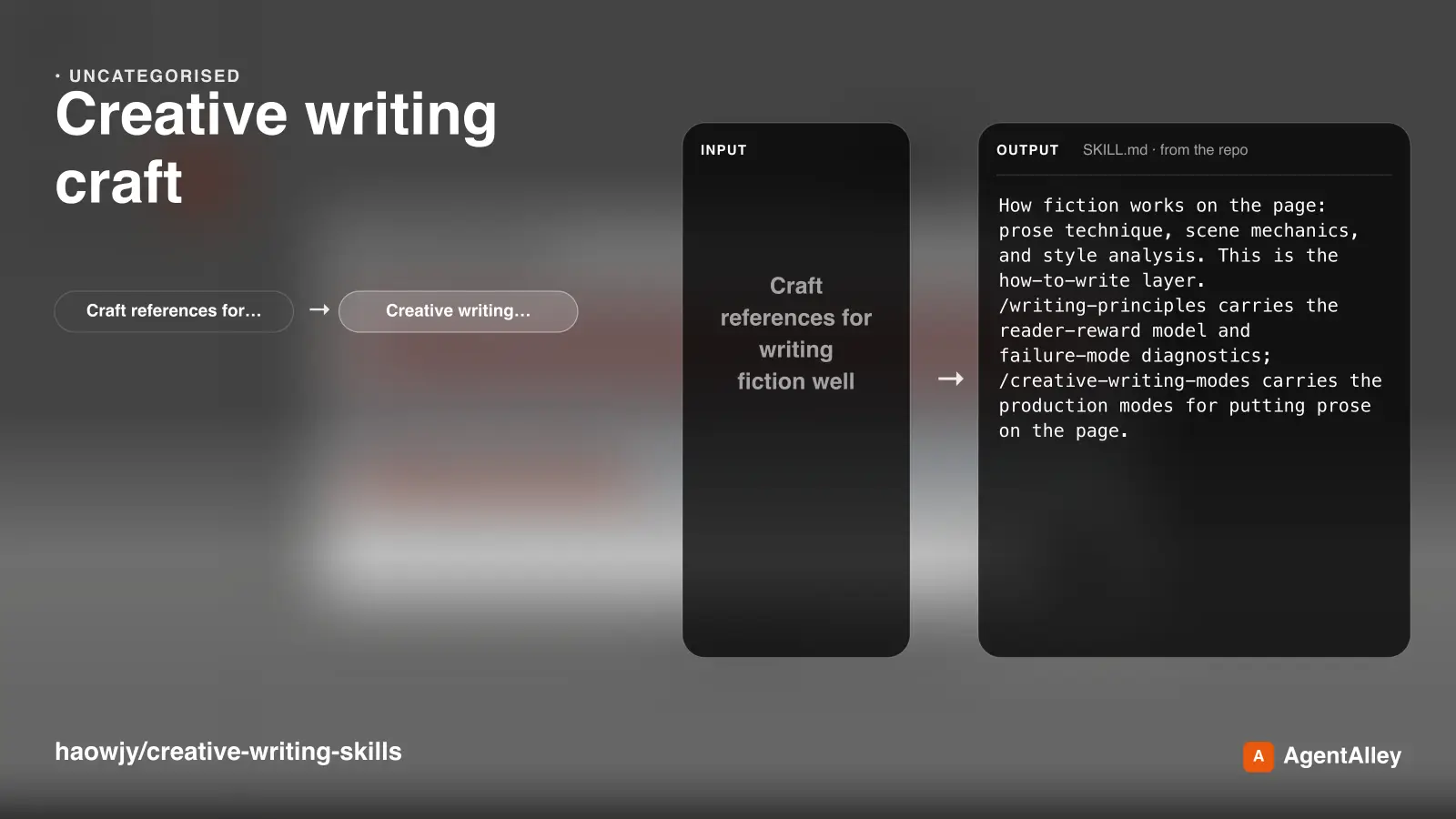 Fiction Writing Craft Guidehaowjy/creative-writing-skills · by haowjyCraft references for writing fiction well: prose, scenes, style, voice, and genre/page-level technique. Load when a writer, critic, or muse needs how-to-write guidance rather than a production mode.★ 506 GitHub stars
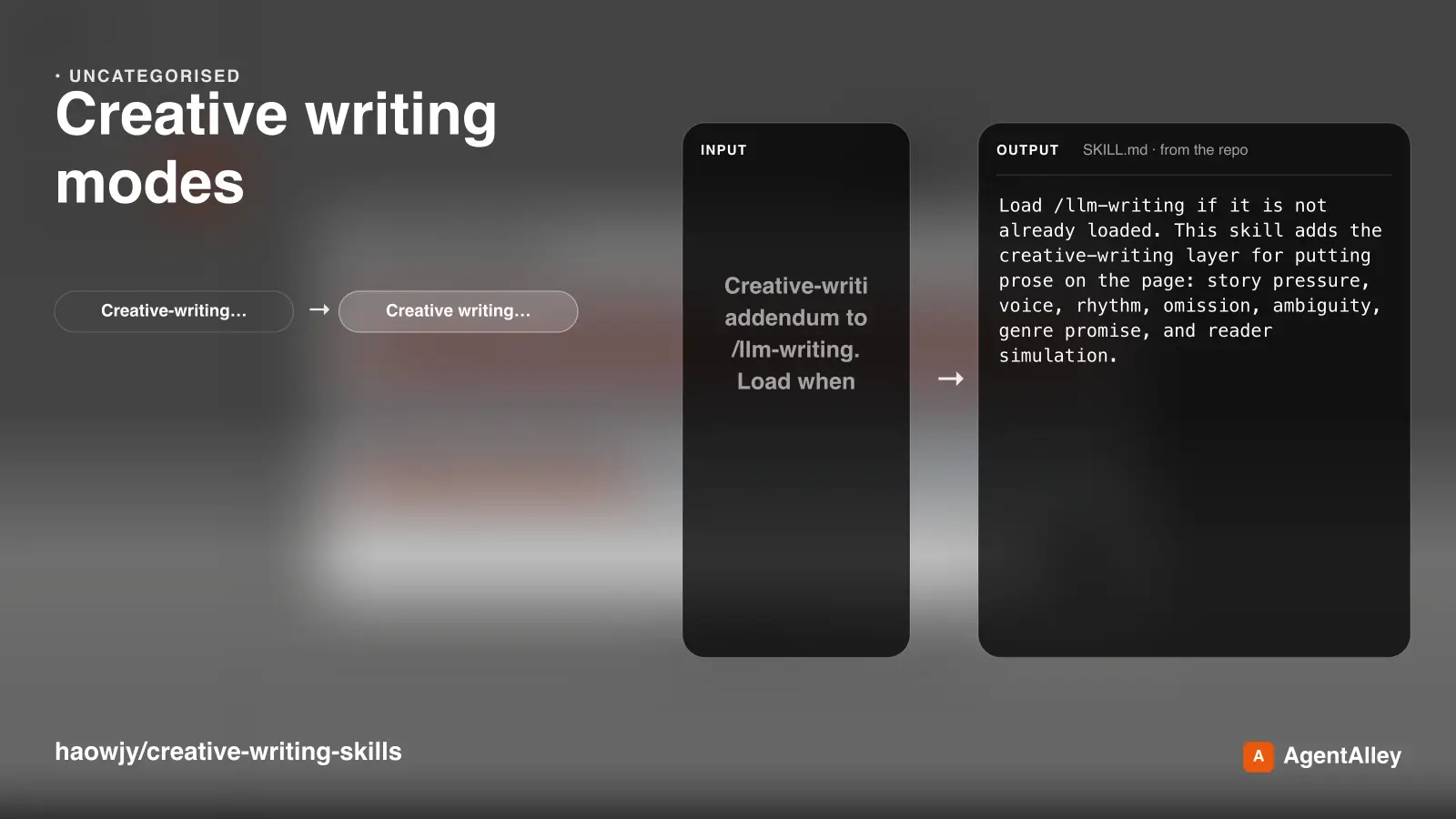 Writing Mode Guidehaowjy/creative-writing-skills · by haowjyCreative-writing addendum to /llm-writing. Load when putting prose on the page: draft, revise, bridge, vary, or polish.★ 506 GitHub stars
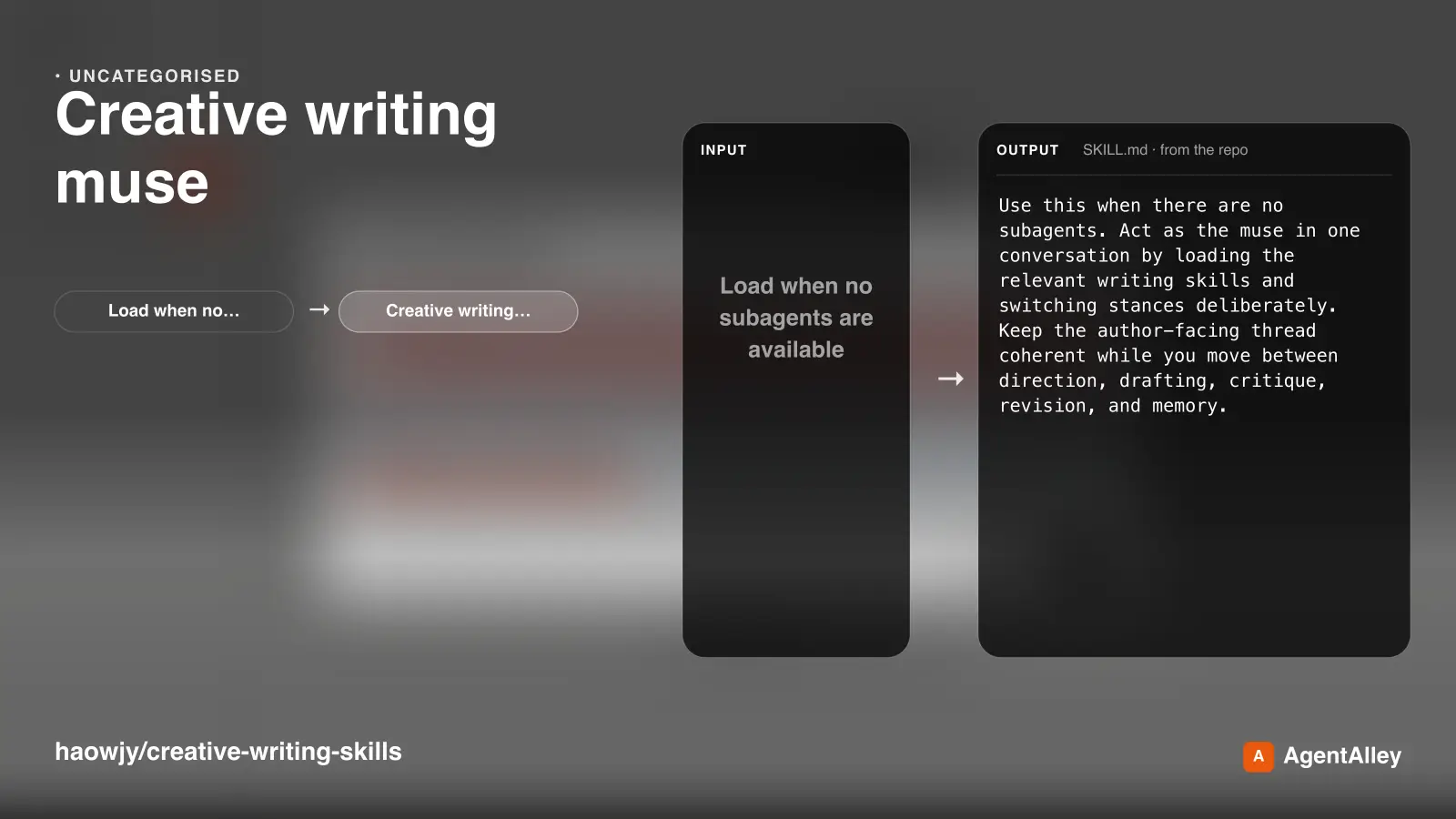 Multi-Mode Writing Studiohaowjy/creative-writing-skills · by haowjyLoad when no subagents are available and one agent must plan, draft, critique, research, and capture memory by switching stances.★ 506 GitHub stars
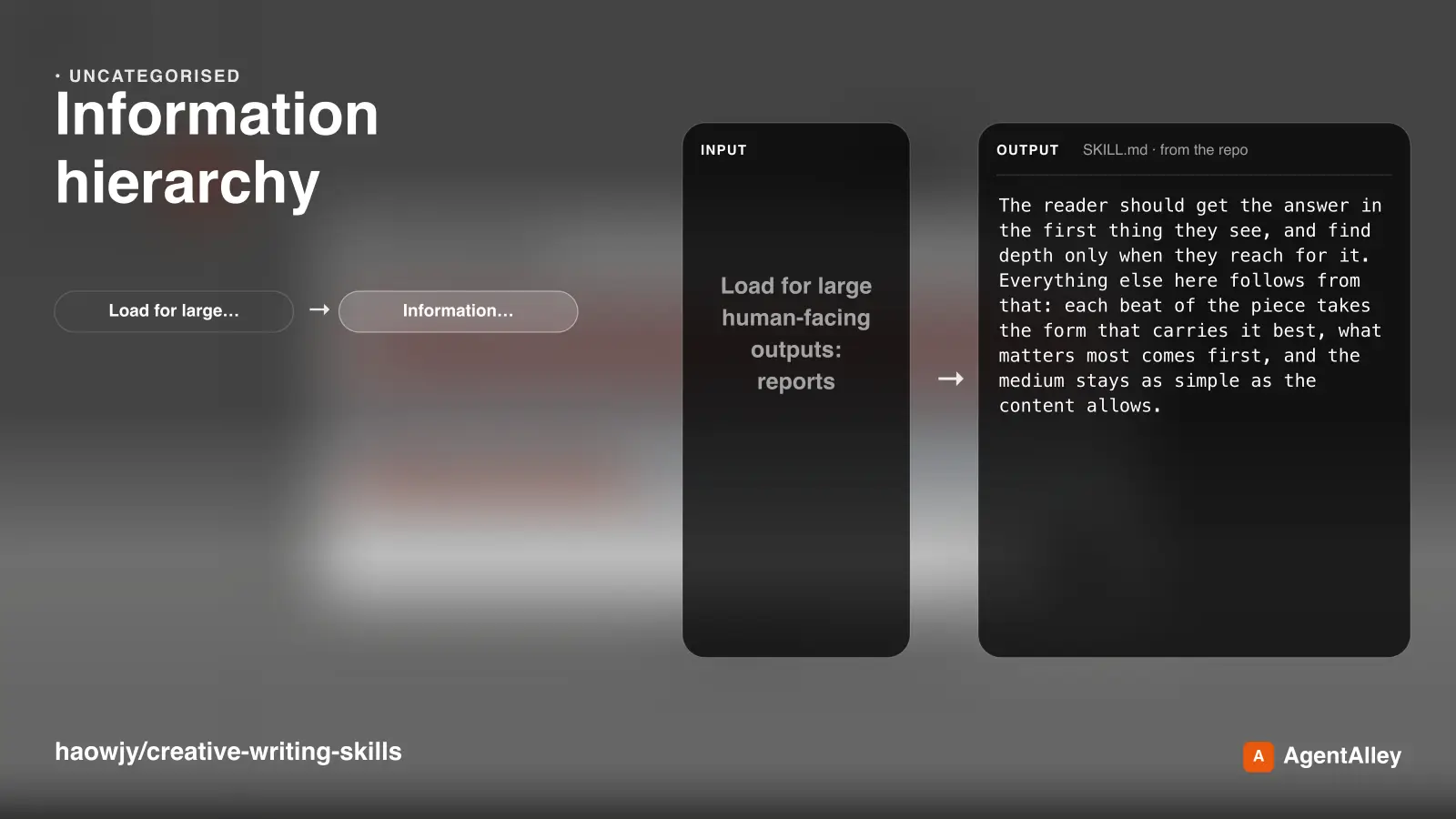 Output Information Hierarchyhaowjy/creative-writing-skills · by haowjyLoad for large human-facing outputs: reports, docs, multi-section explanations, artifacts. Choose the right form for each beat (prose, diagram, table, mockup) and put the answer first, depth behind it. If the medium allows, use progressive disclosure.★ 506 GitHub stars
 Intent Modeling Interviewhaowjy/creative-writing-skills · by haowjyUse before acting on human instructions: separate what they said from what they meant.★ 506 GitHub stars