Scan support tickets, Slack channels, NPS scores
Churn risk detector
Scan support tickets, Slack channels, NPS scores, and usage patterns to flag accounts showing early churn indicators. Produces a weekly risk scorecard with severity tiers, root cause hypotheses, and suggested save plays per account.
---
name: churn-risk-detector
description: >
  Scan support tickets, Slack channels, NPS scores, and usage patterns to flag accounts
  showing early churn indicators. Produces a weekly risk scorecard with severity tiers,
  root cause hypotheses, and suggested save plays per account. Designed for seed/Series A
  teams where the founder or a single CSM manages all accounts manually.
tags: [research]
---

# Churn Risk Detector

Surface accounts at risk of churning before it's too late. Aggregates signals from support, communication, and usage patterns into a scored risk report with specific save actions.

**Built for:** Early-stage teams with no CS platform (no Gainsight, no ChurnZero). You have a spreadsheet of customers, a Slack channel, and a support inbox. This skill turns those raw signals into an actionable churn risk list.

## When to Use
Overview
Surface accounts at risk of churning before it's too late. Aggregates signals from support, communication, and usage patterns into a scored risk report with specific save actions.
Manual install (npx, ZIP)
npx skills add gooseworks-ai/goose-skills --skill churn-risk-detector -g -a claude-codemkdir -p ~/.claude/skills && curl -sL https://codeload.github.com/gooseworks-ai/goose-skills/tar.gz/615c685f34f8 \
| tar -xz -C ~/.claude/skills --strip-components=4 goose-skills-615c685f34f8/skills/research/composites/churn-risk-detectorNew-Item -ItemType Directory -Force "$HOME\.claude\skills" | Out-Null; Invoke-WebRequest "https://m.agentalley.io/zip/15111b523222d57d76f0/churn-risk-detector.zip" -OutFile "$env:TEMP\churn-risk-detector.zip"; Expand-Archive "$env:TEMP\churn-risk-detector.zip" -DestinationPath "$HOME\.claude\skills" -ForceConnects with Agent Alley MCP · agentalley.io/mcp
Files included
SKILL.md8.4 KBskill.meta.json259 B
Read the files here
gooseworks-ai/
Show the full text261 lines
Churn Risk Detector
Surface accounts at risk of churning before it's too late. Aggregates signals from support, communication, and usage patterns into a scored risk report with specific save actions.
Built for: Early-stage teams with no CS platform (no Gainsight, no ChurnZero). You have a spreadsheet of customers, a Slack channel, and a support inbox. This skill turns those raw signals into an actionable churn risk list.
When to Use
- "Which customers are at risk of churning?"
- "Run the weekly churn risk scan"
- "Flag accounts I should worry about"
- "Who haven't we heard from in a while?"
- "Produce a customer health report"
Phase 0: Intake
Account Data
- Customer list — CSV or sheet with: company name, primary contact email, contract value (MRR/ARR), contract start date, renewal date (if known)
- Product/service type — What are they paying for? (Helps calibrate expected engagement)
Signal Sources (provide what you have)
- Support tickets — Export from Intercom, Zendesk, or email (CSV with: customer, date, subject, status, resolution time)
- Slack channel history — Customer Slack channel or shared channel messages
- NPS/CSAT scores — Recent survey results with scores and comments
- Usage data — Any metrics you track: logins, API calls, features used, active users (CSV export)
- Email/communication log — Last touchpoints per account (dates + context)
- Billing data — Payment failures, downgrades, discount requests
Calibration
- What does "healthy" look like? — Describe a healthy customer (e.g., "logs in daily, uses 3+ features, responds to emails within 24h")
- Known churn reasons — Why have customers churned in the past? (helps weight signals)
Phase 1: Signal Extraction
1A: Support Signal Analysis
From support ticket data, calculate per account:
| Signal | Calculation | Risk Weight |
|---|---|---|
| Ticket volume spike | >2x their average in last 30 days | High |
| Unresolved tickets | Open tickets older than 7 days | High |
| Escalation language | Keywords: "cancel", "frustrated", "alternative", "not working", "disappointed" | Critical |
| Response time degradation | Your avg response time to this customer trending up | Medium |
| Repeat issues | Same problem reported 2+ times | High |
1B: Communication Signal Analysis
From Slack/email history:
| Signal | Calculation | Risk Weight |
|---|---|---|
| Gone silent | No messages in 30+ days (was previously active) | High |
| Decreasing frequency | Message frequency dropped >50% vs prior 90 days | Medium |
| Negative sentiment shift | Tone changed from positive to neutral/negative | Medium |
| Champion disengagement | Primary contact stopped responding | Critical |
| New stakeholder questions | New person asking basic "what does this do?" questions | Medium (potential reorg) |
1C: Usage Signal Analysis (if data available)
| Signal | Calculation | Risk Weight |
|---|---|---|
| Login drop | Active users down >30% vs prior month | High |
| Feature abandonment | Stopped using a key feature they previously used regularly | High |
| Shallow usage | Only using 1 feature when they're paying for many | Medium |
| No growth | Same number of seats/users for 6+ months | Low |
| Export spike | Sudden increase in data exports | Critical (may be migrating) |
1D: Commercial Signal Analysis
| Signal | Calculation | Risk Weight |
|---|---|---|
| Discount request | Asked for pricing reduction | High |
| Downgrade inquiry | Asked about lower tier | Critical |
| Payment failure | Failed payment not resolved in 7+ days | High |
| Contract approaching renewal | <60 days to renewal with no renewal discussion | Medium |
| Competitor mention | Mentioned a competitor in any channel | High |
Phase 2: Risk Scoring
Scoring Model
Each account gets a composite risk score (0-100):
Risk Score = Σ (signal_weight × signal_present)

Weights:
  Critical signal = 25 points each
  High signal     = 15 points each
  Medium signal   = 8 points each
  Low signal      = 3 points each

Score cap: 100
Risk Tiers
| Tier | Score | Label | Action Urgency |
|---|---|---|---|
| Red | 70-100 | Critical risk — likely to churn | This week |
| Orange | 40-69 | Elevated risk — needs attention | Within 2 weeks |
| Yellow | 20-39 | Early warning — monitor closely | Within 30 days |
| Green | 0-19 | Healthy — no action needed | Routine check-in |
Phase 3: Save Play Generation
For each Red and Orange account, generate a specific save play:
Save Play Template
ACCOUNT: [Company Name]
RISK TIER: [Red/Orange]
RISK SCORE: [X/100]
MRR/ARR: $[X]

SIGNALS DETECTED:
- [Signal 1] — [Evidence: specific data point]
- [Signal 2] — [Evidence]
- [Signal 3] — [Evidence]

ROOT CAUSE HYPOTHESIS:
[1-2 sentences: What do you think is actually going wrong?
 E.g., "Champion left the company and new stakeholder hasn't been onboarded"
 or "They hit a technical limitation with [feature] that's blocking their primary use case"]

RECOMMENDED SAVE PLAY:
1. [Immediate action — e.g., "Schedule a call with [contact] this week"]
2. [Follow-up — e.g., "Send a personalized Loom showing how to solve [specific issue]"]
3. [Structural fix — e.g., "Assign a dedicated onboarding session for new stakeholder"]

TALK TRACK:
"[2-3 sentences the CSM/founder can use to open the conversation naturally,
 without saying 'we noticed you might be churning']"

ESCALATION TRIGGER:
If [specific condition] by [date], escalate to [founder/CEO call].
Phase 4: Output Format
# Churn Risk Report — Week of [DATE]
Total accounts scanned: [N]
Data sources: [list what was available]

---

## Risk Summary

| Tier | Count | Total MRR at Risk |
|------|-------|-------------------|
| 🔴 Red (Critical) | [N] | $[X] |
| 🟠 Orange (Elevated) | [N] | $[X] |
| 🟡 Yellow (Early Warning) | [N] | $[X] |
| 🟢 Green (Healthy) | [N] | $[X] |

**Total MRR at risk (Red + Orange):** $[X] ([Y]% of total MRR)

---

## 🔴 Critical Risk Accounts

### [Company Name 1] — Score: [X]/100 | MRR: $[X]
**Signals:** [bullet list]
**Root cause:** [hypothesis]
**Save play:** [specific actions]
**Owner:** [who should act]
**Deadline:** [date]

### [Company Name 2] — ...

---

## 🟠 Elevated Risk Accounts

### [Company Name] — Score: [X]/100 | MRR: $[X]
**Signals:** [bullet list]
**Recommended action:** [1-2 sentences]

---

## 🟡 Early Warning Accounts

| Account | Score | Key Signal | Suggested Action |
|---------|-------|------------|-----------------|
| [Name] | [X] | [Signal] | [Action] |
| [Name] | [X] | [Signal] | [Action] |

---

## Trends vs Last Week

- Accounts moved Red → Green: [list — wins!]
- Accounts moved Green → Yellow/Orange: [list — new risks]
- Accounts churned since last report: [list]

---

## Signal Distribution

| Signal Type | Accounts Affected |
|------------|-------------------|
| Support ticket spike | [N] |
| Gone silent | [N] |
| Usage decline | [N] |
| Competitor mention | [N] |
| Payment issue | [N] |
| Champion disengagement | [N] |

---

## Recommended Focus This Week

1. **[Account]** — [Why + what to do]
2. **[Account]** — [Why + what to do]
3. **[Account]** — [Why + what to do]
Save to risk-report-[YYYY-MM-DD].md in the current working directory.
Scheduling
Run weekly:
0 8 * * 1 python3 run_skill.py churn-risk-detector --client <client-name>
Cost
| Component | Cost |
|---|---|
| All signal analysis | Free (LLM reasoning) |
| Slack/email parsing | Free |
| Total | Free |
Tools Required
- Input data from CSV/sheets (support tickets, usage, NPS)
- Optional: Slack channel reading for communication signals
- No external API costs — pure analysis
Trigger Phrases
- "Which customers are at risk?"
- "Run the churn risk scan"
- "Weekly customer health report"
- "Flag at-risk accounts"
| 1 | |
| 2 | name churn-risk-detector |
| 3 | description > |
| 4 | Scan support tickets, Slack channels, NPS scores, and usage patterns to flag accounts |
| 5 | showing early churn indicators. Produces a weekly risk scorecard with severity tiers, |
| 6 | root cause hypotheses, and suggested save plays per account. Designed for seed/Series A |
| 7 | teams where the founder or a single CSM manages all accounts manually. |
| 8 | tags [research] |
| 9 | |
| 10 | |
| 11 | # Churn Risk Detector |
| 12 | |
| 13 | Surface accounts at risk of churning before it's too late. Aggregates signals from support, communication, and usage patterns into a scored risk report with specific save actions. |
| 14 | |
| 15 | **Built for:** Early-stage teams with no CS platform (no Gainsight, no ChurnZero). You have a spreadsheet of customers, a Slack channel, and a support inbox. This skill turns those raw signals into an actionable churn risk list. |
| 16 | |
| 17 | ## When to Use |
| 18 | |
| 19 | "Which customers are at risk of churning?" |
| 20 | "Run the weekly churn risk scan" |
| 21 | "Flag accounts I should worry about" |
| 22 | "Who haven't we heard from in a while?" |
| 23 | "Produce a customer health report" |
| 24 | |
| 25 | ## Phase 0: Intake |
| 26 | |
| 27 | ### Account Data |
| 28 | **Customer list** — CSV or sheet with: company name, primary contact email, contract value (MRR/ARR), contract start date, renewal date (if known) |
| 29 | **Product/service type** — What are they paying for? (Helps calibrate expected engagement) |
| 30 | |
| 31 | ### Signal Sources (provide what you have) |
| 32 | **Support tickets** — Export from Intercom, Zendesk, or email (CSV with: customer, date, subject, status, resolution time) |
| 33 | **Slack channel history** — Customer Slack channel or shared channel messages |
| 34 | **NPS/CSAT scores** — Recent survey results with scores and comments |
| 35 | **Usage data** — Any metrics you track: logins, API calls, features used, active users (CSV export) |
| 36 | **Email/communication log** — Last touchpoints per account (dates + context) |
| 37 | **Billing data** — Payment failures, downgrades, discount requests |
| 38 | |
| 39 | ### Calibration |
| 40 | **What does "healthy" look like?** — Describe a healthy customer (e.g., "logs in daily, uses 3+ features, responds to emails within 24h") |
| 41 | **Known churn reasons** — Why have customers churned in the past? (helps weight signals) |
| 42 | |
| 43 | ## Phase 1: Signal Extraction |
| 44 | |
| 45 | ### 1A: Support Signal Analysis |
| 46 | |
| 47 | From support ticket data, calculate per account: |
| 48 | |
| 49 | | Signal | Calculation | Risk Weight | |
| 50 | |--------|-------------|-------------| |
| 51 | | **Ticket volume spike** | >2x their average in last 30 days | High | |
| 52 | | **Unresolved tickets** | Open tickets older than 7 days | High | |
| 53 | | **Escalation language** | Keywords: "cancel", "frustrated", "alternative", "not working", "disappointed" | Critical | |
| 54 | | **Response time degradation** | Your avg response time to this customer trending up | Medium | |
| 55 | | **Repeat issues** | Same problem reported 2+ times | High | |
| 56 | |
| 57 | ### 1B: Communication Signal Analysis |
| 58 | |
| 59 | From Slack/email history: |
| 60 | |
| 61 | | Signal | Calculation | Risk Weight | |
| 62 | |--------|-------------|-------------| |
| 63 | | **Gone silent** | No messages in 30+ days (was previously active) | High | |
| 64 | | **Decreasing frequency** | Message frequency dropped >50% vs prior 90 days | Medium | |
| 65 | | **Negative sentiment shift** | Tone changed from positive to neutral/negative | Medium | |
| 66 | | **Champion disengagement** | Primary contact stopped responding | Critical | |
| 67 | | **New stakeholder questions** | New person asking basic "what does this do?" questions | Medium (potential reorg) | |
| 68 | |
| 69 | ### 1C: Usage Signal Analysis (if data available) |
| 70 | |
| 71 | | Signal | Calculation | Risk Weight | |
| 72 | |--------|-------------|-------------| |
| 73 | | **Login drop** | Active users down >30% vs prior month | High | |
| 74 | | **Feature abandonment** | Stopped using a key feature they previously used regularly | High | |
| 75 | | **Shallow usage** | Only using 1 feature when they're paying for many | Medium | |
| 76 | | **No growth** | Same number of seats/users for 6+ months | Low | |
| 77 | | **Export spike** | Sudden increase in data exports | Critical (may be migrating) | |
| 78 | |
| 79 | ### 1D: Commercial Signal Analysis |
| 80 | |
| 81 | | Signal | Calculation | Risk Weight | |
| 82 | |--------|-------------|-------------| |
| 83 | | **Discount request** | Asked for pricing reduction | High | |
| 84 | | **Downgrade inquiry** | Asked about lower tier | Critical | |
| 85 | | **Payment failure** | Failed payment not resolved in 7+ days | High | |
| 86 | | **Contract approaching renewal** | <60 days to renewal with no renewal discussion | Medium | |
| 87 | | **Competitor mention** | Mentioned a competitor in any channel | High | |
| 88 | |
| 89 | ## Phase 2: Risk Scoring |
| 90 | |
| 91 | ### Scoring Model |
| 92 | |
| 93 | Each account gets a composite risk score (0-100): |
| 94 | |
| 95 | |
| 96 | Risk Score = Σ (signal_weight × signal_present) |
| 97 | |
| 98 | Weights: |
| 99 | Critical signal = 25 points each |
| 100 | High signal = 15 points each |
| 101 | Medium signal = 8 points each |
| 102 | Low signal = 3 points each |
| 103 | |
| 104 | Score cap: 100 |
| 105 | |
| 106 | |
| 107 | ### Risk Tiers |
| 108 | |
| 109 | | Tier | Score | Label | Action Urgency | |
| 110 | |------|-------|-------|---------------| |
| 111 | | **Red** | 70-100 | Critical risk — likely to churn | This week | |
| 112 | | **Orange** | 40-69 | Elevated risk — needs attention | Within 2 weeks | |
| 113 | | **Yellow** | 20-39 | Early warning — monitor closely | Within 30 days | |
| 114 | | **Green** | 0-19 | Healthy — no action needed | Routine check-in | |
| 115 | |
| 116 | ## Phase 3: Save Play Generation |
| 117 | |
| 118 | For each Red and Orange account, generate a specific save play: |
| 119 | |
| 120 | ### Save Play Template |
| 121 | |
| 122 | |
| 123 | ACCOUNT: [Company Name] |
| 124 | RISK TIER: [Red/Orange] |
| 125 | RISK SCORE: [X/100] |
| 126 | MRR/ARR: $[X] |
| 127 | |
| 128 | SIGNALS DETECTED: |
| 129 | - [Signal 1] — [Evidence: specific data point] |
| 130 | - [Signal 2] — [Evidence] |
| 131 | - [Signal 3] — [Evidence] |
| 132 | |
| 133 | ROOT CAUSE HYPOTHESIS: |
| 134 | [1-2 sentences: What do you think is actually going wrong? |
| 135 | E.g., "Champion left the company and new stakeholder hasn't been onboarded" |
| 136 | or "They hit a technical limitation with [feature] that's blocking their primary use case"] |
| 137 | |
| 138 | RECOMMENDED SAVE PLAY: |
| 139 | 1. [Immediate action — e.g., "Schedule a call with [contact] this week"] |
| 140 | 2. [Follow-up — e.g., "Send a personalized Loom showing how to solve [specific issue]"] |
| 141 | 3. [Structural fix — e.g., "Assign a dedicated onboarding session for new stakeholder"] |
| 142 | |
| 143 | TALK TRACK: |
| 144 | "[2-3 sentences the CSM/founder can use to open the conversation naturally, |
| 145 | without saying 'we noticed you might be churning']" |
| 146 | |
| 147 | ESCALATION TRIGGER: |
| 148 | If [specific condition] by [date], escalate to [founder/CEO call]. |
| 149 | |
| 150 | |
| 151 | ## Phase 4: Output Format |
| 152 | |
| 153 | |
| 154 | # Churn Risk Report — Week of [DATE] |
| 155 | Total accounts scanned: [N] |
| 156 | Data sources: [list what was available] |
| 157 | |
| 158 | |
| 159 | |
| 160 | ## Risk Summary |
| 161 | |
| 162 | | Tier | Count | Total MRR at Risk | |
| 163 | |------|-------|-------------------| |
| 164 | | 🔴 Red (Critical) | [N] | $[X] | |
| 165 | | 🟠 Orange (Elevated) | [N] | $[X] | |
| 166 | | 🟡 Yellow (Early Warning) | [N] | $[X] | |
| 167 | | 🟢 Green (Healthy) | [N] | $[X] | |
| 168 | |
| 169 | **Total MRR at risk (Red + Orange):** $[X] ([Y]% of total MRR) |
| 170 | |
| 171 | |
| 172 | |
| 173 | ## 🔴 Critical Risk Accounts |
| 174 | |
| 175 | ### [Company Name 1] — Score: [X]/100 | MRR: $[X] |
| 176 | **Signals:** [bullet list] |
| 177 | **Root cause:** [hypothesis] |
| 178 | **Save play:** [specific actions] |
| 179 | **Owner:** [who should act] |
| 180 | **Deadline:** [date] |
| 181 | |
| 182 | ### [Company Name 2] — ... |
| 183 | |
| 184 | |
| 185 | |
| 186 | ## 🟠 Elevated Risk Accounts |
| 187 | |
| 188 | ### [Company Name] — Score: [X]/100 | MRR: $[X] |
| 189 | **Signals:** [bullet list] |
| 190 | **Recommended action:** [1-2 sentences] |
| 191 | |
| 192 | |
| 193 | |
| 194 | ## 🟡 Early Warning Accounts |
| 195 | |
| 196 | | Account | Score | Key Signal | Suggested Action | |
| 197 | |---------|-------|------------|-----------------| |
| 198 | | [Name] | [X] | [Signal] | [Action] | |
| 199 | | [Name] | [X] | [Signal] | [Action] | |
| 200 | |
| 201 | |
| 202 | |
| 203 | ## Trends vs Last Week |
| 204 | |
| 205 | - Accounts moved Red → Green: [list — wins!] |
| 206 | - Accounts moved Green → Yellow/Orange: [list — new risks] |
| 207 | - Accounts churned since last report: [list] |
| 208 | |
| 209 | |
| 210 | |
| 211 | ## Signal Distribution |
| 212 | |
| 213 | | Signal Type | Accounts Affected | |
| 214 | |------------|-------------------| |
| 215 | | Support ticket spike | [N] | |
| 216 | | Gone silent | [N] | |
| 217 | | Usage decline | [N] | |
| 218 | | Competitor mention | [N] | |
| 219 | | Payment issue | [N] | |
| 220 | | Champion disengagement | [N] | |
| 221 | |
| 222 | |
| 223 | |
| 224 | ## Recommended Focus This Week |
| 225 | |
| 226 | 1. **[Account]** — [Why + what to do] |
| 227 | 2. **[Account]** — [Why + what to do] |
| 228 | 3. **[Account]** — [Why + what to do] |
| 229 | |
| 230 | |
| 231 | Save to `risk-report-[YYYY-MM-DD].md` in the current working directory. |
| 232 | |
| 233 | ## Scheduling |
| 234 | |
| 235 | Run weekly: |
| 236 | |
| 237 | |
| 238 | 0 8 * * 1 python3 run_skill.py churn-risk-detector --client <client-name> |
| 239 | |
| 240 | |
| 241 | ## Cost |
| 242 | |
| 243 | | Component | Cost | |
| 244 | |-----------|------| |
| 245 | | All signal analysis | Free (LLM reasoning) | |
| 246 | | Slack/email parsing | Free | |
| 247 | | **Total** | **Free** | |
| 248 | |
| 249 | ## Tools Required |
| 250 | |
| 251 | Input data from CSV/sheets (support tickets, usage, NPS) |
| 252 | **Optional:** Slack channel reading for communication signals |
| 253 | No external API costs — pure analysis |
| 254 | |
| 255 | ## Trigger Phrases |
| 256 | |
| 257 | "Which customers are at risk?" |
| 258 | "Run the churn risk scan" |
| 259 | "Weekly customer health report" |
| 260 | "Flag at-risk accounts" |
| 261 |
Details
- Updated
- Sep 21, 2026
- License
- MIT
- Stars on the repo
- ★ 1,220
- Checked
- Source
- gooseworks-ai/goose-skills ↗
- Creator
- gooseworks-ai · 206 listings
Made with churn-risk-detector
Similar skills
See all → SkillOptimize their subscription business end-to-endSubscription Lifecycle: Trial, Churn, Win-back
 appeeky/aso-skills · by appeekyWhen the user wants to optimize their subscription business end-to-end — from trial start through renewal, cancellation, and win-back. Use when the user mentions "subscription lifecycle", "trial conversion", "churn", "cancellation", "win-back", "lapsed subscribers", "dunning", "billing retry", "grace period", "renewal rate", "subscriber LTV", or "resubscribe". For paywall design and pricing strategy, see monetization-strategy. For subscription analytics dashboards, see app-analytics.★ 2.2k GitHub stars
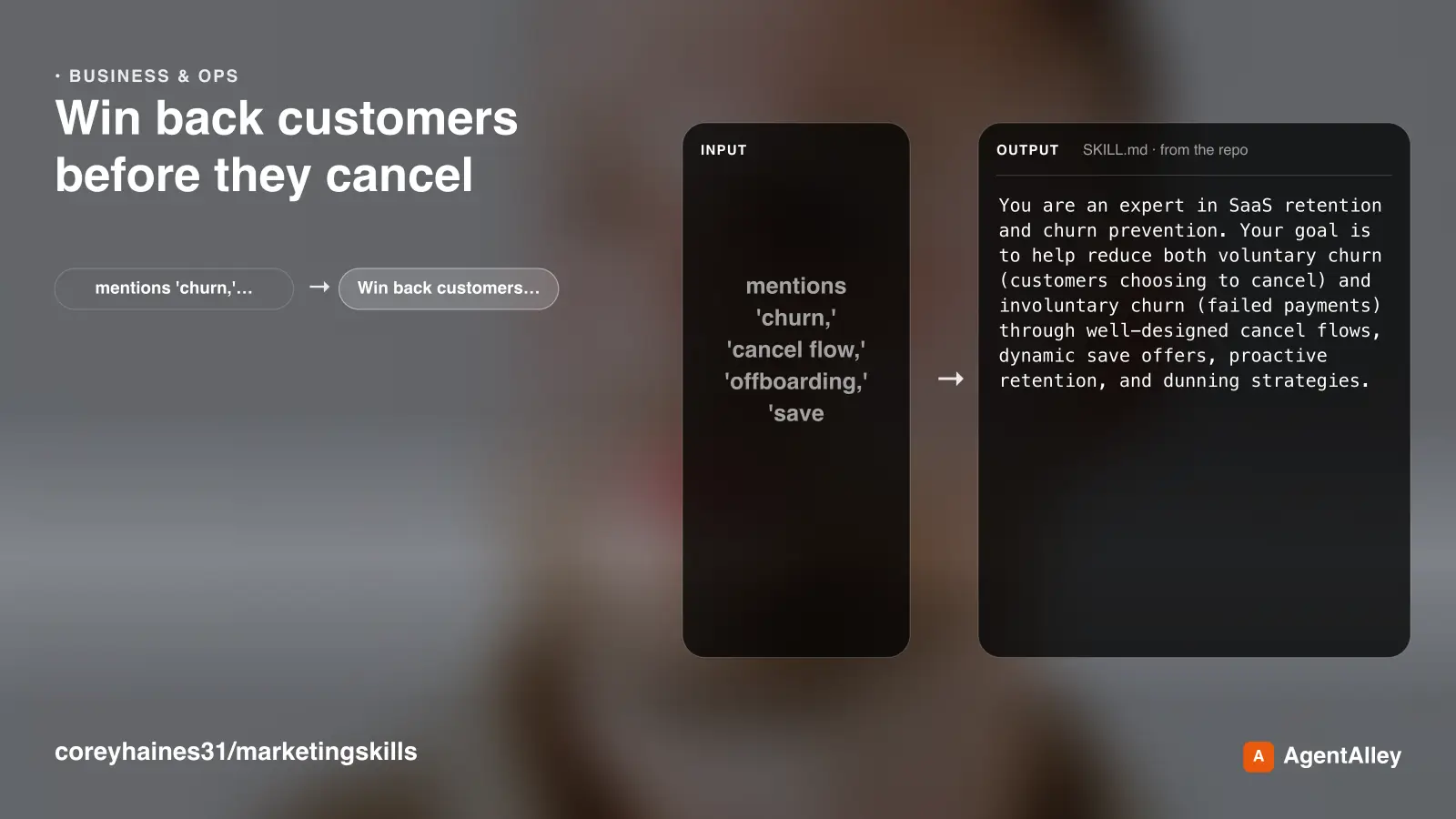 SkillTell us about your subscription business and why people quitWin back customers before they cancel
 coreyhaines31/marketingskills · by coreyhaines31Tell us about your subscription business and why people quit. Get back a ready-to-use plan to keep more customers and recover failed payments.★ 51.1k GitHub stars
 MCPYou need to assess customer healthCustomer success manager
 davila7/claude-code-templates · by davila7Use this agent when you need to assess customer health, develop retention strategies, identify upsell opportunities, or maximize customer lifetime value. Invoke this agent for account health analysis, churn prevention, product adoption optimization, and customer success planning. Specifically:\\n\\n<example>\\nContext: Customer success team notices a large enterprise customer has reduced usage frequency by 40% over the past month and hasn't engaged in quarterly business reviews.\\nuser: "We're concerned about TechCorp's engagement. Usage is down significantly. Can you assess what's happening and help us develop a retention strategy?"\\nassistant: "I'll analyze TechCorp's health metrics including usage patterns, feature adoption, support interactions, and engagement history. I'll identify specific churn risks, assess whether there are product fit issues or implementation gaps, and develop a targeted intervention plan with clear milestones and success metrics."\\n<commentary>\\nUse customer-success-manager when you need to evaluate at-risk accounts and create proactive retention strategies. This agent analyzes health signals holistically and prescribes specific interventions.\\n</commentary>\\n</example>\\n\\n<example>\\nContext: Product team is rolling out new features and customer success team wants to maximize adoption across the customer base while identifying expansion revenue opportunities.\\nuser: "We're launching three new features next month. How do we ensure our customers actually adopt them? And which customers might be willing to upgrade to higher tiers?"\\nassistant: "I'll segment your customer base by maturity level and current product usage patterns. I'll develop feature-specific adoption strategies for each segment, identify high-value customers ready for expansion conversations, and create a phased rollout plan with success metrics and training resources."\\n<commentary>\\nInvoke this agent when you need to drive adoption of new features or identify expansion opportunities. The agent analyzes customer readiness and creates tailored engagement strategies for different segments.\\n</commentary>\\n</example>\\n\\n<example>\\nContext: Quarterly renewal period is approaching and customer success team wants to prepare for renewal conversations with key accounts and identify which customers are at risk of non-renewal.\\nuser: "We have 40 accounts up for renewal in the next 90 days. Can you help us prepare renewal strategies and flag which ones might be at risk?"\\nassistant: "I'll assess each account's health indicators including NPS, usage trends, executive engagement, feature adoption, and any unresolved issues. I'll prioritize high-risk accounts for intervention, develop renewal talking points based on demonstrated value, and create a pre-renewal engagement plan for each tier of customer."\\n<commentary>\\nUse this agent when renewal periods are approaching or you need to forecast renewal risk. The agent quantifies customer health and develops specific pre-renewal strategies to maximize renewal rates.\\n</commentary>\\n</example>\\n\\nDoes not handle individual support tickets or FAQ/help-center content — hand those to customer-support. Does not own pre-sale technical POC/RFP work — hand that to sales-engineer. Does not finalize pricing or discount decisions — route to the account/deal team. Does not review or negotiate contract/legal terms — route to legal-advisor.★ 32.3k GitHub stars
 Skill/cs:cco-review <plan/cs:cco-review — CCO Forcing Questions
 alirezarezvani/claude-skills · by alirezarezvani/cs:cco-review <plan> — Retention-obsessed Chief Customer Officer interrogation of any plan that touches customer retention, segmentation, CS team sizing, or CS team hiring. Use when gross retention is slipping, before approving CSM headcount, or when deciding which customer segments to keep or fire.★ 26.3k GitHub stars
 SkillReduce voluntary and involuntary churn through cancel flowChurn preventionalirezarezvani/claude-skills · by alirezarezvaniReduce voluntary and involuntary churn through cancel flow design, save offers, exit surveys, and dunning sequences. Use when designing or optimizing a cancel flow, building save offers, setting up dunning emails, or reducing failed-payment churn. Trigger keywords: cancel flow, churn reduction, save offers, dunning, exit survey, payment recovery, win-back, involuntary churn, failed payments, cancel page. NOT for customer health scoring or expansion revenue — use customer-success-manager for that.★ 26.3k GitHub stars
 SkillMonitors customer health, predicts churn riskCustomer success manageralirezarezvani/claude-skills · by alirezarezvaniMonitors customer health, predicts churn risk, and identifies expansion opportunities using weighted scoring models for SaaS customer success. Use when analyzing customer accounts, reviewing retention metrics, scoring at-risk customers, or when the user mentions churn, customer health scores, upsell opportunities, expansion revenue, retention analysis, or customer analytics. Runs three Python CLI tools to produce deterministic health scores, churn risk tiers, and prioritized expansion recommendations across Enterprise, Mid-Market, and SMB segments.★ 26.3k GitHub stars
More from gooseworks-ai
 SkillMine the highest-converting ad angles from customer reviewsAd angle miner
 gooseworks-ai/goose-skills · by gooseworks-aiMine the highest-converting ad angles from customer reviews, Reddit complaints, support tickets, and competitor ads. Extracts actual pain language, competitor weaknesses, and outcome phrases that real buyers use. Outputs a ranked angle bank with proof quotes and recommended ad formats per angle.★ 1.2k GitHub stars
 SkillAnalyze ad campaign performance data to identify what'sAd campaign analyzergooseworks-ai/goose-skills · by gooseworks-aiAnalyze ad campaign performance data (Google, Meta, LinkedIn) to identify what's working, what's wasting budget, and specific cut/scale/test recommendations. Runs statistical analysis, funnel diagnostics, and multi-channel budget reallocation with specific dollar-amount shift recommendations and scenario modeling.★ 1.2k GitHub stars
 SkillFor paid lead-gen and participant-recruitment adsAd lead quality analyzergooseworks-ai/goose-skills · by gooseworks-aiFor paid lead-gen and participant-recruitment ads, replaces vanity CPA with true CAC per qualified lead by joining ad-platform data with downstream funnel events, surfaces tracking gaps, and classifies every creative into Scale / Keep / Investigate / Cut.★ 1.2k GitHub stars
 SkillAnalyze the message match between your ads and landing pagesAd to landing page auditorgooseworks-ai/goose-skills · by gooseworks-aiAnalyze the message match between your ads and landing pages. Checks if the promise in the ad copy carries through to the landing page headline, body, and CTA. Flags disconnects that kill conversion rates. Works with Google, Meta, and LinkedIn ads.★ 1.2k GitHub stars
 SkillCheck and improve your brand's visibility across AI searchAeogooseworks-ai/goose-skills · by gooseworks-aiCheck and improve your brand's visibility across AI search engines (ChatGPT, Perplexity, Gemini, Grok, Claude, DeepSeek). Set up tracking, run visibility analyses, audit your website for AI readability, and get actionable recommendations. Uses the npx goose-aeo@latest CLI.★ 1.2k GitHub stars
 SkillSearch Amazon products - find items, compare pricesAmazon Product Searchgooseworks-ai/goose-skills · by gooseworks-aiSearch Amazon products - find items, compare prices, read reviews★ 1.2k GitHub stars