Thinking Out Loud: turn your rambling notes into a clear brief
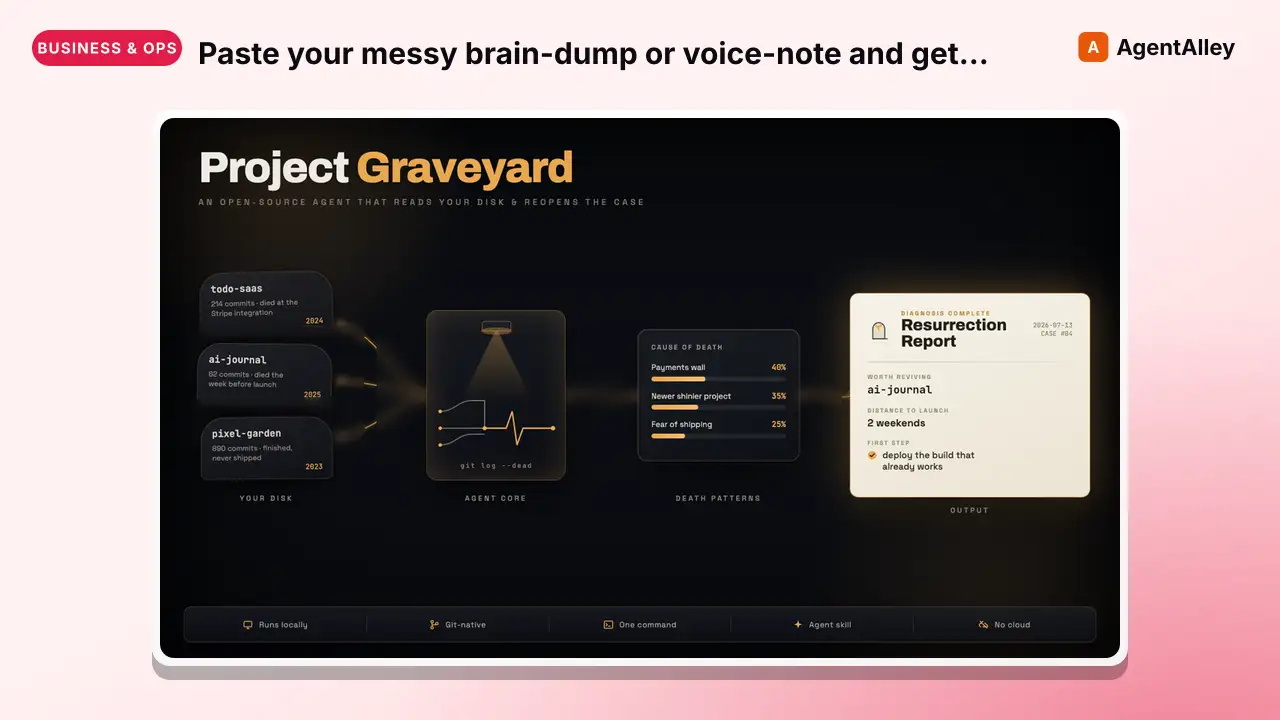
Thinking Out Loud is a free Claude skill by Shubham Saboo for long, messy voice-note rambles. Before acting, Claude returns an echo brief: your mission, locked decisions, open questions, the places you changed your mind, and its own guesses kept apart from your words. Nothing gets built until you approve the brief.
---
name: thinking-out-loud
description: >-
  A contract for what the agent does when a long, messy, stream-of-consciousness
  ramble arrives (usually voice dictation): act on nothing until the echo brief
  is approved. The echo audits the entire transfer, mission, locked decisions
  and constraints, open questions, flips and parked tangents, with the model's
  inferences and guesses quarantined away from the user's own phrasing, so the
  user verifies what the model believes, not just what it doubts. Use when the
  user says "let me think out loud" or wants to ramble a bit before building
  anything, when a message opens with a speech-to-text preamble like "switching
  to voice, sorry for typos", when input is a long weakly punctuated stream
  with restarts and mid-message reversals ("actually no, wait, scrap that idea
  entirely"), or when the user asks to be interviewed about a fuzzy half-formed
  idea. Includes an optional capture mode for rambles spread across several
  messages and an optional targeted interview.
license: Apache-2.0
metadata:
Overview
A ten minute voice ramble transfers more context than any prompt a person would type, and models reconstruct rambles well. The failure is downstream and invisible: the model fills every gap in the ramble confidently. "The usual model" silently becomes a specific model. "The standard size" becomes a specific viewport. A position the user reversed mid-ramble survives as fact. None of this registers as uncertainty from the inside, so none of it ever becomes a clarifying question. The model then acts on a misreading it fully believes, and the user discovers it an hour of generated work later.
Manual install (npx, ZIP)
npx skills add Shubhamsaboo/awesome-llm-apps --skill thinking-out-loud -g -a claude-codemkdir -p ~/.claude/skills && curl -sL https://codeload.github.com/Shubhamsaboo/awesome-llm-apps/tar.gz/459356969d4d \
| tar -xz -C ~/.claude/skills --strip-components=2 awesome-llm-apps-459356969d4d/agent_skills/thinking-out-loudNew-Item -ItemType Directory -Force "$HOME\.claude\skills" | Out-Null; Invoke-WebRequest "https://m.agentalley.io/zip/02f846842054417d5085/thinking-out-loud.zip" -OutFile "$env:TEMP\thinking-out-loud.zip"; Expand-Archive "$env:TEMP\thinking-out-loud.zip" -DestinationPath "$HOME\.claude\skills" -ForceConnects with Agent Alley MCP · agentalley.io/mcp
Files included
SKILL.md7.3 KBREADME.md2.8 KBreferences/1 file · 2.4 KB
Read the files here
Show the full text159 lines
Thinking Out Loud
A ten minute voice ramble transfers more context than any prompt a person would type, and models reconstruct rambles well. The failure is downstream and invisible: the model fills every gap in the ramble confidently. "The usual model" silently becomes a specific model. "The standard size" becomes a specific viewport. A position the user reversed mid-ramble survives as fact. None of this registers as uncertainty from the inside, so none of it ever becomes a clarifying question. The model then acts on a misreading it fully believes, and the user discovers it an hour of generated work later.
This skill is the fix: before acting on any ramble, produce an echo, a short structured audit of everything absorbed, with the model's own additions quarantined from the user's words. The user corrects three lines instead of debugging a built artifact.
Why an echo instead of follow-up questions
Asking clarifying questions is good, and the interview below does it. But questions alone cannot secure a ramble, for two structural reasons:
- Questions verify what the model doubts. The echo verifies what the model believes. A clarifying question requires felt uncertainty, and confident misreadings feel like knowledge. The echo forces every inference and gap-fill into the open whether or not it felt uncertain.
- Questions sample; the echo audits. A long ramble carries dozens of facts and half-decisions. Even good questions probe three or four; the rest of the model's understanding goes unverified into action. The echo inventories the entire transfer, and it works by recognition, not recall: the user reads and spots what is wrong, which is far cheaper than producing answers, and ramblers often do not know their answer until they see the wrong guess written down.
The contract
- Act on nothing. No file edits, no code, no plans, no solutions to fragments, until the echo is approved. Reconstruct first.
- Label every addition. Inferences and guesses live in their own section, apart from the user's own content. Never present a guess in the user's voice.
- Surface every reversal. Adopt the later position, but flag the flip. Never silently average or pick.
- Lose nothing. Tangents get parked, not dropped.
- Never remark on dictation artifacts. Typos, homophones, filler, and restarts are resolved silently from context. Keep the user's own vocabulary and project names.
- Ask before persisting. The approved brief is offered a home, never saved unprompted.
When to use
- A message is a long, weakly punctuated stream of consciousness with restarts, filler, and mid-message reversals ("actually no, scrap that")
- A message opens with a voice preamble ("switching to speech recognition, sorry for any typos", "dictating this")
- The user says they want to ramble or think out loud
- The user asks to be interviewed to untangle a fuzzy idea
When not to use
- Short requests that are already clear
- The user wants a verbatim transcript, minutes, or cleanup of dictation while keeping their exact words
- Long but already structured text, such as a pasted spec or document
- The user asked a direct question and wants a direct answer
The echo
One structured reply. Dense, scannable, and short: the user should find and fix an error in seconds. Full template with a worked example in references/echo-format.md.
- Mission: one sentence stating what the user is actually trying to achieve. Often this differs from what they said first; that is fine.
- Locked: the user's decisions and constraints, merged into one list. Mark anything they called a top priority.
- Open: questions the ramble raised but did not answer.
- Ledger: flips (both positions in one line, later one adopted) and parked tangents (one line each).
- My additions: the only interpretation callouts. "Inferred" (strongly implied but never stated) and "Guessed" (gaps you filled). Tell the user to correct these first.
Compression rules, non-negotiable:
- Nothing appears twice. Every fact lives in exactly one section.
- No "you said" recap. Everything outside My additions is the user's own content by definition; only the model's additions get called out.
- One line per bullet. If a bullet needs two lines, it is two bullets or it is bloat.
- Vague quantifiers are never silently resolved. "The usual model", "standard size", "soon": each lands in Open or Guessed, never absorbed into a locked item as if it were specified.
Close by inviting corrections and offering the interview.
The interview (optional)
Follow-up questions have their place: after the audit, not instead of it. Only if the user accepts the offer, or asked to be interviewed up front.
- Ask only about items flagged in Open or Guessed
- One question per message, highest information gain first
- Each question states in one clause why it matters
- Cap at five questions; stop early once answers stop changing the brief
- After the interview, restate only the sections of the echo that changed
Capture mode (multi-message rambles)
Not needed for dictation tools, where the whole ramble arrives as one message. Use it when the user invokes the skill before rambling and then adds thoughts across several messages, possibly over a long stretch.
- Acknowledge once, in one short line ("Go ahead, I'm listening. Say 'done' when you want the echo.")
- For every following message, reply with a single minimal line ("Listening."). Vary it slightly so it does not feel robotic.
- Do NOT solve, praise, summarize, analyze, or ask questions mid-stream.
- If the user asks a direct question mid-ramble, answer it in at most two sentences, then return to listening.
- Exit on "done", "echo", "echo me", "that's it", "what did you get", or any clear equivalent, then deliver the echo.
Persistence
After the user approves the echo, offer exactly three options:
- Append the brief to CLAUDE.md so future sessions inherit it
- Save it to
docs/rambles/YYYY-MM-DD-<topic>.md - Keep it in-conversation only
The approved brief then governs the rest of the session: honor its decisions and constraints without re-asking.
| 1 | |
| 2 | name thinking-out-loud |
| 3 | description >- |
| 4 | A contract for what the agent does when a long, messy, stream-of-consciousness |
| 5 | ramble arrives (usually voice dictation): act on nothing until the echo brief |
| 6 | is approved. The echo audits the entire transfer, mission, locked decisions |
| 7 | and constraints, open questions, flips and parked tangents, with the model's |
| 8 | inferences and guesses quarantined away from the user's own phrasing, so the |
| 9 | user verifies what the model believes, not just what it doubts. Use when the |
| 10 | user says "let me think out loud" or wants to ramble a bit before building |
| 11 | anything, when a message opens with a speech-to-text preamble like "switching |
| 12 | to voice, sorry for typos", when input is a long weakly punctuated stream |
| 13 | with restarts and mid-message reversals ("actually no, wait, scrap that idea |
| 14 | entirely"), or when the user asks to be interviewed about a fuzzy half-formed |
| 15 | idea. Includes an optional capture mode for rambles spread across several |
| 16 | messages and an optional targeted interview. |
| 17 | license Apache-2.0 |
| 18 | metadata |
| 19 | author "Shubham Saboo" |
| 20 | version "1.3.0" |
| 21 | source "https://github.com/Shubhamsaboo/awesome-llm-apps" |
| 22 | |
| 23 | |
| 24 | # Thinking Out Loud |
| 25 | |
| 26 | A ten minute voice ramble transfers more context than any prompt a person |
| 27 | would type, and models reconstruct rambles well. The failure is |
| 28 | downstream and invisible: the model fills every gap in the ramble |
| 29 | confidently. "The usual model" silently becomes a specific model. "The |
| 30 | standard size" becomes a specific viewport. A position the user reversed |
| 31 | mid-ramble survives as fact. None of this registers as uncertainty from |
| 32 | the inside, so none of it ever becomes a clarifying question. The model |
| 33 | then acts on a misreading it fully believes, and the user discovers it an |
| 34 | hour of generated work later. |
| 35 | |
| 36 | This skill is the fix: before acting on any ramble, produce an echo, a |
| 37 | short structured audit of everything absorbed, with the model's own |
| 38 | additions quarantined from the user's words. The user corrects three |
| 39 | lines instead of debugging a built artifact. |
| 40 | |
| 41 | ## Why an echo instead of follow-up questions |
| 42 | |
| 43 | Asking clarifying questions is good, and the interview below does it. |
| 44 | But questions alone cannot secure a ramble, for two structural reasons: |
| 45 | |
| 46 | **Questions verify what the model doubts. The echo verifies what the |
| 47 | model believes.** A clarifying question requires felt uncertainty, and |
| 48 | confident misreadings feel like knowledge. The echo forces every |
| 49 | inference and gap-fill into the open whether or not it felt uncertain. |
| 50 | **Questions sample; the echo audits.** A long ramble carries dozens of |
| 51 | facts and half-decisions. Even good questions probe three or four; the |
| 52 | rest of the model's understanding goes unverified into action. The |
| 53 | echo inventories the entire transfer, and it works by recognition, not |
| 54 | recall: the user reads and spots what is wrong, which is far cheaper |
| 55 | than producing answers, and ramblers often do not know their answer |
| 56 | until they see the wrong guess written down. |
| 57 | |
| 58 | ## The contract |
| 59 | |
| 60 | **Act on nothing.** No file edits, no code, no plans, no solutions to |
| 61 | fragments, until the echo is approved. Reconstruct first. |
| 62 | **Label every addition.** Inferences and guesses live in their own |
| 63 | section, apart from the user's own content. Never present a guess in |
| 64 | the user's voice. |
| 65 | **Surface every reversal.** Adopt the later position, but flag the |
| 66 | flip. Never silently average or pick. |
| 67 | **Lose nothing.** Tangents get parked, not dropped. |
| 68 | **Never remark on dictation artifacts.** Typos, homophones, filler, |
| 69 | and restarts are resolved silently from context. Keep the user's own |
| 70 | vocabulary and project names. |
| 71 | **Ask before persisting.** The approved brief is offered a home, never |
| 72 | saved unprompted. |
| 73 | |
| 74 | ## When to use |
| 75 | |
| 76 | A message is a long, weakly punctuated stream of consciousness with |
| 77 | restarts, filler, and mid-message reversals ("actually no, scrap that") |
| 78 | A message opens with a voice preamble ("switching to speech |
| 79 | recognition, sorry for any typos", "dictating this") |
| 80 | The user says they want to ramble or think out loud |
| 81 | The user asks to be interviewed to untangle a fuzzy idea |
| 82 | |
| 83 | ## When not to use |
| 84 | |
| 85 | Short requests that are already clear |
| 86 | The user wants a verbatim transcript, minutes, or cleanup of dictation |
| 87 | while keeping their exact words |
| 88 | Long but already structured text, such as a pasted spec or document |
| 89 | The user asked a direct question and wants a direct answer |
| 90 | |
| 91 | ## The echo |
| 92 | |
| 93 | One structured reply. Dense, scannable, and short: the user should find |
| 94 | and fix an error in seconds. Full template with a worked example in |
| 95 | [references/echo-format.md]. |
| 96 | |
| 97 | **Mission**: one sentence stating what the user is actually trying to |
| 98 | achieve. Often this differs from what they said first; that is fine. |
| 99 | **Locked**: the user's decisions and constraints, merged into one |
| 100 | list. Mark anything they called a top priority. |
| 101 | **Open**: questions the ramble raised but did not answer. |
| 102 | **Ledger**: flips (both positions in one line, later one adopted) and |
| 103 | parked tangents (one line each). |
| 104 | **My additions**: the only interpretation callouts. "Inferred" |
| 105 | (strongly implied but never stated) and "Guessed" (gaps you filled). |
| 106 | Tell the user to correct these first. |
| 107 | |
| 108 | Compression rules, non-negotiable: |
| 109 | |
| 110 | **Nothing appears twice.** Every fact lives in exactly one section. |
| 111 | **No "you said" recap.** Everything outside My additions is the user's |
| 112 | own content by definition; only the model's additions get called out. |
| 113 | **One line per bullet.** If a bullet needs two lines, it is two bullets |
| 114 | or it is bloat. |
| 115 | **Vague quantifiers are never silently resolved.** "The usual model", |
| 116 | "standard size", "soon": each lands in Open or Guessed, never absorbed |
| 117 | into a locked item as if it were specified. |
| 118 | |
| 119 | Close by inviting corrections and offering the interview. |
| 120 | |
| 121 | ## The interview (optional) |
| 122 | |
| 123 | Follow-up questions have their place: after the audit, not instead of |
| 124 | it. Only if the user accepts the offer, or asked to be interviewed up |
| 125 | front. |
| 126 | |
| 127 | Ask only about items flagged in Open or Guessed |
| 128 | One question per message, highest information gain first |
| 129 | Each question states in one clause why it matters |
| 130 | Cap at five questions; stop early once answers stop changing the brief |
| 131 | After the interview, restate only the sections of the echo that changed |
| 132 | |
| 133 | ## Capture mode (multi-message rambles) |
| 134 | |
| 135 | Not needed for dictation tools, where the whole ramble arrives as one |
| 136 | message. Use it when the user invokes the skill before rambling and then |
| 137 | adds thoughts across several messages, possibly over a long stretch. |
| 138 | |
| 139 | Acknowledge once, in one short line ("Go ahead, I'm listening. Say |
| 140 | 'done' when you want the echo.") |
| 141 | For every following message, reply with a single minimal line |
| 142 | ("Listening."). Vary it slightly so it does not feel robotic. |
| 143 | Do NOT solve, praise, summarize, analyze, or ask questions mid-stream. |
| 144 | If the user asks a direct question mid-ramble, answer it in at most two |
| 145 | sentences, then return to listening. |
| 146 | Exit on "done", "echo", "echo me", "that's it", "what did you get", or |
| 147 | any clear equivalent, then deliver the echo. |
| 148 | |
| 149 | ## Persistence |
| 150 | |
| 151 | After the user approves the echo, offer exactly three options: |
| 152 | |
| 153 | Append the brief to CLAUDE.md so future sessions inherit it |
| 154 | Save it to `docs/rambles/YYYY-MM-DD-<topic>.md` |
| 155 | Keep it in-conversation only |
| 156 | |
| 157 | The approved brief then governs the rest of the session: honor its |
| 158 | decisions and constraints without re-asking. |
| 159 |
Details
- Updated
- Sep 21, 2026
- License
- Apache-2.0
- Stars on the repo
- ★ 139,352
- Checked
- Source
- Shubhamsaboo/awesome-llm-apps ↗
- Creator
- Shubham Saboo · 1 listing
Made with thinking-out-loud
Similar skills
See all → PromptA prompt system for generating plain-language project"Explain It Like I Built It" Technical Documentation for Non-Technical Founders
 f/prompts.chat · by Nureddin Gökbey İnaçA prompt system for generating plain-language project documentation. This prompt generates a [FORME].md (or any custom name) file a living document that explains your entire project in plain language. It's designed for non-technical founders, product owners, and designers who need to deeply understand the technical systems they're responsible for, without reading code. The document doesn't dumb things down. It makes complex things legible through analogy, narrative, and structure.New listing
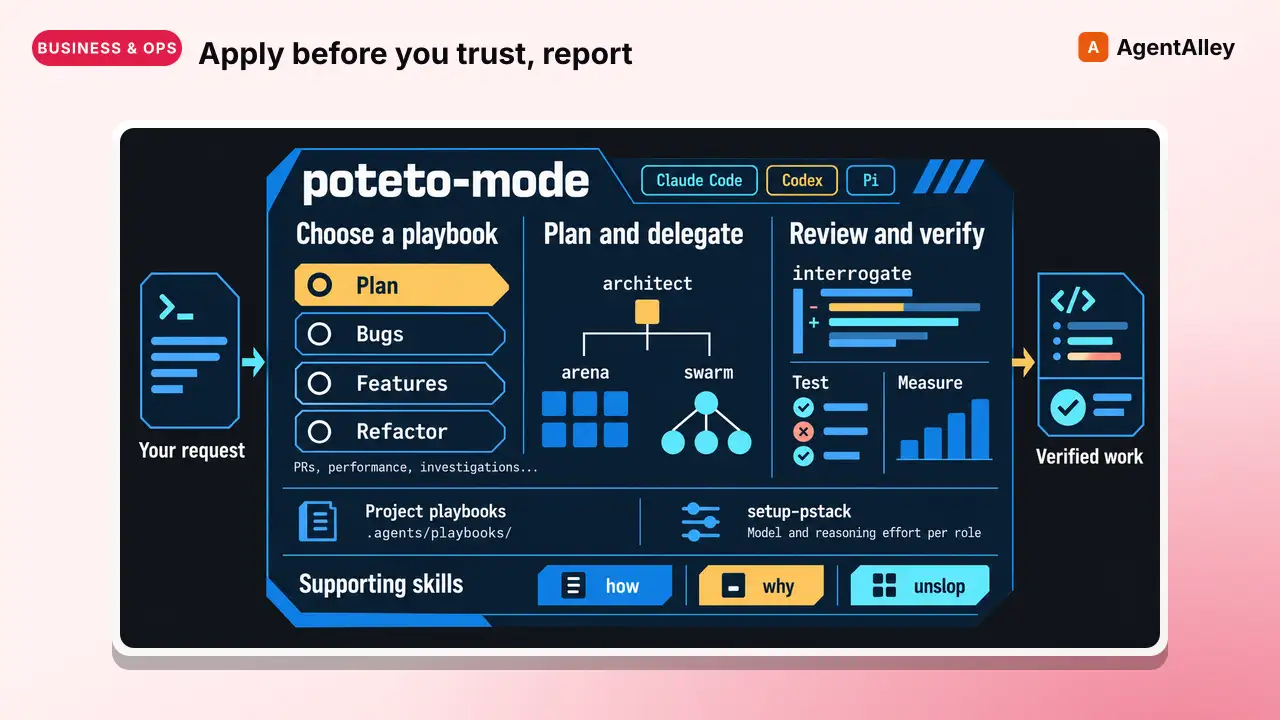 SkillApply before you trust, reportExplain the Number
 michael-denyer/pstack-claude · by michael-denyerApply before you trust, report, or act on a number you measured: a speedup, a regression, a throughput, a latency, or an eval result. Find what limits it, and rule out that it measured something other than the work you think.★ 1k GitHub stars
 PromptWrite a ${tone:professional|friendly} email to ${recipient}Write an emailf/prompts.chat · by Training AccountWrite a ${tone:professional|friendly} email to ${recipient} about ${topic}.New listing
 SkillGenerate SQL queries from natural language descriptionsSQL Query Generator
 phuryn/pm-skills · by phurynGenerate SQL queries from natural language descriptions. Supports BigQuery, PostgreSQL, MySQL, and other dialects. Reads database schemas from uploaded diagrams or documentation. Use when writing SQL, building data reports, exploring databases, or translating business questions into queries.★ 26.6k GitHub stars
 SkillSummarize a meeting transcript into structured notesSummarize meetingphuryn/pm-skills · by phurynSummarize a meeting transcript into structured notes with date, participants, topic, key decisions, summary points, and action items. Use when processing meeting recordings, creating meeting notes, writing meeting minutes, or recapping discussions.★ 26.6k GitHub stars
 SkillStructured research summarization agent skill for non-devResearch summarizer
 alirezarezvani/claude-skills · by alirezarezvaniStructured research summarization agent skill for non-dev users. Handles academic papers, web articles, reports, and documentation. Extracts key findings, generates comparative analyses, and produces properly formatted citations. Use when: user wants to summarize a research paper, compare multiple sources, extract citations from documents, or create structured research briefs. Plugin for Claude Code, Codex, Gemini CLI, and OpenClaw.★ 26.3k GitHub stars