Their Claude agent to self-improve from past usage
SkillOpt-Sleep: offline self-evolution for a local Claude agent
Use when the user wants their Claude agent to self-improve from past usage, asks about a nightly/offline 'sleep' or 'dream' cycle, memory/skill consolidation, or says things like 'make my agent better the more I use it', 'review my past…
---
name: skillopt-sleep
description: "Use when the user wants their Claude agent to self-improve from past usage, asks about a nightly/offline 'sleep' or 'dream' cycle, memory/skill consolidation, or says things like 'make my agent better the more I use it', 'review my past sessions', 'learn my preferences', 'consolidate what you learned', 'run the sleep cycle', or wants to schedule offline self-optimization. Drives the skillopt_sleep engine: harvest past sessions -> mine recurring tasks -> replay offline -> consolidate validated CLAUDE.md and SKILL.md behind a held-out gate."
---

# SkillOpt-Sleep: offline self-evolution for a local Claude agent

SkillOpt-Sleep gives the user's agent a **sleep cycle**. While the user is
offline (e.g. nightly), it reviews their real past Claude Code sessions,
re-runs recurring tasks on their own API budget, and consolidates what it
learns into **memory** (`CLAUDE.md`) and **skills** (`SKILL.md`) — but only
keeps changes that pass a held-out validation gate, and only after the user
adopts them. The agent gets measurably better at *this* user's recurring work,
with no model-weight training. It is the deployment-time analogue of training:
short-term experience → long-term competence.

It synthesizes three ideas:
- **SkillOpt** — the skill/memory doc is trainable text; bounded add/delete/replace
Overview
SkillOpt-Sleep gives the user's agent a sleep cycle. While the user is offline (e.g. nightly), it reviews their real past Claude Code sessions, re-runs recurring tasks on their own API budget, and consolidates what it learns into memory (CLAUDE.md) and skills (SKILL.md) — but only keeps changes that pass a held-out validation gate, and only after the user adopts them. The agent gets measurably better at this user's recurring work, with no model-weight training. It is the deployment-time analogue of training: short-term experience → long-term competence.
Manual install (npx, ZIP)
npx skills add alirezarezvani/claude-skills --skill skillopt-sleep -g -a claude-codemkdir -p ~/.claude/skills && curl -sL https://codeload.github.com/alirezarezvani/claude-skills/tar.gz/19392f7a0826 \
| tar -xz -C ~/.claude/skills --strip-components=4 claude-skills-19392f7a0826/engineering/skillopt-sleep/skills/skillopt-sleepNew-Item -ItemType Directory -Force "$HOME\.claude\skills" | Out-Null; Invoke-WebRequest "https://m.agentalley.io/zip/3385b0bc6232482dfb70/skillopt-sleep.zip" -OutFile "$env:TEMP\skillopt-sleep.zip"; Expand-Archive "$env:TEMP\skillopt-sleep.zip" -DestinationPath "$HOME\.claude\skills" -ForceConnects with Agent Alley MCP · agentalley.io/mcp
Files included
SKILL.md7.1 KB
Read the files here
alirezarezvani/
Shared references2SKILL.md reads these from elsewhere in the repo. Not in the ZIP.
Get them on GitHub ↗Show the full text129 lines
SkillOpt-Sleep: offline self-evolution for a local Claude agent
SkillOpt-Sleep gives the user's agent a sleep cycle. While the user is
offline (e.g. nightly), it reviews their real past Claude Code sessions,
re-runs recurring tasks on their own API budget, and consolidates what it
learns into memory (CLAUDE.md) and skills (SKILL.md) — but only
keeps changes that pass a held-out validation gate, and only after the user
adopts them. The agent gets measurably better at this user's recurring work,
with no model-weight training. It is the deployment-time analogue of training:
short-term experience → long-term competence.
It synthesizes three ideas:
- SkillOpt — the skill/memory doc is trainable text; bounded add/delete/replace edits; accepted only through a held-out gate; rejected edits become negative feedback.
- Claude Dreams — offline consolidation that reads past sessions and rebuilds memory (dedup/merge/resolve); the input is never mutated; output is reviewed then adopted.
- Agent sleep — periodic offline replay turns episodes into durable skill.
When to use this skill
Trigger when the user wants any of:
- "make my agent learn from how I use it" / "get better the more I use it" / "remember my preferences across sessions"
- a nightly/scheduled or on-demand offline self-improvement / dream / sleep run
- to review past sessions/trajectories and distill recurring tasks
- to consolidate feedback into
CLAUDE.mdor a managed skill - to schedule the cycle (cron) or adopt a staged proposal
The cycle (six stages)
- Harvest — read
~/.claude/projects/*/<session>.jsonl+~/.claude/history.jsonl(READ-ONLY) → session digests. - Mine — digests →
TaskRecords (recurring intents + outcome labels + checkable refs where possible). - Replay — re-run tasks offline under the current skill+memory → (hard, soft) scores.
- Consolidate — reflect on failures → propose bounded edits → gate on a held-out slice; accept only if it strictly improves.
- Stage — write
proposed_CLAUDE.md,proposed_SKILL.md, a diff, andreport.mdinto<project>/.skillopt-sleep/staging/<date>/. Nothing live changes. - Adopt — explicit (or opt-in auto): copy staged files over live ones, backing up first.
How to drive it
Prefer the /skillopt-sleep command. Under the hood it calls the bundled runner:
"${CLAUDE_PLUGIN_ROOT}/scripts/sleep.sh" status                       # what's happened
"${CLAUDE_PLUGIN_ROOT}/scripts/sleep.sh" dry-run --project "$(pwd)"    # safe preview
"${CLAUDE_PLUGIN_ROOT}/scripts/sleep.sh" run --project "$(pwd)"        # full cycle, stages a proposal
"${CLAUDE_PLUGIN_ROOT}/scripts/sleep.sh" adopt --project "$(pwd)"      # apply staged proposal (with backup)
- Default backend is
mock(deterministic, no API spend) — good for trying the plumbing. - Add
--backend claudeor--backend codexto spend the user's real budget for genuine improvement. - Scope defaults to the invoked project;
--scope allharvests every project.
Scheduling
"${CLAUDE_PLUGIN_ROOT}/scripts/sleep.sh" schedule --project "$(pwd)" --hour 3 --minute 17
"${CLAUDE_PLUGIN_ROOT}/scripts/sleep.sh" unschedule --project "$(pwd)"
Installs a nightly cron entry. unschedule --all removes every managed entry.
All CLI flags
| Flag | Default | Description |
|---|---|---|
--project PATH |
cwd | Project directory to evolve |
--scope all|invoked |
invoked | Harvest scope |
--backend mock|claude|codex|copilot |
mock | Replay backend (mock = no API spend) |
--model NAME |
backend default | Override the model used for replay |
--source claude|codex|auto |
claude | Transcript source |
--lookback-hours N |
72 | Harvest window |
--max-sessions N |
unlimited | Cap harvested sessions |
--max-tasks N |
40 | Cap mined tasks |
--target-skill-path PATH |
auto | Explicit SKILL.md to evolve |
--tasks-file PATH |
— | Reviewed TaskRecord JSON (skip harvest) |
--progress |
off | Print phase progress to stderr |
--auto-adopt |
off | Auto-adopt if gate passes |
--edit-budget N |
4 | Max bounded edits per night |
--json |
off | Machine-readable JSON output |
Config keys (~/.skillopt-sleep/config.json)
Beyond the CLI flags, advanced behavior is controlled via config:
preferences— free-text house rules injected into the optimizer's reflect step (e.g. "Always use async/await", "Answers in\boxed{}").gate_mode—on(default, validation-gated) oroff(greedy, accept all edits).gate_metric—hard,soft, ormixed(default). Controls how the held-out gate scores.dream_rollouts— >1 enables multi-rollout contrastive reflection per task.recall_k— >0 recalls K similar past tasks into the dream (long-term memory).evolve_memory/evolve_skill— independently toggle CLAUDE.md vs SKILL.md consolidation.
Memory consolidation
The sleep cycle can consolidate both:
- SKILL.md — the managed skill file (bounded edits: add/delete/replace)
- CLAUDE.md — the project memory (same bounded edits)
Both are gated by the same held-out validation score. Set evolve_memory: false to consolidate only skills, or evolve_skill: false for only memory.
Hard rules
- Never hand-edit the user's
CLAUDE.md/SKILL.mdas part of this skill. Only theadoptaction changes live files, and it backs them up first. - Harvest is read-only.
mockreplay has no side effects. - Always show the user the held-out baseline → candidate score and the exact proposed edits before suggesting adoption. Evidence before adoption.
- If asked whether it really helps, run
python -m skillopt_sleep.experiments.run_experiment --persona researcher --json— a deterministic demo that proves held-out lift and that the gate blocks harmful edits.
Validate / demo
# deterministic proof (no API): held-out score rises, gate blocks regressions
python -m skillopt_sleep.experiments.run_experiment --persona researcher --assert-improves
python -m skillopt_sleep.experiments.run_experiment --persona programmer  --assert-improves
See the upstream SkillOpt-Sleep guide section
(https://microsoft.github.io/SkillOpt/docs/guideline.html#sleep) for recorded
output and the full design. (The original repo-relative design-doc path,
docs/superpowers/specs/..., is not vendored into this repo — see this
skill's README.md "What was and wasn't vendored" table.)
| 1 | |
| 2 | name skillopt-sleep |
| 3 | description "Use when the user wants their Claude agent to self-improve from past usage, asks about a nightly/offline 'sleep' or 'dream' cycle, memory/skill consolidation, or says things like 'make my agent better the more I use it', 'review my past sessions', 'learn my preferences', 'consolidate what you learned', 'run the sleep cycle', or wants to schedule offline self-optimization. Drives the skillopt_sleep engine: harvest past sessions -> mine recurring tasks -> replay offline -> consolidate validated CLAUDE.md and SKILL.md behind a held-out gate." |
| 4 | |
| 5 | |
| 6 | # SkillOpt-Sleep: offline self-evolution for a local Claude agent |
| 7 | |
| 8 | SkillOpt-Sleep gives the user's agent a **sleep cycle**. While the user is |
| 9 | offline (e.g. nightly), it reviews their real past Claude Code sessions, |
| 10 | re-runs recurring tasks on their own API budget, and consolidates what it |
| 11 | learns into **memory** (`CLAUDE.md`) and **skills** (`SKILL.md`) — but only |
| 12 | keeps changes that pass a held-out validation gate, and only after the user |
| 13 | adopts them. The agent gets measurably better at *this* user's recurring work, |
| 14 | with no model-weight training. It is the deployment-time analogue of training: |
| 15 | short-term experience → long-term competence. |
| 16 | |
| 17 | It synthesizes three ideas: |
| 18 | **SkillOpt** — the skill/memory doc is trainable text; bounded add/delete/replace |
| 19 | edits; accepted only through a held-out gate; rejected edits become negative feedback. |
| 20 | **Claude Dreams** — offline consolidation that reads past sessions and rebuilds |
| 21 | memory (dedup/merge/resolve); the input is never mutated; output is reviewed then adopted. |
| 22 | **Agent sleep** — periodic offline replay turns episodes into durable skill. |
| 23 | |
| 24 | ## When to use this skill |
| 25 | |
| 26 | Trigger when the user wants any of: |
| 27 | "make my agent learn from how I use it" / "get better the more I use it" / "remember my preferences across sessions" |
| 28 | a nightly/scheduled or on-demand **offline self-improvement / dream / sleep** run |
| 29 | to **review past sessions/trajectories** and distill recurring tasks |
| 30 | to **consolidate** feedback into `CLAUDE.md` or a managed skill |
| 31 | to **schedule** the cycle (cron) or **adopt** a staged proposal |
| 32 | |
| 33 | ## The cycle (six stages) |
| 34 | |
| 35 | **Harvest** — read `~/.claude/projects/*/<session>.jsonl` + `~/.claude/history.jsonl` (READ-ONLY) → session digests. |
| 36 | **Mine** — digests → `TaskRecord`s (recurring intents + outcome labels + checkable refs where possible). |
| 37 | **Replay** — re-run tasks offline under the *current* skill+memory → (hard, soft) scores. |
| 38 | **Consolidate** — reflect on failures → propose bounded edits → **gate** on a held-out slice; accept only if it strictly improves. |
| 39 | **Stage** — write `proposed_CLAUDE.md`, `proposed_SKILL.md`, a diff, and `report.md` into `<project>/.skillopt-sleep/staging/<date>/`. **Nothing live changes.** |
| 40 | **Adopt** — explicit (or opt-in auto): copy staged files over live ones, backing up first. |
| 41 | |
| 42 | ## How to drive it |
| 43 | |
| 44 | Prefer the `/skillopt-sleep` command. Under the hood it calls the bundled runner: |
| 45 | |
| 46 | |
| 47 | "${CLAUDE_PLUGIN_ROOT}/scripts/sleep.sh" status # what's happened |
| 48 | "${CLAUDE_PLUGIN_ROOT}/scripts/sleep.sh" dry-run --project "$(pwd)" # safe preview |
| 49 | "${CLAUDE_PLUGIN_ROOT}/scripts/sleep.sh" run --project "$(pwd)" # full cycle, stages a proposal |
| 50 | "${CLAUDE_PLUGIN_ROOT}/scripts/sleep.sh" adopt --project "$(pwd)" # apply staged proposal (with backup) |
| 51 | |
| 52 | |
| 53 | Default backend is `mock` (deterministic, **no API spend**) — good for trying the plumbing. |
| 54 | Add `--backend claude` or `--backend codex` to spend the user's real budget for genuine improvement. |
| 55 | Scope defaults to the invoked project; `--scope all` harvests every project. |
| 56 | |
| 57 | ### Scheduling |
| 58 | |
| 59 | |
| 60 | "${CLAUDE_PLUGIN_ROOT}/scripts/sleep.sh" schedule --project "$(pwd)" --hour 3 --minute 17 |
| 61 | "${CLAUDE_PLUGIN_ROOT}/scripts/sleep.sh" unschedule --project "$(pwd)" |
| 62 | |
| 63 | |
| 64 | Installs a nightly cron entry. `unschedule --all` removes every managed entry. |
| 65 | |
| 66 | ## All CLI flags |
| 67 | |
| 68 | | Flag | Default | Description | |
| 69 | |------|---------|-------------| |
| 70 | | `--project PATH` | cwd | Project directory to evolve | |
| 71 | | `--scope all\|invoked` | invoked | Harvest scope | |
| 72 | | `--backend mock\|claude\|codex\|copilot` | mock | Replay backend (mock = no API spend) | |
| 73 | | `--model NAME` | backend default | Override the model used for replay | |
| 74 | | `--source claude\|codex\|auto` | claude | Transcript source | |
| 75 | | `--lookback-hours N` | 72 | Harvest window | |
| 76 | | `--max-sessions N` | unlimited | Cap harvested sessions | |
| 77 | | `--max-tasks N` | 40 | Cap mined tasks | |
| 78 | | `--target-skill-path PATH` | auto | Explicit SKILL.md to evolve | |
| 79 | | `--tasks-file PATH` | — | Reviewed TaskRecord JSON (skip harvest) | |
| 80 | | `--progress` | off | Print phase progress to stderr | |
| 81 | | `--auto-adopt` | off | Auto-adopt if gate passes | |
| 82 | | `--edit-budget N` | 4 | Max bounded edits per night | |
| 83 | | `--json` | off | Machine-readable JSON output | |
| 84 | |
| 85 | ## Config keys (`~/.skillopt-sleep/config.json`) |
| 86 | |
| 87 | Beyond the CLI flags, advanced behavior is controlled via config: |
| 88 | |
| 89 | **`preferences`** — free-text house rules injected into the optimizer's reflect step (e.g. "Always use async/await", "Answers in `\boxed{}`"). |
| 90 | **`gate_mode`** — `on` (default, validation-gated) or `off` (greedy, accept all edits). |
| 91 | **`gate_metric`** — `hard`, `soft`, or `mixed` (default). Controls how the held-out gate scores. |
| 92 | **`dream_rollouts`** — >1 enables multi-rollout contrastive reflection per task. |
| 93 | **`recall_k`** — >0 recalls K similar past tasks into the dream (long-term memory). |
| 94 | **`evolve_memory`** / **`evolve_skill`** — independently toggle CLAUDE.md vs SKILL.md consolidation. |
| 95 | |
| 96 | ## Memory consolidation |
| 97 | |
| 98 | The sleep cycle can consolidate both: |
| 99 | **SKILL.md** — the managed skill file (bounded edits: add/delete/replace) |
| 100 | **CLAUDE.md** — the project memory (same bounded edits) |
| 101 | |
| 102 | Both are gated by the same held-out validation score. Set `evolve_memory: false` to consolidate only skills, or `evolve_skill: false` for only memory. |
| 103 | |
| 104 | ## Hard rules |
| 105 | |
| 106 | **Never** hand-edit the user's `CLAUDE.md` / `SKILL.md` as part of this skill. |
| 107 | Only the `adopt` action changes live files, and it backs them up first. |
| 108 | Harvest is read-only. `mock` replay has no side effects. |
| 109 | Always show the user the **held-out baseline → candidate** score and the |
| 110 | exact proposed edits before suggesting adoption. Evidence before adoption. |
| 111 | If asked whether it really helps, run |
| 112 | `python -m skillopt_sleep.experiments.run_experiment --persona researcher --json` |
| 113 | — a deterministic demo that proves held-out lift and that the gate blocks |
| 114 | harmful edits. |
| 115 | |
| 116 | ## Validate / demo |
| 117 | |
| 118 | |
| 119 | # deterministic proof (no API): held-out score rises, gate blocks regressions |
| 120 | python -m skillopt_sleep.experiments.run_experiment --persona researcher --assert-improves |
| 121 | python -m skillopt_sleep.experiments.run_experiment --persona programmer --assert-improves |
| 122 | |
| 123 | |
| 124 | See the upstream SkillOpt-Sleep guide section |
| 125 | (https://microsoft.github.io/SkillOpt/docs/guideline.html#sleep) for recorded |
| 126 | output and the full design. (The original repo-relative design-doc path, |
| 127 | `docs/superpowers/specs/...`, is not vendored into this repo — see this |
| 128 | skill's README.md "What was and wasn't vendored" table.) |
| 129 |
Details
- Updated
- Aug 30, 2026
- License
- MIT
- Stars on the repo
- ★ 26,349
- Checked
- Source
- alirezarezvani/claude-skills ↗
- Creator
- alirezarezvani · 363 listings
Similar skills
See all →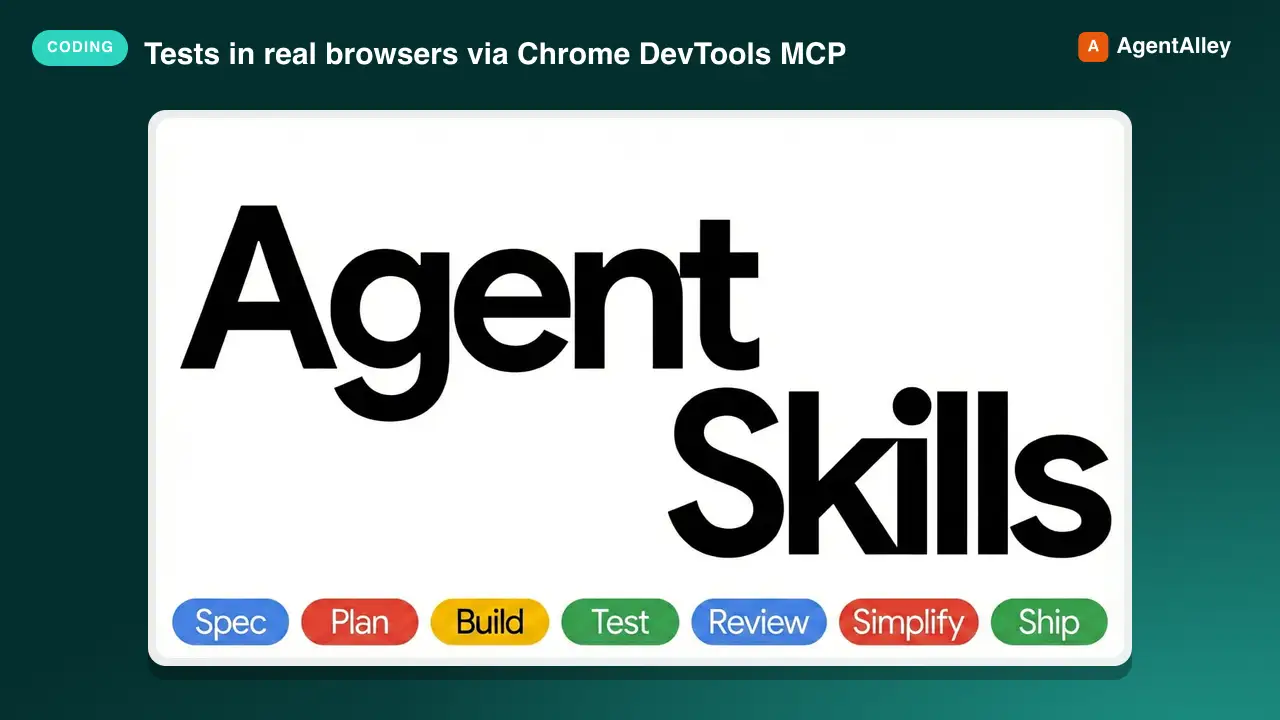 SkillTests in real browsers via Chrome DevTools MCPBrowser testing with devtools
 addyosmani/agent-skills · by addyosmaniTests in real browsers via Chrome DevTools MCP. Use when building or debugging anything that runs in a browser. Use when you need to inspect the DOM, capture console errors, analyze network requests, profile performance, or verify visual output with real runtime data. Requires the chrome-devtools MCP server to be configured.★ 98.7k GitHub stars
 MCPThis MCP server attempts to exercise all the featuresEverything MCP Server
 modelcontextprotocol/servers · by modelcontextprotocolThis MCP server attempts to exercise all the features of the MCP protocol. It is not intended to be a useful server, but rather a test…★ 90.5k GitHub stars
 MCPA Model Context Protocol server that provides web contentFetch MCP Servermodelcontextprotocol/servers · by modelcontextprotocolA Model Context Protocol server that provides web content fetching capabilities. This server enables LLMs to retrieve and process content…★ 90.5k GitHub stars
 MCPNode.js server implementing Model Context ProtocolFilesystem MCP Servermodelcontextprotocol/servers · by modelcontextprotocolNode.js server implementing Model Context Protocol (MCP) for filesystem operations.★ 90.5k GitHub stars
 SkillAbout libraries, frameworks, API referencesContext7 MCP
 upstash/context7 · by upstashThis skill should be used when the user asks about libraries, frameworks, API references, or needs code examples. Activates for setup questions, code generation involving libraries, or mentions of specific frameworks like React, Vue, Next.js, Prisma, Supabase, etc.★ 62.3k GitHub stars
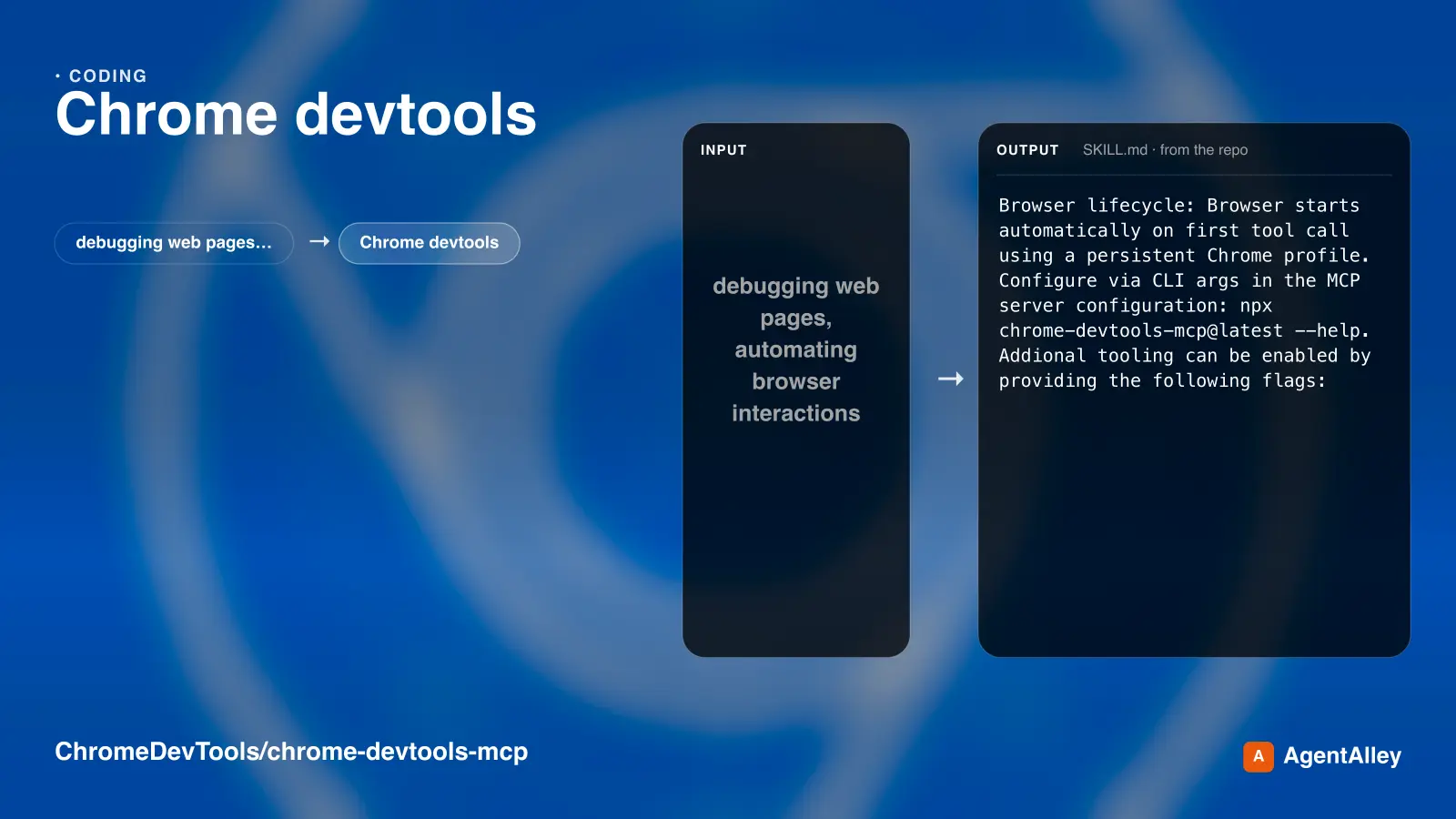 SkillUses Chrome DevTools via MCP for efficient debugging
 ChromeDevTools/chrome-devtools-mcp · by ChromeDevToolsUses Chrome DevTools via MCP for efficient debugging, troubleshooting and browser automation. Use when debugging web pages, automating browser interactions, analyzing performance, or inspecting network requests. This skill does not apply to `--slim` mode (MCP configuration).★ 52.4k GitHub stars
More from alirezarezvani
 SkillResume a paused experiment/ar:ar-resume — Resume Experiment
 alirezarezvani/claude-skills · by alirezarezvaniResume a paused experiment. Checkout the experiment branch, read results history, continue iterating. Use when the user runs /ar:ar-resume or asks to pick up a previously started autoresearch experiment.★ 26.3k GitHub stars
 SkillShow experiment dashboard with results, active loops/ar:ar-status — Experiment Dashboardalirezarezvani/claude-skills · by alirezarezvaniShow experiment dashboard with results, active loops, and progress. Use when the user runs /ar:ar-status or asks how an autoresearch experiment is going.★ 26.3k GitHub stars
 SkillStart an autonomous experiment loop with user-selected/ar:loop — Autonomous Experiment Loopalirezarezvani/claude-skills · by alirezarezvaniStart an autonomous experiment loop with user-selected interval (10min, 1h, daily, weekly, monthly). Uses CronCreate for scheduling. Use when the user runs /ar:loop or asks to run an autoresearch experiment continuously on a schedule.★ 26.3k GitHub stars
 SkillRun a single experiment iteration/ar:run — Single Experiment Iterationalirezarezvani/claude-skills · by alirezarezvaniRun a single experiment iteration. Edit the target file, evaluate, keep or discard. Use when the user runs /ar:run or asks for one manual autoresearch iteration.★ 26.3k GitHub stars
 SkillSet up a new autoresearch experiment interactively/ar:setup — Create New Experimentalirezarezvani/claude-skills · by alirezarezvaniSet up a new autoresearch experiment interactively. Collects domain, target file, eval command, metric, direction, and evaluator. Use when the user runs /ar:setup or asks to start optimizing a file with the autoresearch loop.★ 26.3k GitHub stars
 Skill/cs:boardroom <brief/cs:boardroom — Multi-Role Boardroom Deliberationalirezarezvani/claude-skills · by alirezarezvani/cs:boardroom <brief> — 6-phase multi-role deliberation across the C-suite with Phase 2 isolation, critic pre-screen, and synthesis. Outputs a board memo. Use when a decision spans multiple executive domains — e.g. a pricing change touching finance, positioning, and product, or a raise-vs-cut runway call.★ 26.3k GitHub stars