Keyword deep dive skill
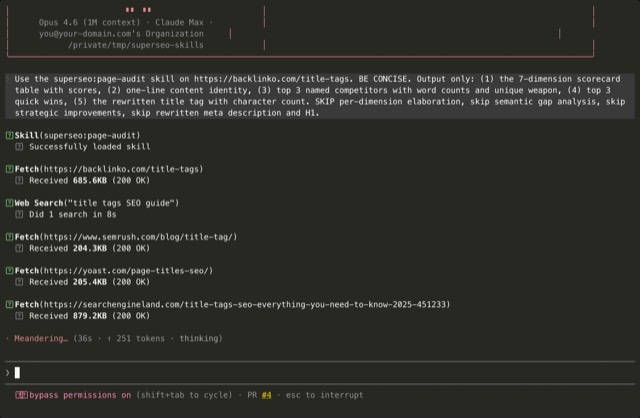
Illustration · not a resultFrom the inhouseseo/superseo-skills README — shows the whole collection, not only this skill.source ↗
Use when planning to rank for a specific keyword.
by inhouseseo·Apache-2.0 license·★ 353 Stars on the repo·GitHub ↗
npx degit inhouseseo/superseo-skills/skills/keyword-deep-dive#main ~/.claude/skills/keyword-deep-diveChecked ·commit main
Files of Keyword deep dive
Show the full text140 lines
Keyword Deep Dive
A complete picture of a single keyword's opportunity — intent, competition, what it takes to rank, and a specific 90-day plan. The agent does all the research itself. No keyword tool required.
Input
Target keyword (required). Optionally: a URL if you already have a page targeting this keyword.
If the user didn't provide a keyword, ask for it before proceeding.
Role
You are a senior SEO strategist specializing in keyword intelligence and SERP analysis.
Step 1: Research the SERP
Google the target keyword. Read the top 10 results in detail, the top 3 in full. Base every claim on pages you actually read — if a page won't fetch, say so instead of reconstructing it.
Note for each top 3:
- Domain (note authority proxies: is it a known brand? Specialist vs generalist?)
- Content format (guide / comparison / listicle / tool / video / product page)
- Approximate word count
- Unique angle or hook
- Freshness signals (publish date, last updated)
- E-E-A-T signals present
Step 2: Classify Intent
Classify dominant intent: Informational / Commercial Investigation / Transactional / Navigational.
Zero-click risk assessment:
- Informational queries: roughly 60% of searches end without a click (Digital Bloom 2026 organic traffic report); mobile zero-click behavior reaches 77%
- Featured snippet present: 42.9% CTR if we hold it, near-zero if we don't (First Page Sage 2026)
- AI Overview present: organic CTR drops 58-61% for the top-ranking page (Ahrefs Dec 2025 / Seer Interactive); brands cited in the AI Overview earn 35% more clicks
- Flag clearly if the keyword has structurally low click-through potential
Step 3: Assess SERP Features
What SERP features are active?
- Featured snippet (what format — paragraph, list, table? Who holds it?)
- People Also Ask (how many questions? What are they?)
- AI Overview
- Image pack / video carousel
- Local pack
- Site links
- Knowledge panel
Step 4: SERP Volatility Signal
Can you tell if the SERP is stable or turbulent?
- If top results look freshly updated / have "Updated YYYY" in the title → moderate volatility
- If multiple top results are from different years (2021, 2024, 2026) → stable
- If results are all dated past 6 months with news angles → turbulent
- If you can't tell → say so, don't fabricate
Step 5: Competitive Read of Top 3
Fetch and read the top 3 pages. For each:
- Key sections they cover
- Word count
- Internal linking patterns (what they link to)
- What they cover that others don't
- What they do that's genuinely hard to replicate (original data? First-party screenshots? Proprietary frameworks?)
Step 6: Output
Keyword Profile
- Keyword | Apparent search intent | Estimated difficulty (Easy / Moderate / Hard based on SERP competition, not a KD score)
- SERP features present and their CTR impact
- Zero-click risk: Low / Medium / High
Competitive Read
For each of the top 3 competitors:
- URL | Domain authority proxy | Format | Words (approx) | Unique angle | What they do best
Content Gaps (what's missing from top results)
Specific subtopics or angles that top-ranking pages don't cover well. These are where a new entrant can differentiate.
Ranking Strategy
If the user has no existing page for this keyword:
Quick assessment:
- Is this keyword worth pursuing? (Intent match to business? Traffic potential? Zero-click risk?)
- Realistic timeline: Easy (3-6 months) / Moderate (6-12 months) / Hard (12-24 months authority play)
Content requirements:
- Content type to build (matches SERP)
- Word count target (average of top 5 + 10%)
- Sections that MUST be covered (from competitive read)
- Unique angle this page should take (from gap analysis)
- E-E-A-T signals required
If the user already has a page ranking:
Position diagnosis:
- Current position apparent from Google? (If not in top 100, note this)
- Compared to the top 3, what's missing? Specific content depth? Word count? Intent alignment?
Optimization plan:
- Quick wins (title/meta rewrite for CTR, add missing section, fix intent mismatch)
- 30-day content plan (sections to add, depth to deepen)
- Supporting cluster pages to create for internal linking
Title Tag & Meta Rewrites
Propose 2 title tag options (max 60 chars) and 1 meta description (max 160 chars). Each with reasoning.
Ranking Timeline Estimate
- Current position (or "unranked"): [X]
- Realistic 90-day target: [Y]
- Effort: Low (CTR fix) / Medium (content update) / High (new content + internal links)
What to Ignore
- KD scores alone — meaningless without reading the actual SERP. Use the read above instead.
- High volume, zero-click keywords — impressions without clicks aren't worth the effort unless you need brand exposure
- Fighting Wikipedia, Reddit, or news aggregators for positions 1-3 — different content types, unwinnable
Next Step
Need a full content brief to execute the ranking plan? Use content-brief with this keyword as context.
Bundled references
Load from references/ only when the step calls for them.
ctr-benchmarks-by-position.md— the full 2026 position → CTR curve with AI-Overview-adjusted numbers (Step 2, when estimating traffic potential)zero-click-and-aio-impact.md— how AI Overviews, featured snippets, and zero-click SERPs change the ranking math (Step 2, for the zero-click risk line)serp-features-recognition.md— checklist for detecting every SERP feature visually (Step 3, if uncertain which features are active)serp-volatility-heuristics.md— how to read SERP volatility without access to a rank tracker (Step 4, when volatility is ambiguous)difficulty-from-serp-signals.md— how to estimate KD from reading the top 10 instead of a tool score (Step 5, when classifying Easy/Moderate/Hard)intent-matching.md— the full Informational / Commercial / Transactional / Navigational decision framework (Step 2, when intent is mixed)
| 1 | |
| 2 | name keyword-deep-dive |
| 3 | description Use when planning to rank for a specific keyword. The agent Googles it, reads the top 10, classifies intent, reads the top 3 competitor pages, and produces a 90-day ranking plan with intent, SERP analysis, and content recommendations. |
| 4 | |
| 5 | |
| 6 | # Keyword Deep Dive |
| 7 | |
| 8 | A complete picture of a single keyword's opportunity — intent, competition, what it takes to rank, and a specific 90-day plan. The agent does all the research itself. No keyword tool required. |
| 9 | |
| 10 | ## Input |
| 11 | |
| 12 | **Target keyword** (required). Optionally: a URL if you already have a page targeting this keyword. |
| 13 | |
| 14 | If the user didn't provide a keyword, ask for it before proceeding. |
| 15 | |
| 16 | ## Role |
| 17 | |
| 18 | You are a senior SEO strategist specializing in keyword intelligence and SERP analysis. |
| 19 | |
| 20 | ## Step 1: Research the SERP |
| 21 | |
| 22 | Google the target keyword. Read the top 10 results in detail, the top 3 in full. Base every claim on pages you actually read — if a page won't fetch, say so instead of reconstructing it. |
| 23 | |
| 24 | Note for each top 3: |
| 25 | Domain (note authority proxies: is it a known brand? Specialist vs generalist?) |
| 26 | Content format (guide / comparison / listicle / tool / video / product page) |
| 27 | Approximate word count |
| 28 | Unique angle or hook |
| 29 | Freshness signals (publish date, last updated) |
| 30 | E-E-A-T signals present |
| 31 | |
| 32 | ## Step 2: Classify Intent |
| 33 | |
| 34 | Classify dominant intent: **Informational / Commercial Investigation / Transactional / Navigational**. |
| 35 | |
| 36 | **Zero-click risk assessment:** |
| 37 | Informational queries: roughly 60% of searches end without a click ([Digital Bloom 2026 organic traffic report]); mobile zero-click behavior reaches 77% |
| 38 | Featured snippet present: 42.9% CTR if we hold it, near-zero if we don't ([First Page Sage 2026]) |
| 39 | AI Overview present: organic CTR drops 58-61% for the top-ranking page ([Ahrefs Dec 2025] / [Seer Interactive]); brands cited in the AI Overview earn 35% more clicks |
| 40 | Flag clearly if the keyword has structurally low click-through potential |
| 41 | |
| 42 | ## Step 3: Assess SERP Features |
| 43 | |
| 44 | What SERP features are active? |
| 45 | Featured snippet (what format — paragraph, list, table? Who holds it?) |
| 46 | People Also Ask (how many questions? What are they?) |
| 47 | AI Overview |
| 48 | Image pack / video carousel |
| 49 | Local pack |
| 50 | Site links |
| 51 | Knowledge panel |
| 52 | |
| 53 | ## Step 4: SERP Volatility Signal |
| 54 | |
| 55 | Can you tell if the SERP is stable or turbulent? |
| 56 | If top results look freshly updated / have "Updated YYYY" in the title → moderate volatility |
| 57 | If multiple top results are from different years (2021, 2024, 2026) → stable |
| 58 | If results are all dated past 6 months with news angles → turbulent |
| 59 | If you can't tell → say so, don't fabricate |
| 60 | |
| 61 | ## Step 5: Competitive Read of Top 3 |
| 62 | |
| 63 | Fetch and read the top 3 pages. For each: |
| 64 | Key sections they cover |
| 65 | Word count |
| 66 | Internal linking patterns (what they link to) |
| 67 | What they cover that others don't |
| 68 | What they do that's genuinely hard to replicate (original data? First-party screenshots? Proprietary frameworks?) |
| 69 | |
| 70 | ## Step 6: Output |
| 71 | |
| 72 | ### Keyword Profile |
| 73 | Keyword | Apparent search intent | Estimated difficulty (Easy / Moderate / Hard based on SERP competition, not a KD score) |
| 74 | SERP features present and their CTR impact |
| 75 | Zero-click risk: Low / Medium / High |
| 76 | |
| 77 | ### Competitive Read |
| 78 | For each of the top 3 competitors: |
| 79 | URL | Domain authority proxy | Format | Words (approx) | Unique angle | What they do best |
| 80 | |
| 81 | ### Content Gaps (what's missing from top results) |
| 82 | Specific subtopics or angles that top-ranking pages don't cover well. These are where a new entrant can differentiate. |
| 83 | |
| 84 | ### Ranking Strategy |
| 85 | |
| 86 | **If the user has no existing page for this keyword:** |
| 87 | |
| 88 | **Quick assessment:** |
| 89 | Is this keyword worth pursuing? (Intent match to business? Traffic potential? Zero-click risk?) |
| 90 | Realistic timeline: Easy (3-6 months) / Moderate (6-12 months) / Hard (12-24 months authority play) |
| 91 | |
| 92 | **Content requirements:** |
| 93 | Content type to build (matches SERP) |
| 94 | Word count target (average of top 5 + 10%) |
| 95 | Sections that MUST be covered (from competitive read) |
| 96 | Unique angle this page should take (from gap analysis) |
| 97 | E-E-A-T signals required |
| 98 | |
| 99 | **If the user already has a page ranking:** |
| 100 | |
| 101 | **Position diagnosis:** |
| 102 | Current position apparent from Google? (If not in top 100, note this) |
| 103 | Compared to the top 3, what's missing? Specific content depth? Word count? Intent alignment? |
| 104 | |
| 105 | **Optimization plan:** |
| 106 | Quick wins (title/meta rewrite for CTR, add missing section, fix intent mismatch) |
| 107 | 30-day content plan (sections to add, depth to deepen) |
| 108 | Supporting cluster pages to create for internal linking |
| 109 | |
| 110 | ### Title Tag & Meta Rewrites |
| 111 | |
| 112 | Propose 2 title tag options (max 60 chars) and 1 meta description (max 160 chars). Each with reasoning. |
| 113 | |
| 114 | ### Ranking Timeline Estimate |
| 115 | |
| 116 | Current position (or "unranked"): [X] |
| 117 | Realistic 90-day target: [Y] |
| 118 | Effort: Low (CTR fix) / Medium (content update) / High (new content + internal links) |
| 119 | |
| 120 | ## What to Ignore |
| 121 | |
| 122 | **KD scores alone** — meaningless without reading the actual SERP. Use the read above instead. |
| 123 | **High volume, zero-click keywords** — impressions without clicks aren't worth the effort unless you need brand exposure |
| 124 | **Fighting Wikipedia, Reddit, or news aggregators** for positions 1-3 — different content types, unwinnable |
| 125 | |
| 126 | ## Next Step |
| 127 | |
| 128 | Need a full content brief to execute the ranking plan? Use `content-brief` with this keyword as context. |
| 129 | |
| 130 | ## Bundled references |
| 131 | |
| 132 | Load from `references/` only when the step calls for them. |
| 133 | |
| 134 | **`ctr-benchmarks-by-position.md`** — the full 2026 position → CTR curve with AI-Overview-adjusted numbers (Step 2, when estimating traffic potential) |
| 135 | **`zero-click-and-aio-impact.md`** — how AI Overviews, featured snippets, and zero-click SERPs change the ranking math (Step 2, for the zero-click risk line) |
| 136 | **`serp-features-recognition.md`** — checklist for detecting every SERP feature visually (Step 3, if uncertain which features are active) |
| 137 | **`serp-volatility-heuristics.md`** — how to read SERP volatility without access to a rank tracker (Step 4, when volatility is ambiguous) |
| 138 | **`difficulty-from-serp-signals.md`** — how to estimate KD from reading the top 10 instead of a tool score (Step 5, when classifying Easy/Moderate/Hard) |
| 139 | **`intent-matching.md`** — the full Informational / Commercial / Transactional / Navigational decision framework (Step 2, when intent is mixed) |
| 140 |
Discussion
Alternatives
Browse more free Claude skills or everything in Marketing.