
YouTube Citation Playbook Skill
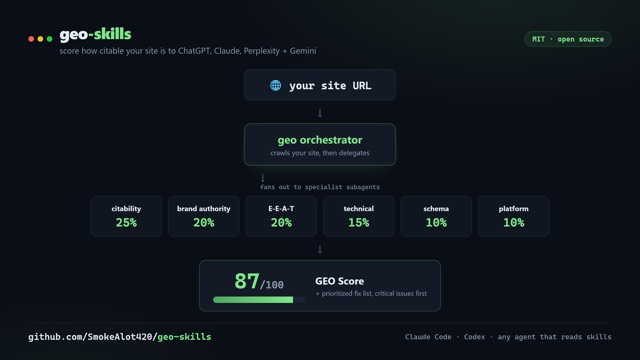
Illustration · not a resultFrom the TheSmokeDev/geo-skills README — shows the whole collection, not only this skill.source ↗
YouTube citation playbook for AI search.
by TheSmokeDev·MIT license·★ 27 Stars on the repo·GitHub ↗
npx degit TheSmokeDev/geo-skills/skills/geo-youtube#main ~/.claude/skills/geo-youtubeChecked ·commit main
Files of YouTube Citation Playbook Skill
Show the full text127 lines
YouTube Citation Playbook Skill
Purpose
This skill turns a YouTube channel into an AI citation source. AI engines do not watch video -- they read the transcript, chapters, title, and description. That makes YouTube a rank-free bypass lane: a channel with no domain authority and few views can earn AI citations that the site's text pages cannot. This skill audits existing videos for citation readiness and produces a build spec for new ones.
Core Insight
YouTube completed the flip in 2026 and is now the dominant non-text citation source:
- Most-cited domain in Google AIOs overall, with share up +34% over 6 months (Ahrefs Brand Radar, 2026).
- #1 social citation source at 38.1% of social citations, overtaking Reddit (5WPR State of AI Citations, May 2026).
- ~23% of finance-vertical citations -- ahead of Wikipedia (7.3%) and LinkedIn (6.8%) (Surfer 46M-citation dataset, 2026).
- 18.2% of AIO citations from beyond the organic top 100 are YouTube URLs (Ahrefs, 863K SERPs / 4M URLs, Mar 2026) -- the clearest rank-free lane in AI search.
- YouTube mentions correlate r=0.737 with AI visibility -- the strongest single signal ever measured, ahead of branded web mentions (0.664) (Ahrefs 75K-brand study via MachineRelations, Jul 2026).
The mechanism that matters: AI reads the transcript, chapters, title, and description -- NOT the video itself. Views and subscriber counts show near-zero correlation with citation (⚠️ single source, AIOCopilot Apr 2026 -- but mechanism-consistent, since engines have no visibility into watch metrics at retrieval time).
Citation-Readiness Rubric (per video)
Score each video 0-100 across five components:
| Component | Weight | Full Marks | Zero Marks |
|---|---|---|---|
| Transcript quality | 30% | Human-corrected transcript with citable numeric/definitional sentences | Auto-captions left uncorrected, or no captions |
| Chapter structure | 25% | 6-12 chapters with descriptive, query-matching titles | No chapters, or generic titles ("Part 1", "Intro") |
| Title match | 20% | Title is verbatim (or near-verbatim) the target query | Clever/branded title with no query language |
| Length & depth | 15% | 10+ minutes, substantive per-chapter content | Under 3 minutes, or a Short |
| Cross-posting | 10% | Video's claims exist as a text page + community answer | Video exists in isolation |
Shorts are never cited -- exclude them from the audit entirely (AIOCopilot, Apr 2026).
Audit Procedure (Existing Channel)
- List the channel's long-form videos (10+ min candidates first).
- For each video, fetch title, description, chapter list, and transcript (YouTube timedtext API or transcript endpoints).
- Check the transcript for:
- Auto-caption errors (numbers, brand names, and technical terms mangled) -- flag for human correction.
- Citable sentences: numeric claims and definitional statements, especially within ~30 seconds of chapter boundaries (citations attach to timestamps).
- Check chapter titles: each should read like an H2 that matches a fan-out sub-query (see
skills/geo-fanout/for sub-query mapping). "How much does SR-22 cost in California?" beats "Pricing section". - Check title against the target query: verbatim or near-verbatim match is the goal.
- Check cross-posting: do the video's core claims exist as a text page on the site and as a community answer (Reddit/Quora/forum)? ChatGPT cites YouTube mainly when the video is discussed in text elsewhere (AIOCopilot, Apr 2026).
- Score per the rubric; produce the fix list ordered by transcript quality first.
Build Spec (New Videos)
For each target query, spec a video as follows:
- Title: verbatim the target query. "How Much Does SR-22 Insurance Cost in California? (2026)" -- not "Everything You Need to Know About SR-22!".
- Length: 10+ minutes. Shorts never cited; long-form gives chapters room to work.
- Chapters: 6-12, each titled like an H2 matching a fan-out sub-query (cost, eligibility, process, location, language variants -- see
skills/geo-fanout/). Citations attach to timestamps, so chapter titles are the retrieval surface. - Script for citable sentences: place numeric and definitional claims near chapter boundaries. "The average SR-22 filing fee in California is $25, and SR-22 insurance raises premiums by 40-80% depending on the violation" is citable; "it can get pretty pricey" is not. Apply the
skills/geo-citability/passage rules to the script. - Transcript: upload a human-corrected transcript. Do not rely on auto-captions -- mangled numbers destroy citability.
- Description: front-load the same numeric/definitional claims; engines read it.
- Production: a faceless explainer with a corrected transcript qualifies -- production value is not the ranking lever here (AIOCopilot, Apr 2026).
- Cross-post (mandatory): publish the video's claims as (a) a text page on the site and (b) an authentic community answer (Reddit, Quora, niche forum) linking or naming the video. Text discussion is what makes ChatGPT surface the video.
Caveat: Treat YouTube Citation Share as a Live Experiment
YMYL video-citation share swung 50+ percentage points in 3 months in BrightEdge's healthcare tracking (Jan 2026). Platforms are actively A/B testing how heavily they cite video. Do not promise a stable citation share to clients; track the channel's actual citation rate over time with skills/geo-measurement/ and rebalance if the lane narrows.
Output Format
Generate a file called GEO-YOUTUBE-CITATION.md:
# YouTube Citation Audit: [Channel/Domain]

**Analysis Date:** [Date]
**Videos Audited:** [N] long-form (Shorts excluded -- never cited)
**Average Citation-Readiness Score:** [X]/100

---

## Per-Video Scores

| Video | Transcript (30) | Chapters (25) | Title (20) | Length (15) | Cross-Post (10) | Total |
|---|---|---|---|---|---|---|
| [Title] | [X] | [X] | [X] | [X] | [X] | [X]/100 |

## Priority Fixes

1. **[Video]** -- [e.g., "Auto-captions mangle every dollar figure; upload corrected transcript"]
2. **[Video]** -- [e.g., "Retitle to verbatim target query: '...'"]
3. **[Video]** -- [e.g., "Add 8 chapters titled as fan-out sub-queries"]

## New Video Build Specs

| Target Query | Title | Chapters | Key Citable Claims | Cross-Post Plan |
|---|---|---|---|---|
| [query] | [verbatim title] | [6-12 chapter titles] | [numeric/definitional sentences] | [text page + community answer] |

## Volatility Note

[Reminder: YMYL video-citation share swung 50+ points in 3 months (BrightEdge, Jan 2026).
 Track actual citations with geo-measurement; do not promise stable share.]
Related Skills
skills/geo-fanout/-- supplies the sub-queries that chapter titles and video titles should match.skills/geo-citability/-- passage rules apply verbatim to scripts, transcripts, and descriptions.skills/geo-brand-mentions/-- YouTube mentions are the strongest measured brand signal (r=0.737); the mention strategy and the citation strategy reinforce each other.skills/geo-measurement/-- track YouTube citation share over time given the documented volatility.
| 1 | |
| 2 | name geo-youtube |
| 3 | description YouTube citation playbook for AI search. YouTube is the most-cited domain in Google AI Overviews and the strongest single brand-visibility signal measured. Optimizes videos for AI citation through transcripts, chapters, titles, and cross-posted text claims -- not views or subscribers. Use when planning video content for AI visibility or auditing an existing channel for citation readiness. |
| 4 | allowed-tools |
| 5 | - Read |
| 6 | - Grep |
| 7 | - Glob |
| 8 | - Bash |
| 9 | - WebFetch |
| 10 | - Write |
| 11 | |
| 12 | |
| 13 | # YouTube Citation Playbook Skill |
| 14 | |
| 15 | ## Purpose |
| 16 | |
| 17 | This skill turns a YouTube channel into an AI citation source. AI engines do not watch video -- they read the transcript, chapters, title, and description. That makes YouTube a **rank-free bypass lane**: a channel with no domain authority and few views can earn AI citations that the site's text pages cannot. This skill audits existing videos for citation readiness and produces a build spec for new ones. |
| 18 | |
| 19 | ## Core Insight |
| 20 | |
| 21 | YouTube completed the flip in 2026 and is now the dominant non-text citation source: |
| 22 | |
| 23 | **Most-cited domain in Google AIOs overall**, with share up +34% over 6 months (Ahrefs Brand Radar, 2026). |
| 24 | **#1 social citation source at 38.1%** of social citations, overtaking Reddit (5WPR State of AI Citations, May 2026). |
| 25 | **~23% of finance-vertical citations** -- ahead of Wikipedia (7.3%) and LinkedIn (6.8%) (Surfer 46M-citation dataset, 2026). |
| 26 | **18.2% of AIO citations from beyond the organic top 100 are YouTube URLs** (Ahrefs, 863K SERPs / 4M URLs, Mar 2026) -- the clearest rank-free lane in AI search. |
| 27 | **YouTube mentions correlate r=0.737 with AI visibility -- the strongest single signal ever measured**, ahead of branded web mentions (0.664) (Ahrefs 75K-brand study via MachineRelations, Jul 2026). |
| 28 | |
| 29 | The mechanism that matters: **AI reads the transcript, chapters, title, and description -- NOT the video itself.** Views and subscriber counts show near-zero correlation with citation (⚠️ single source, AIOCopilot Apr 2026 -- but mechanism-consistent, since engines have no visibility into watch metrics at retrieval time). |
| 30 | |
| 31 | |
| 32 | |
| 33 | ## Citation-Readiness Rubric (per video) |
| 34 | |
| 35 | Score each video 0-100 across five components: |
| 36 | |
| 37 | | Component | Weight | Full Marks | Zero Marks | |
| 38 | |---|---|---|---| |
| 39 | | Transcript quality | 30% | Human-corrected transcript with citable numeric/definitional sentences | Auto-captions left uncorrected, or no captions | |
| 40 | | Chapter structure | 25% | 6-12 chapters with descriptive, query-matching titles | No chapters, or generic titles ("Part 1", "Intro") | |
| 41 | | Title match | 20% | Title is verbatim (or near-verbatim) the target query | Clever/branded title with no query language | |
| 42 | | Length & depth | 15% | 10+ minutes, substantive per-chapter content | Under 3 minutes, or a Short | |
| 43 | | Cross-posting | 10% | Video's claims exist as a text page + community answer | Video exists in isolation | |
| 44 | |
| 45 | Shorts are **never cited** -- exclude them from the audit entirely (AIOCopilot, Apr 2026). |
| 46 | |
| 47 | |
| 48 | |
| 49 | ## Audit Procedure (Existing Channel) |
| 50 | |
| 51 | List the channel's long-form videos (10+ min candidates first). |
| 52 | For each video, fetch title, description, chapter list, and transcript (YouTube timedtext API or transcript endpoints). |
| 53 | Check the transcript for: |
| 54 | Auto-caption errors (numbers, brand names, and technical terms mangled) -- flag for human correction. |
| 55 | Citable sentences: numeric claims and definitional statements, especially within ~30 seconds of chapter boundaries (citations attach to timestamps). |
| 56 | Check chapter titles: each should read like an H2 that matches a fan-out sub-query (see `skills/geo-fanout/` for sub-query mapping). "How much does SR-22 cost in California?" beats "Pricing section". |
| 57 | Check title against the target query: verbatim or near-verbatim match is the goal. |
| 58 | Check cross-posting: do the video's core claims exist as a text page on the site and as a community answer (Reddit/Quora/forum)? **ChatGPT cites YouTube mainly when the video is discussed in text elsewhere** (AIOCopilot, Apr 2026). |
| 59 | Score per the rubric; produce the fix list ordered by transcript quality first. |
| 60 | |
| 61 | ## Build Spec (New Videos) |
| 62 | |
| 63 | For each target query, spec a video as follows: |
| 64 | |
| 65 | **Title:** verbatim the target query. "How Much Does SR-22 Insurance Cost in California? (2026)" -- not "Everything You Need to Know About SR-22!". |
| 66 | **Length:** 10+ minutes. Shorts never cited; long-form gives chapters room to work. |
| 67 | **Chapters:** 6-12, each titled like an H2 matching a fan-out sub-query (cost, eligibility, process, location, language variants -- see `skills/geo-fanout/`). Citations attach to timestamps, so chapter titles are the retrieval surface. |
| 68 | **Script for citable sentences:** place numeric and definitional claims near chapter boundaries. "The average SR-22 filing fee in California is $25, and SR-22 insurance raises premiums by 40-80% depending on the violation" is citable; "it can get pretty pricey" is not. Apply the `skills/geo-citability/` passage rules to the script. |
| 69 | **Transcript:** upload a human-corrected transcript. Do not rely on auto-captions -- mangled numbers destroy citability. |
| 70 | **Description:** front-load the same numeric/definitional claims; engines read it. |
| 71 | **Production:** a faceless explainer with a corrected transcript qualifies -- production value is not the ranking lever here (AIOCopilot, Apr 2026). |
| 72 | **Cross-post (mandatory):** publish the video's claims as (a) a text page on the site and (b) an authentic community answer (Reddit, Quora, niche forum) linking or naming the video. Text discussion is what makes ChatGPT surface the video. |
| 73 | |
| 74 | |
| 75 | |
| 76 | ## Caveat: Treat YouTube Citation Share as a Live Experiment |
| 77 | |
| 78 | YMYL video-citation share **swung 50+ percentage points in 3 months** in BrightEdge's healthcare tracking (Jan 2026). Platforms are actively A/B testing how heavily they cite video. Do not promise a stable citation share to clients; track the channel's actual citation rate over time with `skills/geo-measurement/` and rebalance if the lane narrows. |
| 79 | |
| 80 | |
| 81 | |
| 82 | ## Output Format |
| 83 | |
| 84 | Generate a file called `GEO-YOUTUBE-CITATION.md`: |
| 85 | |
| 86 | |
| 87 | # YouTube Citation Audit: [Channel/Domain] |
| 88 | |
| 89 | **Analysis Date:** [Date] |
| 90 | **Videos Audited:** [N] long-form (Shorts excluded -- never cited) |
| 91 | **Average Citation-Readiness Score:** [X]/100 |
| 92 | |
| 93 | |
| 94 | |
| 95 | ## Per-Video Scores |
| 96 | |
| 97 | | Video | Transcript (30) | Chapters (25) | Title (20) | Length (15) | Cross-Post (10) | Total | |
| 98 | |---|---|---|---|---|---|---| |
| 99 | | [Title] | [X] | [X] | [X] | [X] | [X] | [X]/100 | |
| 100 | |
| 101 | ## Priority Fixes |
| 102 | |
| 103 | 1. **[Video]** -- [e.g., "Auto-captions mangle every dollar figure; upload corrected transcript"] |
| 104 | 2. **[Video]** -- [e.g., "Retitle to verbatim target query: '...'"] |
| 105 | 3. **[Video]** -- [e.g., "Add 8 chapters titled as fan-out sub-queries"] |
| 106 | |
| 107 | ## New Video Build Specs |
| 108 | |
| 109 | | Target Query | Title | Chapters | Key Citable Claims | Cross-Post Plan | |
| 110 | |---|---|---|---|---| |
| 111 | | [query] | [verbatim title] | [6-12 chapter titles] | [numeric/definitional sentences] | [text page + community answer] | |
| 112 | |
| 113 | ## Volatility Note |
| 114 | |
| 115 | [Reminder: YMYL video-citation share swung 50+ points in 3 months (BrightEdge, Jan 2026). |
| 116 | Track actual citations with geo-measurement; do not promise stable share.] |
| 117 | |
| 118 | |
| 119 | |
| 120 | |
| 121 | ## Related Skills |
| 122 | |
| 123 | `skills/geo-fanout/` -- supplies the sub-queries that chapter titles and video titles should match. |
| 124 | `skills/geo-citability/` -- passage rules apply verbatim to scripts, transcripts, and descriptions. |
| 125 | `skills/geo-brand-mentions/` -- YouTube mentions are the strongest measured brand signal (r=0.737); the mention strategy and the citation strategy reinforce each other. |
| 126 | `skills/geo-measurement/` -- track YouTube citation share over time given the documented volatility. |
| 127 |
Discussion
Browse more free Claude skills.