Query Fan-Out / Topic-Cluster Optimization Skill
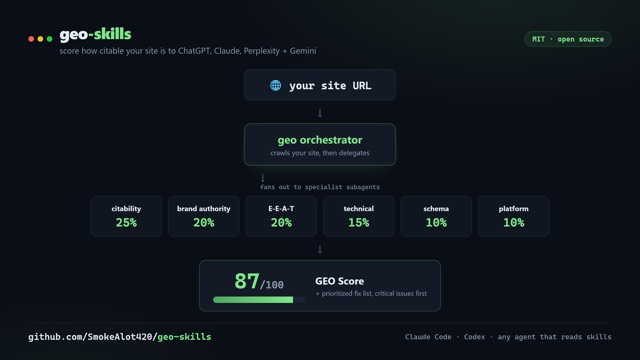
Illustration · not a resultFrom the TheSmokeDev/geo-skills README — shows the whole collection, not only this skill.source ↗
Query fan-out and topic-cluster optimization for AI search.
by TheSmokeDev·MIT license·★ 27 Stars on the repo·GitHub ↗
npx degit TheSmokeDev/geo-skills/skills/geo-fanout#main ~/.claude/skills/geo-fanoutChecked ·commit main
Files of Query Fan-Out / Topic-Cluster Optimization Skill
Show the full text155 lines
Query Fan-Out / Topic-Cluster Optimization Skill
Purpose
This skill optimizes a site for query fan-out -- the mechanism by which AI search engines rewrite a single user prompt into a cluster of sub-queries and retrieve sources per sub-query. Fan-out coverage is the 2026 meta-factor for AI citation: pages win citations by matching the sub-queries engines generate, not by ranking #1 for the head term. This skill maps a topic's sub-query space, audits how much of it the site covers, and engineers titles and URL slugs so pages survive the pre-read gatekeeping step.
Core Insight
Fan-out is the top-scoring citation factor in Zyppy's 23-factor meta-analysis: 9.3/10 (DigitalApplied synthesis of 54 studies, Jun 2026). Engines like Gemini 3 (Jan 2026) and ChatGPT decompose one prompt into multiple sub-queries, run each against their index, and cite the pages that best match each sub-query. The consequence is a collapsed dependence on organic rank:
- Only 38% of AIO-cited URLs rank in the organic top 10 -- down from 76% (Ahrefs, 863K SERPs / 4M URLs, Mar 2026).
- 31% of AIO citations come from positions 11-100, and 31% from beyond position 100 (same study).
Page-3 organic is NOT disqualifying. The fan-out is the small-site opening: a low-authority page that precisely answers one sub-query can be cited over a high-authority page that only covers the head term.
Win the cluster, not the head term.
How Fan-Out Works (Mechanism)
- User submits one prompt (e.g., "how much does SR-22 insurance cost in California?").
- The engine classifies whether to search at all (ChatGPT: only ~18-24% of prompts trigger search).
- The prompt is rewritten into a cluster of sub-queries -- eligibility, cost, process, location, and language variants of the underlying intent.
- Each sub-query is run against the engine's retrieval index (ChatGPT: Bing; Gemini/AIO: Google).
- Retrieved pages pass a pre-read gate on title, snippet, and URL before content is ever opened.
- The engine cites the best-matching pages across the cluster (~15-50% of retrieved URLs get cited; ⚠️ single source, SubscribePR Jul 2026).
Steps 3-5 are what this skill optimizes. Steps 1-2 and 6 are covered by skills/geo-citability/ and skills/geo-ai-index-access/.
Step 1: Map the Sub-Query Space
For each target topic, enumerate the sub-query space an engine would fan out into. Generate candidate sub-queries across these five variant axes:
| Axis | What to Generate | Example (topic: SR-22 insurance in California) |
|---|---|---|
| Eligibility | who qualifies, requirements, edge cases, disqualifiers | "who needs SR-22 in California", "SR-22 after DUI requirements" |
| Cost | price, average cost, cheapest, cost by segment | "average SR-22 cost California 2026", "cheapest SR-22 insurance Los Angeles" |
| Process | how to get, how long, steps, filing, renewal | "how to file SR-22 in California", "how long does SR-22 last" |
| Location | state, county, city, metro variants | "SR-22 insurance San Diego", "SR-22 cost by California county" |
| Language | non-English variants of every axis above | "seguro SR-22 California precio", "quien necesita SR-22" |
Procedure:
- State the head term / target prompt.
- Generate 5-15 sub-queries per axis (25-75 total per topic). Use real query sources where available: Google Search Console queries, Bing Webmaster Tools keyword data, autocomplete, "People Also Ask".
- Deduplicate and cluster the list into 5-10 sub-topics that each deserve a page (or a clearly differentiated section).
- For each sub-query, record: which existing URL (if any) covers it, and whether coverage is dedicated (page is about this) or incidental (mentioned in passing).
Compliance line: do NOT spin keyword-variant pages with near-identical content. Google's official 2026 guidance classifies keyword-variant page farming as scaled-content abuse (Google Search Central, May 2026). Every cluster page must carry per-page unique data (per-city rates, per-county figures, original numbers) -- the same differentiation bar AI Mode applies when rewarding 15-20-page topic clusters over single pages.
Step 2: Cluster-Coverage Audit
- Build the coverage matrix: rows = sub-queries from Step 1, columns = candidate URLs on the site.
- For each sub-query, WebFetch the mapped page and check:
- Does the page's H1/title directly answer this sub-query?
- Does a self-contained passage answer it in the first 40-60 words of a section? (See
skills/geo-citability/for passage scoring.) - Is the answer data-dense (specific numbers, dates, named entities)?
- Score each sub-query: Covered (dedicated page, direct answer), Weak (incidental mention or buried answer), Missing (no page).
- Compute cluster coverage = Covered / total sub-queries.
- Prioritize gaps by expected retrieval volume: cost and location variants typically carry the most fan-out traffic; language variants are often the thinnest competition.
Deliverable from the audit: a build list of missing pages (each with its target sub-query, required unique data, and engineered title/slug per Step 3) plus a rewrite list of weak pages.
Step 3: Title + Slug Semantic-Match Engineering
Titles and slugs are citation factors before content is read -- they gate whether the engine even opens the page (Ahrefs, 1.4M prompts, Apr 2026):
- Cited-URL titles score 0.656 cosine similarity to the fan-out queries vs 0.484 for non-cited URLs (same study).
- Natural-language slugs cite at 89.78% vs 81.11% for non-natural slugs (same study).
Procedure for each page in the build/rewrite list:
- Take the primary sub-query the page targets.
- Write the title to mirror that sub-query in natural language -- include the entity, the variant axis (cost/location/etc.), and the year where freshness matters. Example:
SR-22 Insurance Cost in California (2026 Rates by County). - Write the slug as a natural-language phrase, not a keyword string or ID:
- Good:
/sr-22-insurance-cost-california/ - Bad:
/sr22-ca-cost-v2/,/page?id=4471,/blog/post-8823/
- Good:
- Keep title and H1 aligned with the slug -- all three are read at the gatekeeping step.
- Sanity-check similarity: the title should read as a direct answer to the sub-query, not a clever headline.
This is the highest-leverage-per-minute intervention in the pack: no new content, no links, just matching the strings engines fan out into.
Vertical Caveat: High-Overlap Verticals Still Reward Classic SEO
The 38% overlap figure is an average. Insurance, healthcare, and education retain 68-75% overlap between organic top-10 rankings and AI citations (BrightEdge via Shadow, Jul 2026 -- ⚠️ secondary source only, verify before quoting publicly). In these YMYL verticals:
- Classic ranking work still feeds AI citations directly. Do NOT deprioritize traditional SEO.
- Fan-out coverage is additive, not a replacement: build the cluster AND keep ranking the head terms.
- If the site being audited is in one of these verticals, say so explicitly in the report and weight classic-SEO fixes accordingly.
Output Format
Generate a file called GEO-FANOUT-COVERAGE.md:
# Fan-Out Cluster Coverage: [Domain] -- [Topic]

**Analysis Date:** [Date]
**Head Term / Target Prompt:** [Prompt]
**Sub-Queries Mapped:** [N]
**Cluster Coverage:** [X]% ([Covered]/[Total] sub-queries with dedicated pages)

---

## Coverage Matrix

| Sub-Query | Axis | Mapped URL | Status | Action |
|---|---|---|---|---|
| [sub-query] | Cost | [URL or --] | Covered/Weak/Missing | [Build/Rewrite/None] |

## Title + Slug Engineering Queue

| Page | Target Sub-Query | Current Title | Proposed Title | Proposed Slug |
|---|---|---|---|---|
| [URL/new] | [sub-query] | [title] | [natural-language title] | [/natural-language-slug/] |

## Vertical Overlap Assessment

[Is this a 68-75% high-overlap vertical (insurance/healthcare/education)?
 If yes: classic SEO remains a primary lever -- note the ⚠️ secondary-source flag.]

## Recommended Build Order

1. [Highest-volume missing sub-query page -- required unique data noted]
2. [Next]
Related Skills
skills/geo-citability/-- once a page passes the title/slug gate, passage-level citability determines whether it gets quoted.skills/geo-ai-index-access/-- fan-out coverage is worthless if the pages are not in the retrieval index (Bing for ChatGPT, Google for AIO/Gemini).skills/geo-youtube/-- YouTube is the rank-free bypass for sub-queries the site cannot win with text pages.skills/geo-measurement/-- measure cluster-coverage gains as share-of-citation over a prompt panel, not rank.
| 1 | |
| 2 | name geo-fanout |
| 3 | description Query fan-out and topic-cluster optimization for AI search. Maps a topic's full sub-query space, audits cluster coverage against what engines actually fan out into, and engineers titles and URL slugs for semantic match with fan-out queries. Use when a site needs to win citations beyond the organic top 10 or cover a topic cluster instead of a single head term. |
| 4 | allowed-tools |
| 5 | - Read |
| 6 | - Grep |
| 7 | - Glob |
| 8 | - Bash |
| 9 | - WebFetch |
| 10 | - Write |
| 11 | |
| 12 | |
| 13 | # Query Fan-Out / Topic-Cluster Optimization Skill |
| 14 | |
| 15 | ## Purpose |
| 16 | |
| 17 | This skill optimizes a site for **query fan-out** -- the mechanism by which AI search engines rewrite a single user prompt into a cluster of sub-queries and retrieve sources per sub-query. Fan-out coverage is the 2026 meta-factor for AI citation: pages win citations by matching the sub-queries engines generate, not by ranking #1 for the head term. This skill maps a topic's sub-query space, audits how much of it the site covers, and engineers titles and URL slugs so pages survive the pre-read gatekeeping step. |
| 18 | |
| 19 | ## Core Insight |
| 20 | |
| 21 | Fan-out is the top-scoring citation factor in Zyppy's 23-factor meta-analysis: **9.3/10** (DigitalApplied synthesis of 54 studies, Jun 2026). Engines like Gemini 3 (Jan 2026) and ChatGPT decompose one prompt into multiple sub-queries, run each against their index, and cite the pages that best match each sub-query. The consequence is a collapsed dependence on organic rank: |
| 22 | |
| 23 | Only **38% of AIO-cited URLs rank in the organic top 10** -- down from 76% (Ahrefs, 863K SERPs / 4M URLs, Mar 2026). |
| 24 | **31% of AIO citations come from positions 11-100**, and **31% from beyond position 100** (same study). |
| 25 | |
| 26 | Page-3 organic is NOT disqualifying. The fan-out is the small-site opening: a low-authority page that precisely answers one sub-query can be cited over a high-authority page that only covers the head term. |
| 27 | |
| 28 | Win the cluster, not the head term. |
| 29 | |
| 30 | |
| 31 | |
| 32 | ## How Fan-Out Works (Mechanism) |
| 33 | |
| 34 | User submits one prompt (e.g., "how much does SR-22 insurance cost in California?"). |
| 35 | The engine classifies whether to search at all (ChatGPT: only ~18-24% of prompts trigger search). |
| 36 | The prompt is rewritten into a cluster of sub-queries -- eligibility, cost, process, location, and language variants of the underlying intent. |
| 37 | Each sub-query is run against the engine's retrieval index (ChatGPT: Bing; Gemini/AIO: Google). |
| 38 | Retrieved pages pass a **pre-read gate** on title, snippet, and URL before content is ever opened. |
| 39 | The engine cites the best-matching pages across the cluster (~15-50% of retrieved URLs get cited; ⚠️ single source, SubscribePR Jul 2026). |
| 40 | |
| 41 | Steps 3-5 are what this skill optimizes. Steps 1-2 and 6 are covered by `skills/geo-citability/` and `skills/geo-ai-index-access/`. |
| 42 | |
| 43 | |
| 44 | |
| 45 | ## Step 1: Map the Sub-Query Space |
| 46 | |
| 47 | For each target topic, enumerate the sub-query space an engine would fan out into. Generate candidate sub-queries across these five variant axes: |
| 48 | |
| 49 | | Axis | What to Generate | Example (topic: SR-22 insurance in California) | |
| 50 | |---|---|---| |
| 51 | | **Eligibility** | who qualifies, requirements, edge cases, disqualifiers | "who needs SR-22 in California", "SR-22 after DUI requirements" | |
| 52 | | **Cost** | price, average cost, cheapest, cost by segment | "average SR-22 cost California 2026", "cheapest SR-22 insurance Los Angeles" | |
| 53 | | **Process** | how to get, how long, steps, filing, renewal | "how to file SR-22 in California", "how long does SR-22 last" | |
| 54 | | **Location** | state, county, city, metro variants | "SR-22 insurance San Diego", "SR-22 cost by California county" | |
| 55 | | **Language** | non-English variants of every axis above | "seguro SR-22 California precio", "quien necesita SR-22" | |
| 56 | |
| 57 | Procedure: |
| 58 | |
| 59 | State the head term / target prompt. |
| 60 | Generate 5-15 sub-queries per axis (25-75 total per topic). Use real query sources where available: Google Search Console queries, Bing Webmaster Tools keyword data, autocomplete, "People Also Ask". |
| 61 | Deduplicate and cluster the list into 5-10 sub-topics that each deserve a page (or a clearly differentiated section). |
| 62 | For each sub-query, record: which existing URL (if any) covers it, and whether coverage is **dedicated** (page is about this) or **incidental** (mentioned in passing). |
| 63 | |
| 64 | **Compliance line:** do NOT spin keyword-variant pages with near-identical content. Google's official 2026 guidance classifies keyword-variant page farming as scaled-content abuse (Google Search Central, May 2026). Every cluster page must carry per-page unique data (per-city rates, per-county figures, original numbers) -- the same differentiation bar AI Mode applies when rewarding 15-20-page topic clusters over single pages. |
| 65 | |
| 66 | ## Step 2: Cluster-Coverage Audit |
| 67 | |
| 68 | Build the coverage matrix: rows = sub-queries from Step 1, columns = candidate URLs on the site. |
| 69 | For each sub-query, WebFetch the mapped page and check: |
| 70 | Does the page's H1/title directly answer this sub-query? |
| 71 | Does a self-contained passage answer it in the first 40-60 words of a section? (See `skills/geo-citability/` for passage scoring.) |
| 72 | Is the answer data-dense (specific numbers, dates, named entities)? |
| 73 | Score each sub-query: **Covered** (dedicated page, direct answer), **Weak** (incidental mention or buried answer), **Missing** (no page). |
| 74 | Compute cluster coverage = Covered / total sub-queries. |
| 75 | Prioritize gaps by expected retrieval volume: cost and location variants typically carry the most fan-out traffic; language variants are often the thinnest competition. |
| 76 | |
| 77 | **Deliverable from the audit:** a build list of missing pages (each with its target sub-query, required unique data, and engineered title/slug per Step 3) plus a rewrite list of weak pages. |
| 78 | |
| 79 | ## Step 3: Title + Slug Semantic-Match Engineering |
| 80 | |
| 81 | Titles and slugs are citation factors **before content is read** -- they gate whether the engine even opens the page (Ahrefs, 1.4M prompts, Apr 2026): |
| 82 | |
| 83 | Cited-URL titles score **0.656 cosine similarity to the fan-out queries** vs **0.484 for non-cited URLs** (same study). |
| 84 | **Natural-language slugs cite at 89.78% vs 81.11%** for non-natural slugs (same study). |
| 85 | |
| 86 | Procedure for each page in the build/rewrite list: |
| 87 | |
| 88 | Take the primary sub-query the page targets. |
| 89 | Write the title to mirror that sub-query in natural language -- include the entity, the variant axis (cost/location/etc.), and the year where freshness matters. Example: `SR-22 Insurance Cost in California (2026 Rates by County)`. |
| 90 | Write the slug as a natural-language phrase, not a keyword string or ID: |
| 91 | Good: `/sr-22-insurance-cost-california/` |
| 92 | Bad: `/sr22-ca-cost-v2/`, `/page?id=4471`, `/blog/post-8823/` |
| 93 | Keep title and H1 aligned with the slug -- all three are read at the gatekeeping step. |
| 94 | Sanity-check similarity: the title should read as a direct answer to the sub-query, not a clever headline. |
| 95 | |
| 96 | This is the highest-leverage-per-minute intervention in the pack: no new content, no links, just matching the strings engines fan out into. |
| 97 | |
| 98 | |
| 99 | |
| 100 | ## Vertical Caveat: High-Overlap Verticals Still Reward Classic SEO |
| 101 | |
| 102 | The 38% overlap figure is an average. **Insurance, healthcare, and education retain 68-75% overlap between organic top-10 rankings and AI citations** (BrightEdge via Shadow, Jul 2026 -- ⚠️ secondary source only, verify before quoting publicly). In these YMYL verticals: |
| 103 | |
| 104 | Classic ranking work still feeds AI citations directly. Do NOT deprioritize traditional SEO. |
| 105 | Fan-out coverage is additive, not a replacement: build the cluster AND keep ranking the head terms. |
| 106 | If the site being audited is in one of these verticals, say so explicitly in the report and weight classic-SEO fixes accordingly. |
| 107 | |
| 108 | |
| 109 | |
| 110 | ## Output Format |
| 111 | |
| 112 | Generate a file called `GEO-FANOUT-COVERAGE.md`: |
| 113 | |
| 114 | |
| 115 | # Fan-Out Cluster Coverage: [Domain] -- [Topic] |
| 116 | |
| 117 | **Analysis Date:** [Date] |
| 118 | **Head Term / Target Prompt:** [Prompt] |
| 119 | **Sub-Queries Mapped:** [N] |
| 120 | **Cluster Coverage:** [X]% ([Covered]/[Total] sub-queries with dedicated pages) |
| 121 | |
| 122 | |
| 123 | |
| 124 | ## Coverage Matrix |
| 125 | |
| 126 | | Sub-Query | Axis | Mapped URL | Status | Action | |
| 127 | |---|---|---|---|---| |
| 128 | | [sub-query] | Cost | [URL or --] | Covered/Weak/Missing | [Build/Rewrite/None] | |
| 129 | |
| 130 | ## Title + Slug Engineering Queue |
| 131 | |
| 132 | | Page | Target Sub-Query | Current Title | Proposed Title | Proposed Slug | |
| 133 | |---|---|---|---|---| |
| 134 | | [URL/new] | [sub-query] | [title] | [natural-language title] | [/natural-language-slug/] | |
| 135 | |
| 136 | ## Vertical Overlap Assessment |
| 137 | |
| 138 | [Is this a 68-75% high-overlap vertical (insurance/healthcare/education)? |
| 139 | If yes: classic SEO remains a primary lever -- note the ⚠️ secondary-source flag.] |
| 140 | |
| 141 | ## Recommended Build Order |
| 142 | |
| 143 | 1. [Highest-volume missing sub-query page -- required unique data noted] |
| 144 | 2. [Next] |
| 145 | |
| 146 | |
| 147 | |
| 148 | |
| 149 | ## Related Skills |
| 150 | |
| 151 | `skills/geo-citability/` -- once a page passes the title/slug gate, passage-level citability determines whether it gets quoted. |
| 152 | `skills/geo-ai-index-access/` -- fan-out coverage is worthless if the pages are not in the retrieval index (Bing for ChatGPT, Google for AIO/Gemini). |
| 153 | `skills/geo-youtube/` -- YouTube is the rank-free bypass for sub-queries the site cannot win with text pages. |
| 154 | `skills/geo-measurement/` -- measure cluster-coverage gains as share-of-citation over a prompt panel, not rank. |
| 155 |
Discussion
Browse more free Claude skills.