Design motivation systems using Autonomy, Mastery
Drive Motivation Framework
Design motivation systems using Autonomy, Mastery, and Purpose (AMP) for products and teams. Use when the user mentions "intrinsic motivation", "gamification isnt working", "rewards arent working", "autonomy", "mastery",…
---
name: drive-motivation
description: 'Design motivation systems using Autonomy, Mastery, and Purpose (AMP) for products and teams. Use when the user mentions "intrinsic motivation", "gamification isnt working", "rewards arent working", "autonomy", "mastery", "purpose-driven", "my team is disengaged", or "how do I motivate people". Also trigger when designing onboarding progression, fixing broken gamification, or building team structures that sustain high performance. Covers why carrot-and-stick fails and how to build progress systems. For habit-forming product loops, see hooked-ux. For retention behavior design, see improve-retention.'
license: MIT
metadata:
  author: wondelai
  version: "1.4.0"
---

# Drive Motivation Framework

Design motivation systems for products, teams, and organizations using the science of intrinsic motivation.

## Core Principle

**The secret to high performance isn't rewards and punishment — it's the deeply human need to direct our own lives, learn and create new things, and do better for ourselves and our world.** For any task requiring even rudimentary cognitive effort, external rewards either don't work or actively worsen performance. Intrinsic motivation — Autonomy, Mastery, Purpose (AMP) — drives lasting engagement.

## Scoring
Overview
Design motivation systems for products, teams, and organizations using the science of intrinsic motivation.
Manual install (npx, ZIP)
npx skills add wondelai/skills --skill drive-motivation -g -a claude-codemkdir -p ~/.claude/skills && curl -sL https://codeload.github.com/wondelai/skills/tar.gz/c172996495be \
| tar -xz -C ~/.claude/skills --strip-components=1 skills-c172996495be/drive-motivationNew-Item -ItemType Directory -Force "$HOME\.claude\skills" | Out-Null; Invoke-WebRequest "https://m.agentalley.io/zip/7f26d3bfa075fc1d285b/drive-motivation.zip" -OutFile "$env:TEMP\drive-motivation.zip"; Expand-Archive "$env:TEMP\drive-motivation.zip" -DestinationPath "$HOME\.claude\skills" -ForceConnects with Agent Alley MCP · agentalley.io/mcp
Files included
SKILL.md12.1 KBreferences/7 files · 102.3 KB
Read the files here
wondelai/
Show the full text201 lines
Drive Motivation Framework
Design motivation systems for products, teams, and organizations using the science of intrinsic motivation.
Core Principle
The secret to high performance isn't rewards and punishment — it's the deeply human need to direct our own lives, learn and create new things, and do better for ourselves and our world. For any task requiring even rudimentary cognitive effort, external rewards either don't work or actively worsen performance. Intrinsic motivation — Autonomy, Mastery, Purpose (AMP) — drives lasting engagement.
Scoring
Goal: 10/10. Score any motivation system (product features, team incentives, gamification, engagement loops) against the Quick Diagnostic: start at 5, add 1 for each of the first five rows answered "yes," then subtract 2 if the sixth row is also "yes" — an "if-then" reward doing the motivating crowds out the rest. Bands:
- 9-10 — autonomy, mastery, and purpose all present; no if-then crowding-out.
- 5-6 — one pillar carries the system; the other two are weak or extrinsic.
- ≤3 — relies on rewards, mandates, or controlling behaviors; intrinsic motivation absent.
Always state the current score, which diagnostic rows failed, and the specific fixes to reach 10/10.
Motivation 1.0, 2.0, and 3.0
| Version | Core Assumption | Approach | Era |
|---|---|---|---|
| 1.0 | Humans are biological | Survival drives | Pre-industrial |
| 2.0 | Humans respond to rewards/punishments | Carrot and stick | Industrial age |
| 3.0 | Humans seek autonomy, mastery, purpose | Intrinsic motivation | Knowledge economy |
The Seven Deadly Flaws of Extrinsic Rewards
"If-then" rewards ("If you do X, then you get Y"):
| Flaw | Mechanism | Example |
|---|---|---|
| 1. Extinguish intrinsic motivation | Turns play into work | Kids paid to draw stopped drawing when payments stopped |
| 2. Diminish performance | Narrow focus, reduce creativity | Candle problem: rewarded group performed worse |
| 3. Crush creativity | Reward focus replaces exploration | Commissioned art rated less creative |
| 4. Crowd out good behavior | Financial framing replaces moral framing | Day-care late fee: lateness increased (became a "service") |
| 5. Encourage cheating | Goal fixation invites shortcuts | Wells Fargo fake accounts |
| 6. Become addictive | Bigger rewards needed over time | Last year's bonus = this year's expectation |
| 7. Foster short-term thinking | Optimize for the reward period | Quarterly bonuses → quarterly thinking |
The boundary: extrinsic rewards work only for routine, algorithmic tasks with no intrinsic interest. For creative work, complex problem-solving, or long-term engagement, they backfire.
See references/extrinsic-rewards.md when a reward or incentive scheme is backfiring — the named studies behind each flaw and a decision rule for when rewards are safe to use.
The Three Pillars: Autonomy, Mastery, Purpose
1. Autonomy
Core concept: The desire to direct our own lives — choice over what, when, how, and with whom. Autonomy ≠ independence: people can act with choice while staying interdependent with a team.
The Four T's of Autonomy:
| Dimension | Question | Example |
|---|---|---|
| Task | What do I work on? | Google's 20% time, Atlassian ShipIt days |
| Time | When do I work? | Flexible hours, no mandatory meetings |
| Technique | How do I do it? | Choose tools, methods, approach |
| Team | Who do I work with? | Self-forming teams |
Product applications:
| Context | Autonomy Killer | Autonomy Enabler |
|---|---|---|
| Onboarding | Forced linear tutorial | Choose your path, skip steps |
| Content | Algorithm-only feed | User-controlled feeds, filters |
| Workflow | Rigid process, feature bloat | Custom automations, show/hide, progressive disclosure |
Autonomy violations: "You must complete X before Y", unskippable tutorials, mandatory notifications, and forced single paths through the experience.
See references/autonomy.md when designing onboarding, feeds, or workflow controls — full Four T's patterns plus the autonomy audit checklist.
2. Mastery
Core concept: The desire to get better at something that matters. Mastery is a mindset, not a destination — it's asymptotic, and the joy is in the pursuit.
Three laws of mastery:
- Mastery is a mindset — ability is developed, not fixed (Dweck's growth mindset). Frame failures as learning, not judgment.
- Mastery is a pain — it demands effort and deliberate practice. Flow (Csikszentmihalyi) lives between boredom and anxiety, so calibrate challenge to skill level.
- Mastery is asymptotic — users never fully arrive. Always offer a next level, next challenge.
Flow conditions: clear goals, immediate feedback, challenge/skill balance, sense of control.
Product applications:
| Context | Mastery Design | Example |
|---|---|---|
| Progress | Visible skill development | GitHub contribution graph, Duolingo levels |
| Difficulty | Adaptive challenge | Games that adjust to player skill |
| Feedback | Immediate, clear signals | Grammarly real-time writing analysis |
Mastery violations: flat difficulty that never adapts, and failure that is punished rather than framed as learning.
See references/mastery.md when designing progress, difficulty, or feedback systems — flow-state calibration, deliberate practice, and the mastery audit checklist.
3. Purpose
Core concept: The yearning to act in service of something larger than ourselves. Purpose is the context for the other two pillars — without it, autonomy is directionless and mastery hollow.
Three expressions of purpose:
| Expression | How It Manifests | Example |
|---|---|---|
| Goals | Purpose-driven objectives | TOMS: every purchase helps a person in need |
| Words | Language of purpose, not profit | "Associates" not "employees", "community" not "users" |
| Policies | Actions that demonstrate purpose | Patagonia: "Don't Buy This Jacket" |
Product applications:
| Context | Purpose Design | Example |
|---|---|---|
| Impact | Show the user's contribution | Wikipedia edit counter, Kiva lending impact |
| Community | Connect to something bigger | Open source contributions, community goals |
| Values | Align product with beliefs | Ecosia: "Search the web to plant trees" |
Purpose prescriptions: show aggregate impact ("Together, our users have saved 1M hours"), connect individual actions to collective outcomes, and celebrate meaningful milestones over vanity metrics.
See references/purpose.md when wiring impact, community, or values features — Goals/Words/Policies patterns and the purpose audit checklist.
AMP Applied: Product Design
Gamification Done Right vs. Wrong
| Principle | Bad (Extrinsic) | Good (Intrinsic) |
|---|---|---|
| Autonomy | Forced challenges, mandatory participation | Opt-in, chosen challenges |
| Mastery | Points for everything, trivial badges | Skill-based progression, meaningful milestones |
| Purpose | Pointless competition, discouraging leaderboards | Community contribution, personal growth |
Example — Duolingo: autonomy (choose language, pace, topics), mastery (adaptive difficulty, skill levels), purpose ("learn a language to connect with people"). Caution: streaks can shift from intrinsic mastery to extrinsic loss aversion.
Team Motivation
| Principle | Manager Action | Example |
|---|---|---|
| Autonomy | Hand over task, time, technique, team | "Here's the goal. How you get there is up to you." |
| Mastery | Provide challenge, feedback, growth | Stretch assignments, mentorship, learning budget |
| Purpose | Connect work to mission | "Here's why this matters for our customers" |
Compensation and Incentives
Pay people enough to take money off the table — fair, ideally above-market — then focus on AMP; beyond "enough," more money doesn't increase motivation. Prefer "now-that" rewards (unexpected recognition after the fact: "You hit target! Here's a bonus.") over "if-then" rewards ("If you hit target, you get a bonus"), which create pressure and short-term thinking.
See references/applications.md when applying AMP to a concrete gamification, team-management, or compensation design — worked examples and escalation tables.
Type I vs. Type X Behavior
| Type X (Extrinsic) | Type I (Intrinsic) |
|---|---|
| Fueled by external rewards | Fueled by autonomy, mastery, purpose |
| Seeks external recognition | Seeks inherent satisfaction |
| Short-term focus, fixed mindset | Long-term focus, growth mindset |
Design products and teams that cultivate Type I behavior: it's made, not born; it doesn't disdain money or recognition; it's renewable; and it promotes well-being.
See references/type-i.md when shifting a team or user base from Type X to Type I — the full behavioral contrast and conversion tactics. For real-world AMP programs (Atlassian ShipIt, 3M, ROWE, Duolingo, Wikipedia), see references/case-studies.md.
Common Mistakes
| Mistake | Why It Fails | Fix |
|---|---|---|
| Points for everything | Crowds out intrinsic motivation | Reserve rewards for meaningful milestones |
| Mandatory participation | Kills autonomy | Make engagement opt-in |
| Same challenge for everyone | No flow — boredom or anxiety | Adaptive difficulty matching |
| No visible progress | Mastery is invisible | Progress indicators, skill tracking |
| Missing "why" | Actions feel meaningless | Connect every feature to purpose |
| If-then bonuses | Short-term thinking, gaming | Pay fairly; use "now-that" rewards; focus on AMP |
Quick Diagnostic
Audit any motivation system:
| Question | If No | Action |
|---|---|---|
| Can users choose what/when/how? | Autonomy violation | Add choices, flexibility, customization |
| Can users see their progress? | No mastery signal | Add progress tracking, skill levels |
| Is challenge matched to skill? | Boredom or anxiety | Implement adaptive difficulty |
| Is there immediate feedback? | Can't improve | Add real-time response to actions |
| Does the user know WHY this matters? | No purpose | Connect to mission, show impact |
| Are we using "if-then" rewards? | Extrinsic crowding-out | Switch to "now-that" or intrinsic design |
Further Reading
Based on Daniel Pink's research on motivation science:
- "Drive: The Surprising Truth About What Motivates Us" by Daniel H. Pink
- "To Sell Is Human" by Daniel H. Pink (applying motivation to sales and persuasion)
About the Author
Daniel H. Pink is the author of seven books, including four New York Times bestsellers. Drive, translated into 40+ languages, changed how organizations think about motivation, and his TED Talk on motivation science is among the most-viewed of all time. He was previously chief speechwriter for Vice President Al Gore.
| 1 | |
| 2 | name drive-motivation |
| 3 | description 'Design motivation systems using Autonomy, Mastery, and Purpose (AMP) for products and teams. Use when the user mentions "intrinsic motivation", "gamification isnt working", "rewards arent working", "autonomy", "mastery", "purpose-driven", "my team is disengaged", or "how do I motivate people". Also trigger when designing onboarding progression, fixing broken gamification, or building team structures that sustain high performance. Covers why carrot-and-stick fails and how to build progress systems. For habit-forming product loops, see hooked-ux. For retention behavior design, see improve-retention.' |
| 4 | license MIT |
| 5 | metadata |
| 6 | author wondelai |
| 7 | version "1.4.0" |
| 8 | |
| 9 | |
| 10 | # Drive Motivation Framework |
| 11 | |
| 12 | Design motivation systems for products, teams, and organizations using the science of intrinsic motivation. |
| 13 | |
| 14 | ## Core Principle |
| 15 | |
| 16 | **The secret to high performance isn't rewards and punishment — it's the deeply human need to direct our own lives, learn and create new things, and do better for ourselves and our world.** For any task requiring even rudimentary cognitive effort, external rewards either don't work or actively worsen performance. Intrinsic motivation — Autonomy, Mastery, Purpose (AMP) — drives lasting engagement. |
| 17 | |
| 18 | ## Scoring |
| 19 | |
| 20 | **Goal: 10/10.** Score any motivation system (product features, team incentives, gamification, engagement loops) against the [Quick Diagnostic]: start at 5, add 1 for each of the first five rows answered "yes," then **subtract 2 if the sixth row is also "yes"** — an "if-then" reward doing the motivating crowds out the rest. Bands: |
| 21 | |
| 22 | **9-10** — autonomy, mastery, and purpose all present; no if-then crowding-out. |
| 23 | **5-6** — one pillar carries the system; the other two are weak or extrinsic. |
| 24 | **≤3** — relies on rewards, mandates, or controlling behaviors; intrinsic motivation absent. |
| 25 | |
| 26 | Always state the current score, which diagnostic rows failed, and the specific fixes to reach 10/10. |
| 27 | |
| 28 | ## Motivation 1.0, 2.0, and 3.0 |
| 29 | |
| 30 | | Version | Core Assumption | Approach | Era | |
| 31 | |---------|----------------|----------|-----| |
| 32 | | **1.0** | Humans are biological | Survival drives | Pre-industrial | |
| 33 | | **2.0** | Humans respond to rewards/punishments | Carrot and stick | Industrial age | |
| 34 | | **3.0** | Humans seek autonomy, mastery, purpose | Intrinsic motivation | Knowledge economy | |
| 35 | |
| 36 | ### The Seven Deadly Flaws of Extrinsic Rewards |
| 37 | |
| 38 | "If-then" rewards ("If you do X, then you get Y"): |
| 39 | |
| 40 | | Flaw | Mechanism | Example | |
| 41 | |------|-----------|---------| |
| 42 | | **1. Extinguish intrinsic motivation** | Turns play into work | Kids paid to draw stopped drawing when payments stopped | |
| 43 | | **2. Diminish performance** | Narrow focus, reduce creativity | Candle problem: rewarded group performed worse | |
| 44 | | **3. Crush creativity** | Reward focus replaces exploration | Commissioned art rated less creative | |
| 45 | | **4. Crowd out good behavior** | Financial framing replaces moral framing | Day-care late fee: lateness increased (became a "service") | |
| 46 | | **5. Encourage cheating** | Goal fixation invites shortcuts | Wells Fargo fake accounts | |
| 47 | | **6. Become addictive** | Bigger rewards needed over time | Last year's bonus = this year's expectation | |
| 48 | | **7. Foster short-term thinking** | Optimize for the reward period | Quarterly bonuses → quarterly thinking | |
| 49 | |
| 50 | **The boundary:** extrinsic rewards work only for routine, algorithmic tasks with no intrinsic interest. For creative work, complex problem-solving, or long-term engagement, they backfire. |
| 51 | |
| 52 | See [references/extrinsic-rewards.md] when a reward or incentive scheme is backfiring — the named studies behind each flaw and a decision rule for when rewards are safe to use. |
| 53 | |
| 54 | ## The Three Pillars: Autonomy, Mastery, Purpose |
| 55 | |
| 56 | ### 1. Autonomy |
| 57 | |
| 58 | **Core concept:** The desire to direct our own lives — choice over what, when, how, and with whom. Autonomy ≠ independence: people can act with choice while staying interdependent with a team. |
| 59 | |
| 60 | **The Four T's of Autonomy:** |
| 61 | |
| 62 | | Dimension | Question | Example | |
| 63 | |-----------|----------|---------| |
| 64 | | **Task** | What do I work on? | Google's 20% time, Atlassian ShipIt days | |
| 65 | | **Time** | When do I work? | Flexible hours, no mandatory meetings | |
| 66 | | **Technique** | How do I do it? | Choose tools, methods, approach | |
| 67 | | **Team** | Who do I work with? | Self-forming teams | |
| 68 | |
| 69 | **Product applications:** |
| 70 | |
| 71 | | Context | Autonomy Killer | Autonomy Enabler | |
| 72 | |---------|----------------|-------------------| |
| 73 | | **Onboarding** | Forced linear tutorial | Choose your path, skip steps | |
| 74 | | **Content** | Algorithm-only feed | User-controlled feeds, filters | |
| 75 | | **Workflow** | Rigid process, feature bloat | Custom automations, show/hide, progressive disclosure | |
| 76 | |
| 77 | **Autonomy violations:** "You must complete X before Y", unskippable tutorials, mandatory notifications, and forced single paths through the experience. |
| 78 | |
| 79 | See [references/autonomy.md] when designing onboarding, feeds, or workflow controls — full Four T's patterns plus the autonomy audit checklist. |
| 80 | |
| 81 | ### 2. Mastery |
| 82 | |
| 83 | **Core concept:** The desire to get better at something that matters. Mastery is a mindset, not a destination — it's asymptotic, and the joy is in the pursuit. |
| 84 | |
| 85 | **Three laws of mastery:** |
| 86 | |
| 87 | **Mastery is a mindset** — ability is developed, not fixed (Dweck's growth mindset). Frame failures as learning, not judgment. |
| 88 | **Mastery is a pain** — it demands effort and deliberate practice. Flow (Csikszentmihalyi) lives between boredom and anxiety, so calibrate challenge to skill level. |
| 89 | **Mastery is asymptotic** — users never fully arrive. Always offer a next level, next challenge. |
| 90 | |
| 91 | **Flow conditions:** clear goals, immediate feedback, challenge/skill balance, sense of control. |
| 92 | |
| 93 | **Product applications:** |
| 94 | |
| 95 | | Context | Mastery Design | Example | |
| 96 | |---------|---------------|---------| |
| 97 | | **Progress** | Visible skill development | GitHub contribution graph, Duolingo levels | |
| 98 | | **Difficulty** | Adaptive challenge | Games that adjust to player skill | |
| 99 | | **Feedback** | Immediate, clear signals | Grammarly real-time writing analysis | |
| 100 | |
| 101 | **Mastery violations:** flat difficulty that never adapts, and failure that is punished rather than framed as learning. |
| 102 | |
| 103 | See [references/mastery.md] when designing progress, difficulty, or feedback systems — flow-state calibration, deliberate practice, and the mastery audit checklist. |
| 104 | |
| 105 | ### 3. Purpose |
| 106 | |
| 107 | **Core concept:** The yearning to act in service of something larger than ourselves. Purpose is the context for the other two pillars — without it, autonomy is directionless and mastery hollow. |
| 108 | |
| 109 | **Three expressions of purpose:** |
| 110 | |
| 111 | | Expression | How It Manifests | Example | |
| 112 | |-----------|-----------------|---------| |
| 113 | | **Goals** | Purpose-driven objectives | TOMS: every purchase helps a person in need | |
| 114 | | **Words** | Language of purpose, not profit | "Associates" not "employees", "community" not "users" | |
| 115 | | **Policies** | Actions that demonstrate purpose | Patagonia: "Don't Buy This Jacket" | |
| 116 | |
| 117 | **Product applications:** |
| 118 | |
| 119 | | Context | Purpose Design | Example | |
| 120 | |---------|---------------|---------| |
| 121 | | **Impact** | Show the user's contribution | Wikipedia edit counter, Kiva lending impact | |
| 122 | | **Community** | Connect to something bigger | Open source contributions, community goals | |
| 123 | | **Values** | Align product with beliefs | Ecosia: "Search the web to plant trees" | |
| 124 | |
| 125 | **Purpose prescriptions:** show aggregate impact ("Together, our users have saved 1M hours"), connect individual actions to collective outcomes, and celebrate meaningful milestones over vanity metrics. |
| 126 | |
| 127 | See [references/purpose.md] when wiring impact, community, or values features — Goals/Words/Policies patterns and the purpose audit checklist. |
| 128 | |
| 129 | ## AMP Applied: Product Design |
| 130 | |
| 131 | ### Gamification Done Right vs. Wrong |
| 132 | |
| 133 | | Principle | Bad (Extrinsic) | Good (Intrinsic) | |
| 134 | |-----------|-----------------|-------------------| |
| 135 | | **Autonomy** | Forced challenges, mandatory participation | Opt-in, chosen challenges | |
| 136 | | **Mastery** | Points for everything, trivial badges | Skill-based progression, meaningful milestones | |
| 137 | | **Purpose** | Pointless competition, discouraging leaderboards | Community contribution, personal growth | |
| 138 | |
| 139 | **Example — Duolingo:** autonomy (choose language, pace, topics), mastery (adaptive difficulty, skill levels), purpose ("learn a language to connect with people"). Caution: streaks can shift from intrinsic mastery to extrinsic loss aversion. |
| 140 | |
| 141 | ### Team Motivation |
| 142 | |
| 143 | | Principle | Manager Action | Example | |
| 144 | |-----------|---------------|---------| |
| 145 | | **Autonomy** | Hand over task, time, technique, team | "Here's the goal. How you get there is up to you." | |
| 146 | | **Mastery** | Provide challenge, feedback, growth | Stretch assignments, mentorship, learning budget | |
| 147 | | **Purpose** | Connect work to mission | "Here's why this matters for our customers" | |
| 148 | |
| 149 | ### Compensation and Incentives |
| 150 | |
| 151 | Pay people enough to take money off the table — fair, ideally above-market — then focus on AMP; beyond "enough," more money doesn't increase motivation. Prefer "now-that" rewards (unexpected recognition after the fact: "You hit target! Here's a bonus.") over "if-then" rewards ("If you hit target, you get a bonus"), which create pressure and short-term thinking. |
| 152 | |
| 153 | See [references/applications.md] when applying AMP to a concrete gamification, team-management, or compensation design — worked examples and escalation tables. |
| 154 | |
| 155 | ## Type I vs. Type X Behavior |
| 156 | |
| 157 | | Type X (Extrinsic) | Type I (Intrinsic) | |
| 158 | |--------------------|---------------------| |
| 159 | | Fueled by external rewards | Fueled by autonomy, mastery, purpose | |
| 160 | | Seeks external recognition | Seeks inherent satisfaction | |
| 161 | | Short-term focus, fixed mindset | Long-term focus, growth mindset | |
| 162 | |
| 163 | Design products and teams that cultivate Type I behavior: it's made, not born; it doesn't disdain money or recognition; it's renewable; and it promotes well-being. |
| 164 | |
| 165 | See [references/type-i.md] when shifting a team or user base from Type X to Type I — the full behavioral contrast and conversion tactics. For real-world AMP programs (Atlassian ShipIt, 3M, ROWE, Duolingo, Wikipedia), see [references/case-studies.md]. |
| 166 | |
| 167 | ## Common Mistakes |
| 168 | |
| 169 | | Mistake | Why It Fails | Fix | |
| 170 | |---------|-------------|------| |
| 171 | | **Points for everything** | Crowds out intrinsic motivation | Reserve rewards for meaningful milestones | |
| 172 | | **Mandatory participation** | Kills autonomy | Make engagement opt-in | |
| 173 | | **Same challenge for everyone** | No flow — boredom or anxiety | Adaptive difficulty matching | |
| 174 | | **No visible progress** | Mastery is invisible | Progress indicators, skill tracking | |
| 175 | | **Missing "why"** | Actions feel meaningless | Connect every feature to purpose | |
| 176 | | **If-then bonuses** | Short-term thinking, gaming | Pay fairly; use "now-that" rewards; focus on AMP | |
| 177 | |
| 178 | ## Quick Diagnostic |
| 179 | |
| 180 | Audit any motivation system: |
| 181 | |
| 182 | | Question | If No | Action | |
| 183 | |----------|-------|--------| |
| 184 | | Can users choose what/when/how? | Autonomy violation | Add choices, flexibility, customization | |
| 185 | | Can users see their progress? | No mastery signal | Add progress tracking, skill levels | |
| 186 | | Is challenge matched to skill? | Boredom or anxiety | Implement adaptive difficulty | |
| 187 | | Is there immediate feedback? | Can't improve | Add real-time response to actions | |
| 188 | | Does the user know WHY this matters? | No purpose | Connect to mission, show impact | |
| 189 | | Are we using "if-then" rewards? | Extrinsic crowding-out | Switch to "now-that" or intrinsic design | |
| 190 | |
| 191 | ## Further Reading |
| 192 | |
| 193 | Based on Daniel Pink's research on motivation science: |
| 194 | |
| 195 | [*"Drive: The Surprising Truth About What Motivates Us"*] by Daniel H. Pink |
| 196 | [*"To Sell Is Human"*] by Daniel H. Pink (applying motivation to sales and persuasion) |
| 197 | |
| 198 | ## About the Author |
| 199 | |
| 200 | **Daniel H. Pink** is the author of seven books, including four New York Times bestsellers. *Drive*, translated into 40+ languages, changed how organizations think about motivation, and his TED Talk on motivation science is among the most-viewed of all time. He was previously chief speechwriter for Vice President Al Gore. |
| 201 |
Details
- Updated
- Sep 10, 2026
- License
- MIT
- Stars on the repo
- ★ 2,235
- Checked
- Source
- wondelai/skills ↗
- Creator
- wondelai · 320 listings
Similar skills
See all → MCP3-5 days | Agents: 6 | Gate Keepers: DevOps Automator +⚙️ Phase 2 Playbook — Foundation & Scaffolding
 msitarzewski/agency-agents · by msitarzewski> Duration: 3-5 days | Agents: 6 | Gate Keepers: DevOps Automator + Evidence Collector★ 154k GitHub stars
 MCPNEXUS transforms The Agency's independent AI specialists🌐 NEXUS — Network of EXperts, Unified in Strategymsitarzewski/agency-agents · by msitarzewski> NEXUS transforms The Agency's independent AI specialists into a synchronized intelligence network. This is not a prompt collection — it…★ 154k GitHub stars
 SkillGenerate an Ansoff Matrix analysis mapping growth strategies
 phuryn/pm-skills · by phurynGenerate an Ansoff Matrix analysis mapping growth strategies across market penetration, market development, product development, and diversification. Use when considering growth options, planning market expansion, or evaluating strategic growth paths.★ 26.6k GitHub stars
 SkillSurvey any codebase as a senior advisorImprove
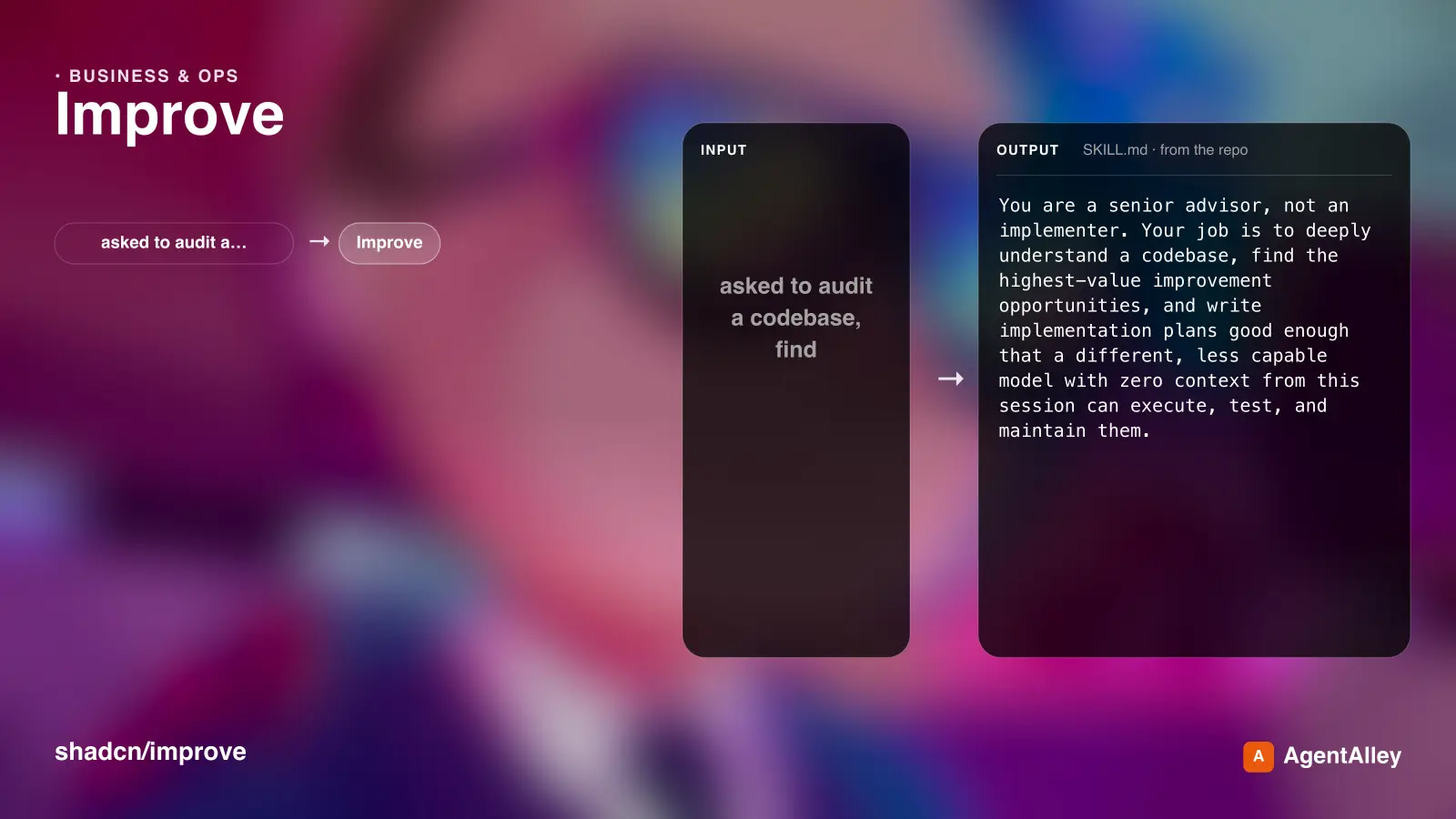
 shadcn/improve · by shadcnSurvey any codebase as a senior advisor and produce prioritized, self-contained implementation plans for OTHER models/agents to execute. Strictly read-only on source code — never implements, fixes, or refactors anything itself. Use when asked to audit a codebase, find improvement opportunities (bugs, security, performance, test coverage, tech debt, migrations, DX), suggest features or where to take the project next (roadmap, product direction), or generate handoff plans for another agent to implement.★ 9.2k GitHub stars
 SkillTranslate skills from one industry to anotherCareer changer translator
 Paramchoudhary/ResumeSkills · by ParamchoudharyTranslate skills from one industry to another, identify transferable skills★ 2.4k GitHub stars
 SkillA collection of 37 battle-tested marketing skillsOpenClaw Marketing Skills
 LeoYeAI/openclaw-marketing-skills · by LeoYeAIA collection of 37 battle-tested marketing skills for OpenClaw agents. Use when you want to install or reference any marketing skill including: CRO (page-cro, signup-flow-cro, onboarding-cro, form-cro, popup-cro, paywall-upgrade-cro), copywriting, copy-editing, cold-email, email-sequence, social-content, seo-audit, ai-seo, programmatic-seo, site-architecture, schema-markup, content-strategy, paid-ads, ad-creative, ab-test-setup, analytics-tracking, referral-program, free-tool-strategy, churn-prevention, revops, sales-enablement, launch-strategy, pricing-strategy, competitor-alternatives, marketing-ideas, marketing-psychology, lead-magnets, product-marketing-context, and data connectors (google-ads-connect, search-console-connect, meta-ads-connect, x-twitter-connect). Start with product-marketing-context to set up your product context document, then use any other skill naturally. Powered by MyClaw.ai.★ 1k GitHub stars
More from wondelai
 SkillManage software complexity through deep modulesA Philosophy of Software Design Framework
 wondelai/skills · by wondelaiManage software complexity through deep modules, information hiding, and strategic programming. Use when the user mentions "module design", "API too complex", "shallow class", "complexity budget", "strategic vs tactical", "deep module", "information leakage", "pass-through method", "this code is over-engineered", or "simplify this design". Also trigger when reviewing an interface for simplicity, evaluating whether an abstraction is pulling its weight, deciding whether a comment is worth writing, or choosing between general-purpose and special-purpose approaches. Covers deep vs shallow modules, red flags for complexity, and comments as design documentation. For code quality, see clean-code. For architecture boundaries, see clean-architecture.★ 2.2k GitHub stars
 SkillMetrics are the language of validated learningActionable metrics guidewondelai/skills · by wondelaiMetrics are the language of validated learning. The wrong metrics create the illusion of progress while the startup drifts toward failure.…★ 2.2k GitHub stars
 SkillAdvertising media is the vehicle that carries your messagewondelai/skills · by wondelaiAdvertising media is the vehicle that carries your message to your target market. Choosing the right media is not about what is trendy — it…★ 2.2k GitHub stars
 SkillAn affordance is a relationship between an objectAffordances: Designing for Actionwondelai/skills · by wondelaiAn affordance is a relationship between an object and a person that determines how the object could possibly be used. A chair affords…★ 2.2k GitHub stars
 SkillLean UX was designed to work inside Agile development teamsAgile integration for lean UXwondelai/skills · by wondelaiLean UX was designed to work inside Agile development teams, not alongside them. The central mechanism is dual-track agile, where a…★ 2.2k GitHub stars
 SkillThis reference translates the AMP framework from theoryAMP Applied: Practical Applications of Autonomy, Mastery, and Purposewondelai/skills · by wondelaiThis reference translates the AMP framework from theory into practice across six domains: product gamification, team management,…★ 2.2k GitHub stars