Stop Slop: make your writing sound human again
Stop Slop is a free Claude skill by Hardik Pandya that removes the patterns that make text read as machine-written. Claude cuts throat-clearing openers and adverbs, breaks not-X-but-Y contrasts, switches to active voice and scores the draft on five dimensions out of 50. It cleans text you already have and adds no new facts.
---
name: stop-slop
description: Remove AI writing patterns from prose. Use when drafting, editing, or reviewing text to eliminate predictable AI tells and produce more human-like writing.
license: MIT
metadata:
  author: Hardik Pandya (https://hvpandya.com)
  source: https://github.com/hardikpandya/stop-slop
  version: "2.0.0"
  updated: "2026-03-17"
---

# Stop Slop

Eliminate predictable AI writing patterns from prose.

## Core Rules

1. **Cut filler phrases.** Remove throat-clearing openers, emphasis crutches, and all adverbs. See Phrases to Remove below.
Overview
Remove these announcement phrases. State the content directly.
Manual install (npx, ZIP)
npx skills add boraoztunc/skills --skill stop-slop -g -a claude-codemkdir -p ~/.claude/skills && curl -sL https://codeload.github.com/boraoztunc/skills/tar.gz/645553ca7622 \
| tar -xz -C ~/.claude/skills --strip-components=1 skills-645553ca7622/stop-slopNew-Item -ItemType Directory -Force "$HOME\.claude\skills" | Out-Null; Invoke-WebRequest "https://m.agentalley.io/zip/faa2c2576d1687071ad5/stop-slop.zip" -OutFile "$env:TEMP\stop-slop.zip"; Expand-Archive "$env:TEMP\stop-slop.zip" -DestinationPath "$HOME\.claude\skills" -ForceConnects with Agent Alley MCP · agentalley.io/mcp
Files included
SKILL.md12.1 KBstop-slop-project-knowledge.md6.7 KB
Read the files here
Show the full text394 lines
Stop Slop
Eliminate predictable AI writing patterns from prose.
Core Rules
Cut filler phrases. Remove throat-clearing openers, emphasis crutches, and all adverbs. See Phrases to Remove below.
Break formulaic structures. Avoid binary contrasts, negative listings, dramatic fragmentation, rhetorical setups, false agency. See Structures to Avoid below.
Use active voice. Every sentence needs a human subject doing something. No passive constructions. No inanimate objects performing human actions ("the complaint becomes a fix").
Be specific. No vague declaratives ("The reasons are structural"). Name the specific thing. No lazy extremes ("every," "always," "never") doing vague work.
Put the reader in the room. No narrator-from-a-distance voice. "You" beats "People." Specifics beat abstractions.
Vary rhythm. Mix sentence lengths. Two items beat three. End paragraphs differently. No em dashes.
Trust readers. State facts directly. Skip softening, justification, hand-holding.
Cut quotables. If it sounds like a pull-quote, rewrite it.
Quick Checks
Before delivering prose:
- Any adverbs? Kill them.
- Any passive voice? Find the actor, make them the subject.
- Inanimate thing doing a human verb ("the decision emerges")? Name the person.
- Sentence starts with a Wh- word? Restructure it.
- Any "here's what/this/that" throat-clearing? Cut to the point.
- Any "not X, it's Y" contrasts? State Y directly.
- Three consecutive sentences match length? Break one.
- Paragraph ends with punchy one-liner? Vary it.
- Em-dash anywhere? Remove it.
- Vague declarative ("The implications are significant")? Name the specific implication.
- Narrator-from-a-distance ("Nobody designed this")? Put the reader in the scene.
- Meta-joiners ("The rest of this essay...")? Delete. Let the essay move.
Scoring
Rate 1-10 on each dimension:
| Dimension | Question |
|---|---|
| Directness | Statements or announcements? |
| Rhythm | Varied or metronomic? |
| Trust | Respects reader intelligence? |
| Authenticity | Sounds human? |
| Density | Anything cuttable? |
Below 35/50: revise.
Phrases to Remove
Throat-Clearing Openers
Remove these announcement phrases. State the content directly.
- "Here's the thing:"
- "Here's what [X]"
- "Here's this [X]"
- "Here's that [X]"
- "Here's why [X]"
- "The uncomfortable truth is"
- "It turns out"
- "The real [X] is"
- "Let me be clear"
- "The truth is,"
- "I'll say it again:"
- "I'm going to be honest"
- "Can we talk about"
- "Here's what I find interesting"
- "Here's the problem though"
Any "here's what/this/that" construction is throat-clearing before the point. Cut it and state the point.
Emphasis Crutches
These add no meaning. Delete them.
- "Full stop." / "Period."
- "Let that sink in."
- "This matters because"
- "Make no mistake"
- "Here's why that matters"
Business Jargon
Replace with plain language.
| Avoid | Use instead |
|---|---|
| Navigate (challenges) | Handle, address |
| Unpack (analysis) | Explain, examine |
| Lean into | Accept, embrace |
| Landscape (context) | Situation, field |
| Game-changer | Significant, important |
| Double down | Commit, increase |
| Deep dive | Analysis, examination |
| Take a step back | Reconsider |
| Moving forward | Next, from now |
| Circle back | Return to, revisit |
| On the same page | Aligned, agreed |
Adverbs
Kill all adverbs. No -ly words. No softeners, no intensifiers, no hedges.
Specific offenders:
- "really"
- "just"
- "literally"
- "genuinely"
- "honestly"
- "simply"
- "actually"
- "deeply"
- "truly"
- "fundamentally"
- "inherently"
- "inevitably"
- "interestingly"
- "importantly"
- "crucially"
Also cut these filler phrases:
- "At its core"
- "In today's [X]"
- "It's worth noting"
- "At the end of the day"
- "When it comes to"
- "In a world where"
- "The reality is"
Meta-Commentary
Remove self-referential asides. The essay should move, not announce its own structure.
- "Hint:"
- "Plot twist:" / "Spoiler:"
- "You already know this, but"
- "But that's another post"
- "X is a feature, not a bug"
- "Dressed up as"
- "The rest of this essay explains..."
- "Let me walk you through..."
- "In this section, we'll..."
- "As we'll see..."
- "I want to explore..."
Performative Emphasis
False intimacy or manufactured sincerity:
- "creeps in"
- "I promise"
- "They exist, I promise"
Telling Instead of Showing
Announcing difficulty or significance rather than demonstrating it:
- "This is genuinely hard"
- "This is what leadership actually looks like"
- "This is what X actually looks like"
- "actually matters"
Vague Declaratives
Sentences that announce importance without naming the specific thing. Kill these.
- "The reasons are structural"
- "The implications are significant"
- "This is the deepest problem"
- "The stakes are high"
- "The consequences are real"
If a sentence says something is important/deep/structural without showing the specific thing, cut it or replace it with the specific thing.
Structures to Avoid
Binary Contrasts
These create false drama. State the point directly.
| Pattern | Problem |
|---|---|
| "Not because X. Because Y." / "Not because X, but because Y." | Telegraphed reversal |
| "[X] isn't the problem. [Y] is." | Formulaic reframe |
| "The answer isn't X. It's Y." | Predictable pivot |
| "It feels like X. It's actually Y." | Setup/reveal cliche |
| "The question isn't X. It's Y." | Rhetorical misdirection |
| "Not X. But Y." / "not X, it's Y" / "isn't X, it's Y" | Mechanical contrast |
| "It's not this. It's that." | Same formula, different words |
| "stops being X and starts being Y" | False transformation arc |
| "doesn't mean X, but actually Y" | Negation-then-assertion crutch |
| "is about X but not Y" | False distinction |
| "not just X but also Y" | Additive hedge |
Instead: State Y directly. "The problem is Y." "Y matters here." Drop the negation entirely.
Negative Listing
Listing what something is not before revealing what it is. A rhetorical striptease.
| Pattern | Problem |
|---|---|
| "Not a X... Not a Y... A Z." | Dramatic buildup through negation |
| "It wasn't X. It wasn't Y. It was Z." | Same structure, past tense |
Instead: State Z. The reader doesn't need the runway.
Dramatic Fragmentation
Sentence fragments for emphasis read as manufactured profundity.
| Pattern | Problem |
|---|---|
| "[Noun]. That's it. That's the [thing]." | Performative simplicity |
| "X. And Y. And Z." | Staccato drama |
| "This unlocks something. [Word]." | Artificial revelation |
Instead: Complete sentences. Trust content over presentation.
Rhetorical Setups
These announce insight rather than deliver it.
| Pattern | Problem |
|---|---|
| "What if [reframe]?" | Socratic posturing |
| "Here's what I mean:" | Redundant preview |
| "Think about it:" | Condescending prompt |
| "And that's okay." | Unnecessary permission |
Instead: Make the point. Let readers draw conclusions.
Formulaic Constructions
| Pattern | Problem |
|---|---|
| "By the time X, I was Y." | Narrative template |
| "X that isn't Y" | Indirect. Say "X is broken" |
False Agency
Giving inanimate things human verbs. Complaints don't "become" fixes. Bets don't "live or die." Decisions don't "emerge." A person does something to make those things happen. AI loves this because it avoids naming the actor.
| Pattern | Problem |
|---|---|
| "a complaint becomes a fix" | The complaint did nothing. Someone fixed it. |
| "a bet lives or dies in days" | Bets don't have lifespans. Someone kills the project or ships it. |
| "the decision emerges" | Decisions don't emerge. Someone decides. |
| "the culture shifts" | Cultures don't shift on their own. People change behavior. |
| "the conversation moves toward" | Conversations don't move. Someone steers. |
| "the data tells us" | Data sits there. Someone reads it and draws a conclusion. |
| "the market rewards" | Markets don't reward. Buyers pay for things. |
Instead: Name the human. "The team fixed it that week" beats "the complaint becomes a fix." If no specific person fits, use "you" to put the reader in the seat.
Narrator-from-a-Distance
Floating above the scene instead of putting the reader in it.
| Pattern | Problem |
|---|---|
| "Nobody designed this." | Disembodied observation |
| "This happens because..." | Lecturer voice |
| "This is why..." | Same |
| "People tend to..." | Armchair sociologist |
Instead: Put the reader in the room. "You don't sit down one day and decide to..." beats "Nobody designed this."
Passive Voice
Every sentence needs a subject doing something. Passive voice hides the actor and drains energy.
| Pattern | Fix |
|---|---|
| "X was created" | Name who created it |
| "It is believed that" | Name who believes it |
| "Mistakes were made" | Name who made them |
| "The decision was reached" | Name who decided |
Instead: Find the actor. Put them at the front of the sentence.
Sentence Starters to Avoid
| Pattern | Fix |
|---|---|
| Sentences starting with What, When, Where, Which, Who, Why, How | Restructure. Lead with the subject or the verb. |
| Paragraphs starting with "So" | Start with content |
| Sentences starting with "Look," | Remove |
Wh- openers become a crutch. "What makes this hard is..." becomes "The constraint is..." or better, name the specific constraint.
Rhythm Patterns
| Pattern | Fix |
|---|---|
| Three-item lists | Use two items or one |
| Questions answered immediately | Let questions breathe or cut them |
| Every paragraph ends punchily | Vary endings |
| Em-dashes | Remove. Use commas or periods. No em dashes at all. |
| Staccato fragmentation | Don't stack short punchy sentences |
| "Not always. Not perfectly." | Hedging disguised as reassurance |
Word Patterns
| Pattern | Problem |
|---|---|
| Lazy extremes (every, always, never, everyone, everybody, nobody) | False authority. Use specifics instead of sweeping claims. |
| All adverbs (-ly words, "really," "just," "literally," "genuinely," "honestly," "simply," "actually") | Empty emphasis. See Adverbs section above. |
Examples
Example 1: Throat-Clearing + Binary Contrast
Before:
"Here's the thing: building products is hard. Not because the technology is complex. Because people are complex. Let that sink in."
After:
"Building products is hard. Technology is manageable. People aren't."
Changes: Removed opener, binary contrast structure, and emphasis crutch. Direct statements.
Example 2: Filler + Unnecessary Reassurance
Before:
"It turns out that most teams struggle with alignment. The uncomfortable truth is that nobody wants to admit they're confused. And that's okay."
After:
"Teams struggle with alignment. Nobody admits confusion."
Changes: Cut hedging ("most"), removed throat-clearing phrases, deleted permission-granting ending.
Example 3: Business Jargon Stack
Before:
"In today's fast-paced landscape, we need to lean into discomfort and navigate uncertainty with clarity. This matters because your competition isn't waiting."
After:
"Move faster. Your competition is."
Changes: Eliminated jargon entirely. Core message in six words.
Example 4: Dramatic Fragmentation
Before:
"Speed. Quality. Cost. You can only pick two. That's it. That's the tradeoff."
After:
"Speed, quality, cost—pick two."
Changes: Single sentence. No performative emphasis.
Example 5: Rhetorical Setup
Before:
"What if I told you that the best teams don't optimize for productivity? Here's what I mean: they optimize for learning. Think about it."
After:
"The best teams optimize for learning, not productivity."
Changes: Direct claim. No rhetorical scaffolding.
| 1 | |
| 2 | name stop-slop |
| 3 | description Remove AI writing patterns from prose. Use when drafting, editing, or reviewing text to eliminate predictable AI tells and produce more human-like writing. |
| 4 | license MIT |
| 5 | metadata |
| 6 | author Hardik Pandya (https://hvpandya.com) |
| 7 | source https://github.com/hardikpandya/stop-slop |
| 8 | version "2.0.0" |
| 9 | updated "2026-03-17" |
| 10 | |
| 11 | |
| 12 | # Stop Slop |
| 13 | |
| 14 | Eliminate predictable AI writing patterns from prose. |
| 15 | |
| 16 | ## Core Rules |
| 17 | |
| 18 | **Cut filler phrases.** Remove throat-clearing openers, emphasis crutches, and all adverbs. See Phrases to Remove below. |
| 19 | |
| 20 | **Break formulaic structures.** Avoid binary contrasts, negative listings, dramatic fragmentation, rhetorical setups, false agency. See Structures to Avoid below. |
| 21 | |
| 22 | **Use active voice.** Every sentence needs a human subject doing something. No passive constructions. No inanimate objects performing human actions ("the complaint becomes a fix"). |
| 23 | |
| 24 | **Be specific.** No vague declaratives ("The reasons are structural"). Name the specific thing. No lazy extremes ("every," "always," "never") doing vague work. |
| 25 | |
| 26 | **Put the reader in the room.** No narrator-from-a-distance voice. "You" beats "People." Specifics beat abstractions. |
| 27 | |
| 28 | **Vary rhythm.** Mix sentence lengths. Two items beat three. End paragraphs differently. No em dashes. |
| 29 | |
| 30 | **Trust readers.** State facts directly. Skip softening, justification, hand-holding. |
| 31 | |
| 32 | **Cut quotables.** If it sounds like a pull-quote, rewrite it. |
| 33 | |
| 34 | ## Quick Checks |
| 35 | |
| 36 | Before delivering prose: |
| 37 | |
| 38 | Any adverbs? Kill them. |
| 39 | Any passive voice? Find the actor, make them the subject. |
| 40 | Inanimate thing doing a human verb ("the decision emerges")? Name the person. |
| 41 | Sentence starts with a Wh- word? Restructure it. |
| 42 | Any "here's what/this/that" throat-clearing? Cut to the point. |
| 43 | Any "not X, it's Y" contrasts? State Y directly. |
| 44 | Three consecutive sentences match length? Break one. |
| 45 | Paragraph ends with punchy one-liner? Vary it. |
| 46 | Em-dash anywhere? Remove it. |
| 47 | Vague declarative ("The implications are significant")? Name the specific implication. |
| 48 | Narrator-from-a-distance ("Nobody designed this")? Put the reader in the scene. |
| 49 | Meta-joiners ("The rest of this essay...")? Delete. Let the essay move. |
| 50 | |
| 51 | ## Scoring |
| 52 | |
| 53 | Rate 1-10 on each dimension: |
| 54 | |
| 55 | | Dimension | Question | |
| 56 | |-----------|----------| |
| 57 | | Directness | Statements or announcements? | |
| 58 | | Rhythm | Varied or metronomic? | |
| 59 | | Trust | Respects reader intelligence? | |
| 60 | | Authenticity | Sounds human? | |
| 61 | | Density | Anything cuttable? | |
| 62 | |
| 63 | Below 35/50: revise. |
| 64 | |
| 65 | |
| 66 | |
| 67 | ## Phrases to Remove |
| 68 | |
| 69 | ### Throat-Clearing Openers |
| 70 | |
| 71 | Remove these announcement phrases. State the content directly. |
| 72 | |
| 73 | "Here's the thing:" |
| 74 | "Here's what [X]" |
| 75 | "Here's this [X]" |
| 76 | "Here's that [X]" |
| 77 | "Here's why [X]" |
| 78 | "The uncomfortable truth is" |
| 79 | "It turns out" |
| 80 | "The real [X] is" |
| 81 | "Let me be clear" |
| 82 | "The truth is," |
| 83 | "I'll say it again:" |
| 84 | "I'm going to be honest" |
| 85 | "Can we talk about" |
| 86 | "Here's what I find interesting" |
| 87 | "Here's the problem though" |
| 88 | |
| 89 | Any "here's what/this/that" construction is throat-clearing before the point. Cut it and state the point. |
| 90 | |
| 91 | ### Emphasis Crutches |
| 92 | |
| 93 | These add no meaning. Delete them. |
| 94 | |
| 95 | "Full stop." / "Period." |
| 96 | "Let that sink in." |
| 97 | "This matters because" |
| 98 | "Make no mistake" |
| 99 | "Here's why that matters" |
| 100 | |
| 101 | ### Business Jargon |
| 102 | |
| 103 | Replace with plain language. |
| 104 | |
| 105 | | Avoid | Use instead | |
| 106 | |-------|-------------| |
| 107 | | Navigate (challenges) | Handle, address | |
| 108 | | Unpack (analysis) | Explain, examine | |
| 109 | | Lean into | Accept, embrace | |
| 110 | | Landscape (context) | Situation, field | |
| 111 | | Game-changer | Significant, important | |
| 112 | | Double down | Commit, increase | |
| 113 | | Deep dive | Analysis, examination | |
| 114 | | Take a step back | Reconsider | |
| 115 | | Moving forward | Next, from now | |
| 116 | | Circle back | Return to, revisit | |
| 117 | | On the same page | Aligned, agreed | |
| 118 | |
| 119 | ### Adverbs |
| 120 | |
| 121 | Kill all adverbs. No -ly words. No softeners, no intensifiers, no hedges. |
| 122 | |
| 123 | Specific offenders: |
| 124 | |
| 125 | "really" |
| 126 | "just" |
| 127 | "literally" |
| 128 | "genuinely" |
| 129 | "honestly" |
| 130 | "simply" |
| 131 | "actually" |
| 132 | "deeply" |
| 133 | "truly" |
| 134 | "fundamentally" |
| 135 | "inherently" |
| 136 | "inevitably" |
| 137 | "interestingly" |
| 138 | "importantly" |
| 139 | "crucially" |
| 140 | |
| 141 | Also cut these filler phrases: |
| 142 | |
| 143 | "At its core" |
| 144 | "In today's [X]" |
| 145 | "It's worth noting" |
| 146 | "At the end of the day" |
| 147 | "When it comes to" |
| 148 | "In a world where" |
| 149 | "The reality is" |
| 150 | |
| 151 | ### Meta-Commentary |
| 152 | |
| 153 | Remove self-referential asides. The essay should move, not announce its own structure. |
| 154 | |
| 155 | "Hint:" |
| 156 | "Plot twist:" / "Spoiler:" |
| 157 | "You already know this, but" |
| 158 | "But that's another post" |
| 159 | "X is a feature, not a bug" |
| 160 | "Dressed up as" |
| 161 | "The rest of this essay explains..." |
| 162 | "Let me walk you through..." |
| 163 | "In this section, we'll..." |
| 164 | "As we'll see..." |
| 165 | "I want to explore..." |
| 166 | |
| 167 | ### Performative Emphasis |
| 168 | |
| 169 | False intimacy or manufactured sincerity: |
| 170 | |
| 171 | "creeps in" |
| 172 | "I promise" |
| 173 | "They exist, I promise" |
| 174 | |
| 175 | ### Telling Instead of Showing |
| 176 | |
| 177 | Announcing difficulty or significance rather than demonstrating it: |
| 178 | |
| 179 | "This is genuinely hard" |
| 180 | "This is what leadership actually looks like" |
| 181 | "This is what X actually looks like" |
| 182 | "actually matters" |
| 183 | |
| 184 | ### Vague Declaratives |
| 185 | |
| 186 | Sentences that announce importance without naming the specific thing. Kill these. |
| 187 | |
| 188 | "The reasons are structural" |
| 189 | "The implications are significant" |
| 190 | "This is the deepest problem" |
| 191 | "The stakes are high" |
| 192 | "The consequences are real" |
| 193 | |
| 194 | If a sentence says something is important/deep/structural without showing the specific thing, cut it or replace it with the specific thing. |
| 195 | |
| 196 | |
| 197 | |
| 198 | ## Structures to Avoid |
| 199 | |
| 200 | ### Binary Contrasts |
| 201 | |
| 202 | These create false drama. State the point directly. |
| 203 | |
| 204 | | Pattern | Problem | |
| 205 | |---------|---------| |
| 206 | | "Not because X. Because Y." / "Not because X, but because Y." | Telegraphed reversal | |
| 207 | | "[X] isn't the problem. [Y] is." | Formulaic reframe | |
| 208 | | "The answer isn't X. It's Y." | Predictable pivot | |
| 209 | | "It feels like X. It's actually Y." | Setup/reveal cliche | |
| 210 | | "The question isn't X. It's Y." | Rhetorical misdirection | |
| 211 | | "Not X. But Y." / "not X, it's Y" / "isn't X, it's Y" | Mechanical contrast | |
| 212 | | "It's not this. It's that." | Same formula, different words | |
| 213 | | "stops being X and starts being Y" | False transformation arc | |
| 214 | | "doesn't mean X, but actually Y" | Negation-then-assertion crutch | |
| 215 | | "is about X but not Y" | False distinction | |
| 216 | | "not just X but also Y" | Additive hedge | |
| 217 | |
| 218 | **Instead:** State Y directly. "The problem is Y." "Y matters here." Drop the negation entirely. |
| 219 | |
| 220 | ### Negative Listing |
| 221 | |
| 222 | Listing what something is *not* before revealing what it *is*. A rhetorical striptease. |
| 223 | |
| 224 | | Pattern | Problem | |
| 225 | |---------|---------| |
| 226 | | "Not a X... Not a Y... A Z." | Dramatic buildup through negation | |
| 227 | | "It wasn't X. It wasn't Y. It was Z." | Same structure, past tense | |
| 228 | |
| 229 | **Instead:** State Z. The reader doesn't need the runway. |
| 230 | |
| 231 | ### Dramatic Fragmentation |
| 232 | |
| 233 | Sentence fragments for emphasis read as manufactured profundity. |
| 234 | |
| 235 | | Pattern | Problem | |
| 236 | |---------|---------| |
| 237 | | "[Noun]. That's it. That's the [thing]." | Performative simplicity | |
| 238 | | "X. And Y. And Z." | Staccato drama | |
| 239 | | "This unlocks something. [Word]." | Artificial revelation | |
| 240 | |
| 241 | **Instead:** Complete sentences. Trust content over presentation. |
| 242 | |
| 243 | ### Rhetorical Setups |
| 244 | |
| 245 | These announce insight rather than deliver it. |
| 246 | |
| 247 | | Pattern | Problem | |
| 248 | |---------|---------| |
| 249 | | "What if [reframe]?" | Socratic posturing | |
| 250 | | "Here's what I mean:" | Redundant preview | |
| 251 | | "Think about it:" | Condescending prompt | |
| 252 | | "And that's okay." | Unnecessary permission | |
| 253 | |
| 254 | **Instead:** Make the point. Let readers draw conclusions. |
| 255 | |
| 256 | ### Formulaic Constructions |
| 257 | |
| 258 | | Pattern | Problem | |
| 259 | |---------|---------| |
| 260 | | "By the time X, I was Y." | Narrative template | |
| 261 | | "X that isn't Y" | Indirect. Say "X is broken" | |
| 262 | |
| 263 | ### False Agency |
| 264 | |
| 265 | Giving inanimate things human verbs. Complaints don't "become" fixes. Bets don't "live or die." Decisions don't "emerge." A person does something to make those things happen. AI loves this because it avoids naming the actor. |
| 266 | |
| 267 | | Pattern | Problem | |
| 268 | |---------|---------| |
| 269 | | "a complaint becomes a fix" | The complaint did nothing. Someone fixed it. | |
| 270 | | "a bet lives or dies in days" | Bets don't have lifespans. Someone kills the project or ships it. | |
| 271 | | "the decision emerges" | Decisions don't emerge. Someone decides. | |
| 272 | | "the culture shifts" | Cultures don't shift on their own. People change behavior. | |
| 273 | | "the conversation moves toward" | Conversations don't move. Someone steers. | |
| 274 | | "the data tells us" | Data sits there. Someone reads it and draws a conclusion. | |
| 275 | | "the market rewards" | Markets don't reward. Buyers pay for things. | |
| 276 | |
| 277 | **Instead:** Name the human. "The team fixed it that week" beats "the complaint becomes a fix." If no specific person fits, use "you" to put the reader in the seat. |
| 278 | |
| 279 | ### Narrator-from-a-Distance |
| 280 | |
| 281 | Floating above the scene instead of putting the reader in it. |
| 282 | |
| 283 | | Pattern | Problem | |
| 284 | |---------|---------| |
| 285 | | "Nobody designed this." | Disembodied observation | |
| 286 | | "This happens because..." | Lecturer voice | |
| 287 | | "This is why..." | Same | |
| 288 | | "People tend to..." | Armchair sociologist | |
| 289 | |
| 290 | **Instead:** Put the reader in the room. "You don't sit down one day and decide to..." beats "Nobody designed this." |
| 291 | |
| 292 | ### Passive Voice |
| 293 | |
| 294 | Every sentence needs a subject doing something. Passive voice hides the actor and drains energy. |
| 295 | |
| 296 | | Pattern | Fix | |
| 297 | |---------|-----| |
| 298 | | "X was created" | Name who created it | |
| 299 | | "It is believed that" | Name who believes it | |
| 300 | | "Mistakes were made" | Name who made them | |
| 301 | | "The decision was reached" | Name who decided | |
| 302 | |
| 303 | **Instead:** Find the actor. Put them at the front of the sentence. |
| 304 | |
| 305 | ### Sentence Starters to Avoid |
| 306 | |
| 307 | | Pattern | Fix | |
| 308 | |---------|-----| |
| 309 | | Sentences starting with What, When, Where, Which, Who, Why, How | Restructure. Lead with the subject or the verb. | |
| 310 | | Paragraphs starting with "So" | Start with content | |
| 311 | | Sentences starting with "Look," | Remove | |
| 312 | |
| 313 | Wh- openers become a crutch. "What makes this hard is..." becomes "The constraint is..." or better, name the specific constraint. |
| 314 | |
| 315 | ### Rhythm Patterns |
| 316 | |
| 317 | | Pattern | Fix | |
| 318 | |---------|-----| |
| 319 | | Three-item lists | Use two items or one | |
| 320 | | Questions answered immediately | Let questions breathe or cut them | |
| 321 | | Every paragraph ends punchily | Vary endings | |
| 322 | | Em-dashes | Remove. Use commas or periods. No em dashes at all. | |
| 323 | | Staccato fragmentation | Don't stack short punchy sentences | |
| 324 | | "Not always. Not perfectly." | Hedging disguised as reassurance | |
| 325 | |
| 326 | ### Word Patterns |
| 327 | |
| 328 | | Pattern | Problem | |
| 329 | |---------|---------| |
| 330 | | Lazy extremes (every, always, never, everyone, everybody, nobody) | False authority. Use specifics instead of sweeping claims. | |
| 331 | | All adverbs (-ly words, "really," "just," "literally," "genuinely," "honestly," "simply," "actually") | Empty emphasis. See Adverbs section above. | |
| 332 | |
| 333 | |
| 334 | |
| 335 | ## Examples |
| 336 | |
| 337 | ### Example 1: Throat-Clearing + Binary Contrast |
| 338 | |
| 339 | **Before:** |
| 340 | > "Here's the thing: building products is hard. Not because the technology is complex. Because people are complex. Let that sink in." |
| 341 | |
| 342 | **After:** |
| 343 | > "Building products is hard. Technology is manageable. People aren't." |
| 344 | |
| 345 | **Changes:** Removed opener, binary contrast structure, and emphasis crutch. Direct statements. |
| 346 | |
| 347 | |
| 348 | |
| 349 | ### Example 2: Filler + Unnecessary Reassurance |
| 350 | |
| 351 | **Before:** |
| 352 | > "It turns out that most teams struggle with alignment. The uncomfortable truth is that nobody wants to admit they're confused. And that's okay." |
| 353 | |
| 354 | **After:** |
| 355 | > "Teams struggle with alignment. Nobody admits confusion." |
| 356 | |
| 357 | **Changes:** Cut hedging ("most"), removed throat-clearing phrases, deleted permission-granting ending. |
| 358 | |
| 359 | |
| 360 | |
| 361 | ### Example 3: Business Jargon Stack |
| 362 | |
| 363 | **Before:** |
| 364 | > "In today's fast-paced landscape, we need to lean into discomfort and navigate uncertainty with clarity. This matters because your competition isn't waiting." |
| 365 | |
| 366 | **After:** |
| 367 | > "Move faster. Your competition is." |
| 368 | |
| 369 | **Changes:** Eliminated jargon entirely. Core message in six words. |
| 370 | |
| 371 | |
| 372 | |
| 373 | ### Example 4: Dramatic Fragmentation |
| 374 | |
| 375 | **Before:** |
| 376 | > "Speed. Quality. Cost. You can only pick two. That's it. That's the tradeoff." |
| 377 | |
| 378 | **After:** |
| 379 | > "Speed, quality, cost—pick two." |
| 380 | |
| 381 | **Changes:** Single sentence. No performative emphasis. |
| 382 | |
| 383 | |
| 384 | |
| 385 | ### Example 5: Rhetorical Setup |
| 386 | |
| 387 | **Before:** |
| 388 | > "What if I told you that the best teams don't optimize for productivity? Here's what I mean: they optimize for learning. Think about it." |
| 389 | |
| 390 | **After:** |
| 391 | > "The best teams optimize for learning, not productivity." |
| 392 | |
| 393 | **Changes:** Direct claim. No rhetorical scaffolding. |
| 394 |
Details
- Updated
- Aug 15, 2026
- License
- MIT
- Stars on the repo
- ★ 361
- Checked
- Source
- boraoztunc/skills ↗
- Creator
- Hardik Pandya (https://hvpandya.com) · 1 listing
Similar skills
See all →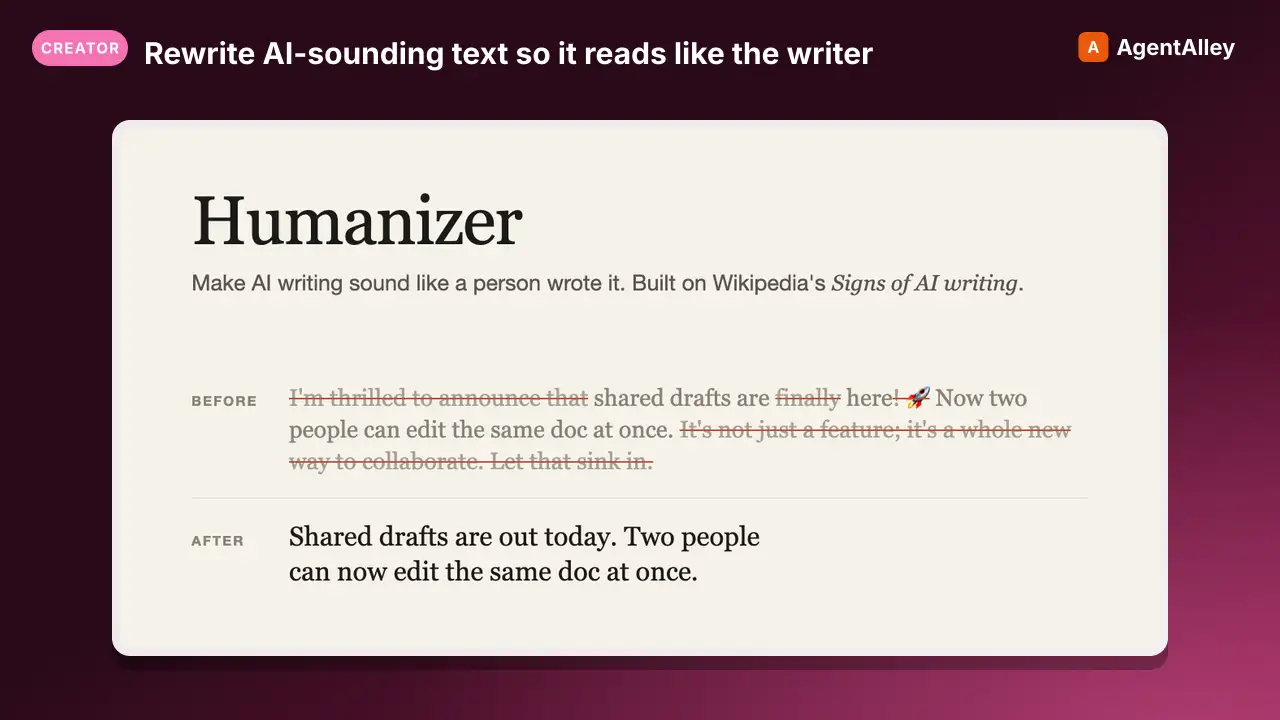 SkillRewrite AI-sounding text so it reads like the writerhumanizer
 blader/humanizer · by bladerRewrite AI-sounding text so it reads like the writer without changing what it says. Use when editing or reviewing prose for AI tells: not-X-but-Y contrasts, one-line closers, staged openers, forced triads, dashes everywhere, inflated claims, sales language, stock AI words, bold labels, or filler. Based on Wikipedia's "Signs of AI writing.★ 53.6k GitHub stars
 SkillRemove AI writing patterns from proseStop slop
 hardikpandya/stop-slop · by hardikpandyaRemove AI writing patterns from prose. Use when drafting, editing, or reviewing text to eliminate predictable AI tells.★ 17.8k GitHub stars
 SkillEdit drafts into sharperNo AI slop
 petergyang/no-ai-slop · by petergyangEdit drafts into sharper, more human writing while preserving the writer's personal voice, or detect AI-slop patterns without rewriting. Use when the user wants a draft clearer, more direct, more opinionated, or less AI-sounding, or asks whether writing reads as AI.★ 12k GitHub stars
 SkillDetect, scan, audit, scoreAI writing detector
 conorbronsdon/avoid-ai-writing · by conorbronsdonUse when the user asks to detect, scan, audit, score, or flag AI-writing patterns without rewriting the text, including requests for a deterministic local detector result when the host can execute Node.★ 4.7k GitHub stars
 SkillAudit and rewrite content to remove AI writing patternsAvoid AI Writing — Audit & Rewriteconorbronsdon/avoid-ai-writing · by conorbronsdonAudit and rewrite content to remove AI writing patterns ("AI-isms"). Use this skill when asked to "remove AI-isms," "clean up AI writing," "edit writing for AI patterns," "audit writing for AI tells," or "make this sound less like AI." Supports a detect-only mode, an edit-in-place mode for files, an optional voice profile (casual / professional / technical / warm / blunt), and an iterate-to-convergence pass.★ 4.7k GitHub stars
 SkillMake AI-generated writing read as human-writtenSepia — de-AI writing
 Nanako0129/sepia · by Nanako0129Make AI-generated writing read as human-written, in fiction and in professional prose. Repairs the narrative architecture of fiction and stories (based on StoryScope, arXiv:2604.03136); routes professional text through domain rules for release notes, announcements, PR and issue replies, code-review comments, incident postmortems, tickets, work orders, technical articles, blog posts, and long-form journalism. Four operations - write, review (diagnose AI tells without editing), refactor (minimal in-place edits), recreate (full rewrite). Use when asked to humanize, de-AI, unslop, or strip AI flavor from any text; when writing or revising any of these document types; or whenever output must not read as machine-written.★ 3.1k GitHub stars