Optimize Apache Spark jobs with partitioning, caching
Apache Spark Optimization
Optimize Apache Spark jobs with partitioning, caching, shuffle optimization, and memory tuning. Use when improving Spark performance, debugging slow jobs, or scaling data processing pipelines.
---
name: spark-optimization
description: Optimize Apache Spark jobs with partitioning, caching, shuffle optimization, and memory tuning. Use when improving Spark performance, debugging slow jobs, or scaling data processing pipelines.
---

# Apache Spark Optimization

Production patterns for optimizing Apache Spark jobs including partitioning strategies, memory management, shuffle optimization, and performance tuning.

## When to Use This Skill

- Optimizing slow Spark jobs
- Tuning memory and executor configuration
- Implementing efficient partitioning strategies
- Debugging Spark performance issues
- Scaling Spark pipelines for large datasets
- Reducing shuffle and data skew
Overview
Production patterns for optimizing Apache Spark jobs including partitioning strategies, memory management, shuffle optimization, and performance tuning.
Manual install (npx, ZIP)
Claude Code
npx skills add wshobson/agents --skill spark-optimization -g -a claude-codeClaude Code (manual)
mkdir -p ~/.claude/skills && curl -sL https://codeload.github.com/wshobson/agents/tar.gz/4236bb91f839 \
  | tar -xz -C ~/.claude/skills --strip-components=4 agents-4236bb91f839/plugins/data-engineering/skills/spark-optimization
Windows (PowerShell)
New-Item -ItemType Directory -Force "$HOME\.claude\skills" | Out-Null; Invoke-WebRequest "https://m.agentalley.io/zip/0ade870cf31857798392/spark-optimization.zip" -OutFile "$env:TEMP\spark-optimization.zip"; Expand-Archive "$env:TEMP\spark-optimization.zip" -DestinationPath "$HOME\.claude\skills" -ForceClaude.ai / desktop
Codex, Cursor, other agents
Connects with Agent Alley MCP · agentalley.io/mcp
Files included
SKILL.md3.1 KBreferences/1 file · 9.6 KB
Read the files here
SKILL.md
Show the full text96 lines
Apache Spark Optimization
Production patterns for optimizing Apache Spark jobs including partitioning strategies, memory management, shuffle optimization, and performance tuning.
When to Use This Skill
- Optimizing slow Spark jobs
- Tuning memory and executor configuration
- Implementing efficient partitioning strategies
- Debugging Spark performance issues
- Scaling Spark pipelines for large datasets
- Reducing shuffle and data skew
Core Concepts
1. Spark Execution Model
Driver Program
    ↓
Job (triggered by action)
    ↓
Stages (separated by shuffles)
    ↓
Tasks (one per partition)
2. Key Performance Factors
| Factor | Impact | Solution |
|---|---|---|
| Shuffle | Network I/O, disk I/O | Minimize wide transformations |
| Data Skew | Uneven task duration | Salting, broadcast joins |
| Serialization | CPU overhead | Use Kryo, columnar formats |
| Memory | GC pressure, spills | Tune executor memory |
| Partitions | Parallelism | Right-size partitions |
Quick Start
from pyspark.sql import SparkSession
from pyspark.sql import functions as F

# Create optimized Spark session
spark = (SparkSession.builder
    .appName("OptimizedJob")
    .config("spark.sql.adaptive.enabled", "true")
    .config("spark.sql.adaptive.coalescePartitions.enabled", "true")
    .config("spark.sql.adaptive.skewJoin.enabled", "true")
    .config("spark.serializer", "org.apache.spark.serializer.KryoSerializer")
    .config("spark.sql.shuffle.partitions", "200")
    .getOrCreate())

# Read with optimized settings
df = (spark.read
    .format("parquet")
    .option("mergeSchema", "false")
    .load("s3://bucket/data/"))

# Efficient transformations
result = (df
    .filter(F.col("date") >= "2024-01-01")
    .select("id", "amount", "category")
    .groupBy("category")
    .agg(F.sum("amount").alias("total")))

result.write.mode("overwrite").parquet("s3://bucket/output/")
Detailed patterns and worked examples
Detailed pattern documentation lives in references/details.md. Read that file when the navigation tier above is insufficient.
Best Practices
Do's
- Enable AQE - Adaptive query execution handles many issues
- Use Parquet/Delta - Columnar formats with compression
- Broadcast small tables - Avoid shuffle for small joins
- Monitor Spark UI - Check for skew, spills, GC
- Right-size partitions - 128MB - 256MB per partition
Don'ts
- Don't collect large data - Keep data distributed
- Don't use UDFs unnecessarily - Use built-in functions
- Don't over-cache - Memory is limited
- Don't ignore data skew - It dominates job time
- Don't use
.count()for existence - Use.take(1)or.isEmpty()
| 1 | |
| 2 | name spark-optimization |
| 3 | description Optimize Apache Spark jobs with partitioning, caching, shuffle optimization, and memory tuning. Use when improving Spark performance, debugging slow jobs, or scaling data processing pipelines. |
| 4 | |
| 5 | |
| 6 | # Apache Spark Optimization |
| 7 | |
| 8 | Production patterns for optimizing Apache Spark jobs including partitioning strategies, memory management, shuffle optimization, and performance tuning. |
| 9 | |
| 10 | ## When to Use This Skill |
| 11 | |
| 12 | Optimizing slow Spark jobs |
| 13 | Tuning memory and executor configuration |
| 14 | Implementing efficient partitioning strategies |
| 15 | Debugging Spark performance issues |
| 16 | Scaling Spark pipelines for large datasets |
| 17 | Reducing shuffle and data skew |
| 18 | |
| 19 | ## Core Concepts |
| 20 | |
| 21 | ### 1. Spark Execution Model |
| 22 | |
| 23 | |
| 24 | Driver Program |
| 25 | ↓ |
| 26 | Job (triggered by action) |
| 27 | ↓ |
| 28 | Stages (separated by shuffles) |
| 29 | ↓ |
| 30 | Tasks (one per partition) |
| 31 | |
| 32 | |
| 33 | ### 2. Key Performance Factors |
| 34 | |
| 35 | | Factor | Impact | Solution | |
| 36 | | ----------------- | --------------------- | ----------------------------- | |
| 37 | | **Shuffle** | Network I/O, disk I/O | Minimize wide transformations | |
| 38 | | **Data Skew** | Uneven task duration | Salting, broadcast joins | |
| 39 | | **Serialization** | CPU overhead | Use Kryo, columnar formats | |
| 40 | | **Memory** | GC pressure, spills | Tune executor memory | |
| 41 | | **Partitions** | Parallelism | Right-size partitions | |
| 42 | |
| 43 | ## Quick Start |
| 44 | |
| 45 | |
| 46 | from pyspark.sql import SparkSession |
| 47 | from pyspark.sql import functions as F |
| 48 | |
| 49 | # Create optimized Spark session |
| 50 | spark = (SparkSession.builder |
| 51 | .appName("OptimizedJob") |
| 52 | .config("spark.sql.adaptive.enabled", "true") |
| 53 | .config("spark.sql.adaptive.coalescePartitions.enabled", "true") |
| 54 | .config("spark.sql.adaptive.skewJoin.enabled", "true") |
| 55 | .config("spark.serializer", "org.apache.spark.serializer.KryoSerializer") |
| 56 | .config("spark.sql.shuffle.partitions", "200") |
| 57 | .getOrCreate()) |
| 58 | |
| 59 | # Read with optimized settings |
| 60 | df = (spark.read |
| 61 | .format("parquet") |
| 62 | .option("mergeSchema", "false") |
| 63 | .load("s3://bucket/data/")) |
| 64 | |
| 65 | # Efficient transformations |
| 66 | result = (df |
| 67 | .filter(F.col("date") >= "2024-01-01") |
| 68 | .select("id", "amount", "category") |
| 69 | .groupBy("category") |
| 70 | .agg(F.sum("amount").alias("total"))) |
| 71 | |
| 72 | result.write.mode("overwrite").parquet("s3://bucket/output/") |
| 73 | |
| 74 | |
| 75 | ## Detailed patterns and worked examples |
| 76 | |
| 77 | Detailed pattern documentation lives in `references/details.md`. Read that file when the navigation tier above is insufficient. |
| 78 | |
| 79 | ## Best Practices |
| 80 | |
| 81 | ### Do's |
| 82 | |
| 83 | **Enable AQE** - Adaptive query execution handles many issues |
| 84 | **Use Parquet/Delta** - Columnar formats with compression |
| 85 | **Broadcast small tables** - Avoid shuffle for small joins |
| 86 | **Monitor Spark UI** - Check for skew, spills, GC |
| 87 | **Right-size partitions** - 128MB - 256MB per partition |
| 88 | |
| 89 | ### Don'ts |
| 90 | |
| 91 | **Don't collect large data** - Keep data distributed |
| 92 | **Don't use UDFs unnecessarily** - Use built-in functions |
| 93 | **Don't over-cache** - Memory is limited |
| 94 | **Don't ignore data skew** - It dominates job time |
| 95 | **Don't use `.count()` for existence** - Use `.take(1)` or `.isEmpty()` |
| 96 |
Details
- Updated
- Sep 21, 2026
- License
- MIT
- Stars on the repo
- ★ 39,857
- Checked
- Source
- wshobson/agents ↗
- Creator
- wshobson · 179 listings
Similar skills
See all → SkillTranslates Snowflake dbt SQL models to Standardized BigQuerydbt Snowflake to BigQuery Translator
 google/skills · by googleTranslates Snowflake dbt SQL models to Standardized BigQuery SQL. Handles SQL compilation, Jinja macro placeholder masking, BigQuery Translation Service migration workflows, AST-based config transformations, explicit type casting, JSON extraction standardization, and deduplication. Use when migrating Snowflake dbt pipelines or models to Google Cloud BigQuery. Don't use for generic BigQuery queries or non-Snowflake SQL migrations.★ 20.9k GitHub stars
 SkillAnswering business analytics, RevOps, GTM metric, pipelineDeepline analytics
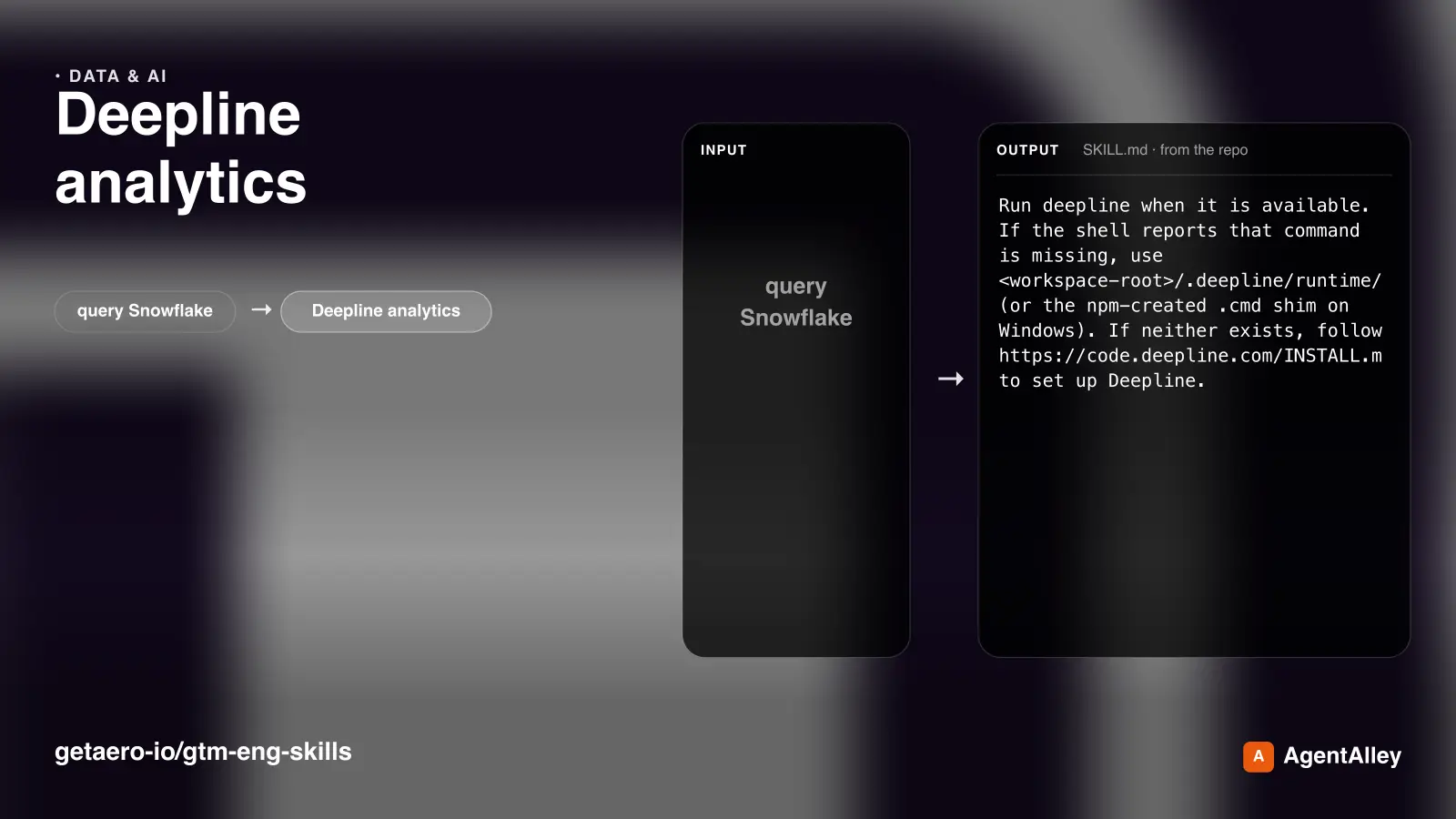
 getaero-io/gtm-eng-skills · by getaero-ioUse this skill when answering business analytics, RevOps, GTM metric, pipeline, revenue, funnel, customer, or warehouse questions with Deepline. Triggers on phrases like 'query Snowflake', 'analyze pipeline', 'total ACV', 'break down by quarter', 'use the semantic layer', 'run a semantic query', or any use of snowflake_get_semantic_layer / snowflake_run_semantic_query. Skip prospecting, enrichment, contact finding, outbound, or personalization workflows; use deepline-gtm for those.★ 66 GitHub stars
 SkillBuild production Apache Airflow DAGs with best practicesApache Airflow DAG Patterns
 wshobson/agents · by wshobsonBuild production Apache Airflow DAGs with best practices for operators, sensors, testing, and deployment. Use when creating data pipelines, orchestrating workflows, or scheduling batch jobs.★ 39.9k GitHub stars
 SkillImplement data quality validation with Great ExpectationsData quality frameworkswshobson/agents · by wshobsonImplement data quality validation with Great Expectations, dbt tests, and data contracts. Use when building data quality pipelines, implementing validation rules, or establishing data contracts.★ 39.9k GitHub stars
 SkillMaster dbt for analytics engineering with model organizationDbt transformation patternswshobson/agents · by wshobsonMaster dbt (data build tool) for analytics engineering with model organization, testing, documentation, and incremental strategies. Use when building data transformations, creating data models, or implementing analytics engineering best practices.★ 39.9k GitHub stars
 SkillAudit datasets for completeness, consistency, accuracyData quality auditor
 alirezarezvani/claude-skills · by alirezarezvaniAudit datasets for completeness, consistency, accuracy, and validity. Profile data distributions, detect anomalies and outliers, surface structural issues, and produce an actionable remediation plan. Use when the user asks to check data quality, profile a dataset, hunt outliers or missing values, or validate data before analysis or model training.★ 26.3k GitHub stars
More from wshobson
 SkillMaster C/.NET backend development patterns for buildingwshobson/agents · by wshobsonMaster C#/.NET backend development patterns for building robust APIs, MCP servers, and enterprise applications. Covers async/await, dependency injection, Entity Framework Core, Dapper, configuration, caching, and testing with xUnit. Use when developing .NET backends, reviewing C# code, or designing API architectures.★ 39.9k GitHub stars
 SkillImplement WCAG 2.2 compliant interfaces with mobileAccessibility compliancewshobson/agents · by wshobsonImplement WCAG 2.2 compliant interfaces with mobile accessibility, inclusive design patterns, and assistive technology support. Use when auditing accessibility, implementing ARIA patterns, building for screen readers, or ensuring inclusive user experiences.★ 39.9k GitHub stars
 SkillMaster Material Design 3 and Jetpack Compose patternsAndroid Mobile Designwshobson/agents · by wshobsonMaster Material Design 3 and Jetpack Compose patterns for building native Android apps. Use when designing Android interfaces, implementing Compose UI, or following Google's Material Design guidelines.★ 39.9k GitHub stars
 SkillMigrate from AngularJS to Angular using hybrid modeAngular migrationwshobson/agents · by wshobsonMigrate from AngularJS to Angular using hybrid mode, incremental component rewriting, and dependency injection updates. Use when upgrading AngularJS applications, planning framework migrations, or modernizing legacy Angular code.★ 39.9k GitHub stars
 SkillUnderstand anti-reversing, obfuscationAnti reversing techniqueswshobson/agents · by wshobsonUnderstand anti-reversing, obfuscation, and protection techniques encountered during software analysis. Use this skill when analyzing malware evasion techniques, when implementing anti-debugging protections for CTF challenges, when reverse engineering packed binaries, or when building security research tools that need to detect virtualized environments.★ 39.9k GitHub starsSkillBuild production Apache Airflow DAGs with best practicesApache Airflow DAG Patternswshobson/agents · by wshobsonBuild production Apache Airflow DAGs with best practices for operators, sensors, testing, and deployment. Use when creating data pipelines, orchestrating workflows, or scheduling batch jobs.★ 39.9k GitHub stars