Tell us your product and a rival you keep losing deals to
Competitor Comparison & Alternatives Pages
Tell us your product and a rival you keep losing deals to, and get back a ready-to-publish page that shows why customers should pick you.
---
name: seo-competitor-pages
description: >
  Generate SEO-optimized competitor comparison and alternatives pages. Covers
  "X vs Y" layouts, "alternatives to X" pages, feature matrices, schema markup,
  and conversion optimization. Use when user says "comparison page", "vs page",
  "alternatives page", "competitor comparison", "X vs Y", "versus",
  "compare competitors", or "alternative to".
user-invocable: true
argument-hint: "[url or generate] [competitor]"
license: MIT
metadata:
  author: AgriciDaniel
  version: "2.3.1"
  category: seo
---

# Competitor Comparison & Alternatives Pages
Overview
Create high-converting comparison and alternatives pages that target competitive intent keywords with accurate, structured content.
Manual install (npx, ZIP)
Claude Code
npx skills add AgriciDaniel/claude-seo --skill seo-competitor-pages -g -a claude-codeClaude Code (manual)
mkdir -p ~/.claude/skills && curl -sL https://codeload.github.com/AgriciDaniel/claude-seo/tar.gz/92795530b4cc \
  | tar -xz -C ~/.claude/skills --strip-components=2 claude-seo-92795530b4cc/skills/seo-competitor-pages
Windows (PowerShell)
New-Item -ItemType Directory -Force "$HOME\.claude\skills" | Out-Null; Invoke-WebRequest "https://m.agentalley.io/zip/c2ffd14beebc91664a20/seo-competitor-pages.zip" -OutFile "$env:TEMP\seo-competitor-pages.zip"; Expand-Archive "$env:TEMP\seo-competitor-pages.zip" -DestinationPath "$HOME\.claude\skills" -ForceClaude.ai / desktop
Codex, Cursor, other agents
Connects with Agent Alley MCP · agentalley.io/mcp
Files included
SKILL.md7.5 KBLICENSE.txt143 B
Read the files here
AgriciDaniel/
SKILL.md
Show the full text221 lines
Competitor Comparison & Alternatives Pages
Create high-converting comparison and alternatives pages that target competitive intent keywords with accurate, structured content.
Page Types
1. "X vs Y" Comparison Pages
- Direct head-to-head comparison between two products/services
- Balanced feature-by-feature analysis
- Clear verdict or recommendation with justification
- Target keyword:
[Product A] vs [Product B]
2. "Alternatives to X" Pages
- List of alternatives to a specific product/service
- Each alternative with brief summary, pros/cons, best-for use case
- Target keyword:
[Product] alternatives,best alternatives to [Product]
3. "Best [Category] Tools" Roundup Pages
- Curated list of top tools/services in a category
- Ranking criteria clearly stated
- Target keyword:
best [category] tools [year],top [category] software
4. Comparison Table Pages
- Feature matrix with multiple products in columns
- Sortable/filterable if interactive
- Target keyword:
[category] comparison,[category] comparison chart
Comparison Table Generation
Feature Matrix Layout
| Feature          | Your Product | Competitor A | Competitor B |
|------------------|:------------:|:------------:|:------------:|
| Feature 1        | ✅           | ✅           | ❌           |
| Feature 2        | ✅           | ⚠️ Partial   | ✅           |
| Feature 3        | ✅           | ❌           | ❌           |
| Pricing (from)   | $X/mo        | $Y/mo        | $Z/mo        |
| Free Tier        | ✅           | ❌           | ✅           |
Data Accuracy Requirements
- All feature claims must be verifiable from public sources
- Pricing must be current (include "as of [date]" note)
- Update frequency: review quarterly or when competitors ship major changes
- Link to source for each competitor data point where possible
Schema Markup Recommendations
Product Schema with AggregateRating
{
  "@context": "https://schema.org",
  "@type": "Product",
  "name": "[Product Name]",
  "description": "[Product Description]",
  "brand": {
    "@type": "Brand",
    "name": "[Brand Name]"
  },
  "aggregateRating": {
    "@type": "AggregateRating",
    "ratingValue": "[Rating]",
    "reviewCount": "[Count]",
    "bestRating": "5",
    "worstRating": "1"
  }
}
SoftwareApplication (for software comparisons)
{
  "@context": "https://schema.org",
  "@type": "SoftwareApplication",
  "name": "[Software Name]",
  "applicationCategory": "[Category]",
  "operatingSystem": "[OS]",
  "offers": {
    "@type": "Offer",
    "price": "[Price]",
    "priceCurrency": "USD"
  }
}
ItemList (for roundup pages)
{
  "@context": "https://schema.org",
  "@type": "ItemList",
  "name": "Best [Category] Tools [Year]",
  "itemListOrder": "https://schema.org/ItemListOrderDescending",
  "numberOfItems": "[Count]",
  "itemListElement": [
    {
      "@type": "ListItem",
      "position": 1,
      "name": "[Product Name]",
      "url": "[Product URL]"
    }
  ]
}
Keyword Targeting
Comparison Intent Patterns
| Pattern | Example | Search Volume Signal |
|---|---|---|
[A] vs [B] |
"Slack vs Teams" | High |
[A] alternative |
"Figma alternatives" | High |
[A] alternatives [year] |
"Notion alternatives 2026" | High |
best [category] tools |
"best project management tools" | High |
[A] vs [B] for [use case] |
"AWS vs Azure for startups" | Medium |
[A] review [year] |
"Monday.com review 2026" | Medium |
[A] vs [B] pricing |
"HubSpot vs Salesforce pricing" | Medium |
is [A] better than [B] |
"is Notion better than Confluence" | Medium |
Title Tag Formulas
- X vs Y:
[A] vs [B]: [Key Differentiator] ([Year]) - Alternatives:
[N] Best [A] Alternatives in [Year] (Free & Paid) - Roundup:
[N] Best [Category] Tools in [Year], Compared & Ranked
H1 Patterns
- Match title tag intent
- Include primary keyword naturally
- Keep under 70 characters
Conversion-Optimized Layouts
CTA Placement
- Above fold: Brief comparison summary with primary CTA
- After comparison table: "Try [Your Product] free" CTA
- Bottom of page: Final recommendation with CTA
- Avoid aggressive CTAs in competitor description sections (reduces trust)
Social Proof Sections
- Customer testimonials relevant to comparison criteria
- G2/Capterra/TrustPilot ratings (with source links)
- Case studies showing migration from competitor
- "Switched from [Competitor]" stories
Pricing Highlights
- Clear pricing comparison table
- Highlight value advantages (not just lowest price)
- Include hidden costs (setup fees, per-user pricing, overage charges)
- Link to full pricing page
Trust Signals
- "Last updated [date]" timestamp
- Author with relevant expertise
- Methodology disclosure (how comparisons were conducted)
- Disclosure of own product affiliation
Fairness Guidelines
- Accuracy: All competitor information must be verifiable from public sources
- No defamation: Never make false or misleading claims about competitors
- Cite sources: Link to competitor websites, review sites, or documentation
- Timely updates: Review and update when competitors release major changes
- Disclose affiliation: Clearly state which product is yours
- Balanced presentation: Acknowledge competitor strengths honestly
- Pricing accuracy: Include "as of [date]" disclaimers on all pricing data
- Feature verification: Test competitor features where possible, cite documentation otherwise
Internal Linking
- Link to your own product/service pages from comparison sections
- Cross-link between related comparison pages (e.g., "A vs B" links to "A vs C")
- Link to feature-specific pages when discussing individual features
- Breadcrumb: Home > Comparisons > [This Page]
- Related comparisons section at bottom of page
- Link to case studies and testimonials mentioned in the comparison
Output
Comparison Page Template
COMPARISON-PAGE.md: Ready-to-implement page structure with sections- Feature matrix table
- Content outline with word count targets (minimum 1,500 words)
Schema Markup
comparison-schema.json: Product/SoftwareApplication/ItemList JSON-LD
Keyword Strategy
- Primary and secondary keywords
- Related long-tail opportunities
- Content gaps vs existing competitor pages
Recommendations
- Content improvements for existing comparison pages
- New comparison page opportunities
- Schema markup additions
- Conversion optimization suggestions
Error Handling
| Scenario | Action |
|---|---|
| Competitor URL unreachable | Report which competitor URLs failed. Proceed with available data and note gaps in the comparison. |
| Insufficient competitor data (pricing, features unavailable) | Flag missing data points clearly. Use "Not publicly available" in comparison tables rather than guessing. |
| No product/service overlap found | Report that the products serve different markets. Suggest alternative competitors that share feature overlap, or pivot to a category roundup format. |
| 1 | |
| 2 | name seo-competitor-pages |
| 3 | description > |
| 4 | Generate SEO-optimized competitor comparison and alternatives pages. Covers |
| 5 | "X vs Y" layouts, "alternatives to X" pages, feature matrices, schema markup, |
| 6 | and conversion optimization. Use when user says "comparison page", "vs page", |
| 7 | "alternatives page", "competitor comparison", "X vs Y", "versus", |
| 8 | "compare competitors", or "alternative to". |
| 9 | user-invocable true |
| 10 | argument-hint "[url or generate] [competitor]" |
| 11 | license MIT |
| 12 | metadata |
| 13 | author AgriciDaniel |
| 14 | version "2.3.1" |
| 15 | category seo |
| 16 | |
| 17 | |
| 18 | # Competitor Comparison & Alternatives Pages |
| 19 | |
| 20 | Create high-converting comparison and alternatives pages that target |
| 21 | competitive intent keywords with accurate, structured content. |
| 22 | |
| 23 | ## Page Types |
| 24 | |
| 25 | ### 1. "X vs Y" Comparison Pages |
| 26 | Direct head-to-head comparison between two products/services |
| 27 | Balanced feature-by-feature analysis |
| 28 | Clear verdict or recommendation with justification |
| 29 | Target keyword: `[Product A] vs [Product B]` |
| 30 | |
| 31 | ### 2. "Alternatives to X" Pages |
| 32 | List of alternatives to a specific product/service |
| 33 | Each alternative with brief summary, pros/cons, best-for use case |
| 34 | Target keyword: `[Product] alternatives`, `best alternatives to [Product]` |
| 35 | |
| 36 | ### 3. "Best [Category] Tools" Roundup Pages |
| 37 | Curated list of top tools/services in a category |
| 38 | Ranking criteria clearly stated |
| 39 | Target keyword: `best [category] tools [year]`, `top [category] software` |
| 40 | |
| 41 | ### 4. Comparison Table Pages |
| 42 | Feature matrix with multiple products in columns |
| 43 | Sortable/filterable if interactive |
| 44 | Target keyword: `[category] comparison`, `[category] comparison chart` |
| 45 | |
| 46 | ## Comparison Table Generation |
| 47 | |
| 48 | ### Feature Matrix Layout |
| 49 | |
| 50 | | Feature | Your Product | Competitor A | Competitor B | |
| 51 | |------------------|:------------:|:------------:|:------------:| |
| 52 | | Feature 1 | ✅ | ✅ | ❌ | |
| 53 | | Feature 2 | ✅ | ⚠️ Partial | ✅ | |
| 54 | | Feature 3 | ✅ | ❌ | ❌ | |
| 55 | | Pricing (from) | $X/mo | $Y/mo | $Z/mo | |
| 56 | | Free Tier | ✅ | ❌ | ✅ | |
| 57 | |
| 58 | |
| 59 | ### Data Accuracy Requirements |
| 60 | All feature claims must be verifiable from public sources |
| 61 | Pricing must be current (include "as of [date]" note) |
| 62 | Update frequency: review quarterly or when competitors ship major changes |
| 63 | Link to source for each competitor data point where possible |
| 64 | |
| 65 | ## Schema Markup Recommendations |
| 66 | |
| 67 | ### Product Schema with AggregateRating |
| 68 | |
| 69 | { |
| 70 | "@context": "https://schema.org", |
| 71 | "@type": "Product", |
| 72 | "name": "[Product Name]", |
| 73 | "description": "[Product Description]", |
| 74 | "brand": { |
| 75 | "@type": "Brand", |
| 76 | "name": "[Brand Name]" |
| 77 | }, |
| 78 | "aggregateRating": { |
| 79 | "@type": "AggregateRating", |
| 80 | "ratingValue": "[Rating]", |
| 81 | "reviewCount": "[Count]", |
| 82 | "bestRating": "5", |
| 83 | "worstRating": "1" |
| 84 | } |
| 85 | } |
| 86 | |
| 87 | |
| 88 | ### SoftwareApplication (for software comparisons) |
| 89 | |
| 90 | { |
| 91 | "@context": "https://schema.org", |
| 92 | "@type": "SoftwareApplication", |
| 93 | "name": "[Software Name]", |
| 94 | "applicationCategory": "[Category]", |
| 95 | "operatingSystem": "[OS]", |
| 96 | "offers": { |
| 97 | "@type": "Offer", |
| 98 | "price": "[Price]", |
| 99 | "priceCurrency": "USD" |
| 100 | } |
| 101 | } |
| 102 | |
| 103 | |
| 104 | ### ItemList (for roundup pages) |
| 105 | |
| 106 | { |
| 107 | "@context": "https://schema.org", |
| 108 | "@type": "ItemList", |
| 109 | "name": "Best [Category] Tools [Year]", |
| 110 | "itemListOrder": "https://schema.org/ItemListOrderDescending", |
| 111 | "numberOfItems": "[Count]", |
| 112 | "itemListElement": [ |
| 113 | { |
| 114 | "@type": "ListItem", |
| 115 | "position": 1, |
| 116 | "name": "[Product Name]", |
| 117 | "url": "[Product URL]" |
| 118 | } |
| 119 | ] |
| 120 | } |
| 121 | |
| 122 | |
| 123 | ## Keyword Targeting |
| 124 | |
| 125 | ### Comparison Intent Patterns |
| 126 | | Pattern | Example | Search Volume Signal | |
| 127 | |---------|---------|---------------------| |
| 128 | | `[A] vs [B]` | "Slack vs Teams" | High | |
| 129 | | `[A] alternative` | "Figma alternatives" | High | |
| 130 | | `[A] alternatives [year]` | "Notion alternatives 2026" | High | |
| 131 | | `best [category] tools` | "best project management tools" | High | |
| 132 | | `[A] vs [B] for [use case]` | "AWS vs Azure for startups" | Medium | |
| 133 | | `[A] review [year]` | "Monday.com review 2026" | Medium | |
| 134 | | `[A] vs [B] pricing` | "HubSpot vs Salesforce pricing" | Medium | |
| 135 | | `is [A] better than [B]` | "is Notion better than Confluence" | Medium | |
| 136 | |
| 137 | ### Title Tag Formulas |
| 138 | X vs Y: `[A] vs [B]: [Key Differentiator] ([Year])` |
| 139 | Alternatives: `[N] Best [A] Alternatives in [Year] (Free & Paid)` |
| 140 | Roundup: `[N] Best [Category] Tools in [Year], Compared & Ranked` |
| 141 | |
| 142 | ### H1 Patterns |
| 143 | Match title tag intent |
| 144 | Include primary keyword naturally |
| 145 | Keep under 70 characters |
| 146 | |
| 147 | ## Conversion-Optimized Layouts |
| 148 | |
| 149 | ### CTA Placement |
| 150 | **Above fold**: Brief comparison summary with primary CTA |
| 151 | **After comparison table**: "Try [Your Product] free" CTA |
| 152 | **Bottom of page**: Final recommendation with CTA |
| 153 | Avoid aggressive CTAs in competitor description sections (reduces trust) |
| 154 | |
| 155 | ### Social Proof Sections |
| 156 | Customer testimonials relevant to comparison criteria |
| 157 | G2/Capterra/TrustPilot ratings (with source links) |
| 158 | Case studies showing migration from competitor |
| 159 | "Switched from [Competitor]" stories |
| 160 | |
| 161 | ### Pricing Highlights |
| 162 | Clear pricing comparison table |
| 163 | Highlight value advantages (not just lowest price) |
| 164 | Include hidden costs (setup fees, per-user pricing, overage charges) |
| 165 | Link to full pricing page |
| 166 | |
| 167 | ### Trust Signals |
| 168 | "Last updated [date]" timestamp |
| 169 | Author with relevant expertise |
| 170 | Methodology disclosure (how comparisons were conducted) |
| 171 | Disclosure of own product affiliation |
| 172 | |
| 173 | ## Fairness Guidelines |
| 174 | |
| 175 | **Accuracy**: All competitor information must be verifiable from public sources |
| 176 | **No defamation**: Never make false or misleading claims about competitors |
| 177 | **Cite sources**: Link to competitor websites, review sites, or documentation |
| 178 | **Timely updates**: Review and update when competitors release major changes |
| 179 | **Disclose affiliation**: Clearly state which product is yours |
| 180 | **Balanced presentation**: Acknowledge competitor strengths honestly |
| 181 | **Pricing accuracy**: Include "as of [date]" disclaimers on all pricing data |
| 182 | **Feature verification**: Test competitor features where possible, cite documentation otherwise |
| 183 | |
| 184 | ## Internal Linking |
| 185 | |
| 186 | Link to your own product/service pages from comparison sections |
| 187 | Cross-link between related comparison pages (e.g., "A vs B" links to "A vs C") |
| 188 | Link to feature-specific pages when discussing individual features |
| 189 | Breadcrumb: Home > Comparisons > [This Page] |
| 190 | Related comparisons section at bottom of page |
| 191 | Link to case studies and testimonials mentioned in the comparison |
| 192 | |
| 193 | ## Output |
| 194 | |
| 195 | ### Comparison Page Template |
| 196 | `COMPARISON-PAGE.md`: Ready-to-implement page structure with sections |
| 197 | Feature matrix table |
| 198 | Content outline with word count targets (minimum 1,500 words) |
| 199 | |
| 200 | ### Schema Markup |
| 201 | `comparison-schema.json`: Product/SoftwareApplication/ItemList JSON-LD |
| 202 | |
| 203 | ### Keyword Strategy |
| 204 | Primary and secondary keywords |
| 205 | Related long-tail opportunities |
| 206 | Content gaps vs existing competitor pages |
| 207 | |
| 208 | ### Recommendations |
| 209 | Content improvements for existing comparison pages |
| 210 | New comparison page opportunities |
| 211 | Schema markup additions |
| 212 | Conversion optimization suggestions |
| 213 | |
| 214 | ## Error Handling |
| 215 | |
| 216 | | Scenario | Action | |
| 217 | |----------|--------| |
| 218 | | Competitor URL unreachable | Report which competitor URLs failed. Proceed with available data and note gaps in the comparison. | |
| 219 | | Insufficient competitor data (pricing, features unavailable) | Flag missing data points clearly. Use "Not publicly available" in comparison tables rather than guessing. | |
| 220 | | No product/service overlap found | Report that the products serve different markets. Suggest alternative competitors that share feature overlap, or pivot to a category roundup format. | |
| 221 |
Details
- Updated
- Sep 11, 2026
- License
- MIT
- Stars on the repo
- ★ 17,394
- Checked
- Source
- AgriciDaniel/claude-seo ↗
- Creator
- AgriciDaniel · 130 listings
Made with seo-competitor-pages
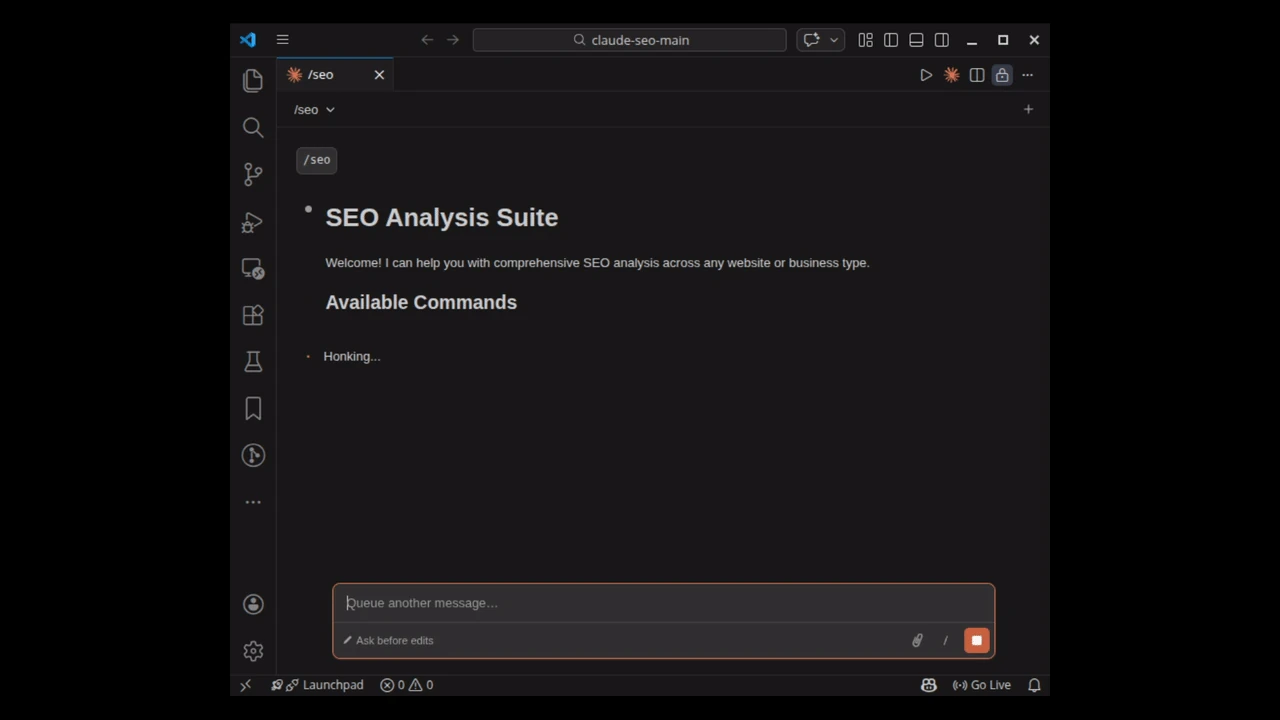
Competitor Comparison & Alternatives Pages — Claude SEO /seo command demo in Claude Code terminal (from the AgriciDaniel/claude-seo README)
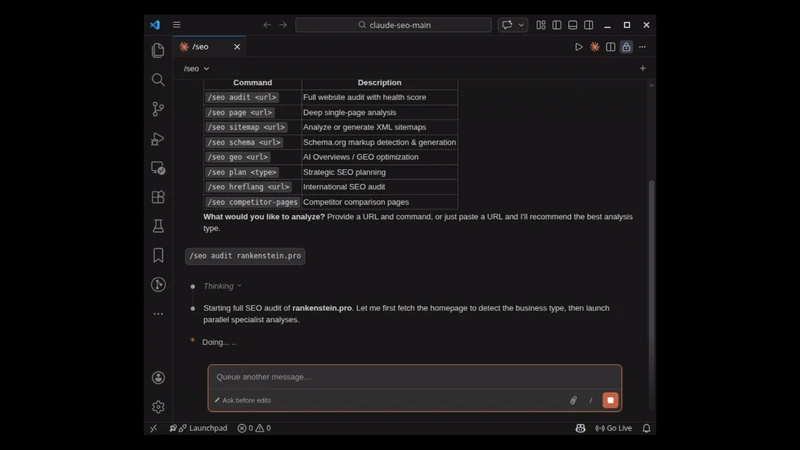
Competitor Comparison & Alternatives Pages — Claude SEO /seo audit demo: parallel subagents producing a prioritized action plan (from the AgriciDaniel/claude-seo README)
Similar skills
See all → SkillEstimate the intrinsic value of a public company using DCFCompany valuation
 himself65/finance-skills · by himself65Estimate the intrinsic value of a public company using DCF, relative (peer multiple) and sum-of-parts (SOTP) methods, then triangulate to an implied share price with upside/downside versus the current market price. Use this skill whenever the user asks: what is AAPL worth", "valuation of NVDA", "fair value of TSLA", "intrinsic value", DCF for MSFT", "build a DCF", "discounted cash flow", "WACC", "terminal value", implied share price", "upside to fair value", "is X overvalued/undervalued", relative valuation", "peer comparison valuation", "EV/EBITDA target", "SOTP", sum of the parts", "how much is [company] worth", "price target from fundamentals", value this company", or any ticker in the context of computing intrinsic or relative valuation. Default to running ALL three methods (DCF + relative + SOTP-if-applicable) and presenting a blended implied price with a sensitivity table. Do not answer valuation questions from memory — always run the workflow.★ 3.3k GitHub stars
 SkillFind keywords a competitor ranks for that the user's siteCompetitor gap
 Ryze-AI-Adgent/open-seo-mcp-skills · by Ryze-AI-AdgentFind keywords a competitor ranks for that the user's site doesn't — the content gap, prioritized by volume and winnability. Use when asked "what does competitor.com rank for", "keyword gap vs X", "steal competitor keywords", or "why do they outrank us".★ 3.1k GitHub stars
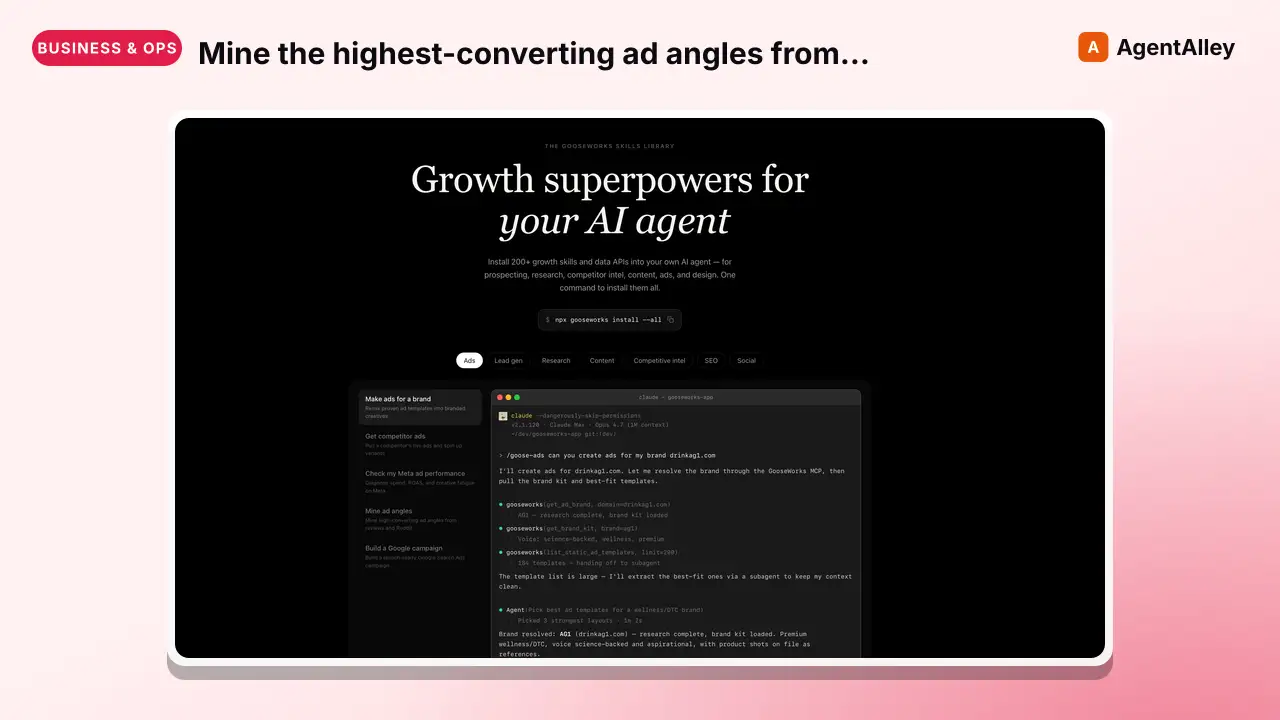 SkillMine the highest-converting ad angles from customer reviewsAd angle miner
 gooseworks-ai/goose-skills · by gooseworks-aiMine the highest-converting ad angles from customer reviews, Reddit complaints, support tickets, and competitor ads. Extracts actual pain language, competitor weaknesses, and outcome phrases that real buyers use. Outputs a ranked angle bank with proof quotes and recommended ad formats per angle.★ 1.2k GitHub stars
 SkillAnalyze competitor content coverageCompetitor content intelligence
 sandbaseai/sandbase-skills · by sandbaseaiAnalyze competitor content coverage and uncover differentiated content opportunities using web search, page extraction, and DataForSEO content analysis. Use when asked for competitor content research, editorial gap analysis, content brief inputs, or topic whitespace.★ 203 GitHub stars
 SkillCreates competitive battlecards for sales deal conversations
 growthack88/growth-marketing-os · by growthack88Creates competitive battlecards for sales deal conversations. Produces win themes, landmines to plant, objection handlers, and competitive positioning per competitor. Outputs a structured markdown battlecard with quick-reference sections for live sales calls. Depends on competitor-research for competitive intelligence and consumes product-messaging, win-loss-analysis, and positioning for framing. Feeds into sales-deck, outreach-emails, and demo-script. Triggered by "battlecard", "competitive intel", "win against [competitor]", or "how do we beat [competitor]".★ 117 GitHub stars
 SkillRead your X audience and niche from real dataX audience insights
 sergebulaev/x-skills · by sergebulaevRead your X (Twitter) audience and niche from real data. Pull a handle's recent tweets (yours or a competitor's) with likes, replies, and views, see which formats and hooks are working, read the repliers on a tweet (X gates likers, so repliers are the signal), and scan a niche query for top tweets. Powered by Apify, no login. Triggers on "analyze my tweets", "what is working on X", "read the replies", "competitor tweets", "who is engaging". Not for writing a tweet (use x-post-writer).★ 95 GitHub stars
More from AgriciDaniel
 SkillThe Lighthouse Agentic Browsing fractionAgentic Browsing Readiness
 AgriciDaniel/claude-seo · by AgriciDanielAudit and fix agent readiness: the Lighthouse Agentic Browsing fraction, accessibility tree for agents, robots.txt and Content-Signal for AI agents, WAF treatment of agent traffic, llms.txt, Markdown delivery, ai-catalog.json, /.well-known discovery files, and WebMCP tools. Exclude AI citability and brand signals (seo-geo) and commerce protocol depth (seo-ecommerce).★ 17.4k GitHub stars
 SkillOptimize content for AI Overviews , ChatGPT web searchAI Search / GEO Optimization (May 2026)AgriciDaniel/claude-seo · by AgriciDanielOptimize content for AI Overviews (formerly SGE), ChatGPT web search, Perplexity, and other AI-powered search experiences. Generative Engine Optimization (GEO) analysis including brand mention signals, AI crawler accessibility, llms.txt compliance, passage-level citability scoring, and platform-specific optimization. Use when user says "AI Overviews", "SGE", GEO", "AI search", "LLM optimization", "Perplexity", "AI citations", ChatGPT search", or "AI visibility".★ 17.4k GitHub stars
 SkillReferring domains, anchor text distributionBacklink Profile AnalysisAgriciDaniel/claude-seo · by AgriciDanielBacklink profile analysis: referring domains, anchor text distribution, toxic link detection, competitor gap analysis. Works with free APIs (Moz, Bing Webmaster, Common Crawl) and DataForSEO extension. Use when user says backlinks, link profile, referring domains, anchor text, toxic links, link gap, link building, disavow, or backlink audit.★ 17.4k GitHub stars
 SkillYou share your Amazon advertising numbers and goals; you getAmazon Ads AuditAgriciDaniel/claude-ads · by AgriciDanielYou share your Amazon advertising numbers and goals; you get back a plain-language review of what's draining your budget and what to change first.★ 9.5k GitHub stars
 SkillPaste what you're spending on Apple Search AdsApple Ads AuditAgriciDaniel/claude-ads · by AgriciDanielPaste what you're spending on Apple Search Ads and your recent numbers; get back a plain review of what's wasting money and what to fix first.★ 9.5k GitHub stars
 SkillPaste the sales and spend numbers each ad platform claimsAttribution AuditAgriciDaniel/claude-ads · by AgriciDanielPaste the sales and spend numbers each ad platform claims, and get back a plain explanation of why they disagree and which figure to trust.★ 9.5k GitHub stars