Migration to Rust with Rust Anything
Migration to Rust with rust-anything
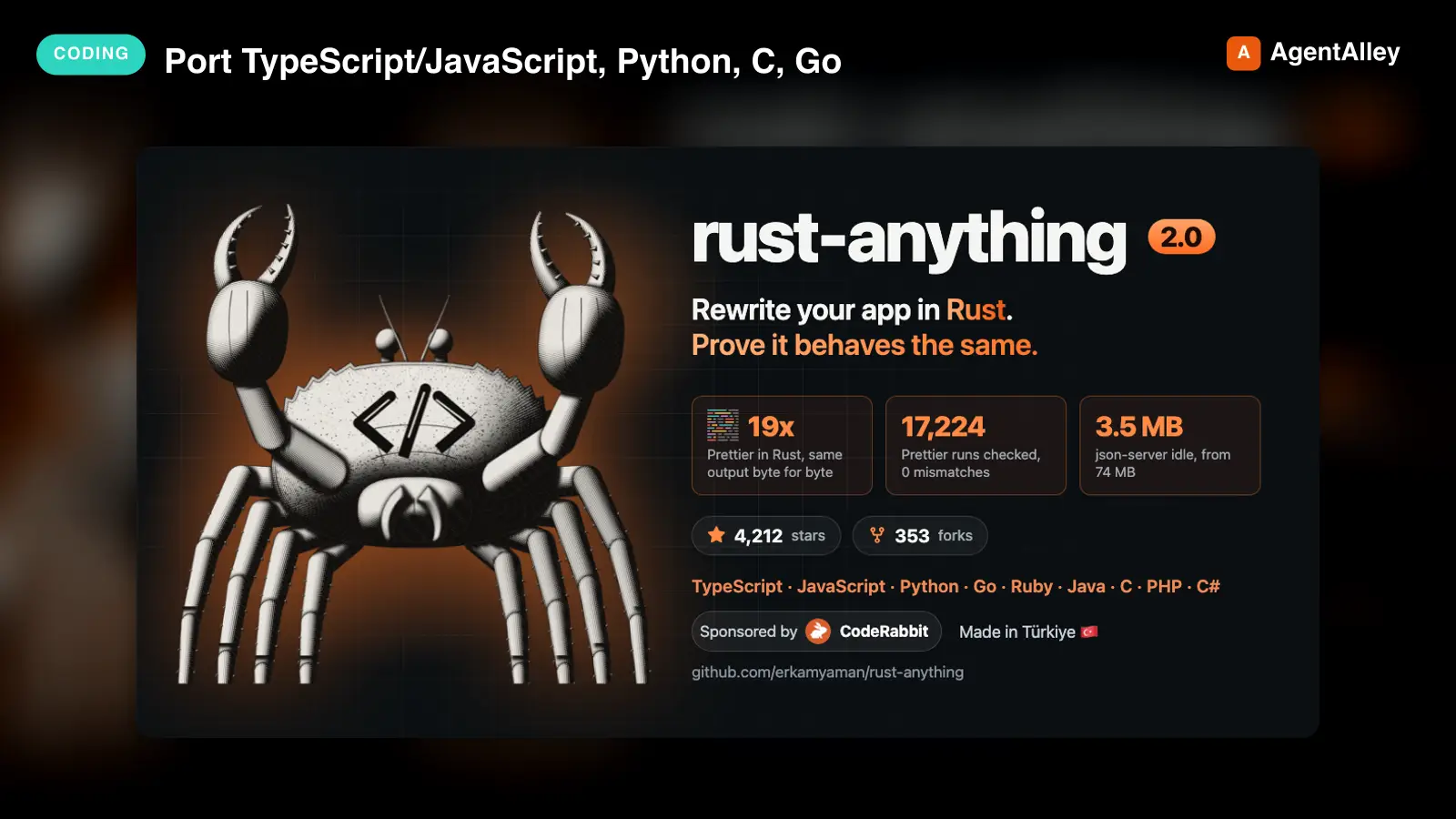
Port TypeScript/JavaScript, Python, C, Go, Ruby or Java to Rust with the rust-anything CLI or MCP tools, from one hot function up to a whole app rewritten as a pure Rust app - profile, plan, bridge one unit at a time, record the…
---
name: rust-anything
description: Port TypeScript/JavaScript, Python, C, Go, Ruby or Java to Rust with the rust-anything CLI or MCP tools, from one hot function up to a whole app rewritten as a pure Rust app - profile, plan, bridge one unit at a time, record the original's behavior, port, diff, bench, shadow and gate; batch hot loops so they run in Rust on all cores. Use when asked to rewrite, port or migrate code or an app to Rust, to plan such a migration, or to make slow code faster with Rust.
---

# Migration to Rust with rust-anything

rust-anything gives you ground truth; you write the Rust. Port one unit at a time, even when the
goal is the whole app, and call a port done only when `gate` passes.

**Whole app to a pure Rust app** (the user wants the app rewritten in Rust, with the original kept
only as reference): read [whole-app.md](whole-app.md) first and follow it. It grills the user on
the decisions, researches the dependencies, records the whole app, puts a Rust front door in front
of the original, runs the steps below for every unit, then lifts the app to a standalone Rust
binary (or, for a library, one pure Rust crate). CLIs, HTTP servers and libraries.

Languages: TypeScript/JavaScript, Python, C, Go, Ruby, Java. The language is detected; `--lang`
overrides it. The steps are the same everywhere; only the bridge differs (napi-rs or wasm for
Overview
rust-anything gives you ground truth; you write the Rust. Port one unit at a time, even when the goal is the whole app, and call a port done only when gate passes.
Manual install (npx, ZIP)
npx skills add erkamyaman/rust-anything --skill rust-anything -g -a claude-codenpx degit erkamyaman/rust-anything/skills/rust-anything#main ~/.claude/skills/rust-anythingConnects with Agent Alley MCP · agentalley.io/mcp
Files included
SKILL.md10.3 KB
Read SKILL.md here
Show the full text180 lines
Migration to Rust with rust-anything
rust-anything gives you ground truth; you write the Rust. Port one unit at a time, even when the
goal is the whole app, and call a port done only when gate passes.
Whole app to a pure Rust app (the user wants the app rewritten in Rust, with the original kept only as reference): read whole-app.md first and follow it. It grills the user on the decisions, researches the dependencies, records the whole app, puts a Rust front door in front of the original, runs the steps below for every unit, then lifts the app to a standalone Rust binary (or, for a library, one pure Rust crate). CLIs, HTTP servers and libraries.
Languages: TypeScript/JavaScript, Python, C, Go, Ruby, Java. The language is detected; --lang
overrides it. The steps are the same everywhere; only the bridge differs (napi-rs or wasm for
TS, PyO3, a C ABI, cgo, a magnus extension, JNI), and the original's callers keep their API.
PHP is in preview: analyze, and for a whole app app record, app replay and
app front-door (CLIs, and servers run with php -S 127.0.0.1:{port} router.php); bridge does not
take PHP units yet, so tell the user before planning a PHP port past the front door. C# is in
preview the same way: record a built app (dotnet out/app.dll, servers with
--urls http://127.0.0.1:{port}); bridge does not take C# units yet.
Tools: the rust-anything CLI, or the same steps as MCP tools (rust-anything mcp): profile,
analyze, bridge, refresh, record, build, diff, bench, shadow, gate, and for a
whole app app_record, app_replay, app_front_door, app_wire, app_lift.
If the MCP tools are not available, use the CLI; if rust-anything is not installed, ask the user
to install it (cargo install rust-anything) and run
rust-anything setup, then restart the agent.
0. Profile: find what is worth moving
When the goal is speed, measure before choosing anything:
rust-anything profile <repo> -- node bench.mjs      # or: python3 bench.py, ruby bench.rb,
                                                #     java -cp out Main, go test -run X -bench . ./pkg
It runs a real workload under the runtime's own profiler and lists hot functions with their
callers and advice. Go profiles only through go test; C is not supported (use perf).
- A small function called once per item is not worth porting alone: one call into Rust costs more than its work, and JITs (V8, the JVM, Go) run it in nanoseconds. Port it together with its callers, or batch it (step 2b). The advice line says which, with the exact command.
- Code that is already compiled (numba
@njit, Cython,@jax.jit) runs as machine code: a Rust port gains little speed.profilelists it under "Already compiled" and says so in the advice of every hot function that calls it; tell the user before porting it for speed. - If the user only wants a migration, skip to step 1.
1. Plan, then stop
rust-anything analyze <repo> -o plan.md        # people
rust-anything analyze <repo> --json            # you: schema rust-anything/analyze@1
- Present the
start_hereunits (best first ports) and the order by package and wave. - Call out
keepunits (UI, editor code: they stay in the source language),blockedunits and their reason, and dependencies with fitnoneorunknown. Do not hand-roll a missing crate silently: flag it. - Wait for the user's approval of the plan and of the first unit.
2. Port one unit
rust-anything bridge <repo> <unit-id>          # crate in <repo>/rust/<name>; never overwrites
rust-anything record <crate>                   # the original's behavior on edge-case inputs -> cases.jsonl
- Add real-world inputs with
--inputs cases.jsonl({"fn": name, "args": [...]}per line) when the generated ones cannot reach the interesting paths (structured arguments, domain strings). - TS that cannot run directly in Node (extensionless imports, path aliases): record from built
output with
--module dist/x.mjs, or pass--node-arg=--import=tsx. - If the original has no tests,
recordis the characterization suite: keepcases.jsonl.
Write the port in src/port.rs only; src/lib.rs and the wrappers are generated. After changing
a signature in port.rs, run rust-anything refresh <crate>.
- Read each risk the plan lists for the unit, at its
file:line, before writing code. - String offsets: JS and Java index UTF-16 code units, Rust UTF-8 bytes: use
src/utf16.rs. - Errors: return
Err("TypeName: message"); it becomes that exception in Python, Ruby and Java, and theerrortext in Go. - Numbers in Python and Ruby: ints that the original passes through must come back as ints;
in Python ports use
crate::pynum::Numfor int-or-float, notserde_json::Value. - C: inputs recorded as
crash:are undefined behavior; any result passes. - Ordered maps and object keys:
indexmapwhere order reaches output. - Regex lookaround or backreferences:
fancy-regex, notregex. Either way,\w,\b,\dand case-insensitive matching treat non-ASCII text differently from the source language's engine: passing the recorded cases is not enough.recordadds regex traps (Turkish i, Kelvin sign, joiners, non-ASCII digits and spaces) to functions in files that use regexes; ask the user for real text the patterns see, record it with--inputs, and setunicode(false)or spell out ASCII classes ([A-Za-z0-9_]) where the original's\wis ASCII-only (JS withoutu, Java). - No
unsafe. If truly needed: minimal, isolated, with a// SAFETY:comment. - Add Rust unit tests in
port.rsfor the cases you reason about.
2b. Batch a hot loop
For a function called over many items (search, scoring, formatting a list):
rust-anything bridge <repo> <unit> --batch fn:param # or: rust-anything refresh <crate> --batch fn:param
This generates a class that takes the param values once and keeps them in Rust:
new FnBatch(items) (TS, Python, Java), Mod::FnBatch.new(items) (Ruby), NewFnBatch(items)
(Go). Per query, run(<other args>) returns every result as one array, and rank(<other args>, min) returns the item indexes, best first. It runs on all cores, and errors are the original's.
Close the batch when done in Go and Java (finalizers are only a fallback).
- Make the caller build the batch once, not per query. Map returned indexes back to items with a
plain loop; in JS,
Array.from(order, fn)costs 20x more. - To prepare items once (lowercase, masks, position tables), define
pub struct FnIndexinport.rswithnew(items)andrun(<other args>) -> Result<Vec<R>, String>. It must give the same result as the function, item by item: test it against the function over every item. - When ranking can skip work, give the index its own
rank(<other args>, min) -> Result<Vec<u32>, String>(narrowing to the last query's matches as the user types, table lookups). It must match ranking the function's results: score high to low, ties in item order. - A batch multiplies the port's per-item speed by the cores. Against compiled originals (Go,
Java) the port itself must be fast: handle ASCII without Unicode tables, build each result in one
pre-sized
String, avoid intermediate copies. Keepdiffpassing. - Items and other arguments: numbers, booleans and strings (Ruby: any value); results: numbers, booleans or strings. Not for C.
3. Prove it
rust-anything build <crate>
rust-anything diff <crate>                     # must be N/N
rust-anything bench <crate>                    # original vs Rust, bridge included, with a verdict
A mismatch is a behavior difference: fix the port, never the recording. If the difference is intended, ask the user first, then re-record with their approval.
Numeric code (physics, statistics, graphics) rarely gives bit-identical floats once ported:
operation order, fused multiply-add and the math library differ. When the user accepts that,
record with --float-tolerance 1e-9 (their number): floats then match within that share of the
larger value (absolute below 1), and diff and gate use it. Integers, strings and the same
value written differently (3 and 3.0) still must match exactly. Never widen a tolerance to make
a mismatch go away: a difference beyond it is a bug in the port.
Follow bench's verdict: ship, keep the slower functions in the source language, or port a
bigger unit (batch or include the callers). Do not ship a port that makes callers slower without
saying so.
4. Ship it safely
rust-anything shadow <crate> # drop-in with the original's API
Load the shadow where the app loaded the original. RUST_ANYTHING_MODE=shadow (default) returns the
original's results and reports Rust mismatches; new switches to Rust; old turns Rust off.
The public API does not change.
5. Done means gate passes
rust-anything gate <crate>
fmt, clippy with warnings as errors, cargo tests, unsafe only with SAFETY comments, nothing
unimplemented!, every place the original fails on purpose (throw, raise, an error result)
reached by a recorded failing case (add one with record --inputs when gate names it), no
unwrap, expect or panic! in a function whose original returns an error (return Err; for a
state the original also treats as impossible, a // INFALLIBLE: <why> comment), the port at most
3x the original's lines (over that, use the crates analyze lists and fold repeated code), the
module builds, every export present, every recorded case matches. A Rust panic never matches a
recorded error: return Err where the original throws.
Then report to the user, and wait for their go-ahead before the next unit:
- what changed (files, functions, bridge, batches),
- gate output, diff counts and bench numbers,
- behavior differences or risks left (e.g. error messages differ, a napi
Stringrefuses lone surrogates), and what is left in the plan.
| 1 | |
| 2 | name rust-anything |
| 3 | description Port TypeScript/JavaScript, Python, C, Go, Ruby or Java to Rust with the rust-anything CLI or MCP tools, from one hot function up to a whole app rewritten as a pure Rust app - profile, plan, bridge one unit at a time, record the original's behavior, port, diff, bench, shadow and gate; batch hot loops so they run in Rust on all cores. Use when asked to rewrite, port or migrate code or an app to Rust, to plan such a migration, or to make slow code faster with Rust. |
| 4 | |
| 5 | |
| 6 | # Migration to Rust with rust-anything |
| 7 | |
| 8 | rust-anything gives you ground truth; you write the Rust. Port one unit at a time, even when the |
| 9 | goal is the whole app, and call a port done only when `gate` passes. |
| 10 | |
| 11 | **Whole app to a pure Rust app** (the user wants the app rewritten in Rust, with the original kept |
| 12 | only as reference): read [whole-app.md] first and follow it. It grills the user on |
| 13 | the decisions, researches the dependencies, records the whole app, puts a Rust front door in front |
| 14 | of the original, runs the steps below for every unit, then lifts the app to a standalone Rust |
| 15 | binary (or, for a library, one pure Rust crate). CLIs, HTTP servers and libraries. |
| 16 | |
| 17 | Languages: TypeScript/JavaScript, Python, C, Go, Ruby, Java. The language is detected; `--lang` |
| 18 | overrides it. The steps are the same everywhere; only the bridge differs (napi-rs or wasm for |
| 19 | TS, PyO3, a C ABI, cgo, a magnus extension, JNI), and the original's callers keep their API. |
| 20 | PHP is in preview: `analyze`, and for a whole app `app record`, `app replay` and |
| 21 | `app front-door` (CLIs, and servers run with `php -S 127.0.0.1:{port} router.php`); `bridge` does not |
| 22 | take PHP units yet, so tell the user before planning a PHP port past the front door. C# is in |
| 23 | preview the same way: record a built app (`dotnet out/app.dll`, servers with |
| 24 | `--urls http://127.0.0.1:{port}`); `bridge` does not take C# units yet. |
| 25 | |
| 26 | Tools: the `rust-anything` CLI, or the same steps as MCP tools (`rust-anything mcp`): `profile`, |
| 27 | `analyze`, `bridge`, `refresh`, `record`, `build`, `diff`, `bench`, `shadow`, `gate`, and for a |
| 28 | whole app `app_record`, `app_replay`, `app_front_door`, `app_wire`, `app_lift`. |
| 29 | If the MCP tools are not available, use the CLI; if `rust-anything` is not installed, ask the user |
| 30 | to install it (`cargo install rust-anything`) and run |
| 31 | `rust-anything setup`, then restart the agent. |
| 32 | |
| 33 | ## 0. Profile: find what is worth moving |
| 34 | |
| 35 | When the goal is speed, measure before choosing anything: |
| 36 | |
| 37 | |
| 38 | rust-anything profile <repo> -- node bench.mjs # or: python3 bench.py, ruby bench.rb, |
| 39 | # java -cp out Main, go test -run X -bench . ./pkg |
| 40 | |
| 41 | |
| 42 | It runs a real workload under the runtime's own profiler and lists hot functions with their |
| 43 | callers and advice. Go profiles only through `go test`; C is not supported (use `perf`). |
| 44 | |
| 45 | A small function called once per item is **not** worth porting alone: one call into Rust costs |
| 46 | more than its work, and JITs (V8, the JVM, Go) run it in nanoseconds. Port it together with its |
| 47 | callers, or batch it (step 2b). The advice line says which, with the exact command. |
| 48 | Code that is already compiled (numba `@njit`, Cython, `@jax.jit`) runs as machine code: a Rust |
| 49 | port gains little speed. `profile` lists it under "Already compiled" and says so in the advice of |
| 50 | every hot function that calls it; tell the user before porting it for speed. |
| 51 | If the user only wants a migration, skip to step 1. |
| 52 | |
| 53 | ## 1. Plan, then stop |
| 54 | |
| 55 | |
| 56 | rust-anything analyze <repo> -o plan.md # people |
| 57 | rust-anything analyze <repo> --json # you: schema rust-anything/analyze@1 |
| 58 | |
| 59 | |
| 60 | Present the `start_here` units (best first ports) and the order by package and wave. |
| 61 | Call out `keep` units (UI, editor code: they stay in the source language), `blocked` units and |
| 62 | their reason, and dependencies with fit `none` or `unknown`. Do not hand-roll a missing crate |
| 63 | silently: flag it. |
| 64 | **Wait for the user's approval of the plan and of the first unit.** |
| 65 | |
| 66 | ## 2. Port one unit |
| 67 | |
| 68 | |
| 69 | rust-anything bridge <repo> <unit-id> # crate in <repo>/rust/<name>; never overwrites |
| 70 | rust-anything record <crate> # the original's behavior on edge-case inputs -> cases.jsonl |
| 71 | |
| 72 | |
| 73 | Add real-world inputs with `--inputs cases.jsonl` (`{"fn": name, "args": [...]}` per line) when |
| 74 | the generated ones cannot reach the interesting paths (structured arguments, domain strings). |
| 75 | TS that cannot run directly in Node (extensionless imports, path aliases): record from built |
| 76 | output with `--module dist/x.mjs`, or pass `--node-arg=--import=tsx`. |
| 77 | If the original has no tests, `record` is the characterization suite: keep `cases.jsonl`. |
| 78 | |
| 79 | Write the port in `src/port.rs` only; `src/lib.rs` and the wrappers are generated. After changing |
| 80 | a signature in `port.rs`, run `rust-anything refresh <crate>`. |
| 81 | |
| 82 | Read each risk the plan lists for the unit, at its `file:line`, before writing code. |
| 83 | String offsets: JS and Java index UTF-16 code units, Rust UTF-8 bytes: use `src/utf16.rs`. |
| 84 | Errors: return `Err("TypeName: message")`; it becomes that exception in Python, Ruby and Java, |
| 85 | and the `error` text in Go. |
| 86 | Numbers in Python and Ruby: ints that the original passes through must come back as ints; |
| 87 | in Python ports use `crate::pynum::Num` for int-or-float, not `serde_json::Value`. |
| 88 | C: inputs recorded as `crash:` are undefined behavior; any result passes. |
| 89 | Ordered maps and object keys: `indexmap` where order reaches output. |
| 90 | Regex lookaround or backreferences: `fancy-regex`, not `regex`. Either way, `\w`, `\b`, `\d` |
| 91 | and case-insensitive matching treat non-ASCII text differently from the source language's |
| 92 | engine: passing the recorded cases is not enough. `record` adds regex traps (Turkish i, Kelvin |
| 93 | sign, joiners, non-ASCII digits and spaces) to functions in files that use regexes; ask the user |
| 94 | for real text the patterns see, record it with `--inputs`, and set `unicode(false)` or spell out |
| 95 | ASCII classes (`[A-Za-z0-9_]`) where the original's `\w` is ASCII-only (JS without `u`, Java). |
| 96 | No `unsafe`. If truly needed: minimal, isolated, with a `// SAFETY:` comment. |
| 97 | Add Rust unit tests in `port.rs` for the cases you reason about. |
| 98 | |
| 99 | ## 2b. Batch a hot loop |
| 100 | |
| 101 | For a function called over many items (search, scoring, formatting a list): |
| 102 | |
| 103 | |
| 104 | rust-anything bridge <repo> <unit> --batch fn:param # or: rust-anything refresh <crate> --batch fn:param |
| 105 | |
| 106 | |
| 107 | This generates a class that takes the `param` values once and keeps them in Rust: |
| 108 | `new FnBatch(items)` (TS, Python, Java), `Mod::FnBatch.new(items)` (Ruby), `NewFnBatch(items)` |
| 109 | (Go). Per query, `run(<other args>)` returns every result as one array, and `rank(<other args>, |
| 110 | min)` returns the item indexes, best first. It runs on all cores, and errors are the original's. |
| 111 | Close the batch when done in Go and Java (finalizers are only a fallback). |
| 112 | |
| 113 | Make the caller build the batch once, not per query. Map returned indexes back to items with a |
| 114 | plain loop; in JS, `Array.from(order, fn)` costs 20x more. |
| 115 | To prepare items once (lowercase, masks, position tables), define `pub struct FnIndex` in |
| 116 | `port.rs` with `new(items)` and `run(<other args>) -> Result<Vec<R>, String>`. It must give the |
| 117 | same result as the function, item by item: test it against the function over every item. |
| 118 | When ranking can skip work, give the index its own `rank(<other args>, min) -> Result<Vec<u32>, |
| 119 | String>` (narrowing to the last query's matches as the user types, table lookups). It must |
| 120 | match ranking the function's results: score high to low, ties in item order. |
| 121 | A batch multiplies the port's per-item speed by the cores. Against compiled originals (Go, |
| 122 | Java) the port itself must be fast: handle ASCII without Unicode tables, build each result in one |
| 123 | pre-sized `String`, avoid intermediate copies. Keep `diff` passing. |
| 124 | Items and other arguments: numbers, booleans and strings (Ruby: any value); results: numbers, |
| 125 | booleans or strings. Not for C. |
| 126 | |
| 127 | ## 3. Prove it |
| 128 | |
| 129 | |
| 130 | rust-anything build <crate> |
| 131 | rust-anything diff <crate> # must be N/N |
| 132 | rust-anything bench <crate> # original vs Rust, bridge included, with a verdict |
| 133 | |
| 134 | |
| 135 | A mismatch is a behavior difference: fix the port, never the recording. If the difference is |
| 136 | intended, ask the user first, then re-record with their approval. |
| 137 | |
| 138 | Numeric code (physics, statistics, graphics) rarely gives bit-identical floats once ported: |
| 139 | operation order, fused multiply-add and the math library differ. When the user accepts that, |
| 140 | record with `--float-tolerance 1e-9` (their number): floats then match within that share of the |
| 141 | larger value (absolute below 1), and `diff` and `gate` use it. Integers, strings and the same |
| 142 | value written differently (`3` and `3.0`) still must match exactly. Never widen a tolerance to make |
| 143 | a mismatch go away: a difference beyond it is a bug in the port. |
| 144 | |
| 145 | Follow `bench`'s verdict: ship, keep the slower functions in the source language, or port a |
| 146 | bigger unit (batch or include the callers). Do not ship a port that makes callers slower without |
| 147 | saying so. |
| 148 | |
| 149 | ## 4. Ship it safely |
| 150 | |
| 151 | |
| 152 | rust-anything shadow <crate> # drop-in with the original's API |
| 153 | |
| 154 | |
| 155 | Load the shadow where the app loaded the original. `RUST_ANYTHING_MODE=shadow` (default) returns the |
| 156 | original's results and reports Rust mismatches; `new` switches to Rust; `old` turns Rust off. |
| 157 | The public API does not change. |
| 158 | |
| 159 | ## 5. Done means gate passes |
| 160 | |
| 161 | |
| 162 | rust-anything gate <crate> |
| 163 | |
| 164 | |
| 165 | fmt, clippy with warnings as errors, cargo tests, `unsafe` only with SAFETY comments, nothing |
| 166 | `unimplemented!`, every place the original fails on purpose (`throw`, `raise`, an `error` result) |
| 167 | reached by a recorded failing case (add one with `record --inputs` when gate names it), no |
| 168 | `unwrap`, `expect` or `panic!` in a function whose original returns an error (return `Err`; for a |
| 169 | state the original also treats as impossible, a `// INFALLIBLE: <why>` comment), the port at most |
| 170 | 3x the original's lines (over that, use the crates `analyze` lists and fold repeated code), the |
| 171 | module builds, every export present, every recorded case matches. A Rust panic never matches a |
| 172 | recorded error: return `Err` where the original throws. |
| 173 | |
| 174 | Then report to the user, and **wait for their go-ahead before the next unit**: |
| 175 | |
| 176 | what changed (files, functions, bridge, batches), |
| 177 | gate output, diff counts and bench numbers, |
| 178 | behavior differences or risks left (e.g. error messages differ, a napi `String` refuses lone |
| 179 | surrogates), and what is left in the plan. |
| 180 |
Details
- License
- MIT
- Stars on the repo
- ★ 1,854
- Checked
- Source
- erkamyaman/rust-anything ↗
- Creator
- erkamyaman · 1 listing
Similar skills
See all → Xberg Document Extractor
 xberg-io/xberg · by xberg-ioExtract text, tables, metadata, and images from 107 document formats (PDF, Office, images, HTML, email, archives, academic) using Xberg. Use when writing code that calls Xberg APIs in Python, Node.js/TypeScript, Rust, or CLI. Covers installation, extraction (sync/async), configuration (OCR, chunking, output format), batch processing, error handling, and plugins.★ 9.4k GitHub stars
 Code Migration Validator
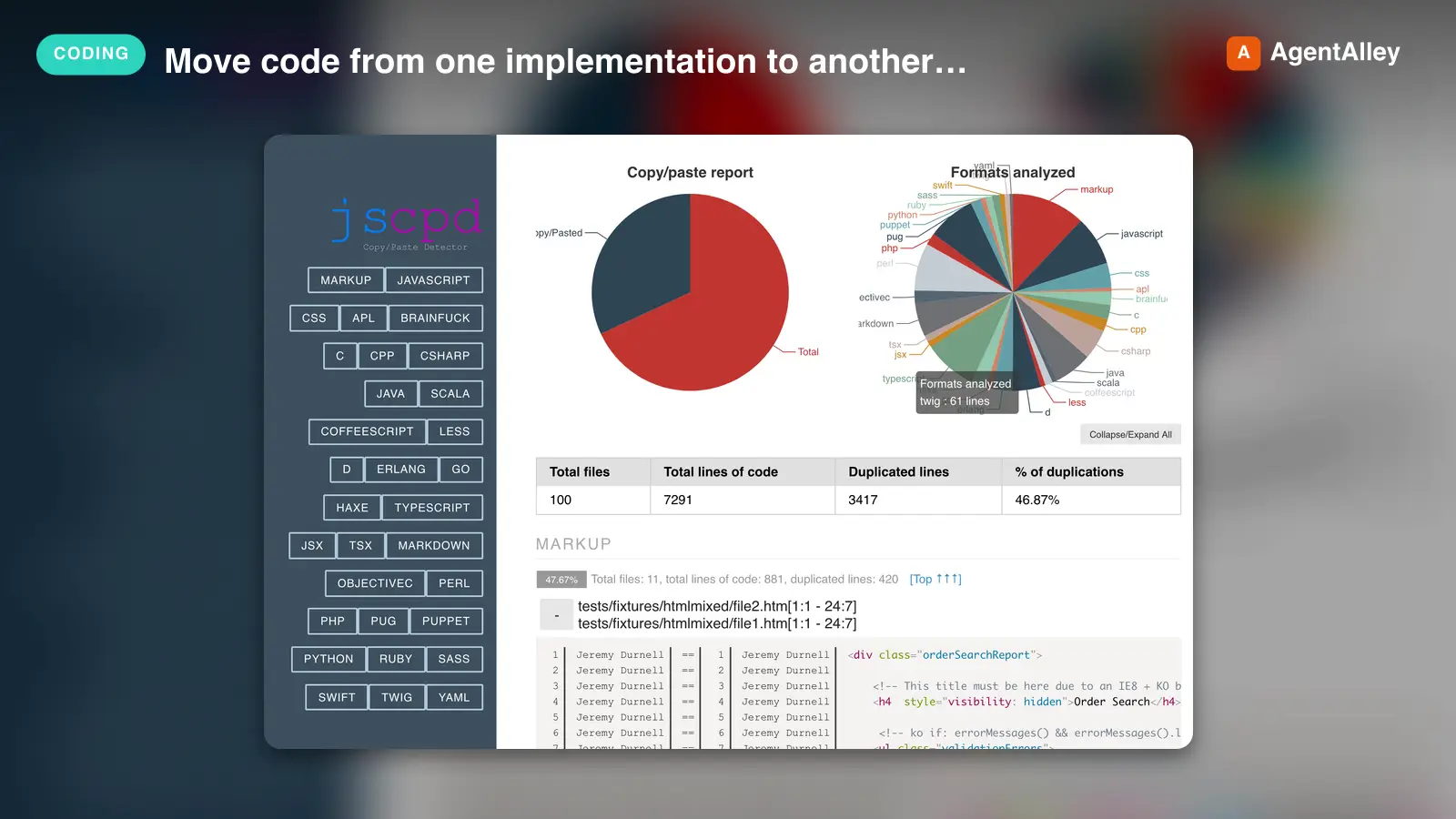
 kucherenko/jscpd · by kucherenkoMove code from one implementation to another function by function, tests first and code second, and check two implementations of one app for parity, with jscpd --compare as the progress measure and a coverage map binding each function to its tests. Use when porting a library or app to another language or framework (Java to Kotlin, JavaScript to Rust, a Python library to TypeScript, an iOS app to Android), when asked what is left to port, or when comparing the Android and iOS versions of an app.★ 6.3k GitHub stars
 Ahrefs API Manager
 OpenClaudia/openclaudia-skills · by OpenClaudiaManages Ahrefs API usage in Python using `ahrefs-python` library. Use when working with SEO / marketing related tasks or with data including backlinks, keywords, domain ratings, organic traffic, site audits, rank tracking, and brand monitoring. Covers `ahrefs-python` usage including AhrefsClient / AsyncAhrefsClient, typed request/response models, error handling, and all API sections.★ 705 GitHub stars
 Docx to Markdown Translator
 dealfluence/adeu · by dealfluenceDocx ↔ LLM translator. Projects .docx office files to Markdown for editing. Projects edits back to OOXML as tracked changes (redlines). Python and Node.js implementations.★ 165 GitHub stars
 Sendmux SDK
 Sendmux/sendmux-sdk · by SendmuxOfficial monorepo of SDKs, CLI, and MCP servers for Sendmux email APIs across TypeScript, Python, Go, PHP, Rust, and Ruby.★ 65 GitHub stars
 Source-Driven Development
 addyosmani/agent-skills · by addyosmaniGrounds every implementation decision in official documentation. Use when you want to verify an approach against the official docs before implementing it, or when you want authoritative, source-cited code free from outdated patterns. Use when building with any framework or library where correctness matters.★ 98.7k GitHub stars