Generate and maintain OpenAPI 3.1 specifications from code
Openapi spec generation
Generate and maintain OpenAPI 3.1 specifications from code, design-first specs, and validation patterns. Use when creating API documentation, generating SDKs, or ensuring API contract compliance.
---
name: openapi-spec-generation
description: Generate and maintain OpenAPI 3.1 specifications from code, design-first specs, and validation patterns. Use when creating API documentation, generating SDKs, or ensuring API contract compliance.
---

# OpenAPI Spec Generation

Comprehensive patterns for creating, maintaining, and validating OpenAPI 3.1 specifications for RESTful APIs.

## When to Use This Skill

- Creating API documentation from scratch
- Generating OpenAPI specs from existing code
- Designing API contracts (design-first approach)
- Validating API implementations against specs
- Generating client SDKs from specs
- Setting up API documentation portals
Overview
Comprehensive patterns for creating, maintaining, and validating OpenAPI 3.1 specifications for RESTful APIs.
Manual install (npx, ZIP)
Claude Code
npx skills add wshobson/agents --skill openapi-spec-generation -g -a claude-codeClaude Code (manual)
mkdir -p ~/.claude/skills && curl -sL https://codeload.github.com/wshobson/agents/tar.gz/4236bb91f839 \
  | tar -xz -C ~/.claude/skills --strip-components=4 agents-4236bb91f839/plugins/documentation-generation/skills/openapi-spec-generation
Windows (PowerShell)
New-Item -ItemType Directory -Force "$HOME\.claude\skills" | Out-Null; Invoke-WebRequest "https://m.agentalley.io/zip/fc42a797c3e4a3b393f3/openapi-spec-generation.zip" -OutFile "$env:TEMP\openapi-spec-generation.zip"; Expand-Archive "$env:TEMP\openapi-spec-generation.zip" -DestinationPath "$HOME\.claude\skills" -ForceClaude.ai / desktop
Codex, Cursor, other agents
Connects with Agent Alley MCP · agentalley.io/mcp
Files included
SKILL.md2.0 KBreferences/2 files · 23.1 KB
Read the files here
SKILL.md
Show the full text67 lines
OpenAPI Spec Generation
Comprehensive patterns for creating, maintaining, and validating OpenAPI 3.1 specifications for RESTful APIs.
When to Use This Skill
- Creating API documentation from scratch
- Generating OpenAPI specs from existing code
- Designing API contracts (design-first approach)
- Validating API implementations against specs
- Generating client SDKs from specs
- Setting up API documentation portals
Core Concepts
1. OpenAPI 3.1 Structure
openapi: 3.1.0
info:
  title: API Title
  version: 1.0.0
servers:
  - url: https://api.example.com/v1
paths:
  /resources:
    get: ...
components:
  schemas: ...
  securitySchemes: ...
2. Design Approaches
| Approach | Description | Best For |
|---|---|---|
| Design-First | Write spec before code | New APIs, contracts |
| Code-First | Generate spec from code | Existing APIs |
| Hybrid | Annotate code, generate spec | Evolving APIs |
Templates and detailed worked examples
Full template library and detailed worked examples live in references/details.md. Read that file when you need the concrete templates.
Best Practices
Do's
- Use $ref - Reuse schemas, parameters, responses
- Add examples - Real-world values help consumers
- Document errors - All possible error codes
- Version your API - In URL or header
- Use semantic versioning - For spec changes
Don'ts
- Don't use generic descriptions - Be specific
- Don't skip security - Define all schemes
- Don't forget nullable - Be explicit about null
- Don't mix styles - Consistent naming throughout
- Don't hardcode URLs - Use server variables
| 1 | |
| 2 | name openapi-spec-generation |
| 3 | description Generate and maintain OpenAPI 3.1 specifications from code, design-first specs, and validation patterns. Use when creating API documentation, generating SDKs, or ensuring API contract compliance. |
| 4 | |
| 5 | |
| 6 | # OpenAPI Spec Generation |
| 7 | |
| 8 | Comprehensive patterns for creating, maintaining, and validating OpenAPI 3.1 specifications for RESTful APIs. |
| 9 | |
| 10 | ## When to Use This Skill |
| 11 | |
| 12 | Creating API documentation from scratch |
| 13 | Generating OpenAPI specs from existing code |
| 14 | Designing API contracts (design-first approach) |
| 15 | Validating API implementations against specs |
| 16 | Generating client SDKs from specs |
| 17 | Setting up API documentation portals |
| 18 | |
| 19 | ## Core Concepts |
| 20 | |
| 21 | ### 1. OpenAPI 3.1 Structure |
| 22 | |
| 23 | |
| 24 | openapi: 3.1.0 |
| 25 | info: |
| 26 | title: API Title |
| 27 | version: 1.0.0 |
| 28 | servers: |
| 29 | - url: https://api.example.com/v1 |
| 30 | paths: |
| 31 | /resources: |
| 32 | get: ... |
| 33 | components: |
| 34 | schemas: ... |
| 35 | securitySchemes: ... |
| 36 | |
| 37 | |
| 38 | ### 2. Design Approaches |
| 39 | |
| 40 | | Approach | Description | Best For | |
| 41 | | ---------------- | ---------------------------- | ------------------- | |
| 42 | | **Design-First** | Write spec before code | New APIs, contracts | |
| 43 | | **Code-First** | Generate spec from code | Existing APIs | |
| 44 | | **Hybrid** | Annotate code, generate spec | Evolving APIs | |
| 45 | |
| 46 | ## Templates and detailed worked examples |
| 47 | |
| 48 | Full template library and detailed worked examples live in `references/details.md`. Read that file when you need the concrete templates. |
| 49 | |
| 50 | ## Best Practices |
| 51 | |
| 52 | ### Do's |
| 53 | |
| 54 | **Use $ref** - Reuse schemas, parameters, responses |
| 55 | **Add examples** - Real-world values help consumers |
| 56 | **Document errors** - All possible error codes |
| 57 | **Version your API** - In URL or header |
| 58 | **Use semantic versioning** - For spec changes |
| 59 | |
| 60 | ### Don'ts |
| 61 | |
| 62 | **Don't use generic descriptions** - Be specific |
| 63 | **Don't skip security** - Define all schemes |
| 64 | **Don't forget nullable** - Be explicit about null |
| 65 | **Don't mix styles** - Consistent naming throughout |
| 66 | **Don't hardcode URLs** - Use server variables |
| 67 |
Details
- Updated
- Sep 21, 2026
- License
- MIT
- Stars on the repo
- ★ 39,857
- Checked
- Source
- wshobson/agents ↗
- Creator
- wshobson · 179 listings
Similar skills
See all → SkillImplement the result of /to-spec and /to-tickets in codeImplement spec
 mattpocock/skills · by mattpocockImplement the result of /to-spec and /to-tickets in code.★ 267k GitHub stars
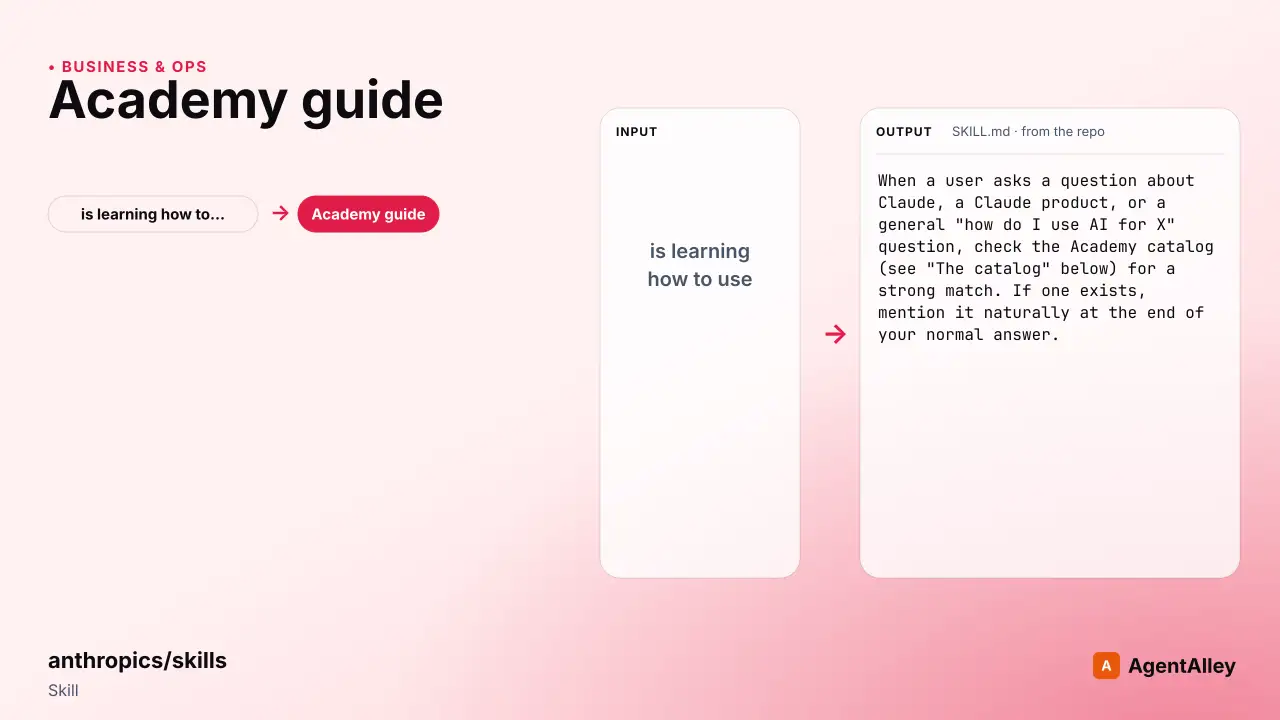 SkillStop and check this skill before finishing any replyAcademy guide
 anthropics/skills · by anthropicsStop and check this skill before finishing any reply to a question about how to use Claude or a Claude product — it recommends matching courses, tutorials, and use cases from Claude Academy (academy.claude.com), Anthropic's learning hub. Trigger on: "how do I", "how can I", "getting started with", "what can Claude do", "teach me", "learn to use"; questions about artifacts, projects, skills, plugins, connectors, MCP; requests about rolling Claude out to a team, class, or organization; and any ask for training materials, onboarding content, or learning resources. Use it when the user is learning how to use a feature or product — not when they are mid-task and just want the task done. This skill composes with other skills: after consulting product documentation to answer how a Claude feature works, also check here for a matching course or tutorial — a docs-grounded answer and an Academy recommendation belong together. Only recommend on a strong match; never invent Academy content.★ 178k GitHub stars
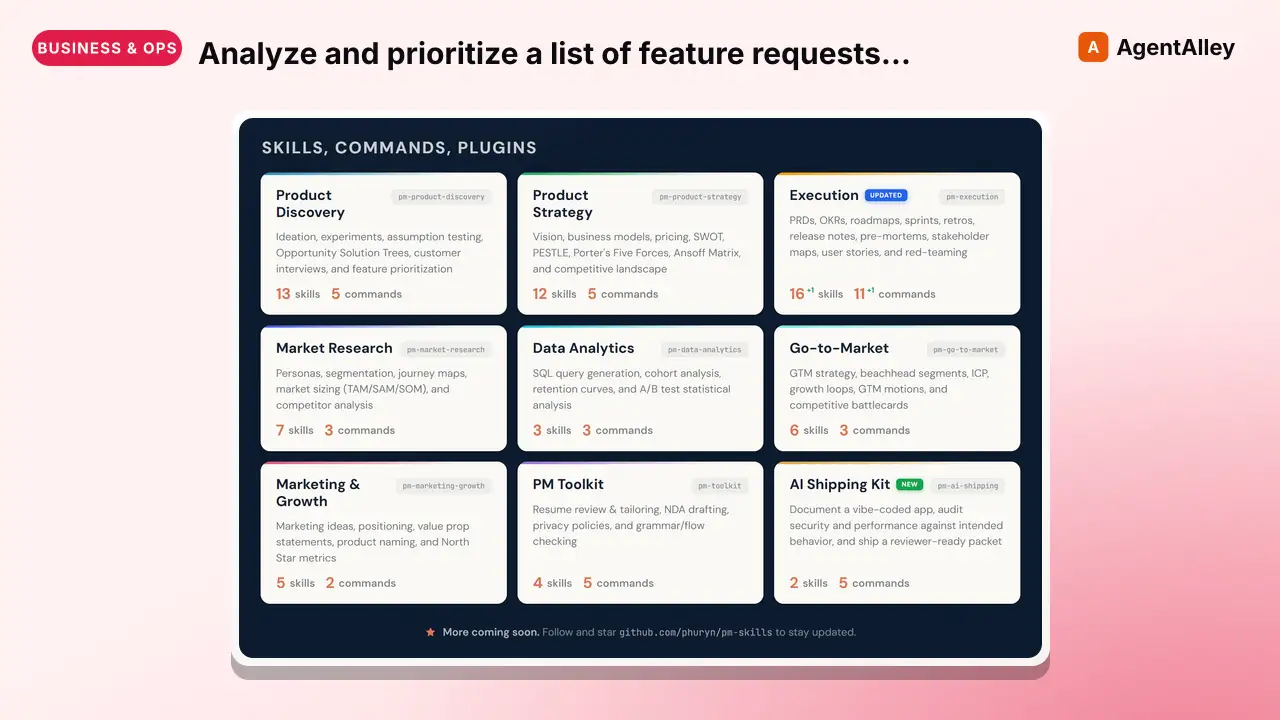 SkillAnalyze and prioritize a list of feature requests by themeAnalyze feature requests
 phuryn/pm-skills · by phurynAnalyze and prioritize a list of feature requests by theme, strategic alignment, impact, effort, and risk. Use when reviewing customer feature requests, triaging a backlog, or making prioritization decisions.★ 26.6k GitHub stars
 SkillDesign an employee advocacy programAdvocacy program designer
 aaron-he-zhu/aaron-marketing-skills · by aaron-he-zhuUse when the user asks to "design an employee advocacy program", "set up founder-led sharing", or "build a share kit for the team"; produces an advocacy program blueprint in two modes — participation-driven opt-in (default) or top-down assigned with its coercion and authenticity risks flagged — with a voluntary opt-in roster spec submitted as channel-registry proposal events, share kits with mandatory per-person variation, staggered human posting windows plus anti-pod guardrails (no coordinated identical reshares, no engagement rings), per-person material-connection disclosure lines per FTC and 《互联网广告管理办法》, and a Slack/Teams distribution spec. Not for paid creator campaigns — use campaign-planner. 员工倡导/创始人IP分享/内部分享计划/披露合规★ 2.9k GitHub stars
 SkillBuilds and edits a model-driven Power Apps appapp-builder — intent → model-driven app
 microsoft/power-platform-skills · by microsoftBuilds and edits a model-driven Power Apps app from a natural-language intent — tables, columns, relationships, adaptive forms with sub-grids, views, Choice-column charts, business rules, business process flows, generative page intents for overview/dashboard surfaces (page `.tsx` generated in generate-pages after plan approval), and an app module + sitemap — via the headless cds-maker-sdk. Runs an interactive, multi-turn authoring flow (env selection, jobs-to-be-done first, then design-only App Spec authoring across confirmed levels, guardrail lint, plan-mode approval, generate-pages, full build) and a narrated build, and can download a deployed app back into an editable spec to change it. Use when the user says "build an app for X", "create a model-driven app", "make me an app to manage Y", "add a business process flow", or "edit/add to my app". This skill stands alone and does not require /genpage — but for a standalone generative page added to an app that already exists, use /genpage instead.★ 954 GitHub stars
 SkillDirect, build and render premium cinematic motion designCinetic
 Leonxlnx/cinetic · by LeonxlnxDirect, build and render premium cinematic motion design from code — launch films, product and feature videos, looping feature animations for landing pages and social, logo stings and reveals, UI walkthroughs, app demos, kinetic type, teasers, trailers, intros and promo clips. Use this whenever the user wants any video, animation, motion graphic or animated demo made with Remotion, HyperFrames, HTML/GSAP or React, or asks to storyboard, time, score, render, polish or critique one — even if they only say "make a video about X", "animate this feature" or "we need a launch clip". It supplies concept and copy discipline, type and colour taste that defers to a supplied brand, a beat-locked timeline that drives both picture and a code-made soundtrack, choreography and transition craft, real product UI in motion, film-grade finishing (true motion blur, no banding, BT.709, sync-checked mux) and a measured self-critique loop on contact sheets and renders.★ 347 GitHub stars
More from wshobson
 SkillMaster C/.NET backend development patterns for building
 wshobson/agents · by wshobsonMaster C#/.NET backend development patterns for building robust APIs, MCP servers, and enterprise applications. Covers async/await, dependency injection, Entity Framework Core, Dapper, configuration, caching, and testing with xUnit. Use when developing .NET backends, reviewing C# code, or designing API architectures.★ 39.9k GitHub stars
 SkillImplement WCAG 2.2 compliant interfaces with mobileAccessibility compliancewshobson/agents · by wshobsonImplement WCAG 2.2 compliant interfaces with mobile accessibility, inclusive design patterns, and assistive technology support. Use when auditing accessibility, implementing ARIA patterns, building for screen readers, or ensuring inclusive user experiences.★ 39.9k GitHub stars
 SkillMaster Material Design 3 and Jetpack Compose patternsAndroid Mobile Designwshobson/agents · by wshobsonMaster Material Design 3 and Jetpack Compose patterns for building native Android apps. Use when designing Android interfaces, implementing Compose UI, or following Google's Material Design guidelines.★ 39.9k GitHub stars
 SkillMigrate from AngularJS to Angular using hybrid modeAngular migrationwshobson/agents · by wshobsonMigrate from AngularJS to Angular using hybrid mode, incremental component rewriting, and dependency injection updates. Use when upgrading AngularJS applications, planning framework migrations, or modernizing legacy Angular code.★ 39.9k GitHub stars
 SkillUnderstand anti-reversing, obfuscationAnti reversing techniqueswshobson/agents · by wshobsonUnderstand anti-reversing, obfuscation, and protection techniques encountered during software analysis. Use this skill when analyzing malware evasion techniques, when implementing anti-debugging protections for CTF challenges, when reverse engineering packed binaries, or when building security research tools that need to detect virtualized environments.★ 39.9k GitHub stars
 SkillBuild production Apache Airflow DAGs with best practicesApache Airflow DAG Patternswshobson/agents · by wshobsonBuild production Apache Airflow DAGs with best practices for operators, sensors, testing, and deployment. Use when creating data pipelines, orchestrating workflows, or scheduling batch jobs.★ 39.9k GitHub stars