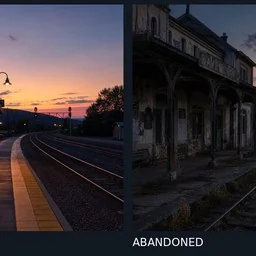
Infographic / Edu Visual - Quiet vs Abandoned Train Station Comparison prompt
Generates a side-by-side comparison showing how changing one word from 'quiet' to 'abandoned' dramatically alters a train station scene at dusk, useful for demonstrating AI prompt sensitivity.
by Human.exe·CC-BY-4.0 license·via YouMind (CC BY 4.0)·Source ↗
Use now
Real results
1 image made with this prompt
Posted publicly by the author. AgentAlley did not make or edit these images. Click an image for the original.
| 1 | A split-screen comparison of two train station scenes at dusk, separated by a thin vertical line. Left panel: A quiet, well-maintained train station named "RIVERDALE" with warm yellow lighting under the platform canopy, a wooden bench, a round clock on the wall, clean concrete platform with yellow tactile paving edge, curved railway tracks leading into the distance, signal lights glowing red, and a vibrant sunset sky with orange and purple hues over distant hills. Right panel: An abandoned, dilapidated train station named "RAVENSBROOK" with peeling paint, broken windows, overgrown weeds and grass between cracked concrete platforms, rusted railway tracks, weathered wooden support beams, dark and eerie atmosphere, similar sunset sky but more muted and cloudy. Bottom labels: "QUIET" in white text on dark background beneath left image, "ABANDONED" in white text on dark background beneath right image. |
Discussion
Alternatives
Company valuationEstimate the intrinsic value of a public company using DCF, relative (peer multiple) and sum-of-parts (SOTP) methods, then triangulate to an implied share price with upside/downside versus the current market price. Use this skill whenever the user asks: what is AAPL worth", "valuation of NVDA", "fair value of TSLA", "intrinsic value", DCF for MSFT", "build a DCF", "discounted cash flow", "WACC", "terminal value", implied share price", "upside to fair value", "is X overvalued/undervalued", relative valuation", "peer comparison valuation", "EV/EBITDA target", "SOTP", sum of the parts", "how much is [company] worth", "price target from fundamentals", value this company", or any ticker in the context of computing intrinsic or relative valuation. Default to running ALL three methods (DCF + relative + SOTP-if-applicable) and presenting a blended implied price with a sensitivity table. Do not answer valuation questions from memory — always run the workflow.Competitor gapFind keywords a competitor ranks for that the user's site doesn't — the content gap, prioritized by volume and winnability. Use when asked "what does competitor.com rank for", "keyword gap vs X", "steal competitor keywords", or "why do they outrank us".Ad angle minerMine the highest-converting ad angles from customer reviews, Reddit complaints, support tickets, and competitor ads. Extracts actual pain language, competitor weaknesses, and outcome phrases that real buyers use. Outputs a ranked angle bank with proof quotes and recommended ad formats per angle.Competitor content intelligenceAnalyze competitor content coverage and uncover differentiated content opportunities using web search, page extraction, and DataForSEO content analysis. Use when asked for competitor content research, editorial gap analysis, content brief inputs, or topic whitespace.
Browse more free AI prompts or everything in Product.