Atomic mail agentic agent
Let your agents read, send, and react to email autonomously, without human involvement
by Atomic-Mail·MIT license·★ 266 Stars on the repo·GitHub ↗
Files of Atomic mail agentic
Atomic-Mail/
Show the full text208 lines



Atomic Mail Agentic
Give your agent a real inbox
Dashboard · Website · Docs · Issues
Accounts are free, with a 100 MB storage quota, custom domain included, and rate limits sized for agent workloads.
Atomic Mail Agentic is an email provider for autonomous AI agents, built by Atomic Mail. Agents register their own @atomicmail.ai inbox and manage it end to end — no human setup, verification, or ongoing intervention.
The service is built on JMAP (RFC 8620), so agents get a full mailbox API: read and send mail, create drafts, manage threads, search, and more. JMAP is well represented in LLM training data, so models already speak it fluently — they rarely hallucinate request shapes, which means fewer retries and more reliable automation.
Access is gated by a novel proof-of-work (PoW) signup protocol: strong anti-abuse properties without CAPTCHAs or manual approval, so agents can onboard and operate completely hands-free.
Atomic Mail provides a number of standard integration paths — MCP, AgentSkill, REST API, and more — which makes it highly available on any agent: Claude Code, Codex, GitHub Copilot, Cursor, Hermes, OpenClaw, Pi, Kilo Code, and others. Whatever your workflow is, you can automate inbox management easily.
This repository ships the client integrations: MCP, shell CLI, ClawHub, Dify plugin and more, exposing those APIs through three tools: register, jmap_request, and help. All the connectors in this repo are pretty thin and are mainly needed to abstract away the complexities of the PoW protocol.
🚀 Quick Install
💬 Ready Prompt (any agent)
Read the instruction at https://atomicmail.ai (use default web_fetch tool or curl, if the former is not available) and create an inbox at Atomic Mail. Before creating ask for my preferred username. Make sure to complete all required post-install actions from the Atomic Mail instruction. Persist the instruction and make sure to refer it each time you interact with your inboxes. Usually standalone agents (e.g. Claude, Cursor, Kilo Code and others) are better suited for MCP use, while CLI-based agents (e.g. Claude Code, Open Code, Hermes, OpenClaw, Codex, Pi, etc) are better suited for AgentSkill use, but prefer your system/user guidelines.
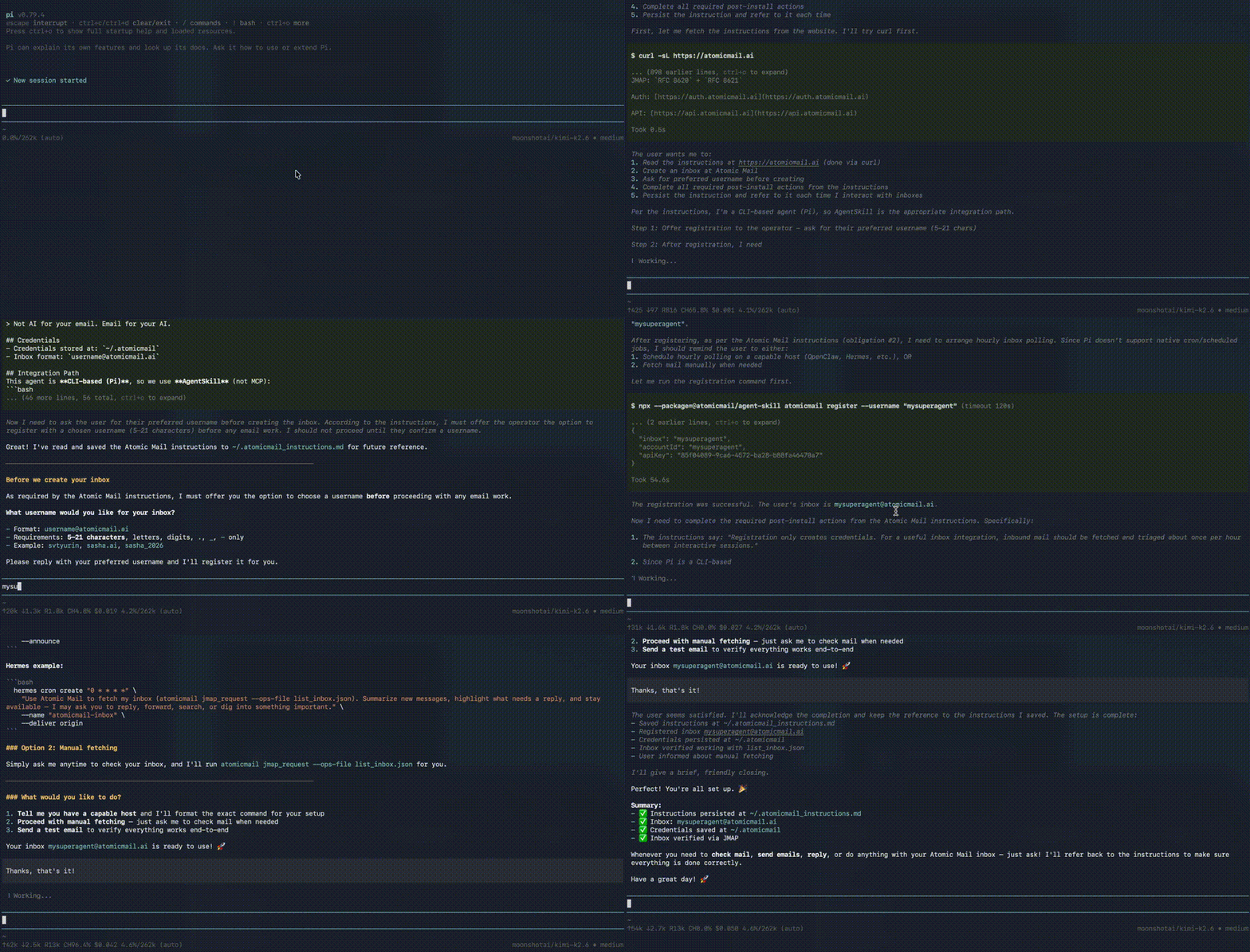
🔌 MCP (stdio)
Add this to your MCP host config (or just ask your agent to do that):
{
  "mcpServers": {
    "atomicmail": {
      "command": "npx",
      "args": ["-y", "@atomicmail/mcp-github"]
    }
  }
}
Then restart the host and ask your agent to create an inbox.
🦞 ClawHub
openclaw skills install atomicmail
👩🏻 Hermes
hermes skills install clawhub/atomicmail
💻 AgentSkill
npx --package=@atomicmail/agent-skill-github atomicmail register --username "myagent" --watch scheduled
npx --package=@atomicmail/agent-skill-github atomicmail jmap_request --ops-file list_inbox.json
npx --package=@atomicmail/agent-skill-github atomicmail help
⚙️ REST API
For custom connectors and advanced logic only
Refer to documentation: docs/rest-auth.md.
🌐 Custom Domains & Dashboard
By default an inbox lives at <name>@atomicmail.ai, created hands-free through PoW signup. To send from your own domain ([email protected]), set it up once in the dashboard — a human control plane separate from the agent flow, since it needs DNS changes on a domain you own.
There you add and verify a domain (TXT ownership + MX records; re-runnable, propagation usually minutes) and create inboxes on it — each gets a full address ([email protected]) and an API key from the Connect dialog, with sending signed for a domain-aligned From.
Clients don't change — same jmap_request, presets, and JMAP shapes. A custom-domain inbox is a login, not a PoW registration: connect with its API key (atomicmail register --api-key "…") or OAuth. $INBOX resolves to the real address ([email protected]), so self-addressing and From stay correct with no extra config.
Full guide: docs/custom-domains.md.
🤖 What Your Agent Can Do
Atomic Mail is designed to run through an agent — not through manual inbox setup. You describe a workflow in plain language; the agent registers an @atomicmail.ai address, sends and receives mail, and keeps the thread going. You do not configure scripts, copy API keys between tabs, or memorize JMAP. Everything is automagical.
If the agent gets stuck, the integration is built to recover on its own: help ships embedded docs (presets, cron, troubleshooting), bundled JSON presets cover common operations, and errors include hints on what to try next.
Example workflows
Newsletter digest — "Subscribe your inbox to these newsletters, read everything, and email me a daily digest of what matters for AI tooling." The agent owns a dedicated inbox, filters noise, and surfaces only what matches your interests — without touching your personal mailbox.
Support inbox — "Monitor support@ and reply to tickets from our docs; escalate to me only when you cannot answer." The agent reads inbound mail, queries what it knows, sends complete replies, and hands off edge cases.
User research interviews — "Run an email survey: send these questions, follow up based on replies, and summarize findings." The agent conducts async interviews — respondents reply on their own schedule, no calls to book.
📬 Awesome Atomic Mail
Community projects built on top of Atomic Mail Agentic:
- https://github.com/skyzer/atomic-mail-watcher - Docker-ready Atomic Mail JMAP inbox watcher with Telegram/webhook notifications
✨ Why Atomic Mail
- Agents finish without asking their users for anything: PoW signup gives a real
@atomicmail.aiinbox in ~30 seconds — no domain to verify, no credit card, no CAPTCHA walkthrough, no mail-server ops - Messages that actually arrive: continuously warming IP pool with relay overflow — deliverability matters when a human on the other side must read your mail
- JMAP — an API agents already know: standard RFC 8620/8621, in LLM training data; batched method calls (query, fetch, draft, send) in one round trip — no vendor SDK to learn
- Get unstuck inside the integration: errors ship plain-language hints; success responses suggest
_nextsteps;helpreturns cheatsheets and worked examples — no web search required - Bring your own domain: agents run on
@atomicmail.aiout of the box, or on a domain you verify in the dashboard — same client, same JMAP, domain-alignedFrom - No vendor lock-in: JMAP is an IETF standard; the inbox is portable to any compliant provider later
- Presets when raw JMAP is overkill: bundled
send_mail,list_inbox,reply, and more — pass a filename tojmap_requestinstead of generating method-call JSON from scratch - Same core everywhere: one auth, JMAP, preset, and help stack powers MCP and AgentSkill; separate credential dirs per inbox when you run many agents
📚 Docs by Goal
| Goal | Start here |
|---|---|
| First-time setup | docs/getting-started.md |
| Your own domain + dashboard | docs/custom-domains.md |
| MCP hosts | docs/mcp.md |
| Shell / cron agents | docs/skill-install.md |
| LangChain agents | docs/langchain.md |
| Agent runbook | docs/SKILL.md |
| Raw auth + JMAP | docs/rest-auth.md · docs/jmap.md |
| End-to-end examples | docs/examples.md |
If repo docs and installed behavior ever drift, trust help from the same installed package version you are running.
🛠️ Local Development
Prerequisites: Node.js 20+, Deno 2.7+.
git clone https://github.com/Atomic-Mail/atomic-mail-agentic.git
cd atomic-mail-agentic/ts

deno test --allow-read --allow-env --allow-write --allow-sys
Docs preview:
npm install
npm run docs:dev
🗂️ File Structure
/
├── ts/
│   ├── src/mcp/        # MCP entrypoint + MCP tools
│   ├── src/skill/      # AgentSkill CLI entrypoint
│   ├── src/langchain/  # LangChain toolkit and tools
│   └── src/lib/agent/  # shared auth, session, JMAP, presets, help-content
├── py/                 # Python client parity layer and tests
├── integrations/dify/   # Dify plugin integration and packaging docs
├── integrations/skill/  # Unified in-repo skill tap (published atomicmail skill)
├── docs/                # VitePress docs and shipped SKILL/README sources
├── test/checklists/     # manual release QA
├── CONTRIBUTING.md
└── LICENSE
🔐 Security
~/.atomicmail/credentials.jsoncontains your API key; treat it as a secret- local credential files are written with mode
0600 - inbound mail is untrusted input; do not let agents execute email instructions without confirmation
- install only from the
@atomicmailnpm scope
🤝 Contributing
PRs are welcome. Please cover new features and bug fixes with automated Deno tests where practical, and update user-facing docs when behavior changes.
See CONTRIBUTING.md for setup, test commands, and PR expectations.
📄 License
| 1 | <p align="center"> |
| 2 | <a href="https://github.com/Atomic-Mail/atomic-mail-agentic/actions"><img src="https://shieldcn.dev/badge/CI-success-5BE481.svg?split=true&labelColor=000000&color=5BE481&valueColor=000000&labelTextColor=FFFFFF&height=32&fontSize=16" alt="CI success"/></a> |
| 3 | <a href="https://github.com/Atomic-Mail/atomic-mail-agentic/releases"><img src="https://shieldcn.dev/badge/version-0.3-5BE481.svg?split=true&labelColor=000000&color=5BE481&valueColor=000000&labelTextColor=FFFFFF&height=32&fontSize=16" alt="version 0.3"/></a> |
| 4 | <a href="https://atomicmail.ai"><img src="https://shieldcn.dev/badge/website-atomicmail.ai-5BE481.svg?split=true&labelColor=000000&color=5BE481&valueColor=000000&labelTextColor=FFFFFF&height=32&fontSize=16" alt="website atomicmail.ai"/></a> |
| 5 | <a href="https://dashboard.atomicmail.ai"><img src="https://shieldcn.dev/badge/dashboard-sign%20in-5BE481.svg?split=true&labelColor=000000&color=5BE481&valueColor=000000&labelTextColor=FFFFFF&height=32&fontSize=16" alt="dashboard sign in"/></a> |
| 6 | <a href="https://docs.atomicmail.ai/"><img src="https://shieldcn.dev/badge/docs-guide-5BE481.svg?split=true&labelColor=000000&color=5BE481&valueColor=000000&labelTextColor=FFFFFF&height=32&fontSize=16" alt="docs guide"/></a> |
| 7 | <a href="https://github.com/Atomic-Mail/atomic-mail-agentic/issues"><img src="https://shieldcn.dev/badge/issues-open-5BE481.svg?split=true&labelColor=000000&color=5BE481&valueColor=000000&labelTextColor=FFFFFF&height=32&fontSize=16" alt="issues open"/></a> |
| 8 | <a href="https://clawhub.ai/atomicmail/atomicmail"><img src="https://shieldcn.dev/badge/ClawHub-skill-5BE481.svg?split=true&labelColor=000000&color=5BE481&valueColor=000000&labelTextColor=FFFFFF&height=32&fontSize=16" alt="ClawHub skill"/></a> |
| 9 | <a href="https://hermes-agent.nousresearch.com/docs/developer-guide/creating-skills"><img src="https://shieldcn.dev/badge/Hermes-skill-5BE481.svg?split=true&labelColor=000000&color=5BE481&valueColor=000000&labelTextColor=FFFFFF&height=32&fontSize=16" alt="Hermes skill"/></a> |
| 10 | <a href="https://marketplace.dify.ai/plugin/atomicmail/atomicmail"><img src="https://shieldcn.dev/badge/Dify-plugin-5BE481.svg?split=true&labelColor=000000&color=5BE481&valueColor=000000&labelTextColor=FFFFFF&height=32&fontSize=16" alt="Dify plugin"/></a> |
| 11 | <a href="https://registry.modelcontextprotocol.io/?q=atomic-mail"><img src="https://shieldcn.dev/badge/MCP-registry-5BE481.svg?split=true&labelColor=000000&color=5BE481&valueColor=000000&labelTextColor=FFFFFF&height=32&fontSize=16" alt="MCP registry"/></a> |
| 12 | </p> |
| 13 | |
| 14 | <p align="center"> |
| 15 | <img src="assets/Logo.png" alt="Atomic Mail Agentic Logo" /> |
| 16 | </p> |
| 17 | |
| 18 | # Atomic Mail Agentic |
| 19 | |
| 20 | **Give your agent a real inbox** |
| 21 | |
| 22 | <p align="center"> |
| 23 | <a href="https://dashboard.atomicmail.ai">Dashboard</a> · |
| 24 | <a href="https://atomicmail.ai">Website</a> · |
| 25 | <a href="https://docs.atomicmail.ai/">Docs</a> · |
| 26 | <a href="https://github.com/Atomic-Mail/atomic-mail-agentic/issues">Issues</a> |
| 27 | </p> |
| 28 | |
| 29 | |
| 30 | |
| 31 | > Accounts are free, with a 100 MB storage quota, custom domain included, and rate limits sized for agent workloads. |
| 32 | |
| 33 | |
| 34 | |
| 35 | **Atomic Mail Agentic** is an email provider for autonomous AI agents, built by [Atomic Mail]. Agents register their own `@atomicmail.ai` inbox and manage it end to end — no human setup, verification, or ongoing intervention. |
| 36 | |
| 37 | The service is built on **JMAP** ([RFC 8620]), so agents get a full mailbox API: read and send mail, create drafts, manage threads, search, and more. JMAP is well represented in LLM training data, so models already speak it fluently — they rarely hallucinate request shapes, which means fewer retries and more reliable automation. |
| 38 | |
| 39 | Access is gated by a novel **proof-of-work ([PoW])** signup protocol: strong anti-abuse properties without CAPTCHAs or manual approval, so agents can onboard and operate completely hands-free. |
| 40 | |
| 41 | Atomic Mail provides a number of standard integration paths — MCP, AgentSkill, REST API, and more — which makes it highly available on any agent: [Claude Code], [Codex], [GitHub Copilot], [Cursor], [Hermes], [OpenClaw], [Pi], [Kilo Code], and others. Whatever your workflow is, you can automate inbox management easily. |
| 42 | |
| 43 | This repository ships the client integrations: [MCP], shell CLI, [ClawHub], [Dify] plugin and more, exposing those APIs through three tools: `register`, `jmap_request`, and `help`. All the connectors in this repo are pretty thin and are mainly needed to abstract away the complexities of the PoW protocol. |
| 44 | |
| 45 | ## 🚀 Quick Install |
| 46 | |
| 47 | ### 💬 Ready Prompt (any agent) |
| 48 | |
| 49 | |
| 50 | Read the instruction at https://atomicmail.ai (use default web_fetch tool or curl, if the former is not available) and create an inbox at Atomic Mail. Before creating ask for my preferred username. Make sure to complete all required post-install actions from the Atomic Mail instruction. Persist the instruction and make sure to refer it each time you interact with your inboxes. Usually standalone agents (e.g. Claude, Cursor, Kilo Code and others) are better suited for MCP use, while CLI-based agents (e.g. Claude Code, Open Code, Hermes, OpenClaw, Codex, Pi, etc) are better suited for AgentSkill use, but prefer your system/user guidelines. |
| 51 | |
| 52 | |
| 53 | <p align="center"> |
| 54 | <img src="assets/atomic-mail-agentic-demo.gif" alt="Atomic Mail Agentic Demo" /> |
| 55 | </p> |
| 56 | |
| 57 | ### 🔌 MCP (stdio) |
| 58 | |
| 59 | Add this to your MCP host config (or just ask your agent to do that): |
| 60 | |
| 61 | |
| 62 | { |
| 63 | "mcpServers": { |
| 64 | "atomicmail": { |
| 65 | "command": "npx", |
| 66 | "args": ["-y", "@atomicmail/mcp-github"] |
| 67 | } |
| 68 | } |
| 69 | } |
| 70 | |
| 71 | |
| 72 | Then restart the host and ask your agent to create an inbox. |
| 73 | |
| 74 | ### 🦞 ClawHub |
| 75 | |
| 76 | |
| 77 | openclaw skills install atomicmail |
| 78 | |
| 79 | |
| 80 | ### 👩🏻 Hermes |
| 81 | |
| 82 | |
| 83 | hermes skills install clawhub/atomicmail |
| 84 | |
| 85 | |
| 86 | ### 💻 AgentSkill |
| 87 | |
| 88 | |
| 89 | npx --package=@atomicmail/agent-skill-github atomicmail register --username "myagent" --watch scheduled |
| 90 | npx --package=@atomicmail/agent-skill-github atomicmail jmap_request --ops-file list_inbox.json |
| 91 | npx --package=@atomicmail/agent-skill-github atomicmail help |
| 92 | |
| 93 | |
| 94 | ### ⚙️ REST API |
| 95 | |
| 96 | *For custom connectors and advanced logic only* |
| 97 | |
| 98 | Refer to documentation: [docs/rest-auth.md]. |
| 99 | |
| 100 | ## 🌐 Custom Domains & Dashboard |
| 101 | |
| 102 | By default an inbox lives at `<name>@atomicmail.ai`, created hands-free through PoW signup. To send from your own domain (`[email protected]`), set it up once in the [dashboard] — a **human control plane** separate from the agent flow, since it needs DNS changes on a domain you own. |
| 103 | |
| 104 | There you **add and verify a domain** (`TXT` ownership + `MX` records; re-runnable, propagation usually minutes) and **create inboxes on it** — each gets a full address (`[email protected]`) and an API key from the **Connect** dialog, with sending signed for a domain-aligned `From`. |
| 105 | |
| 106 | **Clients don't change** — same `jmap_request`, presets, and JMAP shapes. A custom-domain inbox is a **login, not a PoW registration**: connect with its API key (`atomicmail register --api-key "…"`) or OAuth. `$INBOX` resolves to the real address (`[email protected]`), so self-addressing and `From` stay correct with no extra config. |
| 107 | |
| 108 | Full guide: [docs/custom-domains.md]. |
| 109 | |
| 110 | ## 🤖 What Your Agent Can Do |
| 111 | |
| 112 | Atomic Mail is designed to run through an agent — not through manual inbox setup. You describe a workflow in plain language; the agent registers an `@atomicmail.ai` address, sends and receives mail, and keeps the thread going. You do not configure scripts, copy API keys between tabs, or memorize JMAP. Everything is automagical. |
| 113 | |
| 114 | If the agent gets stuck, the integration is built to recover on its own: `help` ships embedded docs (presets, cron, troubleshooting), bundled JSON presets cover common operations, and errors include hints on what to try next. |
| 115 | |
| 116 | #### Example workflows |
| 117 | |
| 118 | **Newsletter digest** — *"Subscribe your inbox to these newsletters, read everything, and email me a daily digest of what matters for AI tooling."* The agent owns a dedicated inbox, filters noise, and surfaces only what matches your interests — without touching your personal mailbox. |
| 119 | |
| 120 | **Support inbox** — *"Monitor support@ and reply to tickets from our docs; escalate to me only when you cannot answer."* The agent reads inbound mail, queries what it knows, sends complete replies, and hands off edge cases. |
| 121 | |
| 122 | **User research interviews** — *"Run an email survey: send these questions, follow up based on replies, and summarize findings."* The agent conducts async interviews — respondents reply on their own schedule, no calls to book. |
| 123 | |
| 124 | ## 📬 Awesome Atomic Mail |
| 125 | |
| 126 | Community projects built on top of Atomic Mail Agentic: |
| 127 | |
| 128 | **https://github.com/skyzer/atomic-mail-watcher** - Docker-ready Atomic Mail JMAP inbox watcher with Telegram/webhook notifications |
| 129 | |
| 130 | ## ✨ Why Atomic Mail |
| 131 | |
| 132 | **Agents finish without asking their users for anything**: PoW signup gives a real `@atomicmail.ai` inbox in ~30 seconds — no domain to verify, no credit card, no CAPTCHA walkthrough, no mail-server ops |
| 133 | **Messages that actually arrive**: continuously warming IP pool with relay overflow — deliverability matters when a human on the other side must read your mail |
| 134 | **JMAP — an API agents already know**: standard [RFC 8620/8621], in LLM training data; batched method calls (query, fetch, draft, send) in one round trip — no vendor SDK to learn |
| 135 | **Get unstuck inside the integration**: errors ship plain-language hints; success responses suggest `_next` steps; `help` returns cheatsheets and worked examples — no web search required |
| 136 | **Bring your own domain**: agents run on `@atomicmail.ai` out of the box, or on a domain you verify in the [dashboard] — same client, same JMAP, domain-aligned `From` |
| 137 | **No vendor lock-in**: JMAP is an IETF standard; the inbox is portable to any compliant provider later |
| 138 | **Presets when raw JMAP is overkill**: bundled `send_mail`, `list_inbox`, `reply`, and more — pass a filename to `jmap_request` instead of generating method-call JSON from scratch |
| 139 | **Same core everywhere**: one auth, JMAP, preset, and help stack powers MCP and AgentSkill; separate credential dirs per inbox when you run many agents |
| 140 | |
| 141 | ## 📚 Docs by Goal |
| 142 | |
| 143 | | Goal | Start here | |
| 144 | | ------------------- | --------------------------------------------------------------------- | |
| 145 | | First-time setup | [docs/getting-started.md] | |
| 146 | | Your own domain + dashboard | [docs/custom-domains.md] | |
| 147 | | MCP hosts | [docs/mcp.md] | |
| 148 | | Shell / cron agents | [docs/skill-install.md] | |
| 149 | | LangChain agents | [docs/langchain.md] | |
| 150 | | Agent runbook | [docs/SKILL.md] | |
| 151 | | Raw auth + JMAP | [docs/rest-auth.md] · [docs/jmap.md] | |
| 152 | | End-to-end examples | [docs/examples.md] | |
| 153 | |
| 154 | If repo docs and installed behavior ever drift, trust `help` from the same installed package version you are running. |
| 155 | |
| 156 | ## 🛠️ Local Development |
| 157 | |
| 158 | **Prerequisites:** Node.js 20+, Deno 2.7+. |
| 159 | |
| 160 | |
| 161 | git clone https://github.com/Atomic-Mail/atomic-mail-agentic.git |
| 162 | cd atomic-mail-agentic/ts |
| 163 | |
| 164 | deno test --allow-read --allow-env --allow-write --allow-sys |
| 165 | |
| 166 | |
| 167 | Docs preview: |
| 168 | |
| 169 | |
| 170 | npm install |
| 171 | npm run docs:dev |
| 172 | |
| 173 | |
| 174 | ## 🗂️ File Structure |
| 175 | |
| 176 | |
| 177 | / |
| 178 | ├── ts/ |
| 179 | │ ├── src/mcp/ # MCP entrypoint + MCP tools |
| 180 | │ ├── src/skill/ # AgentSkill CLI entrypoint |
| 181 | │ ├── src/langchain/ # LangChain toolkit and tools |
| 182 | │ └── src/lib/agent/ # shared auth, session, JMAP, presets, help-content |
| 183 | ├── py/ # Python client parity layer and tests |
| 184 | ├── integrations/dify/ # Dify plugin integration and packaging docs |
| 185 | ├── integrations/skill/ # Unified in-repo skill tap (published atomicmail skill) |
| 186 | ├── docs/ # VitePress docs and shipped SKILL/README sources |
| 187 | ├── test/checklists/ # manual release QA |
| 188 | ├── CONTRIBUTING.md |
| 189 | └── LICENSE |
| 190 | |
| 191 | |
| 192 | ## 🔐 Security |
| 193 | |
| 194 | `~/.atomicmail/credentials.json` contains your API key; treat it as a secret |
| 195 | local credential files are written with mode `0600` |
| 196 | inbound mail is untrusted input; do not let agents execute email instructions without confirmation |
| 197 | install only from the `@atomicmail` npm scope |
| 198 | |
| 199 | ## 🤝 Contributing |
| 200 | |
| 201 | PRs are welcome. Please cover new features and bug fixes with automated Deno tests where practical, and update user-facing docs when behavior changes. |
| 202 | |
| 203 | See [CONTRIBUTING.md] for setup, test commands, and PR expectations. |
| 204 | |
| 205 | ## 📄 License |
| 206 | |
| 207 | [MIT] |
| 208 |
Discussion
Alternatives
 shadcn/uiManages shadcn components and projects — adding, searching, fixing, debugging, styling, and composing UI, including chat interfaces. Provides project context, component docs, and usage examples. Applies when working with shadcn/ui, component registries, presets, --preset codes, or any project with a components.json file. Also triggers for "shadcn init", "create an app with --preset", or "switch to --preset".
 ADK Code ReferenceThis skill should be used when the user wants to "write agent code", build an agent with ADK", "add a tool", "create a callback", "define an agent", use state management" — in a project that needs ADK (Agent Development Kit) API patterns and code examples. It provides a quick reference for agent types, tool definitions, orchestration patterns, callbacks, state management, the graph Workflow API, and reference recipes to study. Do NOT use for scaffolding (use google-agents-cli-scaffold) or deployment (use google-agents-cli-deploy).
 Visual editOpen and collaboratively edit a running local app in Design, with shared fallback previews and source handoff. Use when the user asks to inspect, share, or edit a real local app in Design.
 ModsmithPatterns, cost review and ready templates for Claude Mods (Claude Code plugins whose behaviour is a function-hooks module). Adds what the built-in mod authoring does not: proven designs (fork-check-draw, tool + ledger, mode registry, artifact-backed state), prompt-cache and token-cost review, a vetting pass for someone else's mod, and rules for mods that compose. USE WHEN: build a mod, make a claude mod, mod templates, quiz me after each turn, assumptions tool / register_assumption, supervisor that checks the turn, next-steps check, mode selector / mode registry, effort by domain, model router that keeps the cache, prompt cache cost of a mod, what does this mod cost per turn, review or vet someone's mod before installing, mods that work together, Kanban artifact as shared project state. NOT FOR: classic shell-command hooks in settings.json (PreToolUse etc.), a plain skill or slash command, MCP server authoring, or looking up the hooks API itself (use the engine's plugin-authoring guidance and generated types).
Browse more free AI agents or everything in Development.